

Chris Moneymaker Net Worth 2026: $5M-$10M, Earnings & the 2003 WSOP Win
Chris Moneymaker net worth estimates land between $5 million and $10 million. The range starts in May 2003, when a 27-year-old Knoxville accountant turned an $86 PokerStars satellite into the $2.5 million WSOP Main Event first prize. That win sparked the poker boom now called the Moneymaker Effect.
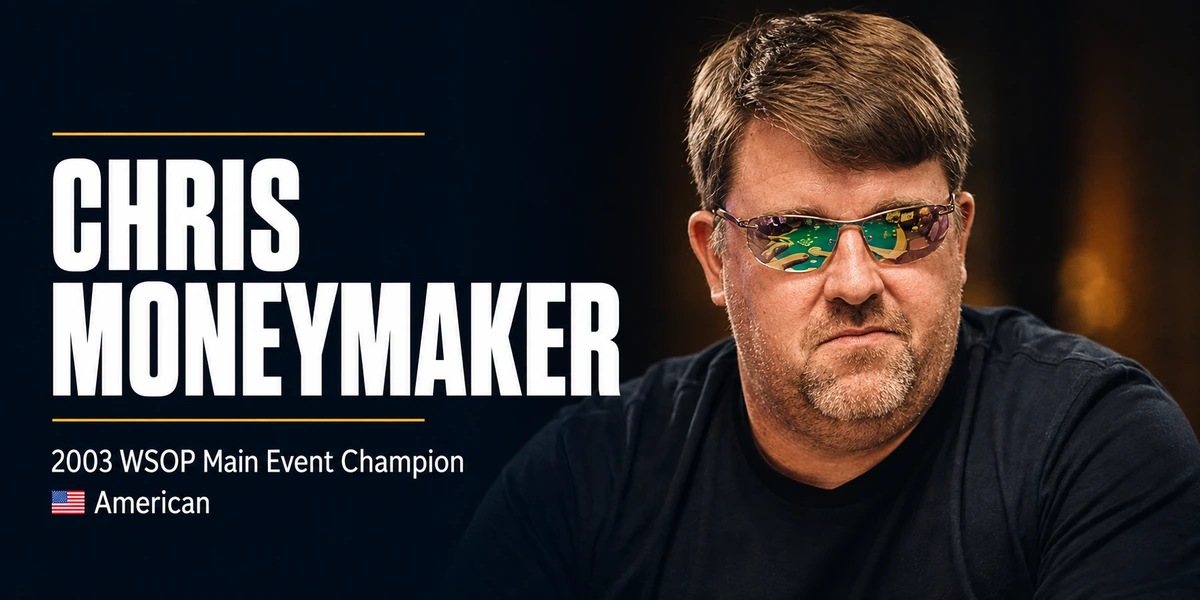
His tracked live tournament earnings sit at $8.65 million across 164 cashes, the only hard number underneath any estimate. At 50 he remains an active ACR Poker ambassador, and a 2023 to 2024 run at Triton Super High Roller events earned him over $4.1 million.
We separate what is verifiable from what is estimated, because the $16 million figure echoed across most poker sites carries no methodology at all. Every payout below was read from The Hendon Mob and WSOP.com on 28 August 2026.
Player Quick Facts

- Full Name: Christopher Bryan Moneymaker
- Born: November 21, 1975 (age 50)
- Birthplace: Atlanta, Georgia
- Hometown: Knoxville, Tennessee
- Residence: Nashville, Tennessee
- Nationality: American
- Ancestry: German (surname anglicised from 'Nurmacher')
- Education: University of Tennessee (Bachelor's and Master's in Accounting)
- Net Worth (Estimate): $5M-$10M (built from tracked earnings and ambassador income)
- Live Tournament Earnings: $8,649,423 (164 cashes, per Hendon Mob, 28 August 2026)
- All-Time Money List: 242nd worldwide, 108th in the USA, 1st in Tennessee
- WSOP Bracelets: 1 (2003 Main Event)
- Primary Format: No-Limit Hold'em tournaments
- Known For: 2003 WSOP Main Event champion; sparking 'The Moneymaker Effect'
- Poker Hall of Fame: Inducted July 2019 (57th member)
- Current Sponsor: ACR Poker (since February 2021)
Chris Moneymaker's Net Worth
Chris Moneymaker’s net worth is $5M-$10M. That range is built from tracked earnings, ambassador deal data and known expenses. Published figures elsewhere run from $4 million on CelebrityNetWorth to $16 million across poker SEO sites, with no transparent methodology behind either number.
This section breaks down how we arrive at that range, what is actually verifiable, and why the popular figure does not survive basic arithmetic.
- Tracked live earnings: $8,649,423 gross, before taxes, buy-ins and staking splits
- Ambassador income: 17 years with PokerStars, five and counting with ACR Poker, terms undisclosed in both cases
- Business ventures: a 2005 book, the Moneymaker Tour, and a Louisville social club
- Deductions: US gambling tax, a 2004 divorce settlement, and two decades of travel and living costs
What is Chris Moneymaker’s net worth in 2026?
Chris Moneymaker’s net worth is estimated between $5 million and $10 million, with a central estimate around $7 million. That sits between the conservative CelebrityNetWorth number and the far higher figure echoed across poker-themed celebrity sites.
The honest answer is that nobody outside Moneymaker’s inner circle knows the exact number. His income has come from tracked live cashes, private ambassador deals with undisclosed terms, book royalties, speaking fees, and the Moneymaker Poker Tour. Several of those streams sit entirely outside public reporting.
What we can verify is that his tracked live tournament earnings total $8,649,423 across 164 cashes, per The Hendon Mob as of 28 August 2026. That is a gross figure before taxes, buy-ins, staking splits, and two decades of living expenses.
How did Chris Moneymaker make his money?
Moneymaker’s income has come from five main streams over the past 23 years: the 2003 WSOP Main Event first prize, a 17-year PokerStars ambassador deal, live tournament cashes, his current ACR Poker sponsorship, and business ventures including a book and the Moneymaker Poker Tour.
- 2003 WSOP Main Event: $2,500,000 gross first prize, though the breakdown below shows how little of it he kept
- PokerStars ambassador (2003 to 2020): a 17-year partnership on undisclosed terms, the longest player deal in online poker
- Live tournament earnings: $8,649,423 gross across 164 cashes per Hendon Mob, with a 2023 to 2024 Triton run adding over $4.1 million
- ACR Poker ambassador (2021 to present): terms undisclosed by either party
- Business ventures: a 2005 autobiography published by HarperCollins, the Moneymaker Tour launched in 2023, and two Kentucky social clubs
The 2023 to 2024 stretch has been his most productive since 2003. Deep runs at Triton Super High Roller events earned him over $2 million in London alone.
Players at that level typically compete on staking arrangements, meaning the actual net from those cashes is lower than the headline numbers suggest. A 50% sold stake in a $250,000 buy-in event halves both the risk and the reward.

Why do Chris Moneymaker net worth estimates vary?
Multiple sites publish “Chris Moneymaker net worth” figures, but almost none disclose a credible methodology. The landscape looks like this:
- CelebrityNetWorth.com: $4 million, no methodology disclosed and not updated for the 2023 to 2024 Triton earnings
- Wealthy Gorilla and MoneyInc: $16 million, both drawing on the same citation cascade
- Multiple poker-themed SEO sites: the same figure, echoed with no independent analysis
- World Poker Federation: a $4 million to $6 million range, no breakdown provided
- Bijog.com: $3.2 million, outdated
The high-end figure appears across multiple poker-themed sites in a classic citation cascade, each one referencing the previous without independent analysis. CelebrityNetWorth is more transparent methodologically but has not been updated to reflect his recent Triton earnings.
What we can reconstruct from public data suggests both ends are likely wrong. Our working range accounts for tracked earnings, the known shape of the ambassador deals, reasonable assumptions about private arrangements, and two decades of expenses and taxes.
How much did Chris Moneymaker actually keep from the $2.5 million win?
Less than $1 million, and within a year of winning he had nothing left. This is the part of the Moneymaker story that most profiles skip entirely, and it explains why any net worth estimate that treats the first prize as a foundation is wrong from the start.
The breakdown looks like this:
- Federal and state taxes on gambling winnings: approximately $750,000
- Action sold pre-tournament to his father and friend David Gamble: approximately $1 million total
- Net to Moneymaker after taxes, action sold, and expenses: approximately $800,000 (per PokerGO Pokerography documentary)
- 2004 divorce settlement: remaining balance of roughly $800,000 given to first wife
- Starting bankroll for the 2005 WSOP: effectively zero
Moneymaker has discussed this openly in interviews. His own words from the PokerGO Pokerography documentary: “I gave it all away. I was broke in ’04.”
That context matters for every subsequent calculation. The wealth he has built since 2004 came from ambassador deals, tournament cashes, and business ventures, not from a windfall that quietly compounded for 20 years.
His current ambassador deal with ACR Poker, combined with the 2023 to 2024 Triton run and the Moneymaker Tour, represents a second financial chapter built almost from scratch.
Career Earnings & Tournament Results
Chris Moneymaker is a tournament player first, not a cash game regular. His tracked results reflect 23 years of selective tournament play, with headline cashes clustered around the 2003 Main Event and a 2023 to 2024 Triton run that reshaped his earnings totals.
What are Chris Moneymaker’s career earnings?
Chris Moneymaker’s live tournament earnings total $8,649,423 across 164 recorded cashes, a Hendon Mob figure current to 28 August 2026. That places him 242nd on poker’s all-time money list, 108th among American players and first in Tennessee.
His best single cash remains the 2003 WSOP Main Event at $2,500,000. His second-best is far more recent: $2,030,000 for 5th place at the 2023 Triton Super High Roller Series London.
The 10 largest career cashes:
| # | Event | Finish | Payout |
|---|---|---|---|
| 1 | $10K WSOP Main Event, Las Vegas (2003) | 1st / 839 | $2,500,000 |
| 2 | $250K Luxon Invitational, Triton SHR London (2023) | 5th | $2,030,000 |
| 3 | $25K GG Million$ Live, Triton Montenegro (2024) | 1st / 163 | $903,000 |
| 4 | $25K Super Main Event, WSOP Paradise (2024) | 10th | $500,000 |
| 5 | $40K Mystery Bounty, Triton Montenegro (2024) | 3rd | $311,000 |
| 6 | NBC National Heads-Up Championship (2011) | 2nd | $300,000 |
| 7 | $1,700 Main Event, Moneymaker Tour MGM Grand (2025) | 1st | $238,900 |
| 8 | $10K WPT Bay 101 Shooting Stars (2004) | 2nd | $200,000 |
| 9 | $1,650 Main Event, Enjoy Poker Tour Punta del Este (2024) | 1st | $179,770 |
| 10 | $10K PCA Main Event, Bahamas (2011) | 11th | $130,000 |
Two patterns stand out. Moneymaker’s post-2003 earnings cluster in two stretches: a 2011 run and the ongoing Triton and Moneymaker Tour era that began in 2023. Six of his top ten cashes came in 2023 or later, evidence of a genuine late-career resurgence rather than a lucky 2003 aberration.
How many WSOP bracelets does Chris Moneymaker have?
Chris Moneymaker has one WSOP bracelet, earned for winning the 2003 Main Event. He has cashed 16 times in bracelet events and a further 10 times on the WSOP Circuit, per The Hendon Mob, but the 2003 title remains his only World Series final table.
His closest second bracelet came at the 2024 WSOP Paradise Super Main Event, where he finished 10th for $500,000. That run was also his deepest WSOP cash since the 2003 title.
- Bracelet events cashed: 16
- WSOP Circuit ring events cashed: 10
- WSOP final tables: 1, the 2003 Main Event
- Career WSOP earnings: $4,682,460, per WSOP.com
- Deepest Las Vegas Main Event finish since 2003: 260th, in 2021
What was Chris Moneymaker’s biggest win after 2003?
After the 2003 Main Event, Moneymaker’s biggest single cash came at the 2023 Triton Super High Roller Series London. He finished 5th in the $250,000 Luxon Invitational for $2,030,000.
That result arrived 20 years after his world title and silenced the “one-hit wonder” narrative that had followed him for two decades.
He followed it by outright winning the 2024 Triton Montenegro $25,000 GG Million$ Live for $903,000, defeating a 163-player field. Across 2023 and 2024 combined, Moneymaker banked $4.18 million in tracked live earnings, the best two-year stretch of his career outside 2003.
Early Life & the $86 Satellite
Before the Main Event win, Chris Moneymaker was a 27-year-old accountant in Tennessee with a young daughter, a new job, and no live tournament experience. Poker was a hobby he played online after work.
The story of how he went from recreational grinder to world champion starts with a cheap online satellite he did not know was a satellite.
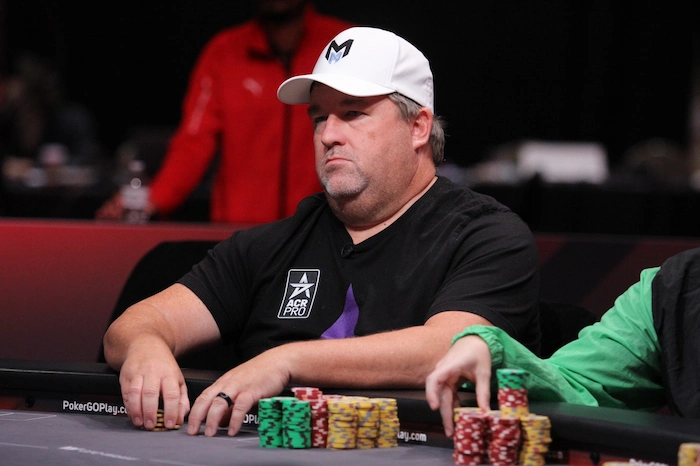
Where is Chris Moneymaker from?
Chris Moneymaker was born in Atlanta, Georgia on 21 November 1975 and raised in Knoxville, Tennessee. He attended Farragut High School, then enrolled at the University of Tennessee, Knoxville, where he earned both a bachelor’s and a master’s degree in accounting.
The Moneymaker surname is real, anglicised from the German ‘Nurmacher’ after ancestors who minted coins. Despite what the name suggests, his upbringing was middle-class and unremarkable: sports, school, and a steady path towards the accounting degree his father had encouraged.
- Born: 21 November 1975, Atlanta, Georgia
- Raised: Knoxville, Tennessee, and educated at Farragut High School
- Surname: anglicised from the German 'Nurmacher', a family that minted coins
- Degrees: bachelor's and master's in accounting, University of Tennessee
What did Chris Moneymaker do before poker?
Chris Moneymaker worked as a comptroller after graduating, while also holding a part-time job at a restaurant in Spring Hill, Tennessee. By his own account the work was unfulfilling, and the salary of approximately $32,000 left him living pay cheque to pay cheque.
He had previously worked as an accountant at Deloitte & Touche before being laid off after the 9/11 economic downturn. Online poker, which he discovered after watching the 1998 film Rounders, was his recreational escape.
There was one other gambling chapter in his pre-poker life: during college, Moneymaker developed a sports betting problem that cost him approximately $60,000 before he quit. That experience shaped his later attitude towards bankroll management and staking arrangements.
- Salary as a comptroller: approximately $32,000 a year
- Second job: part-time at a restaurant in Spring Hill, Tennessee
- Previous employer: Deloitte and Touche, laid off after the post-9/11 downturn
- College sports betting losses: approximately $60,000 before he quit
How did Chris Moneymaker qualify for the 2003 WSOP Main Event?
Chris Moneymaker qualified for the 2003 WSOP Main Event by winning a series of online satellites on PokerStars. The pipeline worked in three steps: a one-table Sit-n-Go, then a $650 final satellite that awarded three $10,000 Main Event seats, and finally the trip to Las Vegas itself.
- Step 1: a one-table Sit-n-Go satellite on PokerStars, which he won
- Step 2: $650 final satellite awarding three $10,000 Main Event seats (won one of the three)
- Step 3: $10,000 WSOP Main Event at Binion's Horseshoe, Las Vegas, May 2003 (won it too)
Moneymaker later admitted he did not realise he was entering a WSOP qualifier. “To be honest, I didn’t know it was a satellite,” he said in a 2018 ESPN podcast. “If I knew I never would have played it.”
His friend David Gamble helped fund the trip to Las Vegas. The 2003 WSOP Main Event was Moneymaker’s first live poker tournament of any kind, a detail most casual fans overlook when discussing the run.
- First live tournament of his life: the 2003 WSOP Main Event itself
- Travel funded by: his friend David Gamble, who also bought a share of his action
- What he thought he had entered: a cash tournament, not a WSOP qualifier
- In his own words: "If I knew I never would have played it"
How much did Chris Moneymaker’s satellite actually cost?
The satellite cost $86, though Moneymaker himself misremembered it for years afterwards. His 2005 autobiography is titled “How an Amateur Poker Player Turned $40 into $2.5 Million at the World Series of Poker.” That figure came from faulty recollection, not deception.
PokerStars’ internal records confirmed the correct buy-in after the fact. Some sources also cite $39, the entry figure minus the satellite fee, adding another small wrinkle to the origin story.
None of this changes the significance. A recreational player spent a small sum on a qualifying route most grinders would never bother with, parlayed it into a $10,000 Main Event seat, and won the whole thing.
- $39: the buy-in excluding the satellite entry fee, cited by some databases
- $40: the figure in the title of his own 2005 autobiography, from faulty recollection
- $86: the actual cost, confirmed afterwards from PokerStars' internal records
- Return on the $86: roughly 29,000 times the original outlay
The 2003 WSOP Main Event
Chris Moneymaker’s 2003 WSOP Main Event victory is the most influential tournament result in poker history. He beat a field of 839 entrants in the first live tournament he ever played.
The run was televised in full by ESPN and rerun relentlessly afterwards, and the heads-up duel against Sam Farha became one of the most replayed broadcasts in the game’s history.

How did Chris Moneymaker win the 2003 WSOP Main Event?
Chris Moneymaker won the 2003 WSOP Main Event by surviving a 5-day grind against 839 players. He busted Phil Ivey in 10th to reach the final table, knocked out Dan Harrington in 3rd, then beat Sam Farha heads-up.
The field included future Hall of Famers, former champions, and one amateur accountant from Tennessee.
The final table formed on 22 May 2003. Moneymaker entered as chip leader, a position he’d held for most of Day 4. By then he had already begun to understand he had a real shot.
“It was only when I busted Johnny Chan that I really started to gain confidence,” Moneymaker later said. Chan, the two-time champion immortalised in Rounders, was one of the first big scalps.
- Day 4: takes the chip lead and holds it into the final table
- 22 May 2003: final table forms at Binion's Horseshoe
- Turning point: busting Johnny Chan, the scalp Moneymaker credits with changing his own belief
- Field: 839 entrants, 63 paid, the largest brick-and-mortar poker tournament played to that point
What was Chris Moneymaker’s famous bluff against Sam Farha?
Chris Moneymaker’s famous bluff came in heads-up play against Sam Farha. He moved all-in with King-high on a wet board, and Farha folded a pair of nines that was top pair. It has been known since as the bluff of the century.
The bluff worked partly because of what had happened minutes earlier. Moneymaker had offered to split the winnings evenly despite holding the chip lead, Farha wanted more than half, and Moneymaker’s answer became a famous poker quote: “Let’s play.”
- Board: wet enough that top pair could not call comfortably
- Moneymaker's hand: King-high, no pair and no draw left
- Farha's hand: a pair of nines for top pair
- Result: Farha folded, and the chip lead swung decisively
Analysts still teach this hand as a case study in table pressure and image. The bluff worked because Moneymaker had played an aggressive, creative style throughout the final table, and Farha could not rule out a monster holding.
The psychology of the moment matters as much as the cards, which is why the hand is still taught two decades on.
Who did Chris Moneymaker beat to win the 2003 Main Event?
Chris Moneymaker knocked out three future Hall of Famers en route to the title. The most famous casualty was Hall of Fame high roller Phil Ivey, who finished 10th after losing a full-house-over-full-house cooler to Moneymaker.
The Ivey hand has become folklore. Ivey moved all-in on a Q-Q-6-9 board with pocket nines for nines full, and Moneymaker called with A-Q for three queens. The river ace made queens full of aces, a bigger full house.
Johnny Chan, the two-time champion Moneymaker has credited as his confidence-turning scalp, fell to him earlier in the run.
1995 WSOP champion Dan Harrington was the last obstacle before heads-up, finishing 3rd. That set up the finale against Lebanese cash game specialist Sam Farha.
- 10th, Phil Ivey: nines full beaten by queens full when Moneymaker rivered an ace
- 3rd, Dan Harrington: the 1995 champion, last man out before heads-up
- 2nd, Sam Farha: beaten with 5-4 offsuit making fives full of fours
- Earlier in the run, Johnny Chan: the two-time champion Moneymaker credits as his confidence-turning scalp
What hand did Chris Moneymaker win the 2003 Main Event with?
Chris Moneymaker won the 2003 Main Event with 5-4 offsuit against Sam Farha’s Jack-10. The flop of J-5-4 gave Moneymaker two pair to Farha’s top pair of jacks. The river 5 completed fives full of fours for the world title.
Chad’s commentary captured the moment: “No one has ever been more appropriately named than the man on the verge of winning the World Series of Poker, Chris Moneymaker.” The first prize was the largest the Main Event had paid to that point, and the broadcast that followed reshaped the game.
The Moneymaker Effect
The phrase “Moneymaker Effect” describes the explosion of mainstream interest in poker that followed the 2003 WSOP Main Event. It remains the single most referenced turning point in the game’s modern history.
What is the Moneymaker Effect?
The Moneymaker Effect is the documented surge in poker participation triggered by Chris Moneymaker’s 2003 WSOP Main Event victory. The term describes how one amateur’s win, broadcast on ESPN to record audiences, convinced millions of viewers that they could compete at the highest level.
- WSOP Main Event entries, 2003: 839
- WSOP Main Event entries, 2006: 8,773, a record that stood 17 years
- First prize, 2003: $2.5 million, the largest the event had paid
- First prize, 2006: $12 million, a record that stood until Daniel Weinman won $12.1 million in 2023
Before 2003, the WSOP Main Event was a niche event for professionals and wealthy amateurs. Stu Ungar’s 1997 comeback title drew just 312 entrants. After Moneymaker’s win, the tournament became a cultural phenomenon covered worldwide.
How did Chris Moneymaker change poker?
Chris Moneymaker changed poker by proving that an online qualifier with no live tournament experience could beat the best in the world. The WSOP Main Event field sizes tell the story.
| Year | Entrants | Change | Champion |
|---|---|---|---|
| 2003 | 839 | – | Chris Moneymaker |
| 2004 | 2,576 | +207% | Greg Raymer |
| 2005 | 5,619 | +118% | Joe Hachem |
| 2006 | 8,773 | +56% | Jamie Gold |
That is more than a tenfold increase in three years. Online poker rooms, particularly PokerStars, saw registration numbers spike immediately after ESPN’s broadcasts aired. The game moved from back rooms and casinos into living rooms and dorm rooms.
PokerStars’ real-money player base grew from a niche platform to the largest poker site in the world within three years of Moneymaker’s victory. The company’s marketing strategy was built around his story: if he could do it, anyone could.
Celebrities, athletes, and tech entrepreneurs began playing publicly, and the celebrity player culture that grew out of it has never gone away.

Why did the 2003 WSOP Main Event cause the poker boom?
The poker boom required three things to align at once, and the 2003 Main Event delivered all three.
- ESPN hole cameras let viewers see players' cards for the first time, turning poker into compelling television
- Online poker platforms like PokerStars made satellite qualification to the WSOP affordable for recreational players
- Moneymaker's every-man persona, from his surname to his $86 buy-in, made the dream feel achievable for millions
Without any one of these factors, the boom might not have happened. Rounders had been released in 1998 and planted the seed, but it took Moneymaker’s live story on ESPN to convert curiosity into action.
ESPN’s return to WSOP coverage in 2026 is an explicit attempt to recreate that cycle. Our coverage of the WSOP’s multi-year ESPN broadcast deal explains the new ownership’s strategy.
PokerStars Ambassador Era (2003 to 2020)
Chris Moneymaker signed with PokerStars within weeks of his 2003 Main Event victory and remained with the company for 17 years. It was the longest-running player sponsorship in online poker history.
How long was Chris Moneymaker with PokerStars?
Chris Moneymaker was a PokerStars Team Pro from 2003 to 2020, a span of 17 years. He wore the red spade patch at every major tournament and served as the brand’s most visible ambassador during the game’s fastest growth period.
His role went beyond playing tournaments. Moneymaker appeared in PokerStars marketing campaigns, hosted satellite events, and became the face of their recreational-player outreach strategy.
His 2005 autobiography, “Moneymaker: How an Amateur Poker Player Turned $40 into $2.5 Million at the World Series of Poker,” became a bestseller. The title carries a factual error he has since acknowledged: the real satellite cost more than double that.
- 2003: signed as a Team Pro within weeks of the Main Event win
- 2005: autobiography published by HarperCollins, becomes a bestseller
- 2011: sponsorship survives Black Friday and the seizure of the PokerStars domain
- 2014: survives again through Amaya Gaming's $4.9 billion acquisition
- 2018-2019: fronts the Moneymaker PSPC Tour, $86 events across the United States, Ireland and England
- 2020: leaves after 17 years, the longest player sponsorship in online poker
How much did PokerStars pay Chris Moneymaker?
Neither party ever disclosed the terms, and no reliable public figure exists for what the deal was worth. What is known is the shape of it: a base retainer plus tournament buy-ins, travel and appearance fees, escalating as ESPN turned him into the game’s most recognisable face.
Why did Chris Moneymaker leave PokerStars?
Chris Moneymaker left PokerStars in 2020 after 17 years. He has never publicly criticised the company, but the departure came during a period when PokerStars was reducing its ambassador roster and shifting marketing spend away from player-facing sponsorships.
The departure followed a broader trend. Eight-time bracelet winner Daniel Negreanu had already left PokerStars in late 2019 to join GGPoker. By 2020, the era of large PokerStars ambassador deals was over.
Within a year of leaving, Moneymaker had signed with ACR Poker as a brand ambassador, beginning the next chapter of his professional career.
ACR Poker & the Moneymaker Tour (2021 to Present)
Chris Moneymaker joined ACR Poker as a brand ambassador in 2021, less than a year after leaving PokerStars. The partnership gave him a platform that reaches the US market, something PokerStars could no longer offer after Black Friday.
When did Chris Moneymaker join ACR Poker?
Chris Moneymaker signed with ACR Poker in February 2021. The deal made him the most prominent ambassador on the Americas Cardroom roster and gave ACR a household name to front its US-facing marketing.
- Why ACR: the room serves the US market, which PokerStars could not after Black Friday
- Signed: February 2021, within a year of leaving PokerStars
- Role: lead ambassador, fronting the Venom and the room's live schedule
- Still in place: ACR published his WSOP bubble-hand analysis in August 2026
Moneymaker has since appeared in ACR promotional content, hosted online tournaments, and represented the brand at live events. He fronts the room’s flagship series, including the Venom, and appears across its tournament marketing.
The role mirrors the PokerStars deal in structure: buy-ins, travel and a retainer, on terms neither party has disclosed. What is different is reach, because ACR can market to American players.
- What ACR gets: a household name fronting its US-facing marketing
- What Moneymaker gets: buy-ins, travel and a retainer, terms undisclosed
- Flagship series: the Venom, which he fronts across ACR's tournament marketing
- Most recent output: an exclusive ACR breakdown of his WSOP bubble hand, August 2026
What is the Moneymaker Tour?
The Moneymaker Tour is a live tournament circuit that Chris Moneymaker launched with executive manager Tony Burns. The tour targets the $1,000 to $3,000 buy-in range, filling a gap between local casino events and the major tours.
Stops have included venues across the United States plus Canada and Australia. The format emphasises mixed games alongside No Limit Hold’em, reflecting Moneymaker’s interest in widening the range of formats available to recreational players.
He plays his own tour and wins on it. The signature event is the Mystery Million and its $1M bounty, which debuted in late 2024.
- April 2025, MGM National Harbor: won a $300 mixed Pot-Limit Omaha event for $5,195
- May 2025, Palm Beach: won the $1,100 Main Event for $83,042
- July 2025, MGM Grand Las Vegas: won the $1,700 Moneymaker Main Event for $238,900
- September 2025, Cincinnati: 17th in the $1,500 Main Event for $5,950
Is Chris Moneymaker still with ACR Poker in 2026?
Yes. He remains ACR Poker’s lead ambassador as of August 2026, and ACR published his own analysis of the WSOP Main Event bubble hand that month. He wears the ACR patch at major live events and promotes the room’s tournament schedule on his social channels.

He bubbled the 2026 WSOP Main Event in July, calling off with J-9 against Antonio Vargas’s pocket aces on a board already reading sevens full of eights. Moneymaker set out his reasoning in our breakdown of the 2026 bubble call.
He went out on the stone bubble alongside Stoyan Madanzhiev and Zhaken Seitbekov, all three in the same hand-for-hand sequence. Only two $15,000 payouts remained, so the $30,000 was split three ways and each man got his $10,000 buy-in back.
Playing Style & Reputation
Chris Moneymaker’s poker style has been debated since the night he won the 2003 Main Event. The consensus among professionals who have played with him is that the public underestimates his ability.
What is Chris Moneymaker’s playing style?
Chris Moneymaker plays a loose-aggressive style built on reading opponents and applying pressure at the right moments. He is not a GTO-driven player. His edge comes from table feel, bet sizing tells, and a willingness to make large bluffs in high-pressure spots.
The 2003 Farha bluff was not a fluke. Moneymaker has consistently shown the ability to put opponents on ranges and execute creative lines, particularly in live settings where physical reads matter.
He is also a far broader player than the Hold’em highlight reel suggests. The mixed-game results run from an EPT 8-Game title in 2013 to a Badugi bracelet-event cash in 2026.
- 2013, EPT Monte Carlo: won a EUR 1,000 8-Game event
- 2013, PCA Bahamas: 4th in a $1,000 H.O.R.S.E. event
- 2016, PokerStars Festival New Jersey: won a $500 Pot-Limit Omaha Hi/Lo turbo
- 2018, WPT Seminole Rock N Roll: won a $360 Omaha 8 or Better event
- 2018, Run It Up Reno: 2nd in a $200 8-Game 6-max
- 2026, WSOP Las Vegas: 12th in the $1,500 Limit Badugi bracelet event
Is Chris Moneymaker a good poker player?
Yes. Moneymaker’s peers have repeatedly said so on the record. Joe Hachem, the 2005 WSOP Main Event champion and former PokerStars teammate, said: “Chris is one of the most underrated poker players I know.”
Moneymaker’s 164 lifetime cashes and $8.65 million in tracked earnings support this. The perception gap exists because Moneymaker plays a selective schedule. He enters far fewer events per year than full-time touring professionals, which limits his volume of results.
Is Chris Moneymaker a one-hit wonder?
The one-hit wonder label follows Moneymaker because no single result has matched the 2003 win. Reducing his career to that framing misses the bigger picture.
He won a Triton Super High Roller title in Montenegro in 2024, finished 10th of 1,978 at the WSOP Paradise Super Main Event, and has banked over $6.1 million outside the 2003 win.
His induction into the Poker Hall of Fame in 2019 recognised both his playing career and his effect on the game.
Moneymaker himself has addressed this directly: “People don’t think I’m that good and think I bluff all the time. It definitely helps me when I play.”
Personal Life
Away from the poker table, Chris Moneymaker lives a relatively private life in the Nashville, Tennessee area with his family.
How old is Chris Moneymaker?
Chris Moneymaker is 50 years old. He was born on 21 November 1975 in Atlanta, Georgia, and grew up in Knoxville, Tennessee, where he attended Farragut High School.
He earned a master’s degree in accounting from the University of Tennessee before working as a comptroller. That accounting career ended shortly after the 2003 win when he committed to poker full-time.
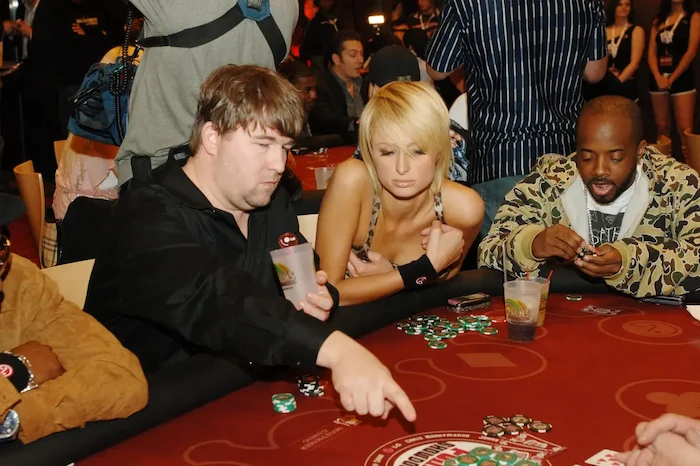
Is Chris Moneymaker married?
Chris Moneymaker has been married twice, with his first marriage ending in divorce in 2004 as a consequence of the lifestyle change that followed his WSOP victory. He has spoken openly about the trade-off: “She was married to a stay-at-home accountant. She didn’t sign up for that life.”
He married his second wife, Christina Wren, in 2005. They have three children together and live in the Nashville area.
Does Chris Moneymaker do charity work?
Moneymaker has participated in various charity poker events throughout his career. He has been a regular at the annual WSOP charity tournaments, and the Moneymaker Tour has included charity components at several stops.
He has also been vocal about responsible gambling, drawing on his own experience with sports betting during his college years at the University of Tennessee.
Setbacks & Business Challenges
Not every venture has gone smoothly for Moneymaker. His post-2003 career includes one shutdown that shows how quickly the ground can shift for anyone running poker in a restrictive state.
What happened to Chris Moneymaker’s social clubs?
Chris Moneymaker has opened two social poker clubs in Kentucky. The Paducah room lasted five months before a county attorney shut the poker down in early 2023. The Louisville room, opened in June 2024 with local prosecutors satisfied it was lawful, is still trading.
No allegations of wrongdoing were attached to the Paducah shutdown. Social poker clubs operate in a legal grey area across many US states, and county-level interpretation can change without warning.
- September 2022, Paducah: Moneymaker Social Club opens on a membership-fee model
Has Chris Moneymaker been involved in any poker controversies?
Moneymaker has largely stayed clear of the scandals that have affected other prominent players. His most notable public stance came when he dismissed Postle’s ACR claims as “false”, publicly backing the room when others stayed silent.
That public defence reinforced his reputation as a straight talker who backs his convictions. In an era of poker scandals involving real-time assistance software and collusion rings, Moneymaker’s record remains clean.
Did Chris Moneymaker go broke after winning the 2003 Main Event?
By Moneymaker’s own admission, the prize money was gone within two years of his win. The full breakdown of where it went is covered in the Net Worth section above.
The PokerStars sponsorship provided financial stability from 2003 onward. But the speed at which the initial windfall disappeared is a cautionary tale that Moneymaker has discussed publicly without evasion.
Latest News & Updates
Chris Moneymaker built his 2026 around the summer in Las Vegas. He took 12th in a $1,500 Limit Badugi bracelet event in May for $7,095, then cashed the Venetian’s $1,100 Seniors in July for $3,714.
Between those came the Main Event, which ended on the money bubble. ACR published his own breakdown of the J-9 call in August.
His deeper runs came earlier. December 2025 brought two cashes at WSOP Paradise, the larger a $70,000 finish in the $25,000 Super Main Event.
July 2025 produced his biggest title outside a super high roller, the $1,700 Moneymaker Main Event at the MGM Grand for $238,900. Those figures come from The Hendon Mob and are current to 28 August 2026.
For broader poker industry coverage, check our latest poker news and tournament results.
FAQs
What is Chris Moneymaker's net worth?
Chris Moneymaker’s net worth is $5M-$10M, centred on approximately $7 million and built from tracked live earnings, ambassador income and known expenses. The $16 million figure widely cited online appears unsourced.
How old is Chris Moneymaker?
Chris Moneymaker was born on 21 November 1975. He is currently 50 years old.
How tall is Chris Moneymaker?
Moneymaker is approximately 5’9″ (175 cm) based on visual evidence from televised poker appearances and photos alongside players of known height.
How many WSOP bracelets does Chris Moneymaker have?
One. Moneymaker won the 2003 WSOP Main Event and has not won a second. He has 16 bracelet-event cashes in total, and the 2003 title is still his only WSOP final table. His closest attempt since was 10th at the 2024 WSOP Paradise Super Main Event.
Is Chris Moneymaker in the Poker Hall of Fame?
Yes. Moneymaker was inducted into the Poker Hall of Fame in 2019, recognising both his playing career and his transformative impact on the game.
What is the Moneymaker Effect?
The Moneymaker Effect describes the explosion of mainstream interest in poker that followed his 2003 WSOP Main Event victory. WSOP Main Event entries grew from 839 in 2003 to 8,773 by 2006, driven largely by ESPN’s coverage of his win.
Did Chris Moneymaker really qualify for $86?
Yes. That was the buy-in on PokerStars. His autobiography incorrectly states $40 and some sources cite $39, but the operator confirmed the higher figure after the fact.
Where does Chris Moneymaker play now?
Moneymaker is a brand ambassador for ACR Poker (Americas Cardroom) since 2021. He also runs the Moneymaker Poker Tour and plays selectively in major live events including WSOP and Triton Poker series.
Is Chris Moneymaker still married?
Moneymaker married his second wife, Christina Wren, in 2005. They have three children and live near Nashville, Tennessee. He also has a daughter, Ashley, from his first marriage, which ended in divorce in 2004.
What are Chris Moneymaker's total career earnings?
As of 28 August 2026, Moneymaker’s tracked live tournament earnings total $8,649,423 across 164 recorded cashes, according to the Hendon Mob database. This does not include online results, ambassador income, or private cash games.
Did Chris Moneymaker go broke after winning?
By his own account, the prize money was gone within approximately two years. Taxes, a divorce settlement, backing other players, and lifestyle expenses consumed it. His PokerStars sponsorship provided financial stability from 2003 onward.
What hand did Chris Moneymaker win with?
Moneymaker won the 2003 WSOP Main Event with 5-4 offsuit against Sam Farha’s Jack-10. He flopped two pair on a J-5-4 board and rivered a full house (fives full of fours).
What was the bluff of the century?
During heads-up play against Sam Farha, Moneymaker moved all-in with King-high on a wet board. Farha held top pair with nines and folded. The hand has been known since as the bluff of the century, and it shifted the chip lead decisively in Moneymaker’s favour.
Sources & Methodology
This player profile separates verifiable facts from estimates and public claims. We cannot accurately calculate any player’s net worth, but we aim to publish transparent, verifiable information.
How we handle net worth
Net worth is not publicly confirmed for most poker players, including Chris Moneymaker. Any figures mentioned are treated as estimates and may vary due to private cash games, staking arrangements, and non-public income. We prioritise direct statements, reputable poker media reporting, and publicly trackable records.
How we report earnings
Live tournament earnings refer to tracked cash results reported by major poker databases. Cash totals are not the same as profit. Online earnings and private cash game results are generally not reliably public, so we avoid presenting them as confirmed totals.
How we cover controversies
We link to our own reporting when controversies are discussed and clearly label what is alleged, denied, or unclear. Where possible, we rely on direct statements and named sources rather than anonymous speculation.
References
- The Hendon Mob – tracked live tournament cashes and results history
- WSOP.com – official WSOP profile and bracelet history
- Wikipedia – biographical context, cross-checked where possible
- X (@CMONEYMAKER) – official social media account