

In June 2026, Phil Hellmuth bet $14,000 on his son in the WSOP Main Event. If Phillip Hellmuth III cashed, Shaun Deeb and Jason Mo had to pay Hellmuth whatever his son won, up to $10,000,000 for first place. He went out on Day 3, short of the money, which made Deeb and Mo the winners.
It is one of many famous poker prop bets, the side wagers players make on almost anything except the hand being played. In 1996 Brian Zembic took a $100,000 bet that he would get breast implants and keep them for a year, and 19 years later they were still in place. John Hennigan bet he could live in Des Moines, Iowa, and lasted two days.
This page collects the best documented poker prop bets: who bet what, at what price, and how each one ended. Every amount comes from the players' own posts or from established outlets such as PokerNews, Card Player and Poker.org, and where a result was never made public, we say so rather than guess. New bets are added as they happen, and the page is updated for 2026.
- Physical and body fat bets: bike rides across the desert, 48 hours of lunges and the body fat targets Bill Perkins keeps setting for poker players.
- Diet and isolation bets: a year without meat, $1,000 of McDonald's in 36 hours and a month long bet to live in a Bellagio bathroom.
- Golf, sports and fights: four rounds of golf in one day in the desert heat, 90 free throws out of 100, a perfect game of bowling and an MMA fight between two pros.
- Bracelet bets and long shots: the bets on Jason Mercier and Tom Dwan, Jesse Lonis's Main Event long shot and a summer crossbook settled to the dollar.
- Challenges that never went ahead: open offers from Phil Hellmuth, Rampage and Charlie Carrel, and the proposed match between Phil Galfond and Grok.
- The maths: how to turn prop bet odds into a percentage, and why so many of these bets end in a buyout.
What Is a Prop Bet in Poker?
A prop bet, short for proposition bet, is a side wager between players on something other than the result of the hand. PokerNews defines them as side bets that are independent of the game's actual outcome. Among high stakes players the idea stretched long ago to almost anything two people can put a price on, from a body fat scan to a golf score.
They are usually made between players who know each other well, at whatever odds the two of them agree.
Where Poker Prop Betting Started
Nobody can date the first poker prop bet, but the best known early ones belong to Thomas Preston Jr., better known as Amarillo Slim, who won the World Series of Poker in 1972. His Associated Press obituary and a 2003 NPR profile describe his two most famous claims:
- Ping pong against Bobby Riggs: the former Wimbledon champion let Slim choose the paddles, and Slim turned up with cooking skillets he had practised with for months.
- Outrunning a horse: over 100 yards, on a course nobody had said must be a straight line.
None of these accounts gives an amount for either bet, and the man who wrote Slim's memoir with him was never sure where the stories ended and the facts began:
“…even he couldn't differentiate his version of reality with actual reality.”
Greg Dinkin, writing on Grantland in 2012
That is why this page treats Slim's stories as legend and builds the record from bets that were reported at the time.
The Main Types of Poker Prop Bets
Almost every poker prop bet falls into one of seven types. The table shows how each one works, with the best known example of each.
| Type | How It Works | Example on This Page |
|---|---|---|
| Physical challenge | A player bets he can finish a feat of endurance before a deadline | Dan Bilzerian's bike ride from Las Vegas to Los Angeles |
| Body fat and weight | A target weight or body fat reading by a set date, checked on a scale or a scan | Shaun Deeb vs Bill Perkins |
| Diet and lifestyle | Giving something up, or living somewhere, for a fixed period | Phil Ivey's vegetarian bet |
| Sports and skill | A score or result in a sport other than poker | Erick Lindgren's four rounds of golf |
| Bracelet bet | Whether a player wins one or more WSOP bracelets in a series | Vanessa Selbst vs Jason Mercier |
| Crossbook | Two players swap a share of each other's tournament results | Landon Tice vs Jeremy Becker |
| Open challenge | A public offer anyone can take, on terms set by the player making it | Phil Hellmuth's cash game challenge |
Two features run through nearly all of them. The price is set by the players rather than a bookmaker, so the odds say as much about the people involved as about the real chance, and many bets end early in a buyout, where one side pays to get out before the deadline.
Prop Bets vs Bankroll Challenges and Heads Up Matches
Prop bets often get lumped in with two other kinds of poker challenge that work differently:
- Prop bet: a wager between two sides on something outside the game, decided at a deadline or on a set condition.
- Bankroll challenge: a public attempt to hit a money target under rules the player sets, often with nobody betting against him.
- Heads up challenge: a set number of hands against one opponent, decided by who is ahead at the end.
Our page on poker bankroll challenges covers the run ups by Doug Polk, Rampage and others, so they are left out here. The lines blur when money rides on a match: Tom Dwan put up $1.5 million against $500,000 from each opponent in the Durrrr Challenge, and neither match reached the 50,000 hands needed to decide the side bet, as our full history of the Durrrr Challenge explains.
The Latest Poker Prop Bets
These are the most recent poker prop bets on this page, newest first. Every bet in the table has its own entry on this page, and new ones are added here as soon as they are reported.
| Date | Bet | Players | Result |
|---|---|---|---|
| Jul 2026 | $14,000 against whatever Phillip Hellmuth III cashed for in the Main Event, up to $10,000,000 | Phil Hellmuth vs Shaun Deeb and Jason Mo | Hellmuth III went out on Day 3, before the money, so Deeb and Mo won |
| Feb 2026 | $5,000 to the first of the two to bowl a perfect 300 | Ryan Riess vs Jesse Lonis | Riess bowled 300 and won the bet |
| Feb 2026 | $100,000 on a year with no alcohol, smoking or recreational drugs | Michael Mizrachi vs Chino Rheem | No result reported |
| Oct 2025 | $1,000,000 side bet on a 50,000 hand heads up match | Phil Galfond vs Grok | Agreed in principle, no match reported |
| Sep 2025 | $500,000 each on his results in televised cash games | Phil Hellmuth vs any critic | No taker on his terms |
| Jul 2025 | $2,000 at 500 to 1 that Lonis would win the Main Event | Jesse Lonis vs Mikita Badziakouski | Lost: Michael Mizrachi won |
| Apr 2025 | $200,000 that Polk could cut his body fat from 22% to 11% | Doug Polk vs Bill Perkins | No result reported |
| Aug 2024 | $10,000 at 100 to 1 to go from a 15.5 golf handicap to scratch | Rampage, with Chris Moneymaker laying the price | No booking reported |
| Jul 2024 | 100% crossbook over at least 25 summer tournaments | Landon Tice vs Jeremy Becker | Becker won by $71,742 |
| Apr 2024 | $3,000 at 20 to 1 on a 30 day water fast | Rob Kuhn vs Shaun Deeb | Bought out for $25,000 after 16 days |
| Feb 2024 | $100,000 at 10 to 1 on reaching 17% body fat | Shaun Deeb vs Bill Perkins | Bought out for $800,000 |
Dates are when each bet was settled, or when it was made or reported if it is still open or never went ahead.
Five of these eleven never produced a public result, because the bet was never booked or the players never said how it ended. New bets usually appear first in our poker news coverage.
Physical Challenge Prop Bets
Physical challenges produce some of the craziest poker prop bets, and they are the simplest to settle: either the player finishes before the deadline or he does not. They are hard to price, because the player taking the bet usually knows his own fitness better than the person betting against him.
Ashton Griffin's Treadmill Run
In February 2011, Ashton Griffin bet his housemate Haseeb Qureshi that he could run 70 miles on a treadmill inside 24 hours. He finished inside the final hour, and the money riding on it grew while he ran:
- Opening bet: 3 to 1, Griffin's $210,000 against Qureshi's $70,000.
- Final position: $900,000 of Griffin's money booked against $300,000, almost all of it Qureshi's.
- Buyout: with 60 miles done and about three hours left, Griffin offered to let Qureshi out for $200,000. Qureshi turned it down.
Our full story of Ashton Griffin's 70 mile prop bet goes through the bet hour by hour, including what the many retellings get wrong.
Dan Bilzerian's Bike Ride Against Bill Perkins
Bill Perkins bet Dan Bilzerian $600,000 at even money in February 2016 that he could not cycle between Los Angeles and Las Vegas inside 48 hours. According to PokerNews, the bet appeared to grow out of a smaller one Bilzerian had offered Samantha Abernathy for the same ride. The rules were strict:
- Time limit: 48 hours from the moment he set off.
- No motor: no engine or assistance of any kind on the bike.
- Police: an arrest voided the bet, and any time spent stopped by police counted against the clock.
Bilzerian left Las Vegas shortly after 3:30pm on March 29 and reached Los Angeles in under 33 hours, riding the opposite way to the route first announced. The only dispute was over a van he rode behind for part of the trip, which was removed about 100 miles from the finish. Perkins estimated it had saved four to six hours, but Bilzerian still netted the $600,000, Card Player wrote.
“I didn't agree to vehicle drafting.”
Bill Perkins, speaking to Card Player after the ride
Rick Salomon had a separate $250,000 side bet against Bilzerian's private jet, which would only have paid out if Bilzerian died or was left braindead on the ride. Salomon objected to the drafting, and according to PokerNews on April 1, Perkins said the wagers had gone to arbitration. No ruling on Salomon's bet has been reported.
The Other Vegas to LA Bike Bets
Bilzerian's ride was the middle one of three that spring. Samantha Abernathy went first, on a $10,000 freeroll from Bilzerian that she could not make the trip in 72 hours, and finished around March 13. Brian Rast went last, with less than a week to train, after Bilzerian and Perkins offered him 6 to 1.
| Rider | Bet | Time Limit | Key Rule | Result |
|---|---|---|---|---|
| Samantha Abernathy | $10,000 freeroll from Bilzerian | 72 hours | Not reported | Finished around March 13 |
| Dan Bilzerian | $600,000 each at even money with Perkins | 48 hours | No motor or assistance | Under 33 hours, netted $600,000 |
| Brian Rast | 6 to 1 from Bilzerian and Perkins | 48 hours | No drafting behind a vehicle | About an hour to spare, won $600,000 |
Unlike Bilzerian, Rast was explicitly banned from drafting behind a vehicle, and he picked a route he said was about 30 miles longer. Card Player put his winnings at $600,000 from the two of them.
Antonio Esfandiari's Lunges
During the 2016 PokerStars Caribbean Adventure, Bill Perkins bet Antonio Esfandiari $50,000 that he could not lunge everywhere he went for 48 hours. He won, but on Day 2 of the PCA Main Event, with his legs exhausted from lunging, he urinated in a container at the table rather than make the trip to the bathroom. He was disqualified with about 115,000 chips.
“On paper I won, but in life I lost.”
Antonio Esfandiari, speaking to PokerNews after his disqualification
He gave the full $50,000 to charity, $25,000 each to One Drop and REG, and said PokerStars had been right to disqualify him.
Huck Seed vs Howard Lederer
Huck Seed made two of poker's best known physical bets against Howard Lederer, and he won only one of them:
- Standing back flip, $10,000: from flat feet, landing on his feet. PokerNews reported he learned it in two days on a harness rigged over a swimming pool, then landed it to win.
- One legged race, $5,000: a 50 yard dash with both men hopping on one foot. Seed watched Lederer's practice run, decided he could not win and paid without racing.
Both bets appear in PokerNews' all time top 10 and in Cigar Aficionado's 2002 feature on poker prop bets, where Lederer recalled the details himself.
Weight Loss and Body Fat Bets
Weight and body fat bets have produced some of the biggest sums in poker prop betting, and Bill Perkins is on the other side of most of the recent ones. The newer bets are decided by a DEXA body fat scan rather than a number on the scales, which leaves little room for argument.
| Bet | Start | Target | Stake | Result |
|---|---|---|---|---|
| Forrest vs Matusow, 2008 | Matusow at 241 lb | 181 lb before the WSOP | $100,000 | Won at 180.8 lb |
| Forrest vs Matusow, 2010 | Forrest at 188 lb | Under 140 lb | $150,000 against $2,000,000 | Won at 138.0 lb, most of it unpaid |
| Staples brothers, 2018 | 304 lb and 134 lb | Within a pound of each other | $3,000 at 50 to 1 | Won $150,000 |
| Walter Fisher, 2017 | 245 lb | Under 10% body fat | $1,000,000 in escrow | Won at 8.8% |
| Doug Polk, 2023 | 27.7% body fat | 13.85% | $200,000 at even money | Lost at 15.1% |
| Doug Polk, 2025 | 22% body fat | 11% | $200,000 | No result reported |
| Shaun Deeb, 2024 | 306 lb, 40.2% body fat | 17% | $100,000 at 10 to 1 | Bought out for $800,000 |
Years are when each bet was settled or due. Weights are in pounds.
Ted Forrest vs Mike Matusow
The best known weight bets in poker were two between Ted Forrest and Mike Matusow, and the second is still argued about. In 2007 Forrest bet Matusow $100,000 that he could not get from 241 pounds back to his high school weight of 181 before the 2008 WSOP. Matusow was still 15 pounds short with nine days left and made it at 180.8 pounds, according to PokerNews.
In May 2010 the roles reversed. Forrest, at 188 pounds, bet he could get under 140, and Matusow and Justin “BoostedJ” Smith took two bets that put $150,000 of Forrest's money against $2,000,000. Forrest weighed in at 138.0 pounds at the Rio on July 13, filmed by ESPN, and the argument over paying has run ever since:
- Forrest's side: he told Card Player in 2014 that he had paid Matusow $100,000 for the first bet, that Matusow had paid him only $70,500 over four years, and that both bets ran on an honour system.
- Matusow's side: he said he was very drunk when the bet was made and that there should have been a drug test, and his brother Scott said Forrest cheated.
- What is owed: more than $1.7 million by Forrest's count in PokerNews, or $1.8 million in his own tweet. No settlement has been reported.
Forrest's figures are from his 2014 interview with Card Player, and the debt totals and Scott Matusow's claim from PokerNews the same month.
The Staples Brothers' Weight Bet
Bill Perkins gave brothers Jaime and Matt Staples 50 to 1 on $3,000 in March 2017 that they could get within a pound of each other in a year. Jaime weighed 304 pounds and Matt 134. On March 25, 2018, both stepped on the scales at exactly 188.3 pounds and collected $150,000, as CNBC reported.
They put $50,000 of it into a rematch with Perkins, to reach 9.9% body fat by March 25, 2019, which PokerNews covered, but no outlet reported how it ended.
Walter Fisher's Body Fat Bet
A group of gamblers bet professional gambler Walter Fisher in December 2016 that he could not get under 10% body fat in six months, with $1 million held in escrow:
- Start: 245 pounds.
- Result: 8.8% body fat at 175 pounds on a scan on June 22, 2017, so he won.
- Net winnings: $600,000 according to CBS News, or $490,000 according to BroBible.
BroBible named Bill Perkins and Dan Bilzerian among his backers, and reported that the two also gave him 4 to 1 on $50,000 that he could do it within four months, a side bet he lost. CBS News did not name any of the backers.
Doug Polk vs Bill Perkins
Doug Polk has lost one body fat bet to Bill Perkins, and the result of the second has never been reported. The first ran from February 11, 2022 to February 10, 2023, for $200,000 at even money, and Polk had to halve his body fat from 27.7% to 13.85%. His final scan read 15.1%, about 1.3 points short, and he lost the $200,000.
In April 2025 he went double or nothing:
- Stake: $200,000.
- Target: from 22% body fat to 11% by October 6, 2025.
- Banned: weight loss drugs such as Ozempic.
PokerNews and Card Player, which reported the ban on weight loss drugs, both covered the start of the rematch. No result has been reported since.
Shaun Deeb vs Bill Perkins
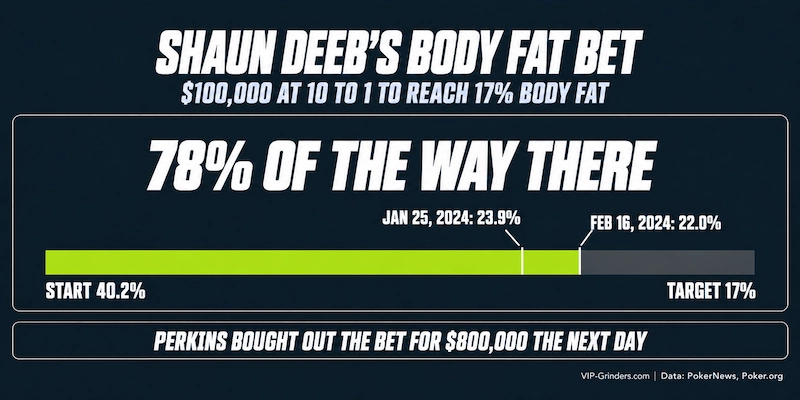
Shaun Deeb took one of the biggest of Perkins's body fat bets in March 2023, when he weighed 306 pounds. Perkins gave him 10 to 1 on $100,000 that he could reach 17% body fat by May 30, 2024, the start of that year's WSOP, which would have paid $1,000,000. His scans showed how close he came:
- March 2023: 306 pounds. His first scan, a few weeks later, read 40.2%.
- January 25, 2024: 23.9%.
- February 16, 2024: 22.0%.
- February 17, 2024: Perkins bought out of the bet for $800,000.
That was 80% of the full payout, with more than three months still to go, PokerNews reported. Deeb said he would keep working toward 17% out of respect for the players who had side action on him, but whether he got there has not been reported. The terms are from PokerNews in March 2023 and the first scan from Poker.org.
Diet and Sobriety Bets
Three of these bets are about giving something up for a set time, and two are about eating. Most ended early, in a buyout or with the player giving in.
Phil Ivey's Vegetarian Bet
In an episode of High Stakes Poker filmed days after his seventh place finish at the 2009 WSOP Main Event, Phil Ivey took a $1,000,000 bet from Tom Dwan that he could go a year without eating meat, fish included. He announced it on the show himself:
“I'm going to become a vegetarian for a year for a million dollars.”
Phil Ivey, on High Stakes Poker, as reported by Card Player
Card Player reported in March 2010 that Dwan said Ivey was already trying to buy out of the bet. By May he had, for $150,000, according to PokerNews.
Howard Lederer's Burger Bet
Howard Lederer, who did not eat meat, once ate a hamburger to win $10,000 from fellow pro David Grey. Grey was then offered the chance to win his money back by eating olives, which he could not stand, and paid up instead. The New York Times told the story in 2008, and so does PokerStrategy, while Cigar Aficionado's 2002 account calls it a cheeseburger.
Mike Noori's McDonald's Challenge
Tournament director Matt Savage laid Mike Noori 5 to 1 in May 2017 that he could not eat $1,000 worth of McDonald's food in 36 hours. The rules were set out in advance:
- Hot food: at least $300 of it, including $50 on burgers.
- Limits: no more than $200 on salads, and drinks did not count toward the total.
- Policing: no food processors, no removing food from an order, no forced vomiting, and an observer at every meal.
- The bill: Noori paid all of it if he failed, and only half if he won.
The terms were published by PokerStrategy before the attempt. Noori gave up with less than $100 of food eaten, as PokerTube recorded at the end of that year.
Rob Kuhn's Water Fast
Rob Kuhn started a 30 day fast against Shaun Deeb on March 25, 2024, with $3,000 of his money against Deeb's $60,000 at 20 to 1. He was allowed water, electrolytes, salt and vitamins, plus coffee in the first two hours after waking, according to Poker.org.
Sixteen days in and 25 pounds lighter, he accepted a $25,000 buyout from Deeb, saying he wanted to carry on in a healthier way.
Michael Mizrachi vs Chino Rheem
Michael Mizrachi and Chino Rheem have $100,000 riding on a year of sobriety, PokerNews reported in February 2026. The rules are simple:
- Banned: alcohol, cigarettes and recreational drugs.
- Allowed: hookah and vaping.
- Passes: any day either player takes as a pass does not count toward the year.
- Settling it: if both fail, nobody wins, and if both last the year, the bet is a chop.
Mizrachi called himself the favourite. The interview in which they described the bet was filmed in early 2025 and only released in February 2026, according to the Action Network, so the start date is not public and no result has been reported.
Lifestyle and Isolation Bets
These bets ask a player to put up with something for weeks or months: a new body, a move to Des Moines, or a room with no light. The isolation bets tend to end in a buyout, because the person who set them starts to worry once the player looks comfortable.
Brian Zembic's Breast Implants
Brian Zembic's 1996 bet with a backgammon player was for $100,000, on whether he would get breast implants and keep them for a year:
- Size: 38C.
- Surgery: free, because the surgeon owed Zembic from a game of backgammon.
- Result: he kept them for the full year and won.
- Since: in 2010 he said he still had them, and would have them removed if they caused his daughter trouble at school.
The details come from Maxim in 2015, which reported the implants still in place 19 years on, and from the Las Vegas Advisor in 2010.
John Hennigan's Move to Des Moines
John Hennigan was given the nickname Johnny World for his skill at prop betting, according to the Las Vegas Sun. His most famous one went the wrong way: a bet that he could live in Des Moines, Iowa, which ended with him back in Las Vegas two days later.
- Length: six weeks, according to PokerNews in 2011, Cigar Aficionado and The New York Times, or a month according to PokerNews in 2009 and PokerStrategy.
- Stake: six figures in both PokerNews accounts, or $50,000 according to PokerStrategy.
- Settling it: PokerNews says he paid off the bet, while PokerStrategy says he bought out of it.
Howard Lederer recalled the bet for Cigar Aficionado in 2002, and said he had never expected Hennigan to last:
“I knew he had no chance of staying in Des Moines.”
Howard Lederer, speaking to Cigar Aficionado
Jay Kwik's Bellagio Bathroom Bet
In January 2008, Andrew Robl and Alec Torelli gave Jay Kwik 2 to 1 on his money that he could live in a bathroom at the Bellagio for a month, from January 12 to February 12. The stake was kept secret in a Bellagio safe deposit box, and the loser had to cover all of Kwik's expenses, Card Player reported as the bet began. Kwik agreed to these conditions:
- No computer, and a prepaid phone with 400 minutes for the whole month.
- Food by room service or a friend, with no more than four deliveries a day.
- Entertainment: a small portable DVD player.
- Monitoring: a webcam outside the bathroom door, and $500 for anyone who spotted a rule break.
Kwik coped well enough that Robl bought him out early for a reported $40,000, according to PokerNews' 2009 list and PokerStrategy. Neither says how many days he lasted.
Rich Alati's Dark Room Bet
Rory Young bet Rich Alati $100,000 at even money at the Bellagio in September 2018 that he could not spend 30 days alone in a dark room. Each side put $5,000 in escrow, and Young, who rated Alati's real chances at 5 to 1 to 10 to 1 against, built the room himself, according to PokerNews. It was a shuttered, soundproofed bathroom with a yoga mat, food delivered at random intervals and no light, people or electronics.
| Day | What Happened |
|---|---|
| Day 1 | Alati goes into the room in late November 2018. |
| Day 10 | Young starts to worry, because Alati looks fine. |
| Day 15 | Young offers $50,000 to end the bet. Alati says no. |
| Day 20 | On Monday, December 10, Alati accepts $62,400 plus his expenses. |
The buyout terms are from PokerNews, which also reported that Young had hedged with a $10,000 bet at 3 to 1. The day 10 and day 15 details come from Fox News, citing The Guardian, which reported that Alati suffered hallucinations and moments of despair in the dark.
Golf, Sports and Fight Bets
Golf, free throws, bowling and an MMA fight have all settled poker prop bets. In each of these, the poker player had to perform himself rather than back someone else.
Erick Lindgren and Huck Seed's Desert Golf Bets
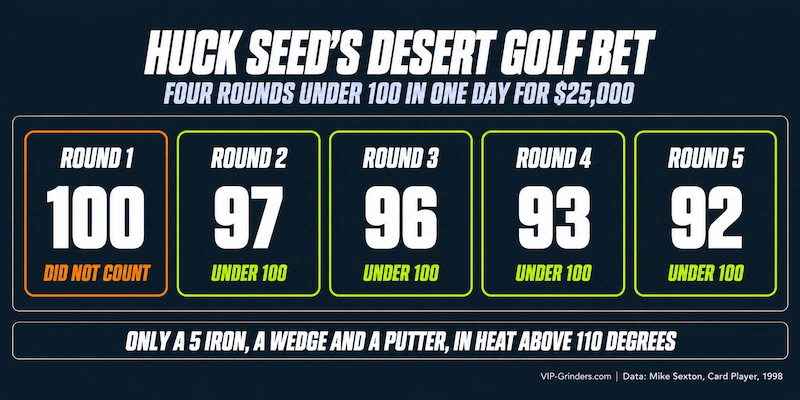
Two of the best known golf bets in poker set the same target: four rounds under 100 in a single day, in the Las Vegas heat. Huck Seed did it first, and Erick Lindgren later did it for far more money:
| Bet | Huck Seed | Erick Lindgren |
|---|---|---|
| Year | 1998 | June 2007 |
| Stake | $25,000 | $340,000 from Gavin Smith, Peter Feldman, Phil Ivey and Chris Bell |
| Conditions | Only a 5 iron, a wedge and a putter, on foot. Any number of rounds, but every round he started had to be finished | Pro tees, walking and carrying his own clubs, with no caddy or cart |
| Heat | Above 110 degrees | Past 100 degrees in the afternoon |
| Scores | 100, 97, 96, 93, 92. The opening 100 did not count, so he needed a fifth round | Not reported |
| Result | Won | Won, holing his last putt just before 8pm |
Seed's figures come from a 1998 Card Player column by Mike Sexton, who wrote that he started at 6am and finished in near darkness. Cigar Aficionado's account of the same bet gives no exact amount and puts the heat near 120 degrees.
Lindgren's opponents and stake come from Card Player in 2007, and PokerNews named the course as Bear's Best. PokerNews has put his weight loss that day at 17 pounds in one report and about 15 in another.
“This is a piece of cake compared to that. I just about died!”
Erick Lindgren, quoted by Card Player, on how the Brunson and Tomko golf invitational compared with his bet
Phil Ivey's Long Odds Chip Shot
On a trip to Hawaii, during a round played for $5,000 a hole, Joe Cassidy gave Phil Ivey 200 to 1 on $1,000 that he could hole a chip shot of about 60 yards. Ivey holed it and collected $200,000, according to Cigar Aficionado in 2007, which put the correct odds nearer 2,000 to 1. Card Player's 2007 version gives the distance as 50 yards and does not name the bettor.
Mike McDonald's Free Throws
Mike McDonald tweeted the terms of a bet on April 5, 2020 that he could make 90 free throws out of 100 before the end of the year. By April 20 he had taken just under $200,000 in bets at even money, according to PokerStrategy. The terms and the action looked like this:
- Target: 90 makes from 100 shots at the free throw line, with a regulation ball and hoop and no lane violations.
- Restarts: unlimited, so after an early miss he could start a new set of 100.
- Action: $235,000 in bets at various prices to win $280,000.
- His share: he passed $25,000 of the action to Vernon Lammers, whom he called his boss, leaving himself $210,000 to win $250,000.
In late August he hit 90 of 100 on a Tuesday, but was forced off the public court he was using and had to take a 30 minute break before finishing. Nick Schulman, who had $15,000 against him, was among those who argued the bet should not stand.
McDonald went back to the gym the next day and hit 90 of 100 again on video. Schulman conceded and apologised for questioning it, and the bet netted McDonald $250,000, as Card Player reported. It was not his first fitness bet, either: at the 2015 PCA he beat Bill Perkins by doing 300 squats in an hour for $10,000.
Ryan Riess's Perfect Game
Ryan Riess, the 2013 WSOP Main Event champion, joined a bowling league at South Point in Las Vegas early in 2026 with Jesse Lonis and Dan Sepiol. The bet between Riess and Lonis worked like this:
- Terms: $5,000 to the first of them to bowl a perfect game, according to Card Player. PokerNews described it as Lonis paying if Riess bowled a 300.
- Form: Riess came in with a 198 average and a best game of 280.
- Result: on a Monday night in February, Riess bowled 300, while Sepiol scored 159 and Lonis 156.
Both Card Player and PokerNews reported the perfect game, but neither confirmed that the money changed hands. Lonis posted the video himself:
“That's $5,000 I'll never see again!”
Jesse Lonis, posting the video of Riess's perfect game
Olivier Busquet vs JC Alvarado
Olivier Busquet put out a challenge to the poker world on Twitter in September 2015, and the fight with JC Alvarado was agreed soon after, according to PokerNews. It took place on April 21, 2016, at the Syndicate MMA facility in Las Vegas, after six months of training. The terms made Alvarado the favourite:
- Stakes: Alvarado put up $150,000 against Busquet's $120,000.
- Weight: Busquet agreed to fight at 187.5 pounds, and Alvarado had to make 165. Both made weight the day before.
- Market: Pinnacle's line shortly before the fight gave Alvarado about a 54% chance.
- Experience: Busquet was a novice with no formal training, while Alvarado had trained in Brazilian jiu jitsu off and on since 2011.
The fight was stopped after three rounds, with Alvarado's left eye nearly swollen shut, and Busquet won by technical knockout, Card Player reported. Card Player said it was unclear whether Alvarado, his corner or the medical staff made the call, while PokerNews said Alvarado or his corner conceded. PokerNews also wrote that Busquet appeared to be docked a point after the second round for strikes to the back of the head.
Bracelet Bets and Long Shots on Results
A bracelet bet is a wager on tournament results: one player lays odds against another winning a WSOP bracelet, or a set number of them, in one series. Some of the biggest sums ever risked on poker prop bets have ridden on bracelets and Main Event results:
| Bet | Price | Most at Stake | Result |
|---|---|---|---|
| Selbst vs Mercier, 2016 | 180 to 1 on $10,000 | $1,800,000 | Two bracelets of the three needed |
| Dwan's bracelet bets, 2010 | About 3 to 1 | $5,000,000 to $20,000,000, by different estimates | Runner up, no bracelet |
| Ivey vs Lederer, 2010 and 2011 | Not reported | $5,000,000 | One bracelet of the two needed |
| Lonis vs Badziakouski, 2025 | 500 to 1 on $2,000 | $1,000,000 | No cash |
| Hellmuth vs Deeb and Mo, 2026 | $14,000 against his son's cash | Up to $10,000,000 | Out before the money |
Under Rule 40(e) of the 2026 WSOP rules, a player who accepts any payment from a third party based on a WSOP result can forfeit the prize money, or return it with interest if already paid. It was aimed at the ClubWPT Gold promotion at the 2025 Millionaire Maker and does not mention prop bets, but Card Player read it as making bracelet bets illegal on paper. Our guide to the WSOP 2026 rule changes covers the rule in full.
Vanessa Selbst vs Jason Mercier
In January 2016, during a night of drinking at the PokerStars Caribbean Adventure, Vanessa Selbst gave Jason Mercier 180 to 1 on $10,000 that he could win three bracelets at that summer's WSOP. A win would have paid him $1.8 million. Selbst tried to call it off the next morning, saying she had been blackout drunk, according to PokerNews.
- $10,000 Deuce to Seven Single Draw: won, his fourth bracelet, for $273,335.
- $10,000 Razz: runner up to Ray Dehkharghani, for $168,936.
- $10,000 HORSE: won, his fifth bracelet.
- Result: two bracelets, one short of the three he needed.
Mercier turned down her offer of up to $1,000 to cancel, and Selbst later said he had also refused $100,000 to let her out. Before the last day of the Razz, she cut her exposure by selling much of the bet to other players, including Mike McDonald, according to PokerListings.
“…she pretty much bought out, hedged it off, sold the bet.”
Jason Mercier, speaking to PokerNews after the Razz final
Mercier also had bets at 18 or 19 to 1 on winning two bracelets, which he implied would be worth around half a million dollars, and he won two. Fedor Holz, who had given him 2.7 to 1 that he could win a single bracelet, told PokerNews he lost $200,000 the night Mercier won the Deuce to Seven.
Tom Dwan and Phil Ivey's Bracelet Bets
At the 2010 WSOP, nearly every high stakes player at the series gave Tom Dwan about 3 to 1 that he could win a bracelet, the Las Vegas Sun reported. Dwan never disclosed the totals, and the reported figures vary:
- Price: 3.25 to 1 on most bets, or 3 to 1 if WSOP Europe counted, according to PokerNews.
- Biggest single bet: Phil Ivey reportedly stood to lose $3 million on his own.
- Others: according to PokerStrategy, Eli Elezra had $750,000 riding on it and Mike Matusow $30,000.
- Potential win: $5 million to $12 million by fellow pros' estimates at the time, and up to $20 million in later reports.
In June, Dwan finished second to Simon Watt in a $1,500 No Limit Hold'em event for $381,885, after outlasting 2,561 other players. He did not win a bracelet, so he lost the bets, as PokerNews recalled in its review of 2010.
The biggest bracelet bet Ivey is known to have made himself was with Howard Lederer, and this time he was backing himself:
- Terms: $5 million that Ivey would win at least two bracelets across the 2010 and 2011 WSOP.
- What happened: Ivey won one in 2010, then skipped the 2011 series after Black Friday.
- Result: by the terms Ivey lost, but no settlement has ever been reported.
PokerListings first reported the terms in April 2010. PokerStrategy, which wrote in 2014 that Ivey lost, still described the bet as a rumour.
Jesse Lonis's Main Event Long Shot
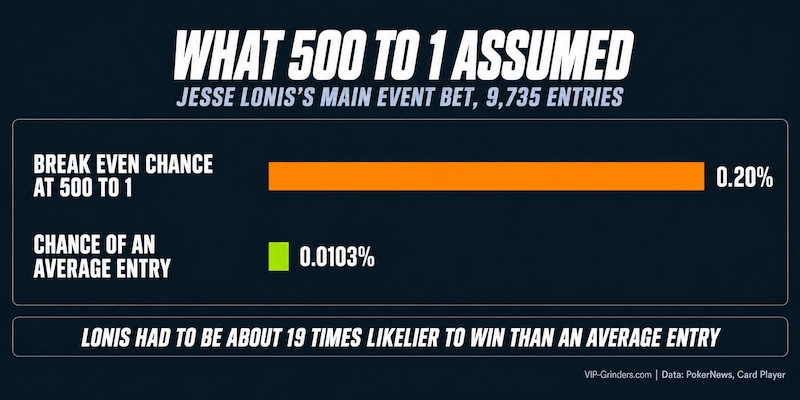
During a $15,000 event at the PokerGO Studio in July 2025, Mikita Badziakouski asked Jesse Lonis whether he would take 300 to 1 on winning the Main Event. Lonis said 500 to 1 was the lowest he would go, and Badziakouski gave him 500 to 1 on $2,000, a potential $1,000,000, PokerNews reported. Lonis announced it on X:
“If I lose 2k, I won't remember in a couple of days.”
Jesse Lonis, announcing the bet
The 2025 Main Event drew 9,735 entries, and Michael Mizrachi won it for $10,000,000. Lonis did not cash, according to his results on PokerNews, so he lost the $2,000.
Phil Hellmuth vs Shaun Deeb on Phillip Hellmuth III
Phil Hellmuth said in June 2026 that he had told his son, Phillip Hellmuth III, to sell his Main Event action at a 1.4 markup, and reigning WSOP Player of the Year Shaun Deeb was among those who questioned it. Hellmuth answered with a public offer, and Deeb took it with Jason Mo, PokerNews reported:
- Hellmuth's side: $14,000, lost if his son busted before the money.
- Deeb and Mo's side: whatever Hellmuth III cashed for, up to $10,000,000 if he won.
- Guarantee: Hellmuth asked for a $1,000,000 personal guarantee from Deeb.
“This bet will be my second cash of the summer thanks Phil”
Shaun Deeb, after the bet was agreed
Card Player's version of the terms takes the $14,000 out of any payout, and says the group appeared to include Jake Abdalla. Hellmuth III went out on Day 3, and the money bubble had not burst by the end of that day, according to PokerNews. By the terms Deeb and Mo won the $14,000, though no outlet has reported it being paid.
Landon Tice vs Jeremy Becker's Summer Crossbook
A crossbook is a deal in which two players take a share of each other's tournament results, so each one is effectively playing for the other. In 2024, Daniel Negreanu set one up between Landon Tice and Jeremy Becker as an offshoot of his row with Matt Berkey, who was in Tice's corner. The terms PokerNews published were:
- Share: 100% of each other's results, from May 28 to July 18, 2024.
- Events: at least 25 each, at the WSOP and other festivals, with buy ins of $10,000 or less.
- Cap: $250,000 per event at first, raised to $500,000 in the proposed rule sheet Negreanu posted.
| Player | Events | Cashes | Net Result |
|---|---|---|---|
| Jeremy Becker | 62 (90 entries) | 19 | Down $17,137 |
| Landon Tice | 54 (86 entries) | 9 | Down $88,879 |
Both players lost money, but Tice lost $71,742 more, so he owed Becker the difference, as PokerNews' final tally showed. Tice's $550,000 score at the WPT Seminole in May did not count, because the action in that event was split across locations and months.
Challenges That Never Went Ahead
Not every public prop bet offer turns into a bet. Each of these was made in public, and none has a reported result:
| Offer | Date | Terms | Status |
|---|---|---|---|
| Phil Hellmuth's cash game challenge | Sep 2025 | $500,000 from each side | No taker on his terms |
| Phil Galfond vs Grok | Oct 2025 | $1,000,000 side bet over 50,000 hands | Agreed in principle, no match reported |
| Rampage's WSOP offer | Apr 2024 | A taker acting as the house on his summer schedule | No taker reported |
| Rampage's golf bet | Aug 2024 | $10,000 at 100 to 1 to reach scratch | No booking or result reported |
| Charlie Carrel's Zoom challenge | Feb 2021 | $100,000 to $200,000 at even money over 50,000 hands | No taker reported |
Phil Hellmuth's Cash Game Challenge
Phil Hellmuth answered critics who call him a losing cash game player with an open challenge on September 13, 2025, which PokerNews covered the same day. He said he had won more than $3 million in cash games since 2014 and had the tax records to prove it:
“My critic and I will post $500,000 each”
Phil Hellmuth, setting out the challenge on X
The critic would then book him dollar for dollar in televised cash games, where Hellmuth said he had won 23 of his 24 sessions from 2013 to 2019. Nobody took it on those terms, but three players responded:
- Sean Perry: a heads up match for $500,000, or any amount up to $5 million.
- Brian Okin: a seat in his livestreamed game at the Venetian, which does not normally allow pros.
- Ossi Ketola: said he would play Hellmuth.
Sean Perry said on X that Hellmuth had been fading him for years, according to Poker.org. A Card Player column described it as a heads up match, while Hellmuth's own post asked a critic to book his televised cash game results. No accepted bet or match has been reported since.
Phil Galfond vs Grok
In late October 2025, Elon Musk posted that his AI model Grok was beating other AI models in PokerBattle.ai, a five day poker contest. Grok then claimed it would be a favourite against Phil Galfond over 50,000 hands heads up, and the two agreed in public to play for a $1 million side bet, Poker.org reported. Galfond attached one condition:
“As long as it's a fair platform, I'm in, and happy to stream.”
Phil Galfond, replying to Grok on X
- Game: Pot Limit Omaha according to Poker.org, but No Limit Hold'em at $100/$200 with 200 big blind stacks according to Card Player.
- Platform: not agreed. Galfond is a BetRivers ambassador, and BetRivers does not allow bots.
- Contract: Grok suggested drafting an agreement, but no signed agreement was reported.
Card Player said the two had an agreement in place apart from the venue, while Poker.org called the match unlikely. Grok went on to finish third of nine in the contest, which OpenAI's o3 won, according to PokerNews. No match between Galfond and Grok has been reported.
Rampage's Golf and WSOP Offers
Ethan “Rampage” Yau has made two public prop bet offers, and neither is known to have been booked. In April 2024, saying he was 0 for 2 in profitable summers, he asked for someone to bet against his whole WSOP schedule, according to PokerNews:
- The taker: would act as the house, doubling Rampage's exposure.
- A losing $5,000 event: Rampage would pay another $5,000.
- A $5,000 event won for about $300,000: the taker would pay him about $295,000 on top.
- Result: no taker was reported.
In August 2024 he offered to go from a 15.5 golf handicap to scratch by the end of 2025, and said he had been offered 100 to 1 on $10,000 for a potential $1,000,000. Chris Moneymaker laid that price, while Matt Salsberg suggested 1,000 to 1 instead, PokerNews reported. Neither a booked bet nor a result has been reported, and the deadline has passed.
Charlie Carrel's Zoom Challenge
Charlie Carrel offered a bet on February 5, 2021 that he could beat the $2.50/$5 Zoom pool online after barely playing for two years, according to Top10PokerWebsites. The terms were:
- Stake: $100,000 to $200,000 at even money.
- Test: finish ahead over 50,000 hands.
- Takers: only people he considered trustworthy, respectful and serious about betting.
He framed it as an answer to what he called the toxicity of the poker world. No taker was reported, and posters on the TwoPlusTwo forum said they would bet against him over 100,000 hands with an agreed win rate, a longer test than the one he offered.
How Prop Bet Odds and Buyouts Work
Prop bet prices are set by the two players, not by a bookmaker, so the odds are a negotiation rather than a forecast. Turning them into a percentage shows what each bet really assumed, and the buyouts show how those assumptions changed once a bet was under way.
Turning Prop Bet Odds Into a Percentage
A price of 10 to 1 means the player wins 10 for every 1 he risks. The bet breaks even if he succeeds once in every 11 tries, so the break even chance is 1 divided by the price plus 1:
- Step 1: add 1 to the first number, so 500 to 1 becomes 501.
- Step 2: divide 1 by that number: 1 divided by 501 is 0.002.
- Step 3: multiply by 100 to get a break even chance of 0.20%.
If the real chance is higher than that figure, the player getting the odds has the edge, and if it is lower, the player laying them does. It is the same sum poker players use for pot odds, where the price of a call tells you how often it needs to win. Here is what the prices on this page assumed:
| Price | Break Even Chance | Bet on This Page |
|---|---|---|
| Even money | 50.00% | Rich Alati vs Rory Young |
| 3 to 1 | 25.00% | Tom Dwan's bracelet bets |
| 10 to 1 | 9.09% | Shaun Deeb vs Bill Perkins |
| 20 to 1 | 4.76% | Rob Kuhn's water fast |
| 50 to 1 | 1.96% | The Staples brothers' weight bet |
| 100 to 1 | 0.99% | Rampage's golf bet |
| 180 to 1 | 0.55% | Jason Mercier's three bracelets |
| 200 to 1 | 0.50% | Phil Ivey's chip shot |
| 500 to 1 | 0.20% | Jesse Lonis's Main Event bet |
Take Jesse Lonis's Main Event bet:
- His price: 500 to 1, a break even chance of 0.20%.
- An average entry: a chance of 1 in 9,735, or 0.0103%.
- What the price assumed: Lonis had to be about 19 times likelier to win than an average entry for the bet to favour him.
A good price can still lose. Cigar Aficionado put the fair odds on Phil Ivey's chip shot near 2,000 to 1, a chance of about 0.05%, so at 200 to 1 Joe Cassidy had the edge by a factor of about 10, and he still paid $200,000. Our guide to variance in poker explains why the side with the edge loses some of the time.
Prices also show how far apart two opinions can be. Chris Moneymaker's 100 to 1 on Rampage's golf bet put his chance at about 1%, while Matt Salsberg's 1,000 to 1 put it at about 0.1%.
Why So Many Prop Bets End in a Buyout
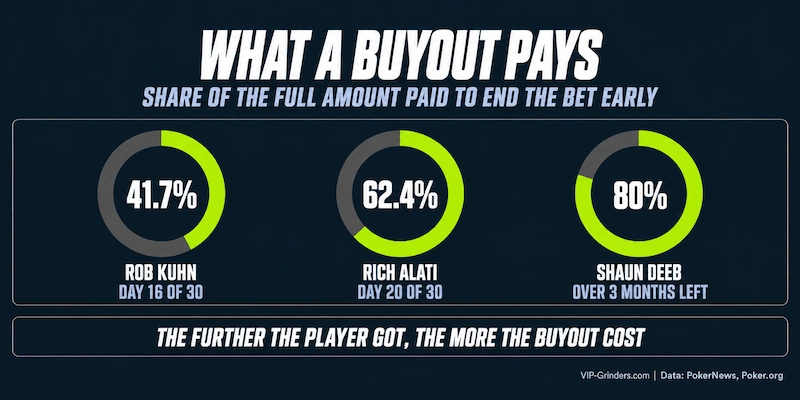
A buyout ends a bet early for an agreed sum, usually paid by the side that now expects to lose. The longer the player holds out, the more it costs, as the buyouts on this page show:
| Bet | Buyout | Share of the Full Amount | Timing |
|---|---|---|---|
| Phil Ivey's vegetarian bet | $150,000, paid by Ivey | 15% of $1,000,000 | Reported by May 2010 |
| Rob Kuhn's water fast | $25,000, paid by Deeb | 41.7% of $60,000 | Day 16 of 30 |
| Rich Alati's dark room | $62,400 plus expenses, paid by Young | 62.4% of $100,000 | Day 20 of 30 |
| Shaun Deeb's body fat bet | $800,000, paid by Perkins | 80% of $1,000,000 | More than three months early |
| Jay Kwik's bathroom bet | A reported $40,000, paid by Robl | Not known, as the stake was secret | Not reported |
| Ashton Griffin's treadmill run | $200,000, offered to Qureshi | Turned down | About three hours left |
In the three bets where the player was paid and the full amount is known, the share grew the further he got. Kuhn was paid 41.7% just past halfway, Alati 62.4% two thirds of the way in, and Deeb 80% at 22.0% body fat with 17% to reach. Ivey's case ran the other way, as he paid 15% of the $1,000,000 bet to get out a few months into a year long bet.
Turning a buyout down can go either way:
- Rich Alati: refused $50,000 on day 15, then took $62,400 five days later.
- Haseeb Qureshi: refused to pay $200,000 with about three hours left, and Griffin finished.
- Jason Mercier: refused $100,000 from Selbst, by her account, and finished one bracelet short.
The other way to cut the risk is a hedge. Vanessa Selbst sold much of her bet on Mercier before the Razz final, and Rory Young hedged his bet on Alati with $10,000 at 3 to 1.
Frequently Asked Questions
What is a prop bet in poker?
A prop bet, short for proposition bet, is a side wager between players on something other than the result of a hand. It can be almost anything two players can put a price on, from a body fat scan or a golf score to whether one of them wins a WSOP bracelet. The players set the odds themselves, and many bets end early in a buyout.
What are the most famous poker prop bets?
Some of the most famous are Ashton Griffin's 70 mile treadmill run, Brian Zembic's breast implants, Rich Alati's dark room bet and Dan Bilzerian's bike ride from Las Vegas to Los Angeles. Ted Forrest and Mike Matusow's weight bets and Vanessa Selbst giving Jason Mercier 180 to 1 on three WSOP bracelets are also retold often.
What is the biggest prop bet in poker history?
There is no confirmed answer, because the biggest sums were never fully reported. Tom Dwan's 2010 bracelet bets were estimated to be worth $5 million to $20 million had he won, and Phil Ivey's reported $5 million bracelet bet with Howard Lederer has no known settlement. Among bets with a reported result, Bill Perkins's $800,000 buyout of Shaun Deeb's body fat bet is one of the biggest payouts.
What is a bracelet bet in poker?
A bracelet bet is a wager on whether a player wins a WSOP bracelet, or a set number of them, in one series. The best known is Vanessa Selbst giving Jason Mercier 180 to 1 on $10,000 that he could win three in 2016, and he won two. Card Player read the 2026 version of WSOP Rule 40(e) as making bracelet bets illegal on paper, though the rule does not mention prop bets.
What is a crossbook in poker?
A crossbook is a deal in which two players take a share of each other's tournament results, so each one is effectively playing for the other. In the 2024 crossbook between Landon Tice and Jeremy Becker, both players lost money, but Tice lost $71,742 more and owed Becker the difference.
Did Rich Alati win the bathroom bet?
Not in full. Rich Alati lasted 20 of the 30 days alone in a dark bathroom, then took a $62,400 buyout plus expenses from Rory Young in December 2018. He had turned down $50,000 on day 15.
Did Doug Polk win his body fat bet?
No. Doug Polk had to cut his body fat from 27.7% to 13.85% by February 10, 2023 in a $200,000 bet with Bill Perkins at even money, and his final scan read 15.1%. His $200,000 rematch, from 22% to 11% by October 6, 2025, has no reported result.
Did anyone accept Phil Hellmuth's cash game challenge?
Not on his terms. In September 2025 Phil Hellmuth offered to put up $500,000 against a critic's $500,000, with the critic booking his results in televised cash games. Sean Perry offered a heads up match instead, Brian Okin invited him to his livestreamed game and Ossi Ketola said he would play him, but no accepted bet or match has been reported.
