

Provably Fair Gambling: How It Works and How to Check a Bet
Provably fair is a system that lets you check, after every bet, that the casino did not change the result. Before you play, the casino locks in a secret server seed and shows you its hash, so any change made later would no longer match it.
To test how well it holds up, we recalculated all 6,700 Duel dice bets from ProvablyFair.org’s 2026 audit using only their seeds and nonces. Every single result matched what the casino had shown the player.
Provably fair proves a result was not tampered with, but not that a game is cheap to play or that a casino will pay you. This guide covers:
- How provably fair works, from server seeds and hashes to nonces
- How to verify a bet step by step, with our own test at Duel
- Which games can be provably fair, from dice and crash to slots and blackjack
- What provably fair does not prove, and why predictor apps cannot work
- How to choose a provably fair casino before you deposit
Already have your seeds? Go straight to our provably fair checker.
What Is Provably Fair?
Provably fair, also called provable fairness, means you can prove each result with math yourself instead of taking it on trust. The casino commits to the inputs of your bet before you place it, then shows you those inputs afterwards so you can rerun the calculation yourself.
Think of it as a sealed envelope. Before you bet, the casino seals its secret and hands you the envelope. After the bet it opens it in front of you, and an intact seal shows nothing inside was swapped.
Despite the link with crypto, provably fair does not need a blockchain. Most casinos calculate and reveal everything themselves, and the math makes it checkable.
Provably Fair vs RNG Certification
Traditional casinos prove fairness a different way, through independent testing labs. The two methods check different things:
| Provably Fair | RNG Certification | |
|---|---|---|
| Who checks | You, after each bet | A testing lab such as GLI, eCOGRA, iTech Labs or BMM |
| When | Every round, once the server seed is revealed | Before release and at set reviews |
| What it proves | Your result came from inputs locked in before you bet | The random number generator and game math work as stated |
| Where you see it | Crypto casino originals and some slots | Most slots and RNG table games |
The two are not rivals. Stake, for one, says its originals run on a certified random number generator with provably fair verification on top.
Where Provably Fair Came From
Provably fair gaming started with Bitcoin gambling in 2012:
- April 2012: SatoshiDice is announced, committing to each day's secret with a hash and publishing the secret afterwards so players can check every roll.
- June 2012: bitZino launches with provably fair blackjack and adds video poker in July. A Provably Fair button lets players check each shuffle, which mixes in a client seed so neither side can know the deck in advance.
- August 2012: Forbes covers bitZino as the dawn of provably fair casino gaming.
Today the same method powers the originals at crypto casinos such as Stake, Shuffle and Duel, and BGaming describes itself as the first major provider to bring it to slots.
How Provably Fair Works: Seeds, Hashes and Nonces
A typical provably fair bet is built from four inputs. Two come from the casino, one comes from you, and one simply counts your bets:
| Input | Set By | What It Does |
|---|---|---|
| Server seed | The casino | A long random secret behind your results, kept hidden until you rotate your seeds |
| Hashed server seed | The casino | A SHA256 fingerprint of the server seed, shown to you before you bet |
| Client seed | You or your browser | Your own input, mixed in so the casino cannot pick results on its own |
| Nonce | Counts by itself | Goes up by one with every bet, so the same seeds give a new result each time |
Games that need several random numbers per bet, such as plinko or mines, draw more numbers from the same seeds and nonce, using a counter Stake calls the cursor. Each bet then follows the same five steps:
- 1The casino commits. It creates a server seed and shows you only its hash.
- 2You add your client seed. Set your own, or keep the one your browser created.
- 3You bet. The casino mixes the server seed, client seed and nonce with a fixed formula, usually HMAC SHA256, and turns the output into your result.
- 4You rotate the seed. Changing your seed pair reveals the old server seed and commits to a new one.
- 5You verify. Hash the revealed seed to check it matches, then rerun the formula for any bet placed with it.
The order is what makes it work.
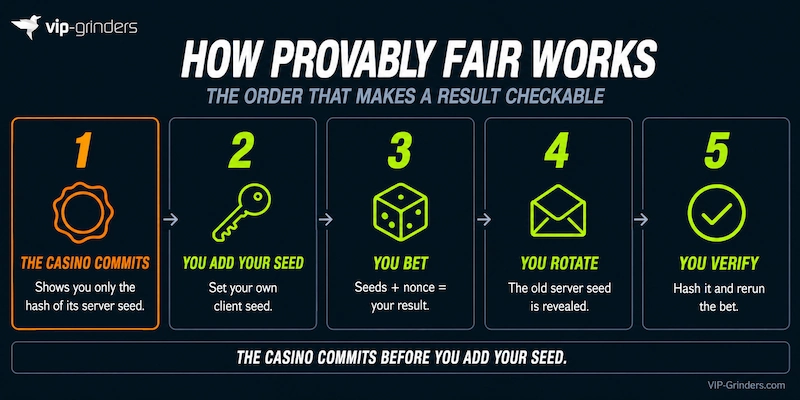
The casino is locked in before you add your input, and you only see its secret once it can no longer affect any future bet.
Why the Casino Cannot Change a Result
A hash works like a fingerprint. SHA256 turns any input into a 64 character code, and changing a single character of the seed gives a completely different code:
| Server Seed | Its SHA256 Hash |
|---|---|
| 8fb70798…d08c2c95 | 5572a231…f6a54215 |
| 8fb70798…d08c2c90 (last character changed) | 80f730b7…e2599b1f |
Because you saw the hash before you bet, the casino is stuck with that seed. Swapping it after a losing bet would produce a hash that no longer matches, and no computer can find another seed with the same hash or work backwards from the hash to the seed.
Why You Should Set Your Own Client Seed
The client seed protects you from a casino choosing its seed after seeing yours. If the server seed came last, a casino could test thousands of seeds and keep one that loses for you, so the hash must always be on screen before your client seed is final.
Casinos usually fill in a random client seed for you. That seed comes from the casino’s own code, so a dishonest casino could pick one that loses against its server seed. Typing your own takes a few seconds and removes that risk:
- Check the hash comes first. The hashed server seed should already be on screen before you change your client seed.
- Type anything you like. A word, a date or a random string all work as a client seed.
- Keep a copy of the hash. A screenshot lets you compare it with the revealed seed later.
How to Verify a Provably Fair Bet
Every casino lays out its fairness panel a little differently, but at most casinos checking a bet takes the same five steps:
- 1Open the fairness panel. In most originals it sits in the game toolbar, labeled Fairness or Provably Fair.
- 2Save the hashed server seed. Copy it or take a screenshot before you place the bet.
- 3Note your bet. Write down the client seed, the nonce and the result from your bet history.
- 4Rotate the seed pair. This reveals the server seed you just played with.
- 5Run the check. Paste the values into the casino's own verifier or our checker below.
Our Test: Duel Dice Bets Recalculated
Duel is a VIP-Grinders partner. We picked it because it publishes its formula and the data behind its audit is public, so anyone can repeat our check.
We started in our own account in October 2026. Each time we opened Duel’s Provably Fair window it offered a different new client seed, but the hash of the next server seed never changed:
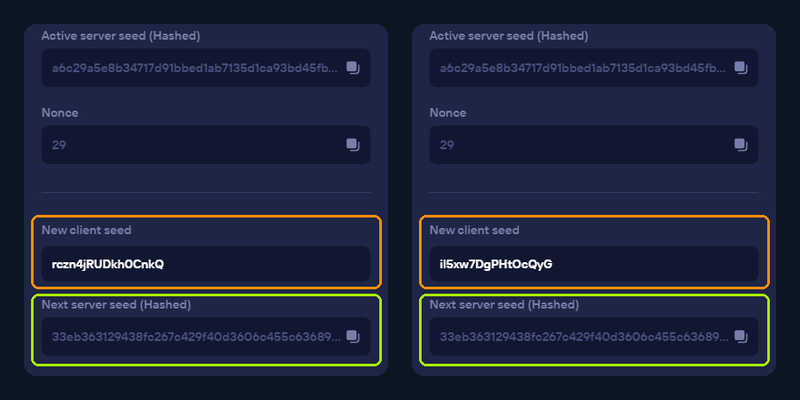
That is the protection the client seed relies on: Duel’s seed was locked in before ours was chosen. These are the checks we ran in our own account:
| Check | What We Saw |
|---|---|
| Next server seed hash shown before our client seed | Yes, starting 33eb3631 |
| Hash changed when the client seed changed | No, it stayed the same |
| Active seed after we rotated | The same 33eb3631 hash, locked in before we bet |
| Nonce after rotating | 0 |
| Win chance at 2x | 49.95%, a 99.9% RTP |
To test the math itself, we recalculated the dice data from ProvablyFair.org’s audit of Duel, certified in June 2026. It holds 6,700 dice bets captured in April 2026, and every server seed behind them was revealed afterwards:
| Check | Result |
|---|---|
| Bets recalculated from their seeds | 6,700 |
| Rolls matching what Duel showed | 6,700 |
| Server seeds matching the hash shown before the bet | All 6,700 |
| First nonce | 0 |
ProvablyFair.org is paid by the casinos it audits, which is a conflict worth knowing about. It also publishes its data and code, and that openness is what let us rerun every bet with our own code.
What provably fair cannot show is the price. Duel’s dice pays 0.999 divided by your win chance, which is why 2x came with a 49.95% chance in our account. The 100% RTP it advertises comes from a 0.1% instant rakeback while its daily Zero Edge allowance lasts.
Provably Fair Checker
Paste the values from your casino’s fairness panel to check the hash and recalculate your roll. The checker covers Duel dice and the Stake dice formula, which Shuffle also uses, and it starts with an example you can change:
Everything runs in your browser, so your seeds are never sent anywhere. Use the nonce of the exact bet you want to check, since it changes with every bet.
For other games and casinos, use the verifier inside the game, since each one turns the same seeds into a result in its own way.
Why Casino Algorithms Give Different Rolls From the Same Seeds
Duel, Stake and Shuffle all use HMAC SHA256, but they turn its output into a dice roll in different ways:
| Duel | Stake and Shuffle | |
|---|---|---|
| Server seed read as | Hex bytes | Text |
| Message | Client seed:nonce | Client seed:nonce:cursor |
| From hash to roll | First group of 4 bytes under a cutoff, divided by 10,001, keeping the remainder | First 4 bytes turned into a fraction, times 10,001, rounded down |
| Roll range | 0.00 to 100.00 | 0.00 to 100.00 |
Duel’s cutoff skips the rare values that would make some rolls about 0.0002% more likely than others. Stake’s method leaves that tiny gap in place, which has no practical effect, so both are fair and both can be checked. The same seeds still give different rolls under each one.
That is why a generic verifier can flag an honest bet as a mismatch. Always check a bet with the formula of the casino where you placed it.
Which Casino Games Can Be Provably Fair?
Any game whose result can be drawn from numbers can be provably fair. What changes from game to game is how the casino turns the seeds into a result:
| Game | How the Seeds Become a Result |
|---|---|
| Dice and limbo | One number from the hash sets the roll or the multiplier |
| Crash | A chain of hashes or a mix of seeds sets where the multiplier stops |
| Plinko | One number per row decides if the ball falls left or right |
| Mines and keno | Numbers from the hash place the mines or draw the keno numbers |
| Blackjack, baccarat and poker | Numbers from the hash pick each card in turn |
| Roulette | One number from the hash picks the pocket |
| Slots | The seeds set where each reel stops |
Most slots and live dealer games are not provably fair, even at casinos whose originals are. Their results come from the provider’s certified random number generator or a real dealer, which you cannot check bet by bet.
Provably Fair Crash Games
Crash games use one of two methods to fix every round in advance:
- A chain of hashes. In 2018 Bustabit built a chain of 10 million hashes, where hashing one game's hash gives the hash of the game before it, and salted every result with a Bitcoin block hash nobody could know yet.
- A mix of seeds. Spribe's Aviator combines a server seed, hashed and shown before the round, with the client seeds of the first three players to bet.
When we opened Crash at Cashy, the Fairness tab sat in the game toolbar next to Rules and Live Stats, so any round can be checked without leaving the game.
So are crash games rigged? A provably fair round cannot be changed once bets are in, but the house edge still applies, from 0.1% on Duel’s crash to 3% on Aviator, which Spribe sets at a 97% RTP. You can compare the casinos that run them in our list of crash gambling sites.
Provably Fair Slots
BGaming is the best known provider of provably fair slots, and they work in three steps:
- 1Before the spin, BGaming calculates the result and shows you a SHA256 hash of that result plus a secret.
- 2Your client seed then shifts where each reel stops.
- 3After the spin, it reveals the result and the secret, so you can check the hash and see that your seed was applied.
BGaming names titles such as Aztec Magic Megaways and Spin and Spell among its provably fair slots.
Provably Fair Blackjack, Roulette and Poker
Card games draw a new number for every card, while roulette needs only one per spin:
- Blackjack and baccarat. Numbers from the hash draw each card in turn. Duel's blackjack, for example, takes 4 bytes at a time and turns each into one of 52 cards.
- Roulette. One number picks one of the 37 pockets on a European wheel.
- Poker. Rare, since many players share one deck. CoinPoker, a VIP-Grinders partner, says every player's device adds randomness to its shuffle, and since 2018 it has offered a tool to check that your input was used.
What Provably Fair Does Not Prove
Provably fair answers one question: was your result changed after you bet? Everything else needs a separate check:
| Question | Does Provably Fair Answer It? |
|---|---|
| Was my result changed after I bet? | Yes |
| What does the game cost me per bet? | No, check the RTP or house edge |
| Will the casino pay my winnings? | No, check its license and payout record |
| Are its other slots and live tables fair? | No, they rely on certified RNG or real dealers |
| Is the casino licensed? | No, check the regulator that issued it |
The price matters most. A provably fair game can carry any house edge the casino chooses, and our guide to RTP in online casinos shows how to find the real figure.
Our own checks show how much the claims around provably fair can vary:
- Duel. Its dice rolls are verifiable, but the game itself runs at 99.9% RTP, and the 100% it advertises depends on rakeback.
- Thrill. We looked for seed and hash documentation for its originals and did not find it in the help articles we read.
- Cashy. The originals we opened all had a Fairness tab but no house edge figure on the game page, so you can confirm a round was not changed without knowing what it costs.
When Provably Fair Fails
The system only works if the casino does its part. These warning signs mean a provably fair label proves nothing:
- Old server seeds are never revealed. Without them, no bet can be checked. In 2020, players on the Wizard of Vegas forum called out Wixiplay for showing hashes but never the seeds behind past rounds.
- The hash appears after your client seed. The casino could then pick a server seed that loses for you.
- You cannot change your client seed. A seed fixed by the casino takes away your only input.
- The formula is not published. Without it, nobody outside the casino can rerun a bet.
If a casino shows any of these signs, treat its provably fair label as marketing rather than proof.
Can You Predict or Hack a Provably Fair Game?
No. Before you bet, the only thing you can see is the hash of the server seed, and turning that hash back into the seed would take more computing power than exists.
By the time the seed is revealed, it no longer controls any of your future bets. In Aviator, each round also depends on client seeds from other players, which nobody knows in advance.
Why Predictor Apps Do Not Work
Predictor apps and Telegram bots for crash, mines and Aviator claim to know the next result. They cannot, so look at what they ask from you instead:
- Money or a deposit first. Access is sold, or unlocked only after you sign up at a casino through their link.
- Your casino login. Any tool that needs your account details can empty it.
- An app from outside the official stores. Installing files from unknown sources is a common way to spread malware.
- Past wins as proof. Anyone can calculate past results once a seed is revealed, so they say nothing about the next round.
How to Win at Provably Fair Games
You cannot beat a provably fair game over time, because the edge is built into the payout, not hidden in the randomness. A dice game at 99% RTP costs you about $1 for every $100 you wager on average, however fair each roll is.
Our casino house edge chart shows what each game costs per bet and per hour. What you can control is how much you pay:
- Pick the lowest edge. Originals at 99% to 99.9% RTP cost far less per bet than most slots at around 96%.
- Bet slower. Autobet can run more than a thousand bets an hour, and every bet adds to the cost.
- Set a limit before you play. Decide what you can afford to lose, and stop when you reach it.
If you find yourself chasing a result a predictor promised, our responsible gambling page lists help lines by country and explains each limit tool.
How to Choose a Provably Fair Casino
A provably fair casino lets you check the result of its original games yourself. All provably fair casinos make that promise, so the label alone will not help you pick one. These seven checks cover fairness, cost and payouts, in the order you would do them:
- 1Check the license. Provably fair says nothing about whether you get paid. Find the license in the site footer, from a regulator such as Curaçao or Anjouan, and confirm the number on the regulator's own website.
- 2Read the fairness page. It should explain, game by game, how the seeds become a result, as Stake and Duel do.
- 3Find the house edge. Look for the RTP or house edge in each game's rules, such as the 1% Stake lists for its dice. If there is no figure, ask support before you play.
- 4Read the bonus terms for originals. Originals are often grouped with table or instant games, which counted 5% at BitStarz and 20% at Cashy toward wagering in the terms we checked.
- 5Test one small bet. Place it, rotate your seeds and run it through the casino's verifier or our checker above. If the roll does not match or the old server seed never appears, play somewhere else.
- 6Check your bet history. Each bet should show the client seed, nonce and server seed hash it used, so you can verify it after you rotate.
- 7Make a small withdrawal first. Cash out a small amount before you deposit more, since payouts are the one thing no fairness check can show.
At a 5% contribution, a $1,000 wagering target takes $20,000 in dice bets. Our guide to wagering requirements and game contribution shows how to work out what a bonus is worth before you claim it.
For a shortlist, every casino in our list of crypto casinos we have tested went through real deposits and withdrawals before we added it.
Frequently Asked Questions
Is it probably fair or provably fair?
Provably fair. Probably fair is a common misspelling of the term, which means you can prove each result yourself from the server seed, client seed and nonce instead of trusting the casino.
Is provably fair the same as RNG?
No. An RNG certificate means a testing lab checked the game before release, while provably fair lets you check each result yourself after you bet. Some casinos use both, and Stake says its originals run on a certified RNG with provably fair verification on top.
How do I verify a provably fair bet?
Save the hashed server seed before you bet, then rotate your seed pair to reveal the server seed. Hash it to confirm it matches, and enter the server seed, client seed and nonce into the casino’s verifier or our checker to recalculate the result.
Which games are provably fair?
Mainly crypto casino originals such as dice, limbo, crash, plinko, mines and keno, plus some blackjack, roulette and BGaming slots. Most other slots and live dealer games rely on a certified RNG or a real dealer, so you cannot check them bet by bet.
Are BGaming slots provably fair?
Some of them are. BGaming says it was the first major provider to offer provably fair games, and it names slots such as Aztec Magic Megaways and Spin and Spell. The result is calculated and hashed with a secret before your spin, and your client seed then shifts where each reel stops.
Are crash games rigged or provably fair?
A provably fair crash round cannot be changed once it starts, because a chain of hashes or a mix of seeds fixes the crash point in advance and you can check it afterwards. The house edge still applies, from 0.1% on Duel’s crash to 3% on Spribe’s Aviator at 97% RTP. Crash games without a working verifier offer no such proof.
Does a provably fair predictor work?
No. Before a round you only see the hash of the server seed, and no existing computer can turn that hash back into the seed. Predictor apps and bots that claim otherwise usually want a deposit through their link or your casino login.
Is provably fair gambling safe?
Provably fair makes each result checkable, but it does not make a casino safe. Whether you get paid depends on the license and the operator, so check the regulator, read the bonus terms and make a small withdrawal before you deposit more.