

Casino House Edge: What Each Game Costs You Per Hour
The casino house edge is the share of every bet the house expects to keep over time. On European roulette it is 2.70%, so $100 in bets costs you $2.70 on average, while the same $100 on a baccarat tie bet costs you $14.36.

The chart and table below show the house edge on the most popular bets at online and crypto casinos, lowest first. They cover live table games, game shows, crash games, crypto originals and slots, so you can compare them all on one scale.
Here is what this guide covers:
- The house edge on 19 popular bets at online and crypto casinos, from live blackjack to Aviator and crypto dice
- What the house edge costs you per hour, with a calculator and speed estimates for online, live and crypto games
- What percentage of gamblers win, from our own calculation and published player studies
- Whether you can beat the house edge, and the few situations where the math turns in your favor
Casino House Edge Chart by Game
The house edge varies far more between bets than most players expect. The casino keeps just 0.72% of every dollar you bet on live blackjack, but 14.36% on the baccarat Tie bet, almost 20 times as much.
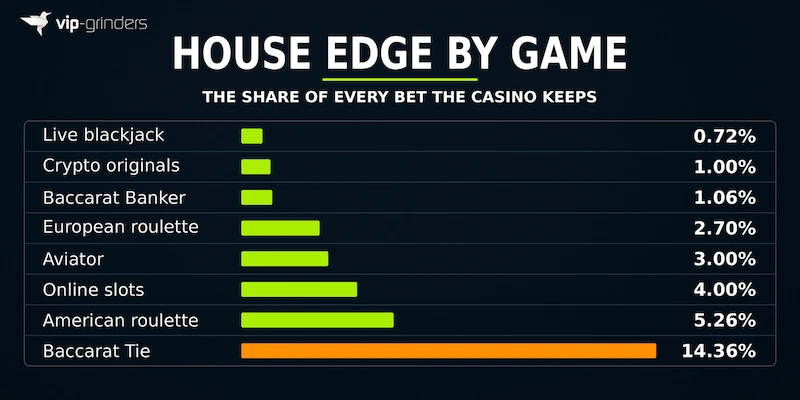
Crypto originals and the baccarat Banker bet sit close to 1%, while slots, Aviator and roulette fall between 2.70% and 5.26%. The full table below covers all 19 bets, sorted from the lowest edge to the highest. RTP, or return to player, is simply 100% minus the house edge.
| Game | Bet | House Edge | RTP |
|---|---|---|---|
| Video poker | Jacks or Better 9/6, optimal strategy | 0.46% | 99.54% |
| Infinite Blackjack (live) | Main bet, basic strategy | 0.53% | 99.47% |
| Blackjack (live) | Standard table, basic strategy | 0.72% | 99.28% |
| Crypto originals | Dice, Limbo, Plinko, Keno | 1.00% | 99.00% |
| Baccarat | Banker | 1.06% | 98.94% |
| Baccarat | Player | 1.24% | 98.76% |
| French roulette | Even money bets, La Partage rule | 1.35% | 98.65% |
| Craps | Pass Line | 1.41% | 98.59% |
| Casino Hold’em (live) | Ante, optimal strategy | 2.16% | 97.84% |
| European roulette | Any standard bet | 2.70% | 97.30% |
| Lightning Roulette | Outside bets | 2.70% | 97.30% |
| Sic Bo | Big, Small | 2.78% | 97.22% |
| Aviator | Any bet | 3.00% | 97.00% |
| Three Card Poker | Ante and Play | 3.37% | 96.63% |
| Online slots | Top RTP version of popular titles | 3.50% to 4.00% | 96.00% to 96.50% |
| Crazy Time | Depends on the spot | 3.92% to 5.59% | 94.41% to 96.08% |
| Caribbean Stud (live) | Ante | 5.22% | 94.78% |
| American roulette | Any standard bet | 5.26% | 94.74% |
| Baccarat | Tie, pays 8 to 1 | 14.36% | 85.64% |
Blackjack, video poker and the poker games assume the best strategy, so every mistake adds to your cost. Live games, Aviator and slots use the RTP the game provider publishes, while crypto originals use 99%, a common setting that each casino chooses for itself. All figures were last checked in September 2026.
The online slots row shows the top RTP version of popular titles. Many slots also exist in lower RTP versions and the casino chooses which one you get, so check the RTP in the game’s information screen.
Casino Games With the Lowest House Edge
These are the casino games with the best odds, since they cost you the least per dollar wagered. Where a condition applies, it is listed next to the bet.
- Jacks or Better video poker: 0.46%. Only on the full pay 9/6 version with optimal strategy.
- Live blackjack: 0.53% to 0.72%. Only with basic strategy, depending on the table version.
- Crypto dice, limbo, plinko and keno: 1.00%. A common setting at crypto casinos, and no strategy is needed.
- Baccarat Banker: 1.06%. No strategy needed, which makes it the simplest low edge bet at a live table.
- French roulette even money bets: 1.35%. Only on tables with the La Partage rule, which returns half your stake when zero hits.
Casino Bets With the Highest House Edge
These bets cost you the most per dollar. Each one has a cheaper option on the same table or in the same lobby.
- Baccarat Tie: 14.36%. Over 13 times the edge of the Banker bet on the same table.
- Crazy Time: up to 5.59%. Depending on the spot you back, it can cost about twice as much as European roulette.
- American roulette: 5.26%. Nearly double the European wheel in the same lobby, so $1,000 in bets costs you $52.60 on average instead of $27.
- Caribbean Stud: 5.22%. More than twice the edge of Casino Hold'em, a similar live poker game.
What Is a Casino House Edge?
A casino house edge, also called the house advantage, means the average share of each bet the casino keeps, written as a percentage of your stake. It exists because casino games pay winners slightly less than the true odds of winning. On a single bet you either win or lose, but over thousands of bets your results settle close to that percentage.
A coin flip shows how the house edge works. A fair flip pays $1 when you win and takes $1 when you lose, so nobody profits over time. Now imagine a casino version that pays only 95 cents on a win:
- 1Half your flips win and pay you $0.95 each.
- 2Half your flips lose and cost you $1 each.
- 3After 100 flips of $1, you have won $47.50 and lost $50.
- 4The casino keeps $2.50 from $100 in bets, a house edge of 2.5%.
That 5 cent gap between the fair payout and the real one is where the house edge comes from. Every table game, slot and crypto original works the same way, and only the size of the gap changes.
How the House Edge Is Calculated
The house edge formula is simple: take every possible result of a $1 bet, multiply each one by its probability and add them up. The sum shows how much you lose on average per $1 bet, and that loss written as a percentage is the house edge.
Roulette gives the cleanest example. A European wheel has 37 pockets, the numbers 1 to 36 plus a single zero, and a straight up bet on one number pays 35 to 1. Bet $1 on all 37 numbers and one of them must win, so you get back $36 (your $1 stake plus $35) for $37 staked.
| Wheel | Pockets | Straight Up Pays | Fair Payout | $1 on Every Number | House Edge |
|---|---|---|---|---|---|
| European | 37 | 35 to 1 | 36 to 1 | $37 staked, $36 back | 2.70% (1 ÷ 37) |
| American | 38 | 35 to 1 | 37 to 1 | $38 staked, $36 back | 5.26% (2 ÷ 38) |
The zero pockets are the entire edge. Every standard bet on the wheel carries this same edge, which is why betting on red costs you exactly as much per dollar as betting on a single number.
In games where your decisions matter, such as blackjack and video poker, the published house edge assumes perfect strategy. Every mistake adds to it, so your real cost depends on how well you play.
House Edge vs RTP
House edge and RTP measure the same cost from opposite sides. RTP, short for return to player and also called the payout percentage, is the share of every bet paid back to players over time, and the house edge is the share the casino keeps. Add the two together and you always get 100%.
Slot providers quote RTP, while table games are usually described by their house edge. Converting one into the other shows what each game really costs:
| Game | RTP | House Edge | Expected Loss per $1,000 Bet |
|---|---|---|---|
| Live blackjack, basic strategy | 99.28% | 0.72% | $7.20 |
| Crypto dice at a 1% edge | 99.00% | 1.00% | $10 |
| European roulette | 97.30% | 2.70% | $27 |
| Aviator | 97.00% | 3.00% | $30 |
| Slot with a 96% RTP | 96.00% | 4.00% | $40 |
| American roulette | 94.74% | 5.26% | $52.60 |
A 96% RTP sounds generous, but its 4% house edge costs you more per dollar than European roulette. Our guide to how RTP works in online casinos shows how to find the RTP of the exact game version you are playing.
Is the House Edge Lower Online?
Online table games use the same math as land casinos, so a European roulette bet costs 2.70% whether you place it on your phone or at a casino table. The real differences come from the rules each version uses and from games that only exist online:
| Game | Land Casino | Online and Crypto Casinos |
|---|---|---|
| Blackjack | 0.28% with the best rules, about 1.67% at 6 to 5 tables | 0.53% to 0.72% at live tables |
| Roulette | 2.70% European, 5.26% American | The same |
| Keno | 25% to 29% | 1% as a crypto original |
| Slots | 7.12% kept by Nevada slots, July 2025 to June 2026 | About 3.50% to 4.00% on the top RTP version of popular titles |
| Dice and crash games | Not offered | 1% to 3% |
The biggest savings are on slots and keno, while table games cost about the same in both places. Crypto originals go furthest, with a 1% edge that is lower than almost any slot and most table games.
What the House Edge Costs You Per Hour
The house edge tells you what each bet costs, but your real cost depends on how many bets you place. Multiply your bet size by your bets per hour and the house edge, and you get your expected loss for every hour you play:
- 1Bet size: $1 per spin.
- 2Speed: 500 spins per hour.
- 3House edge: 4% on a slot with a 96% RTP.
- 4Expected loss: $1 × 500 × 4% = $20 per hour.
Speed changes far more between games than the edge does. Here is what an hour costs on popular online and crypto casino games, at $1 and $10 per bet:
| Game | Bets per Hour | House Edge | Hourly Cost at $1 | Hourly Cost at $10 |
|---|---|---|---|---|
| Online slot, turbo mode | 900 | 4.00% | $36 | $360 |
| Online slot, normal speed | 500 | 4.00% | $20 | $200 |
| Crypto dice on autobet | 1,500 | 1.00% | $15 | $150 |
| Aviator | 150 | 3.00% | $4.50 | $45 |
| RNG roulette | 150 | 2.70% | $4.05 | $40.50 |
| Live roulette | 60 | 2.70% | $1.62 | $16.20 |
| RNG blackjack | 180 | 0.72% | $1.30 | $12.96 |
| Live blackjack | 60 | 0.72% | $0.43 | $4.32 |
Bets per hour are VIP-Grinders estimates, based on more than 10 years working with casino operators. For slots, UK Gambling Commission data for early 2026 points the same way, with 124 spins in an average 15 minute session, close to 500 an hour.
House Edge Calculator
Pick a game or enter your own numbers to see what a session costs you on average.
Out of $500.00 wagered, you get back $480.00 on average and the casino keeps $20.00.
Expected loss is the average over many sessions. Any single session can finish well above or below it.
Why Speed Matters More Than the Edge
Crypto dice has one of the lowest house edges of any casino game, yet on autobet it costs more per hour than any table game. At 1,500 bets an hour, its 1% edge adds up to $15 on $1 bets, nearly four times RNG roulette and more than nine times live roulette.
“In more than 10 years working with casino operators, I have seen far more players drained by speed than by a bad edge. A 1% game on autobet empties a balance faster than a 5% game at a live table.”
João Mourato, Head of Casino & Poker Product at VIP-Grinders
UK rules set a minimum of 2.5 seconds per slot spin and ban turbo and autoplay features to slow players down. Crypto casinos licensed outside the UK usually have no such limits, so the pace is up to you:
- Turn off turbo and autobet. It is the quickest way to cut your hourly cost without changing games.
- Live tables are the cheapest per hour. Dealers need time to deal and spin, so live blackjack at $1 a hand costs about $0.43 an hour.
- Bonuses speed you up. Wagering requirements push you to place more bets, and the edge applies to every one.
- Set a time limit as well as a budget. Your expected loss grows with every hour, so deciding how long to play matters as much as deciding how much.
Many casinos let you set deposit and session limits in your account. Our guide to responsible gambling tools and helplines explains how each one works.
Crypto Casino Originals and the 1% Edge
Crypto originals are games that crypto casinos build themselves, such as dice, limbo, plinko, mines and crash. Many run at a 1% house edge, which puts them among the cheapest bets available per dollar, but a single round takes only a second or two.
Stake, for example, lists a 1% house edge on its dice, limbo, plinko and keno. Some sites go further, such as Duel with its zero house edge originals. Read the terms first, since offers like this can carry a daily wagering cap or apply only to selected games.
How Provably Fair Works
Most crypto originals are provably fair, which means you can check every result yourself:
- 1The casino locks in its seed. Before you bet, it creates a secret server seed and shows you its hash, a fingerprint that proves the seed cannot change later.
- 2You add your own seed. Your client seed goes into every result, together with a counter called the nonce that rises by one with each bet.
- 3The result comes from all three. The server seed, client seed and nonce are combined to produce each roll, so neither side controls the outcome alone.
- 4You verify afterwards. When you change seeds, the casino reveals the old server seed, so you can hash it yourself, match it to the fingerprint and recalculate every result.
Provably fair proves the casino did not change a result after you placed your bet. It does not lower the house edge, so a provably fair dice game with a 1% edge still costs you 1% of every bet. Our provably fair gambling guide shows how to run the check step by step.
How the House Edge Ensures Casinos Always Make a Profit
A casino does not need to win every bet. It only needs a small cut of a huge number of bets, and the house edge delivers that cut with near certainty.
Any one player can win on a given night. Across thousands of players and millions of bets, though, the results land very close to the edge:
- Volume removes the luck. One player's results swing wildly, but across millions of bets the casino's result barely moves away from the edge.
- No betting pattern changes the math. Every bet pays less than its true odds, so doubling after a loss or switching tables only changes how your losses arrive.
- The casino outlasts any streak. A player on a losing streak goes broke long before the casino does, while table limits and maximum win caps restrict what one lucky player can take.
What Percentage of Gamblers Win?
The longer you play, the smaller your chance of being ahead. We calculated the chance of being in profit after a set number of even money bets on red at European roulette and on a crypto dice roll with a 49.5% win chance:
| Number of Bets | European Roulette, Red (2.70% Edge) | Crypto Dice, 49.5% Chance (1% Edge) |
|---|---|---|
| 10 | 34.4% | 36.5% |
| 100 | 35.5% | 42.1% |
| 1,000 | 18.8% | 36.4% |
| 10,000 | 0.3% | 15.6% |
| 100,000 | Almost 0% | 0.08% |
A tie counts as not ahead, and after 10 bets about 1 in 4 players are exactly even, which is why the chance after 10 bets is lower than after 100.
The lower edge keeps dice players in profit for longer, but speed cancels that out. At autobet pace, 10,000 dice rolls take less than seven hours, while 10,000 spins of live roulette would take around 167 hours.
Real player data tells the same story. Researchers at the Division on Addiction, a Harvard Medical School affiliate, tracked 4,222 bwin casino players for two years. The players won money on 30% of the days they played, yet when the Wall Street Journal analyzed the same data, it found:
“Just 11% of players ended up in the black over the full period.”
The Wall Street Journal, October 2013
The same data also showed:
- The typical player lost 5.5% of the money wagered. Their median net loss over the study was €117.
- Heavy players won least often. Just 5.4% of the heaviest gamblers finished ahead, against about 17% of the lightest.
- Volume beat a lower edge. The most active 5% lost only 2.5% of their wagers, yet their median loss was €6,698 because they bet so much more.
- A few players supplied the profit. Just 2.8% of players, 119 people, provided half of the casino's take.
Our casino statistics research has more data on player losses and where casino revenue comes from.
Is It Possible to Beat the House Edge?
In a standard casino game, there is no reliable way to beat the house edge. It is built into every payout, so no betting system, pattern or bankroll plan can turn it around over time.
A few situations do change the math, though each one comes with limits:
- Full pay video poker. A handful of pay tables return more than you bet with perfect strategy, such as full pay Deuces Wild at 100.76%. They are rare, and most casinos offer lower paying versions of the same game.
- Card counting. It only works when used cards stay out of the deck, so it is useless against RNG blackjack, which reshuffles before every hand.
- Bonuses, cashback and rakeback. When the value you receive is bigger than the edge you pay while wagering, the math turns in your favor for that offer. This is the realistic edge for most online and crypto casino players.
- Games against other players. In poker the casino does not bet against you, so a skilled player can win over time.
House Edge vs Poker Rake
Poker is the one game in the casino where the house has no edge over you. The room earns rake instead, a small cut of each pot or tournament buy in, and your results depend on how well you play against the others at the table.
| Casino Games | Poker | |
|---|---|---|
| You play against | The casino | Other players |
| How the house earns | House edge on every bet | Rake from pots and buy ins |
| Can skill win long term? | Only in rare cases | Yes, if you beat your opponents by more than the rake |
| What cuts your cost | Lower edge games, bonuses and cashback | Rakeback and choosing softer games |
That is why VIP-Grinders started in 2013 as a poker site, and why poker rakeback deals are still at the heart of what we do. Our guide to what rake in poker really costs you explains how rooms charge it.
Prediction markets use the same model as poker, charging a fee instead of betting against you. Kalshi’s take rate was 1.318% in the second quarter of 2026, against the 4.76% margin built into a standard two way sportsbook line, as our prediction markets report shows.
Frequently Asked Questions
What is a good house edge?
As a rule of thumb, anything under 1% is excellent and anything under 3% is reasonable. Live blackjack with basic strategy at 0.53% to 0.72%, crypto dice at 1% and the baccarat Banker bet at 1.06% sit at the low end. Above 5%, as with American roulette or the baccarat Tie bet, you are paying well over the odds.
What is the house edge on slot machines?
Online slots usually carry a house edge of about 3.5% to 4% on their top RTP version, since most popular titles publish an RTP of 96% to 96.5%. Land casino slots cost more, with Nevada slots keeping 7.12% of every dollar played between July 2025 and June 2026. Many online slots also come in lower RTP versions, so check the RTP in the game’s information screen before you play.
What is the house edge in roulette?
European roulette has a house edge of 2.70% because of its single zero, and American roulette has 5.26% because it adds a double zero. French roulette with the La Partage rule cuts the edge on even money bets to 1.35%. On an American wheel, the five number bet on 0, 00, 1, 2 and 3 is worse still at 7.89%.
Which casino game has the lowest house edge?
Among common online games, full pay Jacks or Better video poker has the lowest house edge at 0.46% with optimal strategy, followed by live blackjack at 0.53% to 0.72% with basic strategy. If you do not want to learn a strategy, crypto dice at 1% and the baccarat Banker bet at 1.06% are the cheapest options.
Is the house edge the same online?
For table games, mostly yes, since online roulette, baccarat and craps use the same math as a land casino. Blackjack depends on the rules, with live tables at 0.53% to 0.72% against 0.28% at the best land tables. Slots and keno are usually far cheaper online, and crypto originals such as dice have no land casino equivalent.
Do crypto casinos have a lower house edge?
On their own games, often yes. Crypto originals such as dice, limbo, plinko and keno commonly run at a 1% house edge, while slots and live games cost the same as anywhere else, or more if the casino picks a lower RTP version. Our list of the best crypto casinos compares the sites we have tested.