

What Is RTP in a Casino? What a 96% Return Really Means
RTP, or return to player, is the percentage of all money wagered on a casino game that is paid back to players over time. A slot with a 96% RTP returns $96 for every $100 wagered, on average, across millions of spins.
That average hides how most sessions actually go. We simulated 100,000 players on two slots with the same 96% RTP, and on the high volatility one the typical player got back just 61% after 1,000 spins. Poker players know this effect as variance, and we have been explaining it to them since 2013.
Many crypto casinos never show you a slot’s RTP, so knowing where to look matters as much as the number itself. Here is what this guide covers:
- The RTP formula, with a worked example of how game providers set the number
- Our 96% RTP simulation, showing what the typical player gets back after 100, 1,000 and 10,000 spins
- Why the same slot can have a different RTP from one casino to the next, and how to check yours
- The highest RTP slots and crypto originals, including games that pay back 99% to 100%
What RTP Means in a Casino
RTP describes the return across every bet that every player places on a game over its whole lifetime. That is why two players on the same slot can finish with very different results, even on the same night.
That rules out a few common beliefs about a 96% RTP:
- You will get $96 back from $100. A single session can end far above or below the RTP, and our simulation below shows by how much.
- It is guaranteed. RTP is an expected average, not a promise, so nothing forces a game to pay back 96% to you in any given week.
- It applies to your deposit. The percentage works on every bet, so betting the same $100 ten times over means $1,000 wagered and about $40 lost on average.
- The game pays often. RTP says nothing about how often a slot pays. Our two model slots pay on 44% and 28% of spins, yet both return exactly 96%.
RTP vs House Edge
RTP and the house edge always add up to 100%. A slot with a 96% RTP has a 4% house edge, so the casino keeps $4 of every $100 wagered on average. Our guide to the casino house edge by game shows what that edge costs you per hour on every popular game.
How RTP Is Calculated: The RTP Formula
The RTP formula divides the total amount a game pays back by the total amount wagered on it, then multiplies the result by 100:
RTP = total paid back ÷ total wagered × 100
For a slot that took $1,000,000 in bets, the math works like this:
- 1Add up the wins paid back. Say the slot paid out $960,000.
- 2Divide by the total wagered. $960,000 ÷ $1,000,000 = 0.96.
- 3Multiply by 100. 0.96 × 100 = 96% RTP.
The same formula works on your own play, but over a few hundred spins it measures your luck rather than the game.
How Game Providers Set the RTP
The RTP is built into a game’s math before the first spin. Every possible win is multiplied by its chance of landing, and the results are added up, as this simplified paytable shows for the low volatility model slot in our simulation below:
| Win (x Your Bet) | Chance per Spin | Adds to RTP |
|---|---|---|
| 0.5x | 15% | 7.5% |
| 1x | 12.5% | 12.5% |
| 2x | 10% | 20% |
| 5x | 5% | 25% |
| 10x | 1.5% | 15% |
| 50x | 0.2% | 10% |
| 100x | 0.06% | 6% |
| No win | 55.74% | 0% |
| Total | 100% | 96% |
Change one number, say the 5x win landing on 4% of spins instead of 5%, and the RTP drops to 91%. That is how providers build several versions of the same game with different RTPs, which we come back to below.
Who Checks the RTP
For licensed games, an independent testing lab such as GLI, eCOGRA, iTech Labs or BMM certifies the game before release. The lab checks three things:
- The math. Millions of simulated rounds confirm that the paytable really returns the stated RTP.
- The random number generator. Every result must be random and impossible to predict.
- Each version. Every RTP setting of a game is certified on its own, so a 94% build needs its own approval.
Crypto originals work differently, because the numbers you need are on screen even when the RTP is not. A dice roll with a 49.5% win chance that pays 2x has an RTP of 49.5% × 2 = 99%, and our guide on how to verify a provably fair result shows how to confirm no result was changed after you bet.
What RTP Does Not Tell You: Our 96% RTP Simulation
RTP tells you the average result across all players, which is rarely what any one player gets. We simulated 100,000 players on two 96% RTP slots, one low volatility and one high volatility.
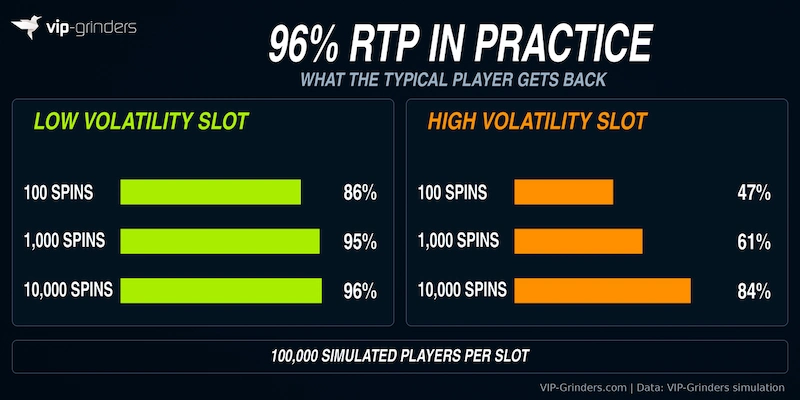
The average came out at 96% in every scenario, just as the RTP predicts. The typical player, the one in the middle with half doing better and half doing worse, got back less, and on the high volatility slot far less:
Low volatility slot, 96% RTP
| Spins | Typical Player Gets Back | Chance of Being Ahead | Middle 80% of Players |
|---|---|---|---|
| 100 | 86% | 31% | 62% to 146% |
| 1,000 | 95% | 33% | 82% to 111% |
| 10,000 | 96% | 14% | 91% to 101% |
High volatility slot, 96% RTP
| Spins | Typical Player Gets Back | Chance of Being Ahead | Middle 80% of Players |
|---|---|---|---|
| 100 | 47% | 13% | 29% to 135% |
| 1,000 | 61% | 24% | 44% to 156% |
| 10,000 | 84% | 36% | 63% to 140% |
On the low volatility slot, the typical player lands close to 96% within 1,000 spins. On the high volatility slot, the typical player gets back just 61% after 1,000 spins, and only 1 in 4 finishes ahead.
How We Ran the Simulation
We built two model slots with an RTP of exactly 96% and simulated 100,000 players on each, for 100, 1,000 and 10,000 spins at a fixed bet. The low volatility slot uses the paytable shown above, while the high volatility slot pays 0.5x on 10% of spins, 1x on 9%, 2x on 6%, 5x on 2%, 20x on 0.5%, 100x on 0.1%, 500x on 0.02%, 1,000x on 0.01% and 5,000x on 0.004%. A player only counts as ahead if they finish with more than they wagered.
Why Most Players Get Back Less Than the RTP
The high volatility slot saves a big part of its 96% for wins that almost never land. Its 5,000x win hits on just 1 spin in 25,000, yet that single win supplies a fifth of the whole RTP:
- Wins of 500x and above pay back 40 cents of every 96 cents the slot returns.
- 71% of players never land one in 1,000 spins.
- For those players, the slot plays like a 56% RTP game, since only 56 cents of every dollar comes back without the big wins.
- The lucky 29% pull the average back up to 96%, which is why the average and the typical player end up so far apart.
Real high volatility slots work the same way, keeping much of their RTP in bonus rounds and top wins that most sessions never reach.
RTP vs Volatility
Volatility decides how the RTP is paid out: in lots of small wins or in a few big ones. Our two slots have the same 96% RTP but play like different games:
| Low Volatility | High Volatility | |
|---|---|---|
| Pays on | 44% of spins | 28% of spins |
| Biggest win | 100x | 5,000x |
| Typical return after 1,000 spins | 95% | 61% |
| Chance of being ahead after 10,000 spins | 14% | 36% |
The last row is the surprise. More spins pulled low volatility players toward 96%, so their chance of finishing ahead fell to 14%. On the high volatility slot it rose to 36%, because every extra spin is another shot at a win big enough to cover the losses.
High volatility only looks better on that one row, since the typical player still gets back less and the swings are far bigger. If you play it, set a loss limit before you start, and our guide to responsible gambling tools shows the limits most casinos offer.
Why the Same Slot Can Have a Different RTP
Many big providers do not make just one version of a slot. They certify several, each with its own RTP, and the casino picks which one to run. Hacksaw Gaming lists every version on its own website:
| Slot | RTP Versions | Cost per $1,000 at Top Version | Cost per $1,000 at Lowest Version |
|---|---|---|---|
| Wanted Dead or a Wild | 96.38%, 94.55%, 92.33%, 88.42% | $36.20 | $115.80 |
| Le Bandit | 96.34%, 94.23%, 92.17%, 88.36% | $36.60 | $116.40 |
| Chaos Crew | 96.30%, 92.40%, 88.40% | $37.00 | $116.00 |
On the lowest version, every $1,000 you wager costs more than three times as much as on the top one, for the same game with the same graphics and features. Other providers, including Pragmatic Play, only list the top figure on their website, such as 96.50% for Gates of Olympus.
Versions Above the Standard
Versions can go up as well as down. Stake runs a group of Pragmatic Play slots with enhanced RTPs of up to 98%, such as Wild West Bounty at 98.02%, and says these versions are exclusive to its site. Every $1,000 wagered at 98% costs about $20 on average, against $35 at a standard 96.5%.
Bonus Buys and Jackpot Slots
The RTP on a slot’s info screen usually covers normal spins. Buying the bonus, adding an ante bet or playing for a jackpot can change it:
- Bonus buys can pay more. Stake lists Sugar Twist at 96.53% on normal spins and 98% when you buy the free spins round, but each buy costs a large multiple of your bet, so the swings are much bigger.
- Bonus buys can also pay less. On some games the buy runs slightly below the base RTP, so check the buy screen before you pay.
- Progressive jackpots take a cut. Part of every bet feeds the jackpot, so normal spins return less and the rest only comes back to the rare player who hits it.
- Ante bets have their own RTP. Paying extra per spin for more bonus chances changes the math, and the figure can differ from the base game.
A higher RTP on the buy does not change what our simulation showed: the more of the RTP a game keeps for big wins, the further the typical result sits below the average.
How to Find a Slot’s RTP
The RTP of the version you are playing sits inside the game, not on the casino’s lobby page. Four steps get you there:
- 1Open the game in real money mode. Log in first, since demo mode does not have to run the same RTP version as real money.
- 2Open the game rules. Tap the menu, info or question mark icon inside the slot and open the rules or help screen.
- 3Look for the RTP line. It is usually near the end of the rules and may be labeled RTP, return to player or theoretical return. Some games list the bonus buy or ante bet RTP on separate lines.
- 4Compare it with the provider. The provider's website usually shows the top version, so a lower number in the game means the casino runs a reduced one.
What If the Casino Does Not Show the RTP?
In our own accounts, a hidden RTP is the norm at crypto casinos:
“Most crypto casinos don’t show you the RTP of their originals when it is 99%, and slots usually are not shown either. Duel is one of the cleanest on this, with the RTP on every original, and that is the kind of transparency I want to see.”
João Mourato, Head of Casino & Poker Product at VIP-Grinders
When a casino keeps the number hidden, you still have options:
- Check the provider's website for the top figure, and treat the version you are playing as unknown.
- Ask support which RTP version the casino runs. A clear answer is a good sign, and a vague one tells you something too.
- Favor games where the math is visible. On crypto originals, the payout and win chance on screen let you work out the RTP yourself.
- Give more weight to casinos that show it. Showing the RTP is one of the simplest trust signals a crypto casino can give.
What Is a Good RTP?
A good RTP for an online slot is 96% or higher. That is the top version of most popular games: the seven big slots we checked on their providers’ websites, from Gates of Olympus to Wanted Dead or a Wild, all sit between 96.30% and 96.71%.
Anything above 97% is rare for slots and often comes with a condition, while crypto originals at 99% cost less than almost any slot. The table shows what each range costs you:
| RTP | House Edge | Cost per $1,000 Wagered | What It Usually Means |
|---|---|---|---|
| 99% or more | 1% or less | $10 or less | Crypto originals and a handful of slots, often with conditions |
| 97% to 99% | 1% to 3% | $10 to $30 | Rare for slots, usually an enhanced version or a bonus buy |
| 96% to 97% | 3% to 4% | $30 to $40 | The top version of most popular slots |
| 94% to 96% | 4% to 6% | $40 to $60 | Often a reduced version of a popular slot |
| Under 94% | Over 6% | Over $60 | A heavily reduced version or a jackpot slot, worth avoiding |
Minimum RTP by Regulator
A license does not guarantee a good RTP. The rules set a low floor, and for most crypto casinos there is no published floor at all:
- Malta Gaming Authority: online games must pay back at least 85%, a floor the MGA lowered from 92% in May 2021.
- UK Gambling Commission: no minimum, but casinos must show each game's RTP, house edge or odds before you play.
- Curacao and Anjouan: the licenses most crypto casinos hold, with no published minimum RTP that we could find.
- New Jersey: the free play version of a game cannot pay more than its lowest approved real money version, so a demo there can show a lower RTP than the game you would play for real.
In Malta, a legal slot can keep up to 15% of every bet, so a license alone does not tell you the version you are playing is a good one.
Highest RTP Slots
The highest RTP slots are mostly older, simpler games with small top prizes. These are the ones whose RTP we could confirm on the provider’s own website in September 2026:
| Slot | Provider | RTP | Biggest Win |
|---|---|---|---|
| Book of 99 | Relax Gaming | 99% | 5,000x |
| Mega Joker | NetEnt | 99% | 200x in basic mode |
| 1429 Uncharted Seas | Thunderkick | 98.6% | 670x |
| Blood Suckers | NetEnt | 98% | 900x |
Apart from Book of 99, their top prizes are small by modern standards. A slot that returns 98% or more has little left over for huge wins, which is the same trade our simulation showed.
We left out games that appear on other RTP rankings but that the provider does not back up:
- Some figures are a best case. Yggdrasil lists Jokerizer at 88.8% to 98%, so the 98% on most RTP rankings is the top of a range.
- Some lists are out of date. White Rabbit Megaways still shows up at 97.7% on many of them, while Big Time Gaming's own page lists 96.42%.
- Many crypto casinos do not carry these games. Older titles like these are often missing from crypto casino lobbies, so check before you plan around them.
Crypto Originals at 99% to 100% RTP
Crypto originals beat almost every slot on RTP. Stake lists 99% on its dice, limbo, plinko, mines and keno, so every $1,000 wagered costs $10 on average, a quarter of what a typical 96% slot costs.
Duel goes further, with 100% RTP on its originals up to a daily wagering limit of $50,000 and a maximum bet of $1,000. Past that limit, a house edge applies again until the daily reset.
Originals like these are usually provably fair: the casino shows you the hash of a secret server seed before you bet, mixes in your own client seed, and reveals the server seed later so you can recheck every result.

A zero house edge does not stop you from losing a session, since results still swing both ways. What it removes is the casino’s cut, and our list of the crypto casinos we have tested compares the sites that offer originals like these.
If you are clearing a bonus, check which games count toward the wagering first, since many casinos exclude originals or count them at a lower rate. Our guide to how casino wagering requirements work shows how to work out what a bonus really costs.
Frequently Asked Questions
What does 96% RTP mean?
A 96% RTP means a game pays back $96 for every $100 wagered across all players over its lifetime, and keeps $4 as the house edge. It is an average, so your own session can end far above or below it. In our simulation of a high volatility 96% slot, the typical player got back 61% after 1,000 spins.
What is RTP in gambling?
RTP, or return to player, is the percentage of all money wagered on a casino game that is paid back to players as winnings over time. The provider builds it into the game’s math, and 100% minus the RTP gives you the house edge.
Does RTP apply to each session?
No. RTP describes the return across every bet that every player places on a game over its lifetime, so a single session can end well above or below it. The more volatile the game, the further a typical session tends to land from the RTP.
What is a good RTP for slots?
96% or higher is a good RTP for an online slot, since that is the top version of most popular games. Anything above 97% is rare and often comes with conditions, while anything under 94% is usually a reduced version worth avoiding.
Can online casinos change a slot's RTP?
Casinos cannot change a slot’s math, but they can choose which certified version to run when the provider offers several. Hacksaw’s Wanted Dead or a Wild, for example, comes in versions from 96.38% down to 88.42%. Check the game’s rules screen while logged in to see which one you are playing.
Which slot has the highest RTP?
Among slots whose RTP the provider confirms on its own website, Book of 99 by Relax Gaming and Mega Joker by NetEnt both list 99%. Crypto originals match or beat that, with Stake’s dice and plinko at 99% and Duel’s originals at 100% up to a daily wagering limit.
Does buying a bonus change the RTP?
It can. On some slots the bonus buy pays more than normal spins, such as Sugar Twist at Stake with 96.53% on normal spins and 98% on the buy, while on others the buy runs slightly lower. The buy also makes your results swing much more, so check its RTP before you pay.