

What Is a Crypto Casino? How It Works and How It Differs From a Regular Casino
A crypto casino is an online casino where you deposit, play and withdraw in cryptocurrency such as Bitcoin, Ethereum or USDT, sent from a wallet you control.

Compared with a regular online casino, most crypto casinos:
- Hold an offshore license, usually from Curaçao or Anjouan rather than from your own country
- Ask for ID later, often only at a set limit or a big withdrawal
- Pay out in minutes instead of days
The trade off is protection: a crypto transfer cannot be reversed, and the complaint routes are weaker than at a casino licensed where you live.
Crypto gambling is no longer a niche. TRM Labs, a blockchain analytics firm, tracked $51 billion flowing into gambling sites on chain in 2025, and another $14 billion in the first three months of 2026.
To show how it works in practice, we funded a new account at Rainbet, a crypto casino run under an Anjouan license, in October 2026.
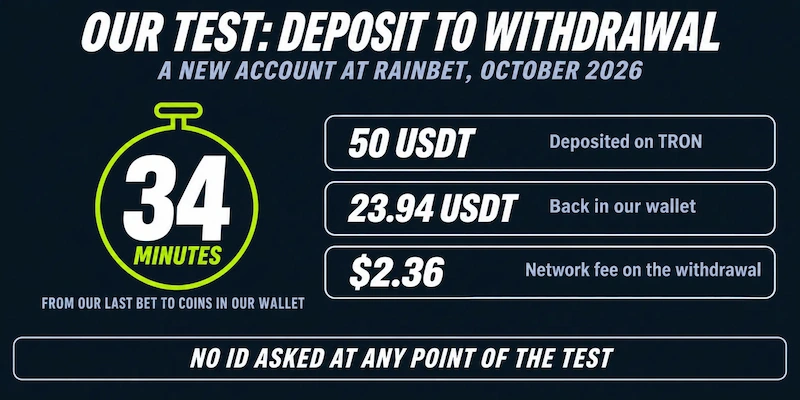
We sent 50 USDT on the TRON network, played 209 bets and withdrew what was left. The coins were back in our wallet 34 minutes after our last bet, and nobody asked us for ID.
VIP-Grinders has reviewed gambling sites since 2013, first poker rooms and, since 2024, crypto casinos. This guide covers:
- What a crypto casino is, and the three types: crypto only, hybrid and onchain
- How a crypto casino works step by step, using our own Rainbet test
- The 8 key differences from a regular online casino, from payouts and ID checks to bonuses
- Who licenses crypto casinos, and what Curaçao's 2026 crypto rules change
- Whether crypto casinos are legal where you live
- The real risks, including hacks and exit scams, and 5 checks before you deposit
- The pros and cons, and who a crypto casino suits
What Is a Crypto Casino?
A crypto casino is an online casino built around cryptocurrency. You fund your account by sending coins to a deposit address and cash out to your own wallet, with no bank or card processor in between.
That is why a withdrawal can arrive in minutes. Most crypto casinos also offer things you rarely find at a regular casino, such as in house “originals” like dice with a 99% RTP and rakeback on every bet.
Your balance usually shows in dollars, but the coins sit in the casino’s wallets, not yours, until you withdraw. At Rainbet, our 50 USDT appeared as exactly $50.00, because the casino counts USDT one to one with the dollar.
Not every casino that takes crypto works the same way. There are three main types:
| Type | How you pay | Where your money sits | Account and ID | Usual license |
|---|---|---|---|---|
| Crypto only casino | Crypto only. A card works only through a Buy Crypto partner that sends coins to the casino | In the casino’s wallets, shown as a balance | Email sign up, ID asked later or at set limits | Curaçao or Anjouan |
| Hybrid casino | Crypto plus cards, bank transfers or eWallets | In the casino’s wallets and bank accounts | ID checks often come sooner when you pay by card or bank | Curaçao or Anjouan |
| Onchain casino | Each bet sent from your own wallet to a smart contract | In your own wallet until you bet | No account, you connect a wallet | Often none |
Rainbet is a hybrid: besides crypto, its cashier lists Interac and SEPA bank transfers. Onchain casinos are still a small niche, so this guide focuses on the first two types, where most players start.
How Big Crypto Gambling Is in 2026
TRM Labs tracks gambling payments across eight blockchains, and its June 2026 report shows how players fund their play:
- Stablecoins carry about 70% of all on chain gambling volume since 2022, $117 billion of $169 billion. USDT alone accounts for $73 billion and USDC for $34 billion
- TRON took in $19.3 billion of gambling payments in 2025, 38% of the total, and USDT makes up about 94% of gambling volume on TRON
- Bitcoin fell from about 36% of gambling volume in 2022 to around 2% by 2025
- High rollers are 6.3% of personal gambling wallets but sent 91.8% of all gambling money that came from personal wallets since 2022
That is why the old name “bitcoin casino” no longer fits most of the market. A USDT balance keeps its dollar value while you play, while a bitcoin balance rises and falls with the price.
For a casino by casino view, our crypto casino market report tracks on chain deposits and market share across 41 operators.
How Does a Crypto Casino Work? Step by Step
Playing at a crypto casino follows the same six steps at almost every site. Here is each one, with what happened when we tested Rainbet in October 2026 for our Rainbet review:
- 1Sign up with an email. Rainbet asked for no ID documents, and our account stayed at Level 1 of its four verification levels for the whole test
- 2Choose a coin and network. The cashier gives you a deposit address for each pair. Rainbet takes USDT on Ethereum, TRON, Solana, Polygon and BNB Smart Chain, and we picked TRON, where the minimum deposit is $15
- 3Send from your wallet. You paste that address into your wallet and send the coins. Rainbet counts a USDT deposit after one network confirmation
- 4Get your balance. Our 50 USDT showed as $50.00, and every bet after that was in dollars
- 5Play. We placed 209 bets on dice, Plinko, Book of Dead and live roulette, $101 wagered in total
- 6Withdraw to your wallet. We asked for the $26.30 left. Rainbet took a $2.36 network fee from it, and 23.94 USDT reached our wallet 34 minutes after our last bet
The two choices that cost players most are the network and the address, because coins sent on the wrong network can be lost for good.
Our guide on which coin and network to send covers both, and if you have no wallet yet, start with setting up a wallet of your own.
The withdrawal is usually the slowest step, and our guide to how fast crypto casinos pay out explains what can hold one up.
What Our Test Showed
A small test like this tells you more than a casino’s own claims. Four things stood out:
- No ID was asked. The withdrawal went through at Level 1, without even a verified email. Rainbet's ID and selfie check sit at Level 2
- The fee hit a small cashout hardest. $2.36 was 9% of our $26.30 and would be 15.7% of Rainbet's $15 minimum withdrawal. A network fee costs about the same on $26 as on $2,600
- Rewards came back on their own. Rakeback plus small weekly and daily reload rewards added $0.41 on $101 wagered
- Game errors did not cost money. Three errors hit within 35 minutes on the second day, but every balance matched the bet history we exported, to the cent
Results differ by casino, coin and amount, so start with a small deposit and a small withdrawal before you move bigger sums. We treat every crypto casino the same way: deposit, play, withdraw, and never leave a big balance sitting there.
Playing Without Owning Crypto
Many crypto casinos have a Buy Crypto button that lets you pay by card through a partner company. Rainbet’s Buy tab lists Onramper and Swapped, with PayPal, Visa, Mastercard, Apple Pay and Google Pay.
It costs more than sending coins you already own: a $300 card payment through Onramper would have bought 290.1 USDT, about 3.3% less. The partner also runs its own ID check, as our guide to buying crypto by card in the cashier explains.
Crypto Casino vs Online Casino: 8 Key Differences
A regular online casino here means one licensed in your own market, such as the UK or Malta:
| Difference | Crypto casino | Regular online casino |
|---|---|---|
| Payments | Coins sent from your own wallet, cards only through a Buy Crypto partner | Cards, bank transfers and eWallets in your own name |
| Payout time | Minutes once approved. Ours arrived 34 minutes after our last bet | Hours to several working days, depending on the method |
| Fees | A network fee on withdrawals, often taken from the amount ($2.36 in our test) | Usually no casino fee, though your bank may charge for currency conversion |
| ID checks | Often only at a legal limit (about $2,235 in Curaçao), a big withdrawal or at random | Before your first bet in the UK, by €2,000 in deposits in Malta |
| License | Mostly Curaçao or Anjouan, and some have none | The regulator of your market, such as the UK Gambling Commission or the Malta Gaming Authority |
| Games | Slots and live tables plus originals such as dice and Plinko, many of them provably fair | Slots and live tables from licensed studios, rarely originals |
| Bonuses | Rakeback, reloads and wager races on top of welcome offers | Mainly welcome offers and free spins with wagering |
| Player protection | Limit tools vary by casino, no chargebacks, complaints go to the casino and then a dispute service | Deposit limits, self exclusion schemes and dispute services set by the regulator |
The sections below explain the four differences that surprise new players most.
ID Checks Come Later, Not Never
Crypto casinos often let you deposit, play and withdraw before they ask for anything. Rainbet paid us at Level 1, and Duel and Vave also paid out in our own tests without asking for ID.
But no casino is fully “no KYC”: every one keeps the right to ask in its terms. Curaçao’s rules require documents once your running total of deposits and withdrawals reaches 4,000 guilders, about $2,235, and other common triggers include:
- A big win or a large withdrawal
- A deposit from a wallet that the casino's screening flags
- VPN use, or a location that does not match your country
- Deposits withdrawn with little or no play
Our guide on when and why a casino asks for ID explains each trigger and which documents get accepted.
Originals and Provably Fair Games
Originals are games a crypto casino makes itself, such as dice, Plinko, limbo and mines. Rainbet lists each one’s RTP in the game’s info panel, and these are the figures it showed us:
| Rainbet original | RTP | House edge |
|---|---|---|
| Dice, Limbo, Coinflip | 99.00% | 1% |
| Keno, Plinko | 99.00% (98.00% in the Extreme and Rain modes) | 1% (2%) |
| Roulette | 97.30% | 2.7% |
| Mines, Hilo, Moles | 96.00% | 4% |
The slots we checked at Rainbet ran at 96.07% to 96.71%, so the best originals return about three points more. Not all of them do, though: Mines returns 96%, no better than a typical slot.
Our guide to the odds of each crypto casino original shows how the house edge works in each game.
Most originals are also provably fair, which lets you check each result yourself. In simple terms:
- 1Before you bet, the casino picks a secret server seed and shows you its hash, a scrambled fingerprint that cannot be turned back into the seed
- 2Your browser adds a client seed, which you can change, and a nonce that counts your bets
- 3Each result is calculated from the server seed, client seed and nonce together
- 4When you change the seed pair, the casino reveals the old server seed. You hash it yourself, and if it matches the fingerprint you saw first, the casino could not have changed your results
Our guide on how provably fair checks work includes a bet checker.
Bonuses Lean on Rakeback
Regular casinos compete mainly with welcome offers. Crypto casinos add rewards that return part of every bet, whether you win or lose, and Rainbet’s rewards page is a typical example:
- Rakeback, a share of the house edge on every bet
- Daily, weekly and monthly rewards
- Daily reloads and rank up rewards, with the first rank reached after $4,000 wagered
- Wager races of $25,000 a day, $100,000 a week and $1 million a month
Welcome bonuses still exist, and they still come with wagering, so read the terms before you take one. Our guide on how casino rakeback is paid has a calculator that shows what it is worth on your own play.
No Chargebacks
At a regular casino, a card payment can sometimes be reversed through your bank in a dispute. A crypto transfer is final once the blockchain confirms it: no bank, wallet or casino can pull it back, and only the casino can choose to send coins back to you.
“A crypto deposit has no undo button. Check the network and the address two or three times before you send, because if the coins go to the wrong place, your only hope is that the casino can find them and agrees to return them.”
João Mourato, Head of iGaming Product at VIP-Grinders
Who Licenses Crypto Casinos?
Most crypto casinos hold an offshore license from Curaçao or Anjouan, which lets one site serve players in many countries and take crypto. TRM Labs adds that others “operate without any regulatory authorization” at all.
A license matters most on the day something goes wrong, so this table shows who hears your complaint under each one:
| License | Crypto | If the casino will not pay |
|---|---|---|
| Curaçao (CGA) | Allowed, under crypto rules issued in June 2026 | A dispute service certified by the CGA, free for players. The CGA itself does not handle individual disputes |
| Anjouan | Allowed | The casino’s own complaint process, then a dispute service the casino pays for. The licensing body does not handle complaints |
| MGA (Malta) | Only with the MGA’s prior approval | An independent dispute service whose decision the casino must follow within 20 days |
| UK Gambling Commission | Not offered by licensed casinos | An independent dispute service approved by the regulator |
| No license | Anything goes | Nobody beyond the casino’s own support |
Curaçao and Anjouan trade protection for freedom: fewer limits on stakes, bonuses and crypto, but less to fall back on in a dispute, above all with Anjouan. That suits players who research a casino before they deposit and keep their balance small.
What Curaçao’s 2026 Crypto Rules Change
In June 2026, the Curaçao Gaming Authority issued its first rules written for crypto, with a deadline of June 2027 for full compliance:
- At once: no funds from sanctioned wallets or mixers, and no acting as a crypto exchange
- By September 2026: a crypto policy filed with the CGA
- By December 2026: risk assessments and checks on the crypto firms each casino works with
- By June 2027: player funds in separate wallets, blockchain analytics on deposits and withdrawals, and withdrawal whitelisting
For players, that means more screening of the wallets you deposit from and cash out to. Privacy coins such as Monero are not banned outright, but each casino must set its own position on them, and the CGA prefers regulated, fiat backed stablecoins where a casino has the choice.
The UK has no route yet. Licensed casinos there do not take crypto, and in February 2026 the Gambling Commission said it was only exploring whether a regulated route could work, with no deadline.
Licensed Offshore Casino or Black Market Site?
A Curaçao or Anjouan license protects you less than the MGA, but far more than a site with no license at all. A licensed casino gives you:
- A company named in its terms, and a license number you can look up on the regulator's own register
- A complaints process set out in its terms
- ID and anti money laundering rules, which is why it may ask for documents
- Responsible gambling tools such as self exclusion
A black market site has none of these, and often shows a copied seal that leads nowhere when you click it. Our guide on what each casino license protects shows how to check a license on the official register, step by step.
Are Crypto Casinos Legal?
Paying in crypto does not change the law. A crypto casino is legal under the license it holds, but whether you may play there depends on the law where you live.
In most countries the law targets the casino rather than the player, but not everywhere:
- UK: offering gambling to British players without a UK license is the operator's offense, not yours, but you lose every UK protection
- Australia: the law targets operators, and the regulator, ACMA, blocks illegal offshore sites
- Germany: taking part in unlicensed gambling is a criminal offense for players too
- US: federal law targets gambling businesses, but a few states, such as Washington, also cover players
This is a summary, not legal advice. Laws change, so check the rules in your own country before you play.
The Casino’s Own List of Countries
Crypto casinos also list countries they do not accept, and playing from one breaks the terms even where your local law is silent. Before you sign up, check that:
- 1Your country is not on the restricted list in the casino's terms
- 2Your local law does not penalize players at offshore casinos
- 3The games you want are open in your country, since some game studios block countries of their own
Why a VPN Can Cost You Your Balance
Hiding your location with a VPN is one of the quickest ways to lose a balance. Rainbet’s terms say you “may not use a VPN, proxy or similar services”.
After a breach, Rainbet can void bets and withhold the money in your account, deposit included. Stake treats a VPN used to “manipulate your real location” as a breach that lets it close the account.
A casino often looks closest at an account when it asks to withdraw a big win, so a breach can stay hidden until the worst moment. Our guide on why casinos close accounts compares what crypto casinos’ own terms allow.
Are Crypto Casinos Safe? The Real Risks
The risks at a crypto casino differ from those at a regular casino. These are the ones that cost players money:
| Risk | What happened | How to protect yourself |
|---|---|---|
| Hot wallet hack | Stake lost $41 million in September 2023, in an attack the FBI tied to North Korea’s Lazarus Group. Duelbits lost about $7 million in September 2026 and went offline for three days | Keep only what you play with on the site, and withdraw winnings soon after you win |
| Exit scam | ZKasino failed to return more than $33 million in ether that over 10,000 users had bridged to it. In April 2024, Dutch investigators arrested a suspect and seized €11.4 million | Be wary of new projects that ask you to lock funds for a token or a future launch |
| Fake license | In February 2026, Curaçao’s regulator publicly warned about trumpbet.cc for showing its seal without a license | Click the seal, check the license on the regulator’s own site and bookmark the real address |
| Closed account | The terms of the casinos we checked let them keep winnings after a breach such as a VPN or a second account | One account, no VPN, and pay only from your own wallet |
| Price swings | A balance held in bitcoin rises and falls with the price while you play | Play in USDT or USDC if you want your balance to hold its dollar value |
Both hacks hit hot wallets, the online wallets a casino pays withdrawals from, and both casinos said player balances were safe.
One of Stake’s founders, Ed Craven, said it keeps only “a small portion” of its reserves in hot wallets, and Duelbits reopened deposits and withdrawals three days after its hack.
A promise like that is only as good as the casino’s reserves, so it is no reason to leave a big balance on any site. We no longer recommend Duelbits because of ongoing payment issues.
Our tracker of every crypto casino hack we have recorded lists each theft and data breach since 2013.
How to Check a Crypto Casino Before You Deposit
Five checks take a few minutes and catch the most common problems:
- 1Check the license. Click the seal: it should open the regulator's own site with the same company and domain as the casino
- 2Read the terms. Look for the restricted countries, the withdrawal limits and when the casino asks for documents
- 3Search for problems. Look the casino up on player complaint sites and in hack reports before you send anything
- 4Find the limit tools. See whether you can set a deposit limit, a loss limit or self exclude before you need one
- 5Make a small test withdrawal. Deposit a small amount, play a little and cash out before you move bigger sums
For the games themselves, our guide on how casino games are tested explains how slots, live tables and originals are checked for fairness.
Crypto Casino Pros and Cons
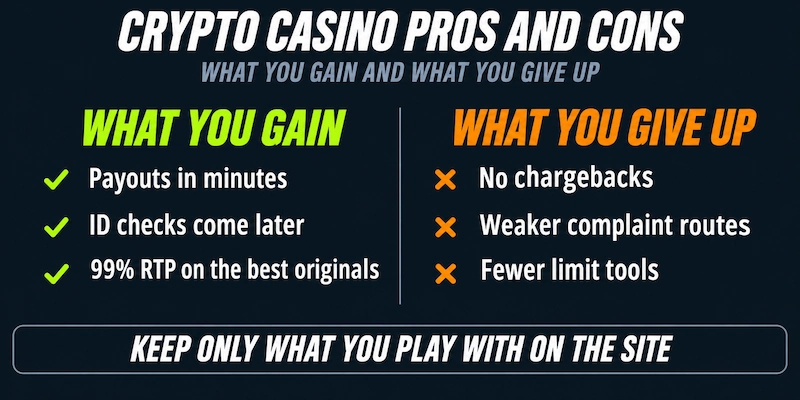
A crypto casino gives you speed, privacy and better odds on some games, and takes away part of the protection a regular casino gives you. Whether that trade is worth it depends on how you play.
What You Gain
These are the main advantages:
- Fast payouts. Coins can reach your wallet in minutes, and ours arrived 34 minutes after our last bet
- Fewer early ID checks. Many casinos let you play and withdraw small amounts before they ask for documents
- Better odds on originals. Dice, limbo and coinflip at Rainbet return 99%, against about 96% on the slots we checked
- Rewards on every bet. Rakeback and reloads pay back part of what you wager, win or lose
- Fewer limits. Stakes and bonuses are set by the casino rather than capped by a national regulator
- Results you can check. Provably fair games let you verify each bet yourself
What You Give Up
The downsides matter as much, and most of them only show up when something goes wrong:
- No chargebacks. A mistake or a dispute cannot be reversed through a bank
- Weaker complaint routes. Offshore regulators leave disputes to dispute services, and Anjouan's authority does not handle complaints at all
- Hack risk. A casino's hot wallet can be drained, as Stake and Duelbits found
- Fewer limit tools. At Rainbet, for example, the responsible gambling page offers self exclusion and a loss limit, but no deposit limit
- Fees on small cashouts. A network fee took 9% of our $26.30 withdrawal
- Price swings if you play in bitcoin or another coin that is not pegged to the dollar
Set your own limits before you start, because the casino may not set them for you. Our page on gambling limits and where to find help covers the tools to use and where to find support.
Who a Crypto Casino Suits
A crypto casino suits players who already hold crypto, want fast payouts and are happy to check a casino before they deposit. It suits less well anyone who wants a regulator to step in when things go wrong, or who relies on deposit limits to control their play.
If a crypto casino fits how you play, our list of crypto casinos we have tested shows the sites we have checked with real deposits and withdrawals.
Frequently Asked Questions
What is a crypto casino in simple terms?
A crypto casino is an online casino where you deposit, play and withdraw in cryptocurrency sent from your own wallet, instead of paying by card or bank. Most hold a Curaçao or Anjouan license, pay out in minutes and offer in house games such as dice and Plinko. Many show your balance in dollars, while the coins sit in the casino’s wallets until you withdraw.
How do crypto casinos work?
You sign up with an email, choose a coin and network in the cashier and send coins from your wallet to the deposit address it gives you. The casino credits your balance once the network confirms the transfer, and you withdraw by entering your own wallet address. In our Rainbet test, 50 USDT went in on TRON and the coins came back 34 minutes after our last bet.
What is the difference between a crypto casino and a regular online casino?
A crypto casino takes payments in crypto, usually holds an offshore license and often checks ID later, while a regular online casino is licensed in your market and takes cards and bank transfers. Crypto casinos pay out faster and add originals and rakeback. Regular casinos give stronger protection, such as chargebacks, deposit limit tools and dispute services set by the regulator.
Are crypto casinos legal?
A crypto casino is legal under the license it holds, but whether you may play there depends on the law where you live. In most countries the law targets the operator, while some, such as Germany, also penalize players at unlicensed sites. Check your local law and the casino’s list of restricted countries before you sign up, and never use a VPN to get around them.
Do crypto casinos ask for ID?
Often not at first, but no casino is fully no KYC. Rainbet, Duel and Vave paid us out without documents, yet every casino keeps the right to ask, and Curaçao’s rules require ID once your deposits and withdrawals reach 4,000 guilders, about $2,235. A big win, a large withdrawal or a flagged wallet can also trigger a check.
How fast do crypto casinos pay out?
Once a withdrawal is approved, the coins usually arrive within minutes, depending on the network. In our Rainbet test, 23.94 USDT reached our wallet 34 minutes after our last bet, with a $2.36 network fee taken from the amount. First withdrawals, big amounts and ID checks can add delays.
Can I play at a crypto casino without owning crypto?
Yes, through the Buy Crypto button many casinos have in the cashier, which lets you pay by card through a partner such as Onramper or Swapped. It costs more than sending coins you own: a $300 card payment quoted at Rainbet would have bought 290.1 USDT, about 3.3% less. The partner also runs its own ID check.
What happens to my balance if a crypto casino gets hacked?
In the two hacks covered in this guide, the casino said player balances were safe: Stake after losing $41 million in 2023, and Duelbits, which reopened withdrawals three days after a $7 million hack in 2026. That promise is only as good as the casino’s reserves, and we have stopped recommending Duelbits because of ongoing payment issues. Keep only what you are playing with on the site, because an exit scam such as ZKasino can leave users with nothing.