

No-Limit Hold’em Cash Game Strategy: A Complete Guide 2026
Cash game strategy is fundamentally different from tournament strategy, but most poker content treats them as the same game. In cash games, you can reload at any time, stacks are always deep, there is no ICM pressure, and table selection matters more than almost any card-related decision you make.

The players who profit consistently are the ones who pick the right tables, play the right hours, adjust to stake-level tendencies, and structure sessions around sustainable volume. For the underlying math on how your setup converts to income, see the hourly rate guide.
Here is what this guide covers:
- Cash vs tournament differences and why they require separate strategies
- Stake-specific adjustments from NL5 through NL200 plus live $1/$2
- Table and seat selection using lobby stats and player reads
- Session planning including peak hours, session length, and multi-tabling
What Makes Cash Games Different
Every strategic difference between cash games and tournaments traces back to one fact: in cash games, chips equal real money at all times. There is no payout structure, no bubble, and no increasing blinds forcing you to act. You can sit down, play one hand, and leave with your profit intact.
That single difference creates a completely different strategic environment.
| Factor | Cash Games | Tournaments |
|---|---|---|
| Stack depth | Always 100bb+ (you reload) | Changes constantly as blinds increase |
| Chip value | 1 chip = $1 always | Changes based on ICM and payout structure |
| Table selection | You choose your table and can leave anytime | Random seating, no choice |
| Session length | You decide when to stop | Plays until you bust or win |
| Blinds | Fixed throughout | Escalate on a timer |
| Reloading | Top up anytime between hands | No rebuys (in freezeouts) |
| Primary edge | Table selection + postflop depth | Push/fold + ICM awareness |
The constant 100bb+ stack depth is the biggest strategic difference. In tournaments, you spend most of your time between 15bb and 40bb where decisions are simplified to push/fold math. In cash games, every street matters because there is always enough money behind to make turn and river decisions complex.
Postflop skill is rewarded more heavily in cash games than in any other format. A player who understands range advantage on different board textures and uses pot control across multiple streets will extract significantly more from cash games than from tournaments where deep-stack play only occurs in the early levels.
The other major advantage is control. You pick your table, your seat, your hours, and you leave when the game turns bad. Cash players can optimize every variable around their session.
Stake-Specific Strategy: From $1/$2 to NL200
The player pool at NL10 looks nothing like the player pool at NL100. The strategies that crush micro stakes will leave money on the table at mid stakes, and the adjustments that work at NL200 will get you exploited at $1/$2 games where opponents do not fold. Understanding what changes at each level is one of the most practical edges a cash game player can develop.
The table below maps the key tendencies and adjustments for each stake tier.
| Stake | Player Pool | Primary Adjustment | Biggest Leak to Exploit |
|---|---|---|---|
| NL5 to NL10 | Mostly recreational, many limpers | Value bet relentlessly, avoid bluffing | Players call too much with weak hands |
| NL25 | Mix of recreational and semi-regulars | Start isolating limpers wider in position | Semi-regulars fold too much to 3-bets |
| NL50 | Fewer recreational players, more regulars | Add bluffing lines and balance your ranges | Regulars overfold rivers and underbluff turns |
| NL100 | Mostly regulars, some strong players | Study solver outputs for your most common spots | Predictable bet sizing tells from autopilot regs |
| NL200+ | Strong regulars, few easy spots | Exploit specific player tendencies, not population | Player-specific reads matter more than general strategy |
At micro stakes (NL5 to NL25), the dominant strategy is straightforward: play tight, bet your strong hands for value, and avoid elaborate bluffs. Most opponents at these levels call too often and fold too rarely, which means your profit comes from bigger value bets rather than creative lines.
The transition from NL25 to NL50 is where most players feel the first real difficulty spike. The recreational player count drops, regulars start 3-betting more frequently, and you can no longer rely on passive opponents paying off automatically. Our guide to moving up stakes covers the exact thresholds and adjustments for each transition.
Understanding how to build and read ranges becomes a measurable edge at NL50+. This is the stake where studying solver outputs and reviewing hand histories starts to pay off.
At NL100 and above, population-level exploits become less effective because the player pool is smaller and most opponents are competent.
Your edge increasingly comes from identifying specific player tendencies through notes, HUD stats (where available), and session-to-session reads.
To put the data layer behind these adjustments, pair your sessions with a tracker that fits your stake. Our DriveHUD 2 review walks through the exact ROI math for NL10 through NL400 cash and shows where a +1 bb/100 lift starts paying for the annual license.
Live $1/$2 No-Limit Strategy
Live $1/$2 cash games play very differently from online poker at the same stake. The effective skill level at a typical $1/$2 live table is closer to NL5 or NL10 online, because the player pool includes far more recreational players who are there for entertainment rather than profit.
- Tighten up preflop: live $1/$2 games reward patience. Many pots go multiway, which reduces the value of marginal hands and increases the value of hands that make strong pairs and sets.
- Size up your value bets: live players at $1/$2 call far more often than online players. Betting 75% to 100% pot with strong hands gets paid off at a rate that would never work at NL50 online.
- Cut your bluffing frequency: against players who call too much, bluffing is a losing play. Our bluffing guide covers the exact conditions that need to line up before firing, and at $1/$2 most of those conditions are missing.
- Position is even more valuable live: with only 25 to 30 hands per hour (compared to 75 online), every positional advantage is amplified. Playing tight from early position and wide from the button produces stronger results live than at any online stake.
The biggest mistake live $1/$2 players make is applying online mid-stakes strategy to a live low-stakes environment. At a $1/$2 table where three players see every flop and nobody folds top pair, GTO balance is irrelevant. Value betting and patience win the money.
For players looking to set a specific monthly income target at any stake, the $1,000/month guide covers the exact math by stake level, table count, and rakeback deal.
Table Selection and Seat Selection
If you could only improve one skill as a cash game player, table selection would produce the highest return. Sitting at the right table with one or two weak players is worth more bb/100 than any postflop adjustment you could learn in a month of study. The math is simple: your win rate comes from your opponents’ mistakes, and some tables have far more mistakes available than others.
How to Identify a Good Table
Most poker lobbies show basic stats per table: average pot size, players per flop percentage, and hands per hour. These three numbers tell you almost everything you need to know before sitting down.
| Lobby Stat | What It Tells You | What to Look For |
|---|---|---|
| Players/Flop % | How loose the table plays preflop | Above 25% is good. Above 35% is excellent. |
| Average Pot Size | How much money goes in per hand | Larger pots mean more action and weaker players |
| Hands/Hour | How fast the table plays | Low hands/hour can mean players are timing out (distracted recreational players) |
A table with 35%+ players seeing the flop and above-average pot sizes is almost always softer than one with 20% and small pots. The high flop percentage means multiple players are entering pots with weak holdings, which is exactly the environment where tight, aggressive play prints money.
If you have HUD data or notes from previous sessions, look for tables with at least one player running a VPIP above 40%. One loose recreational player at a 6-max table changes the entire dynamic and can double your effective win rate for that session.
Seat Selection
The ideal seat puts the loosest player to your right, so you act after them on every street.
- Loose player on your right: you get to see their action before you decide. You can isolate them with raises when they limp, and you play every contested pot in position against them.
- Tight regulars on your left: players who fold a lot in the seats behind you make your steals more profitable and reduce the chance of getting 3-bet when you open.
- Avoid aggressive regulars on your left: if a strong, aggressive player sits to your left, they will 3-bet you frequently and make your position uncomfortable. Move seats or change tables if this happens.
When to Leave a Table
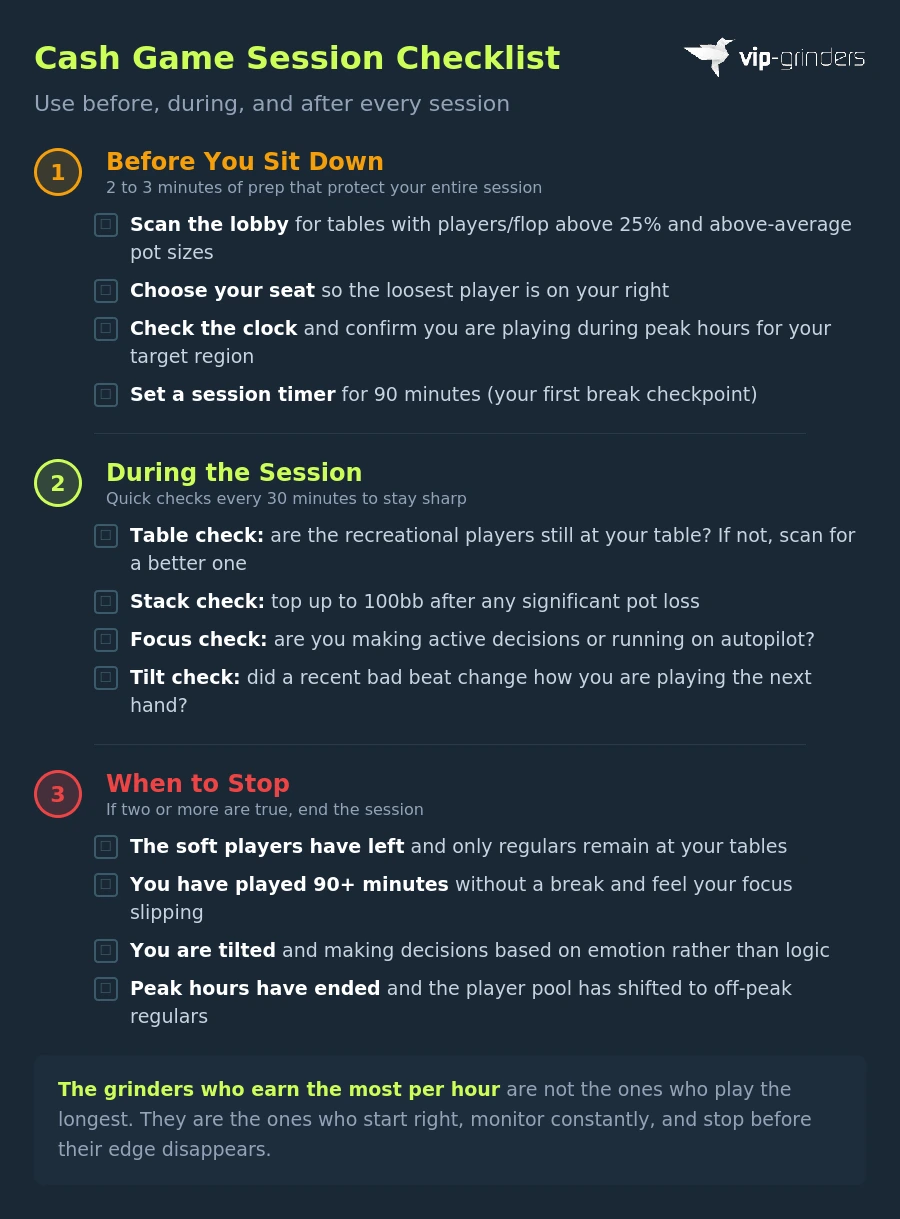
Leave when two or more of these are true: the loose players have left, you have been losing focus for 15+ minutes, or your results feel significantly below your average. There is no penalty for standing up. A new soft table is always one lobby scan away.
For the full process including HUD reads, room comparisons, and rakeback-adjusted decisions, see our table selection guide.
Session Planning and Multi-Tabling
When you play matters almost as much as how you play. Cash game traffic follows predictable patterns: recreational players log on during evening hours and on weekends, while regulars fill the tables during off-peak hours. Playing during peak traffic means softer tables, higher win rates, and more game selection options.
Peak Hours by Region
| Region | Peak Hours (local time) | Best Days |
|---|---|---|
| Europe | 7pm to midnight CET | Friday to Sunday |
| North America | 7pm to midnight EST | Friday to Sunday |
| Asia/Pacific | 8pm to 1am local | Weekends and holidays |
| Latin America | 9pm to 2am local | Friday to Sunday |
If you can only play 3 hours a day, scheduling those 3 hours during peak traffic will produce a measurably higher win rate than playing the same 3 hours at 10am when only regulars are online. This is one of the easiest adjustments a cash game player can make and it costs nothing.
Session Length
Most players perform best in sessions of 60 to 90 minutes before focus starts to fade. A better approach than 4-hour marathons is two focused 90-minute blocks with a 15-minute break. Track your results by session length over 50+ sessions to find the drop-off point where your win rate declines.
How Many Tables to Play
Adding tables increases your hands per hour and your rake generated, but it reduces your win rate per table. The optimal count depends on your skill level, your format, and your rakeback deal.
- Regular cash (6-max): 4 to 6 tables for most players. Beyond 6, only players with strong rakeback deals and a disciplined ABC style continue to benefit.
- Zoom and fast-fold: 2 to 3 tables. Each fast-fold table already deals 200+ hands per hour, so adding a fourth creates extreme decision volume that tanks most players' win rates.
- Full ring (9-max): 4 to 8 tables. Fewer decisions per orbit compared to 6-max, which means you can handle more tables before your win rate drops.
The goal is to find the table count where your total hourly rate (table profit plus rakeback) peaks. Our multi-tabling guide covers how to find that number with room caps and the diminishing returns math.
The bankroll management guide covers how your roll should scale as you add tables. Use our poker bankroll calculator to check whether your current roll supports the setup you are targeting.
Cash Game Leaks That Cost You the Most
Most cash game players lose more money to repeated mistakes than to bad beats, and more still to the cash game tilt that turns one of those mistakes into five. The leaks below are the most common and most expensive, and every one of them is fixable within a single session once you identify it.
Fix your biggest leak first. Review your last 10,000 hands and filter for your biggest losing spots by position and action type. If your results look bad but your decisions look correct, run our poker variance simulator to check whether your downswing is within the expected range.
Frequently Asked Questions
What is the best cash game strategy for beginners?
Start with tight-aggressive (TAG) play: open a narrow range of strong hands, raise instead of limping, bet your strong hands for value, and avoid bluffing at micro stakes. Focus on learning position and table selection before studying advanced concepts. A simple TAG approach with good table selection is enough to beat NL5 to NL25 at most rooms.
How many tables should I play in online cash games?
Most players maximize their hourly rate between 4 and 6 regular tables or 2 to 3 Zoom tables. Adding more tables increases volume and rakeback but lowers your win rate per table. Find your personal sweet spot by adding one table at a time and tracking your total hourly including rakeback over 5,000+ hands at each count.
Is cash game poker more profitable than tournaments?
Cash games produce more consistent income because you control your session length, table selection, and volume. Tournaments offer higher peak earnings from single deep runs but with much greater variance. For players who value steady monthly income over occasional big scores, cash games are generally the better choice.
What stakes should I start playing cash games?
Start at NL5 or NL10 with a bankroll of at least 30 buy-ins ($150 to $300). These stakes have the softest player pools and the lowest financial risk while you develop your game. Move up to NL25 once you have a proven win rate over 50,000+ hands and a bankroll of $750 or more.
How do I beat $1/$2 no-limit hold'em?
Live $1/$2 plays closer to NL5 or NL10 online in terms of skill level. Tighten your preflop range, size up your value bets (75% to 100% pot), cut your bluffing frequency, and focus on position. Most $1/$2 players call too much and fold too rarely, so your profit comes from patient value betting rather than creative bluffs.
What is a good win rate for online cash games?
At micro stakes (NL5 to NL25), a solid winner averages 3 to 5bb/100. At NL50, 2 to 4bb/100 is strong. At NL100 and above, 1 to 3bb/100 is considered very good. These numbers represent long-term averages over 50,000+ hands. Short-term results can vary wildly due to variance.
Should I play 6-max or full ring cash games?
6-max is the dominant format online and offers more action per orbit, which means more decisions, more volume, and faster skill development. Full ring is more forgiving for beginners because you play fewer hands from bad positions. If your goal is long-term profitability, 6-max is the standard format at most rooms and where the largest player pools are.
How important is rakeback for cash game players?
Very important at NL25 and above, where rakeback typically contributes 25% to 40% of a grinder’s total monthly income. Signing up without a tracked affiliate deal means leaving that income on the table every session.