

Stack-to-Pot Ratio (SPR): Planning Hands Before the Flop in 2026
Stack-to-Pot Ratio (SPR) is one number that tells you whether to commit all your chips or slow down. You calculate it on the flop by dividing your remaining stack by the size of the pot. The result tells you how many pot-sized bets are left to play with, and that single number changes how you should play almost every hand you are dealt.

Most players learn pot odds and implied odds early. SPR ties those concepts together into a single planning tool: it answers “should I be willing to put my entire stack in on this hand?” before you even see the flop. Once you understand SPR, you stop guessing and start planning.
Here is what this guide covers:
- The SPR formula and how to calculate it on any flop
- Four commitment zones every player should memorize
- A breakeven equity table you can reference at the table
- Which hand types want which SPR and why
- How to set the right SPR through preflop sizing
The formula below takes ten seconds to learn. The four commitment zones after it are the core of this guide.
What Is Stack-to-Pot Ratio (SPR)?
SPR compares your effective stack to the pot on the flop. The formula is:
SPR = Effective Stack ÷ Pot Size on the Flop
The effective stack is the smaller of the two stacks in the hand. If you have $500 and your opponent has $300, the effective stack is $300 because that is the most either player can win or lose. SPR always uses this number, not your own stack.
A high SPR (like 15 or above) means there is a lot of money behind relative to the pot, so you have room to maneuver across multiple streets. A low SPR (like 2 or 3) means the pot is already large compared to what is left, so you are close to committing your full stack on the flop. The number itself is the shortcut: it tells you how committed you are before any postflop action begins.
Three Quick Examples
All three examples assume 100bb effective stacks (the standard online buy-in) in a heads-up pot.
- 1Single-raised pot: Button opens to 2.5bb, big blind calls, small blind folds. Pot on the flop = 5.5bb. Effective stack behind = 97.5bb. SPR ≈ 17.7 (deep: roughly 18 pot-sized bets left).
- 23-bet pot: Cutoff opens to 2.5bb, button 3-bets to 10bb, blinds fold, cutoff calls. Pot = 21.5bb. Effective stack = 90bb. SPR ≈ 4.2 (medium: about 4 pot-sized bets left).
- 34-bet pot: Open to 2.5bb, 3-bet to 10bb, 4-bet to 25bb, call. Pot = 51.5bb. Effective stack = 75bb. SPR ≈ 1.5 (shallow: barely one pot-sized bet left).
Notice how each extra preflop raise cuts the SPR dramatically. A single-raised pot gives you room for three streets of betting. A 4-bet pot leaves almost no room at all.
This is not a coincidence: preflop sizing is how you set your SPR, and the section on preflop manipulation later in this guide covers exactly how to use that.
The Four SPR Zones
Every flop SPR falls into one of four zones. Each zone tells you which hands are strong enough to stack off with and which hands should slow down. Memorize these four bands and you will have a ready-made plan for almost every postflop situation.
| Zone | SPR Range | Hands That Can Stack Off | Default Action |
|---|---|---|---|
| Commit | 0 to 3 | Top pair, overpairs, sets, big draws | Get the money in |
| Decision | 3 to 6 | TPTK, overpairs, sets, combo draws | Depends on board and reads |
| Pot Control | 6 to 13 | Two pair+, sets, nut draws | Bet for value, not for stacks |
| Deep | 13+ | Sets, two pair, nut draws with redraws | Implied odds territory |
SPR 0 to 3: The Commit Zone
At SPR 3 or below, you are already committed. The pot is so large relative to what is behind that folding a strong one-pair hand is almost always a mistake. Top pair, overpairs (a pocket pair higher than any card on the board, such as Q-Q on a J-8-3 flop), sets, and strong draws should all go in on the flop.
Slow-playing in this zone wastes equity. With only one to three pot-sized bets remaining, every check gives your opponent a free chance to improve. Bet, raise, and get the chips in.
SPR 3 to 6: The Decision Zone
This is the grey area where hand reading earns its money. TPTK (top pair, top kicker: for example, holding A-K on a K-9-4 board) and overpairs are usually good enough to commit, but board texture and opponent tendencies start to matter.
On a dry board like K♦ 7♠ 2♣ (few draws possible), TPTK at SPR 5 is a comfortable stack-off. On a wet board like J♥ 10♥ 9♣ (many straight and flush draws possible), the same hand needs more caution because straights, flushes, and combo draws (a hand with both a straight draw and a flush draw at the same time) are all live. This is the zone where the standard 3-bet pot plays out at 100bb.
Below SPR 6, strong one-pair hands can commit. Above SPR 6, they should check a street and keep the pot small. That single dividing line covers most of the decisions you will face at the table.
SPR 6 to 13: The Pot Control Zone
One-pair hands should bet once for value and then check. At these stack depths, committing with just top pair requires close to 47% equity against your opponent’s continuing range, and most top-pair hands fall short of that number against raises and multi-street aggression.
The stacking-off hands here are two pair or better: sets, straights, flushes, and strong combo draws with 12+ outs (cards remaining in the deck that complete your draw). For a full breakdown of how to manage pot size with medium-strength holdings, see our pot control guide.
SPR 13+: The Deep Zone
Deep stacks reward speculative hands and punish one-pair hands. Sets, disguised two-pair combinations, and nut draws with redraws (like a flush draw that also has a straight draw) are the only clean stack-off holdings.
Top pair at SPR 13+ becomes a one-street value hand. Bet the flop, check the turn, and evaluate the river.
Do not 3-bet the flop or commit across three streets with a single pair at this depth. The money you save by slowing down with marginal hands adds up fast over thousands of hands.
The Breakeven Equity Table
When all the money goes in on the flop, how much equity (your percentage chance of winning the hand at showdown) do you need for the call to break even? The answer depends entirely on SPR. The formula is:
Breakeven Equity = SPR ÷ (2 × SPR + 1)
You do not need to memorize the formula. Memorize the table instead.
| SPR | You Risk | Final Pot | Equity Needed |
|---|---|---|---|
| 1 | 1× | 3× | 33.3% |
| 2 | 2× | 5× | 40.0% |
| 3 | 3× | 7× | 42.9% |
| 4 | 4× | 9× | 44.4% |
| 6 | 6× | 13× | 46.2% |
| 10 | 10× | 21× | 47.6% |
| 13 | 13× | 27× | 48.1% |
How to Read This Table
The “You Risk” column is always equal to the SPR. At SPR 4, you are risking 4 pot-sized units to win a final pot of 9 units (your 4 + opponent’s 4 + the original 1 pot). That means you need at least 44.4% equity for the call to break even.
Two Takeaways Most Players Miss
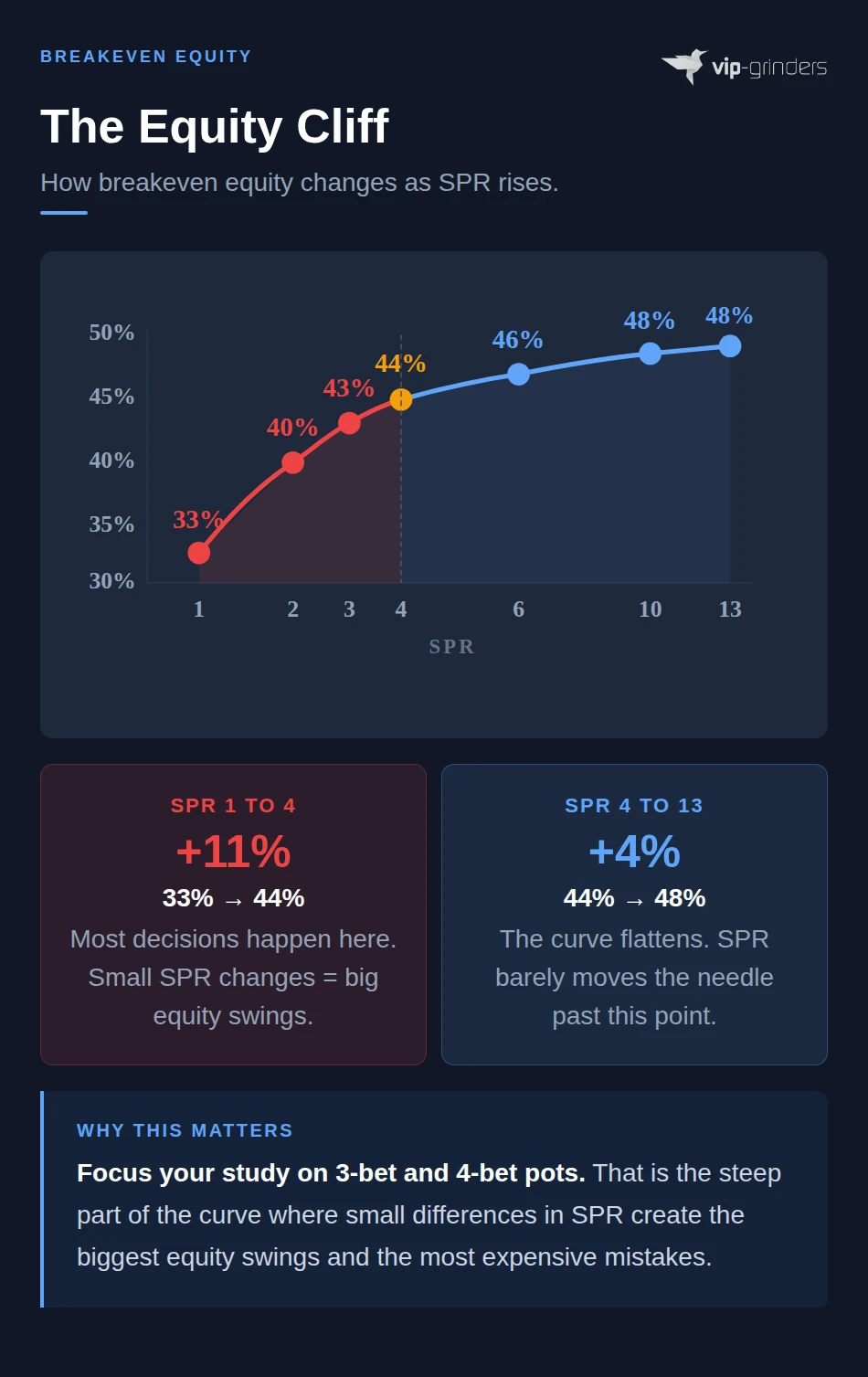
- The equity threshold climbs fast at first, then flattens. Going from SPR 1 to SPR 4 adds 11 percentage points (33% to 44%). Going from SPR 4 to SPR 13 adds only 4 more (44% to 48%). The biggest jump happens in the low SPR range where most 3-bet and 4-bet pots play out.
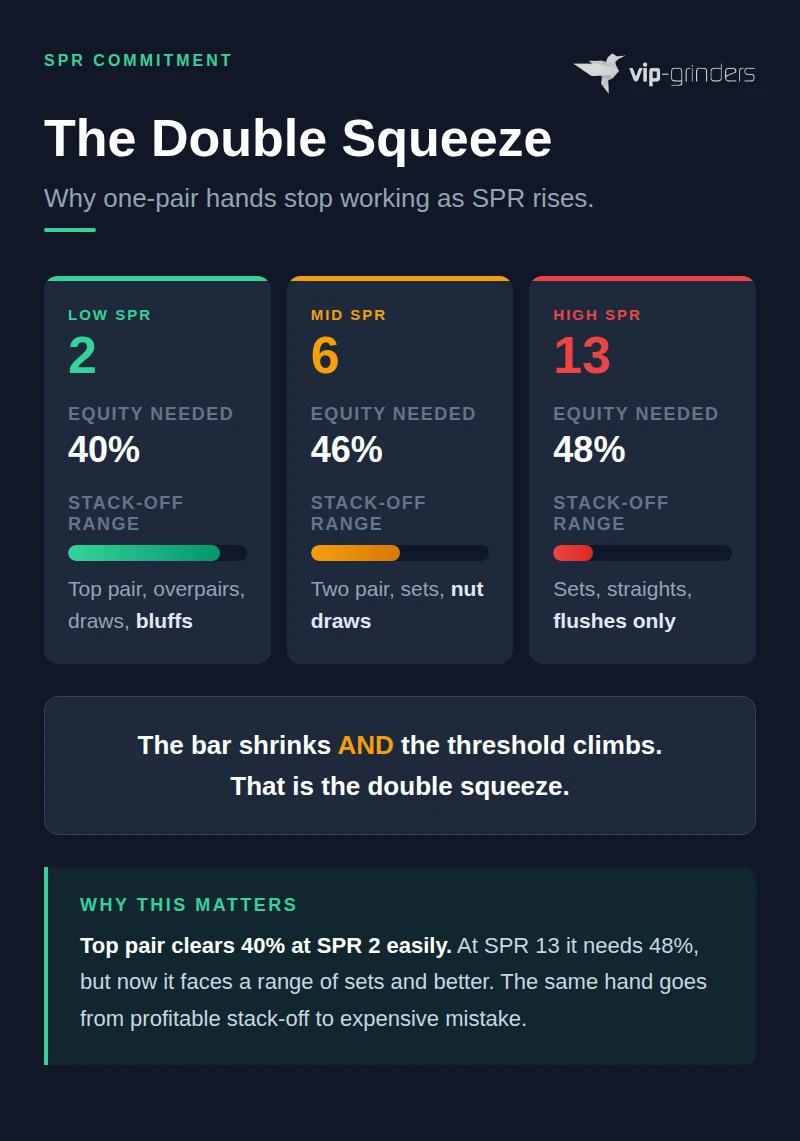
- Your opponent’s range gets stronger as SPR rises. At SPR 1, players shove with flush draws, gutshots (an inside straight draw needing one specific card), and top pair. At SPR 13, the same shove is almost always a set or better. So you need more equity AND that equity is harder to find against a tighter range.
This is exactly why one-pair hands lose their stack-off value as SPR increases. At SPR 2, top pair with a good kicker easily clears the 40% bar. At SPR 10, that same hand needs 47.6% and is facing a range that barely includes anything weaker than two pair.
Typical SPR by Pot Type
The table below shows the flop SPR you will actually see in standard 100bb cash game spots. Use it as a quick mental benchmark before you call or raise preflop.
| Pot Type | Typical Flop SPR | What It Means |
|---|---|---|
| Limped pot | ~25 to 50 | Very deep. Varies by number of limpers. |
| Single-raised pot (open + call) | ~13 to 18 | Deep. Speculative hands and set-mining thrive. |
| 3-bet pot | ~4 to 5 | Medium. TPTK and overpairs are stack-off hands. |
| 4-bet pot | ~1.5 | Shallow. Nearly committed before the flop is dealt. |
| 5-bet / preflop all-in | <1 | No decisions left. Shove or fold preflop. |
These numbers shift in two common situations. Bigger open sizes (3bb or 4bb instead of 2.5bb) compress the single-raised pot SPR from ~17 down to roughly ~13 or ~10.
Shorter starting stacks (40bb in a tournament or 25bb in a Spin & Go) compress every row in the table by roughly the same proportion. Both scenarios are covered in the sections below.
Which Hands Want Which SPR
Different hand types perform best at different stack depths. Knowing which SPR your hand wants is what connects the zone system above to the preflop sizing decisions below. If you are building or refining your opening ranges, this table explains why certain hands belong in 3-bet pots and others belong in flat-call lines.
| Hand Type | Target SPR | Why |
|---|---|---|
| AA, KK | 1 to 5 | Almost always flop one pair. Low SPR lets you commit cleanly. |
| AK, AQ | 3 to 8 | TPTK hands. Sweet spot in 3-bet pots. |
| TT to 88 | 5 to 10 | Sometimes overpair, sometimes need to set-mine. Medium SPR keeps both lines open. |
| 77 to 22 | 15+ | Set-mining hands. Need deep implied odds to profit. |
| Suited connectors (e.g. 7-6 suited) | 10+ | Make flushes, straights, and disguised two pair. Need room to extract value. |
Why Small Pairs Need Deep Stacks
Pocket pairs flop a set (three of a kind using both hole cards) only 11.8% of the time. That means you miss roughly 7 out of 8 flops. To make calling a raise profitable, you need to win enough on the 1 in 8 flops where you hit to cover the 7 times you fold, and that requires deep stacks and a high SPR.
At SPR 15+, the potential payout is large enough to justify the call. At SPR 4 (a typical 3-bet pot), there is not enough money behind to recover from the 88% miss rate. This is why flatting small pairs against 3-bets is usually a losing play at 100bb.
Small pairs and premium pairs want opposite SPRs. That single fact explains most of your preflop decisions: 3-bet the premiums to compress SPR, flat-call the small pairs to keep it deep.
Why AA and KK Want Low SPR
Premium pairs almost always flop just one pair. One pair is strong enough to commit at low SPR (the Commit and Decision zones) but becomes a marginal hand at SPR 13+ where opponents only stack off with two pair or better. This is the main reason AA and KK should 3-bet preflop: it compresses SPR into the zone where their hand is strongest.
Flat-calling with AA to “trap” creates exactly the wrong SPR. You end up in a single-raised pot at SPR 17 with a hand that plays best at SPR 4.
How to Set SPR With Preflop Sizing
SPR is not something that just happens to you. You set it before the flop through your open size, whether you 3-bet or flat-call, and how large your 3-bet is. Matching your sizing to your hand type is one of the most practical skills in this entire guide.
Three Sizing Levers
- 1Open size. A 2.5bb open produces flop SPR around 15 to 18. A 3bb open drops it to roughly 13 to 15. A 4bb open (common in live games) drops it to roughly 10 to 11. Bigger opens favour premium pairs that want low SPR.
- 23-betting vs flat-calling. A standard 3-bet compresses SPR from ~17 down to roughly 4 to 5 in one action. This is why AA, KK, and AK should almost always 3-bet: they want to play in the Decision Zone, not the Deep Zone. Flat-calling keeps SPR high and is the correct line for speculative hands like small pairs and suited connectors that need room to realize their equity.
- 33-bet sizing. The exact size of your 3-bet fine-tunes the SPR. A 3-bet to 8bb (over a 2.5bb open) leaves flop SPR around 5.3. A 3-bet to 10bb brings it down to 4.2. With KK or AA, aim for a flop SPR between 3 and 5.
Live Straddles Change Everything
In live cash games, a straddle (a voluntary blind, usually 2x the big blind, posted before the cards are dealt) inflates the preflop pot and cuts your effective SPR by more than half. If you normally play $1/$2 with a $200 stack, your preflop SPR is roughly 67. Add a $4 straddle and it drops to about 29.
Every pot type shifts down accordingly, so when a straddle is on, treat your stack as if it were half its usual depth. Tighten your speculative calling range and increase your 3-bet frequency with premiums. For a full breakdown of how sizing decisions carry through the rest of the hand, see our bet sizing guide.
SPR in Tournaments and Short Stacks
Tournament SPR compresses for three reasons that do not exist in cash games:
- 1Rising blinds shrink your stack in big blinds every level, which drops your flop SPR with it.
- 2Antes inflate the pot. A 1bb big-blind ante adds dead money to every hand, making the flop pot 15% to 20% larger than the same action without antes. That alone can shift you from the Pot Control zone into the Decision zone.
- 3ICM tightens commitment thresholds. Near the bubble or at a final table, busting costs more than equal chips can win. That structural pressure means players fold hands they would call with in a cash game at the same SPR.
Two Quick Tournament Examples
| Scenario | Effective Stack | Flop Pot | SPR | Zone |
|---|---|---|---|---|
| MTT mid-stage, 2.5bb open + call, 1bb ante | 37.5bb | 6.5bb | 5.8 | Decision |
| MTT late stage, min-raise + call, 1bb ante | 8bb | 5.5bb | 1.5 | Commit |
At 40bb with antes, a standard open plus one caller already puts you in the Decision Zone. Top pair is a stack-off hand.
At 10bb, any raise and call creates SPR below 2, which means every flop decision is a commitment decision. This is exactly why push/fold charts dominate short-stack tournament play: there are no postflop decisions left to make. Our ICM guide covers how chip value changes near pay jumps and how to adjust your commitment thresholds.
In tournaments, SPR compresses on its own as blinds rise. In cash games, you compress it yourself through preflop sizing.
Spin & Go Starting Stacks
Most Spin & Go formats start at 25bb. A standard 2.5bb open plus one call produces a flop pot of roughly 5.5bb with 22.5bb behind, giving you SPR ≈ 4.
That is the Decision Zone from hand one. Top pair and overpairs are commitment hands from the very first deal, which is why Spin strategy looks so different from deep-stacked cash games.
For the full stage-by-stage breakdown of how stack sizes change your strategy across an entire tournament, see our tournament strategy guide.
Five Common SPR Mistakes
Most SPR errors come from ignoring the number entirely and playing on autopilot. These five cost players money at every stake.
- Stacking off with TPTK at SPR 13+. Top pair top kicker holds about 55% equity against a typical c-bet (continuation bet) range, but only around 35% to 40% against a check-raise or all-in range at deep stacks. The breakeven threshold at SPR 13 is 48%. Call once, then re-evaluate on the turn.
- Folding overpairs at SPR 2. At SPR 2 you only need 40% equity to commit. J-J on a Q-8-3 board still has 45% to 50% against most ranges. Folding in this zone burns money unless you have a very specific read.
- Flatting speculative hands when flop SPR will be below 6. Calling a large open with 5-4 suited when the resulting flop SPR is only 3 or 4 is a guaranteed loss. You cannot reach implied odds at that depth. Calculate the flop SPR before you call, not after.
- Treating SPR as a turn or river metric. SPR is a flop metric. You set your commitment plan on the flop based on the SPR at that moment, then execute that plan across all three streets. Do not recalculate on the turn and change your mind.
- 3-betting KK too small and ending up at SPR 9. If your 3-bet only brings the flop SPR to 8 or 9, you are in the Pot Control Zone with a hand that wants to be in the Decision Zone. Size your 3-bet to produce SPR 3 to 5. That is where premium pairs commit cleanly.
Every mistake on this list comes back to the same root cause: not knowing (or not checking) the flop SPR before making a decision. Build the habit of estimating SPR during the preflop action, before the flop even lands. Within a few sessions, the number will appear in your head automatically.
Worked Hand Example: 3-Bet Pot at SPR 4
This hand shows SPR in action from preflop planning through to a final decision. Every choice follows directly from the SPR calculated before the flop was dealt.
The Setup
$1/$2 cash game, 100bb effective. Cutoff opens to $6 and you 3-bet to $20 from the button with A♣ K♥. Blinds fold and cutoff calls.
Pot on the flop: $43 ($20 + $20 + $1 small blind + $2 big blind). Your remaining stack: $180.
SPR = $180 ÷ $43 ≈ 4.2 (Decision Zone)
Before the flop is even dealt, you already know: if you flop top pair or an overpair on a safe board, you are committing your stack. That is what SPR 4 means.
The Flop
Flop: K♦ 9♠ 4♥
You have top pair, top kicker on a dry, rainbow board (three different suits, so no flush draw is possible). This is the best possible scenario for TPTK at SPR 4, so when cutoff checks, you bet $25 into $43.
Cutoff check-raises to $75.
The Decision
Many players panic here. A check-raise looks strong and their instinct says slow down. But the SPR already answered this question before the flop.
At SPR 4.2, you need 44.4% equity to commit (from the breakeven table). TPTK on K♦ 9♠ 4♥ has roughly 65% to 75% equity against a typical check-raising range that includes sets, two pair, strong draws, and some bluffs. You clear the threshold by a wide margin.
You jam all in. The plan was set before the flop. The check-raise did not change it.
SPR is one number, but it connects every decision from preflop sizing to river commitment. For a full list of the most expensive leaks across every aspect of the game, ranked by their actual bb/100 cost, see our common mistakes guide.
Frequently Asked Questions
What does SPR stand for in poker?
SPR stands for Stack-to-Pot Ratio. It is calculated by dividing the effective stack (the smaller of the two stacks in the hand) by the pot size on the flop. The result tells you how many pot-sized bets remain and whether you should be planning to commit your full stack or slow down with medium-strength hands.
What is a good SPR in poker?
There is no single “good” SPR. The right number depends on what you hold. Premium pairs like AA and KK want low SPR (1 to 5) so they can commit cleanly with one pair. Speculative hands like small pocket pairs and suited connectors want high SPR (13+) so they have enough implied odds to profit when they hit.
Do you calculate SPR on the turn or river?
No. SPR is a flop metric. You calculate it once after the preflop action is complete and use that number to set your commitment plan for the entire hand. The ratio changes after every bet, but your plan should not: decide on the flop whether you are willing to stack off, then execute across all three streets.
How does SPR change in 3-bet pots?
A 3-bet dramatically compresses SPR. In a standard 100bb cash game, a single-raised pot produces flop SPR around 15 to 18. The same stacks in a 3-bet pot produce flop SPR around 4 to 5. That lower number is why top pair and overpairs become stack-off hands in 3-bet pots but not in single-raised pots.
Does SPR matter in tournaments?
Yes, and it matters more as stacks get shorter. Rising blinds, antes, and ICM pressure all compress tournament SPR faster than in cash games. At 40bb with a big-blind ante, a standard open plus one caller already produces flop SPR around 5.8. At 10bb, almost every flop SPR is below 2, which is why short-stack tournament play is dominated by push/fold decisions rather than postflop strategy.
Where can I calculate SPR quickly?
The SPR Calculator at the top of this guide lets you plug in your effective stack and pot size for an instant result. It also tells you which of the four commitment zones you are in and what hands are strong enough to stack off at that depth.