

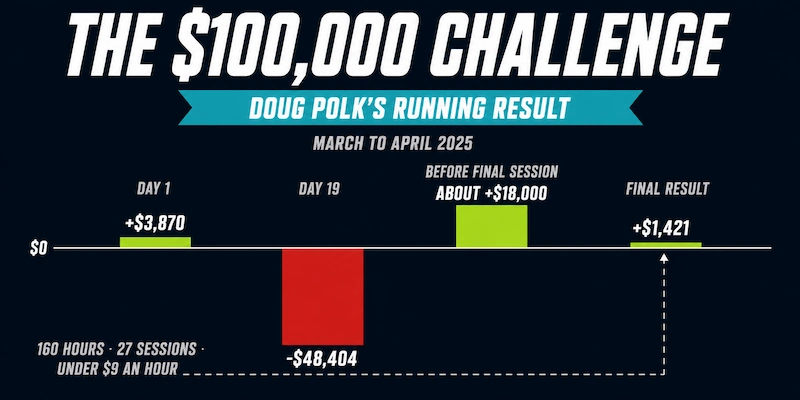
Doug Polk made under $9 an hour playing poker. Across 160 hours and 27 sessions of heads up cash games in March and early April 2025, he finished his $100,000 challenge with a total profit of $1,421. That number never makes it into a thumbnail.

The challenge was built to prove that a skilled player can still win serious money in online cash games. It ended up proving something closer to the opposite, and it was not the only one that year. Ethan “Rampage” Yau chased $1,000,000 over twelve months and called his own result “a complete failure.”
Poker bankroll challenges are the best entertainment the game produces and the worst instruction manual. This article covers what actually happened in the most famous ones, why the format works against the player attempting it, and what the math says about your chances if you try the same thing.
What Is a Poker Bankroll Challenge?
A poker bankroll challenge is a public attempt to hit a money target under rules the player sets in advance and then broadcasts. The rules usually cover the starting stake, the stakes allowed, the deadline, and whether reloading is permitted. The broadcast is the part that matters, because a challenge nobody watches is just a player having a normal month.
Three formats account for almost every famous attempt:
| Format | How It Works | Known Examples |
|---|---|---|
| The run-up | Start with a small fixed bankroll and grow it to a target. No reloads. | Chris Ferguson $0 to $10,000. Doug Polk $100 to $10,000. Andre Coimbra $100 to $100,000. |
| The profit target | Win a set amount inside a fixed deadline, usually with stake and table limits. | Doug Polk $100,000 in one month. |
| The long haul total | A large profit figure across a full year, stakes unrestricted. | Ethan “Rampage” Yau $1,000,000 in twelve months. |
Who Pays for These Challenges?
The formats differ, but the incentive behind them rarely does. Nearly every high profile bankroll challenge has been attached to a poker site: Ferguson ran his on Full Tilt, Coimbra on PokerStars, Kevin Martin under a sponsorship deal, Yau as a WPT Global ambassador, and Polk on ClubWPT Gold with a sign-up code carrying his name.
That does not make the poker fake. It does mean the challenge exists because someone is paying for attention, and attention is generated by drama rather than by disciplined bankroll management.
Doug Polk's $100K Challenge: The Real Results
Doug Polk was widely regarded as the best heads up no limit player in the world before he stepped back from that level, and he beat Daniel Negreanu out of $1.2 million across their 2020 to 2021 heads up match. This was not an amateur attempting something ambitious. He was arguably the best qualified person alive for the specific task he set himself.
The rules he announced in late February 2025 were tight:
- Stakes: $3/$6 heads up no limit hold em, with $1,200 buy ins.
- One table only: no multi tabling at any point.
- Fully streamed: every session broadcast live, hole cards visible on delay.
- Deadline: one month, running from March 3, 2025.
- Forfeit: his hair on the line if he finished the month down.
He was open that $100,000 was the headline number, with $68,000 closer to his own realistic expectation. Either figure demanded a winrate that almost nobody sustains across a full year, let alone inside a single month at one table.
How the Month Actually Went
The first days went well enough. Then the graph turned, and it kept turning for nearly three weeks.
| Point in Challenge | Running Result | What Was Happening |
|---|---|---|
| Day 1 | +$3,870 | Comfortable start at the announced stakes. |
| Day 12 | Deep in the red | A single session against one opponent cost $36,480. |
| Day 19 | -$48,404 | The low point. The $100,000 target was no longer discussed. |
| Day 29 | Back above zero | A sustained recovery, partly at higher stakes. |
| Final session | +$1,421 | A $17,000 loss in the last match wiped out most of the recovery. |
By the midpoint the goal had quietly changed. A challenge announced as a $100,000 win attempt had become an effort to avoid finishing the month in the red, and the forfeit was the only target still in play.
The stakes changed too. Much of the early damage happened around the announced limits, and the recovery came after he moved up, finishing against Eric Persson at $50/$100 with $20,000 buy ins. Chasing a deadline had pushed him well above the game he set out to play.
Why the Format Fought Him
Polk gave his own assessment while it was happening: a genuinely terrible run combined with some slightly too loose play against opponents whose ranges were too tight on later streets. Both things can be true. Neither fully explains the result.
The structural problem was the stream itself. His hole cards and his reasoning were public, on delay, to the same small pool of opponents he faced every session.
Single tabling meant those 160 hours produced a fraction of the hands a multi tabling grinder sees in the same time. Opponents who lost often declined to reload, so the games that were good did not stay available. A format designed for watchability had removed most of the levers a professional uses to build a winrate.
The final number, $1,421 across 27 sessions, is not evidence that online poker is unbeatable. It is evidence that a month is a very small sample, and that a challenge built for an audience is not built for profit.
The full final session against Persson is still up on Polk's channel, cooler and all:
Doug Polk's $100 to $10,000 Challenge: Highlight Reel vs Reality
Ask most players about the $100 to $10,000 challenge and the story is simple: Polk took a hundred dollars and ran it to five figures in about two months. It is the run people point to when they argue the dream is still alive at micro stakes. The log he published tells a different story.
| The Version That Circulates | What the Published Log Shows |
|---|---|
| Finished in around 60 days | 58 sessions spread across two years, August 2016 to August 2018 |
| A steady climb from $100 | Under $4,000 for 57 of the 58 sessions |
| Micro stakes discipline throughout | 200NL and 500NL shots to finish it |
| A lesson in bankroll management | Buy ins at about one twelfth of the roll at the end |
None of this makes the achievement fake. It does mean the version that gets repeated has almost nothing in common with what happened.
The Two Year Grind
The challenge opened in August 2016 on WSOP.com and closed in August 2018. By the fourth session the bankroll was down to $45, after a nineteen hour stretch that went the wrong way. It took about 25 sessions to clear $1,000.
Then came a preview of how it would finish. The bankroll spiked to around $3,700 near session 30, gave almost all of it back within six sessions, and then sat between $1,000 and $1,500 for roughly the next twenty. The calendar stretched to two years partly because Polk found the grind miserable and went long stretches without touching it.
How It Actually Ended
The final session did most of the work. Polk entered it with roughly $3,300 and finished above $10,100, which means around two thirds of the entire challenge was won on the last day. He got there by taking shots at 200NL and 500NL.
Those buy ins were far larger than the bankroll justified. When a viewer put the figure at one tenth of his roll, Polk corrected it himself.
“It was 1/12th my br.”
Doug Polk
Standard cash game guidance is 20 to 30 buy ins for the stake you are playing. One twelfth of a bankroll leaves roughly half that cushion, and that is what he played on the session that decided the whole challenge.
A project that began as a bankroll management demonstration ended by setting bankroll management aside. That is not a knock on Polk, who was open about it at the time and simply wanted the thing finished. It is the clearest illustration in poker of what a finish line does to a bankroll.
Rampage's $1,000,000 Challenge and the Cost of a Big Target
While Polk was single tabling for a month, Ethan “Rampage” Yau was working through something far larger. His target was $1,000,000 in profit across twelve months, with no restriction on stakes or format, documented for a YouTube audience of more than 300,000. The two were winding down at the same time.
For a while it looked possible. By the midpoint he was up more than $300,000, which is a strong year for most professionals and a genuine fraction of a number almost nobody reaches.
| 2025 Challenge | Doug Polk | Ethan Yau |
|---|---|---|
| Target | $100,000 in one month | $1,000,000 in twelve months |
| Format | One table, heads up, online | Unrestricted stakes, largely live |
| Best point | About $18,000 up before the final session | More than $300,000 up at the midpoint |
| Final result | +$1,421 | +$28,427 |
| Share of target reached | 1.4% | 2.8% |
The Final Tally
The finish was quiet. Yau was showing about $31,000 for the year before sitting down in one last $25/$50 game at the Aria, and that session took the figure down rather than up. The final number was $28,427.
He did not spin it, telling his audience plainly how he saw the year.
“A complete failure.”
Ethan “Rampage” Yau
He added straight afterwards that he might be judging himself too harshly. That candour is the only reason the number is on record at all. The finale episode carries the verdict in his own words:
Why the Target Itself Was the Problem
A million dollars in a year cannot be reached through ordinary winning sessions. The only route is bigger games, and bigger games swing hard enough to erase most of a good year in a single afternoon. The size of the goal dictated the risk, exactly as a one month deadline dictated Polk's move up in stakes.
The two challenges even crossed paths. On the day Polk's own deficit reached its worst point in late March, he noted that he had at least stacked Rampage.
Two players, two formats, one shape. Both announced a large number in public and finished with a small one.
The Bankroll Challenges You Never Hear About
Every challenge covered so far shares one thing. Somebody finished it and published the result. That is not how most of them end.
The Ones That Stopped
In early 2024, Kevin Martin set out to build $5,000 from nothing and streamed the attempt. He shut it down after roughly 500 hours of broadcast with about a tenth of the target in his account, and summed it up as winning money while failing the challenge.
In January 2026, Alex “KDog” Kobzyev announced $100 to $30,000 inside a single month. Seven days later the account was at zero.
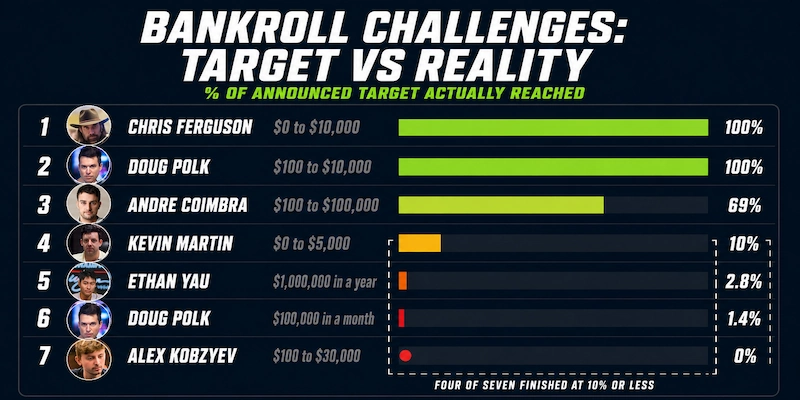
| Player | Target | Finished At | Outcome |
|---|---|---|---|
| Chris Ferguson | $0 to $10,000 | $10,000 | Reached, over roughly 18 months |
| Andre Coimbra | $100 to $100,000 | $69,200 | Missed by about 31% |
| Doug Polk | $100 to $10,000 | $10,100 | Reached, over two years |
| Kevin Martin | $0 to $5,000 | About $500 | Abandoned after 500 streamed hours |
| Doug Polk | $100,000 in one month | $1,421 | Missed |
| Ethan Yau | $1,000,000 in one year | $28,427 | Missed |
| Alex Kobzyev | $100 to $30,000 | $0 | Busted in seven days |
Martin and Kobzyev are visible at all only because they kept broadcasting after the plan stopped working. Most people do not.
Even the Wins Were Smaller Than the Story
Chris Ferguson turned nothing into $10,000 through freerolls and slow, disciplined moves up the stakes. It is the founding example of the genre, and it took him around 18 months. The version that gets repeated rarely includes the timeline.
Andre Coimbra ran $100 toward $100,000 on PokerStars playing tournaments, and finished at $69,200. He said afterwards that the six figure headline was “more of a catchy number” than something he expected to reach.
What Polk's Own Record Shows
Polk has run several more challenges since 2025 and has lost most of them. In one case he technically won the challenge and still finished down around $4,100 at the tables.
That record is not the full picture, and the exception is worth understanding. He beat Ben Sulsky heads up in 2013, and he took $1.2 million off Negreanu across their match. Both were contests against a single named opponent over an agreed number of hands.
Growing a bankroll to a deadline is a different problem. Beating one opponent you have studied for weeks is a question of skill. Hitting a number by a date is mostly a question of variance, and variance does not care who is playing.
The Math: Why Even Elite Players Miss
Every poker bankroll challenge above has the same explanation underneath it. Two numbers decide whether a bankroll grows or disappears: how much you win per hand, and how violently results swing around that average.
What a Real Winrate Actually Buys You
A winrate of 5bb/100 is strong at almost any stake. It also means you win one buy in roughly every 2,000 hands, which is several sessions of work for most players.
Polk put the winrate his month required at around 20bb/100. Analysis published at the time suggested the headline number needed closer to 40bb/100. Both sit far above anything a professional sustains across a career.
| Winrate | What It Represents | Hands to Win One Buy In |
|---|---|---|
| 2bb/100 | A genuine edge | 5,000 |
| 3bb/100 | Solid winner | 3,333 |
| 5bb/100 | Strong at most stakes | 2,000 |
| 20bb/100 | Polk's own estimate for his challenge | 500 |
Why One Month Proves Nothing
Standard deviation in no limit hold em sits near 100bb/100, and runs higher heads up. That is roughly twenty times a strong winrate, which is why short stretches of results look close to random and why variance in poker dominates small samples.
A single tabled month produces a fraction of the volume a winrate needs before it carries meaning. The $1,421 says almost nothing about how well Polk played. It says a great deal about how little a month can prove.
How Often a Winning Player Still Goes Broke
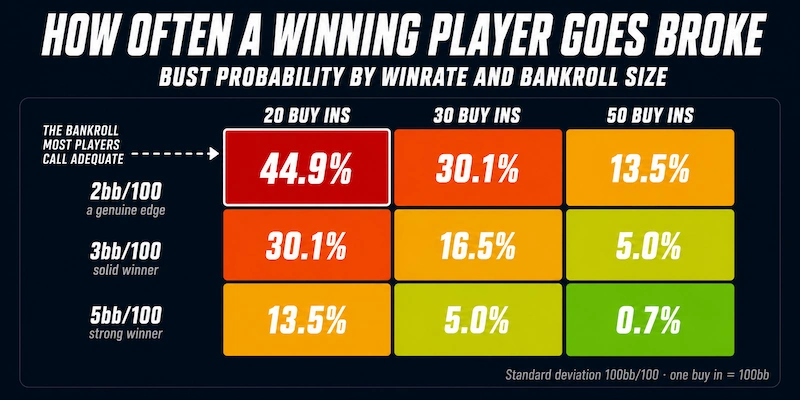
There is a standard calculation for this, popularised in poker by Mason Malmuth in 1987 and still the reference. It takes a winrate, a bankroll and a standard deviation, and returns the probability of losing everything before the edge has time to work. The industry calls it risk of ruin.
| Winrate | 20 Buy Ins | 30 Buy Ins | 50 Buy Ins |
|---|---|---|---|
| 2bb/100 | 44.9% | 30.1% | 13.5% |
| 3bb/100 | 30.1% | 16.5% | 5.0% |
| 5bb/100 | 13.5% | 5.0% | 0.7% |
Look at that first row again. A genuine winning player at 2bb/100, holding the twenty buy ins most people would call adequate, goes broke almost half the time.
A 4bb/100 winner needs 58 buy ins before that figure drops to 1%. That is roughly double what standard poker bankroll management rules recommend, which is why the usual 20 to 30 buy ins is better understood as a floor than a target.
Three things to keep in mind when reading that table:
- They assume fixed stakes and a constant winrate, which no real player has.
- They describe the shape of the risk, not a prediction for any individual.
- The direction is the point: every buy in you add cuts the danger sharply.
What a Deadline Does to All of This
The same pattern repeats across most of the challenges in this article. The clock ran down before the edge could do its work, and moving up in stakes became the only way to close the gap.
Run ups have no clock, but the finish line does the same job. Buying in for one twelfth of a bankroll, as Polk did to end his, means sitting roughly twelve buy ins deep, and that move is exactly what the table punishes. Taking $20,000 to a $50/$100 table is the same decision wearing a bigger number.
A deadline damages a bankroll in three separate ways:
- It removes the option to wait for good games and forces you to play whatever is running.
- It makes moving up the only realistic way to close a gap late on.
- It turns a small sample into the final verdict on your ability.
The deadline is the problem, not the player.
Can a Regular Player Replicate a Bankroll Challenge?
You can certainly run one. Whether it teaches you anything about your poker is a different question, and the honest answer is usually no.
Every celebrated run in this article came with at least one advantage an average player does not have. Elite skill, a sponsorship deal behind the attempt, an audience that made the time worth spending, or all three. Most of them still finished short of the number.
What a Realistic Winrate Actually Pays
Assume you are a strong winner at 5bb/100. That is better than most players ever achieve. Here is what it produces per 1,000 hands, which is a couple of sessions for most people.
| Stake | Big Blind | Profit per 1,000 Hands at 5bb/100 |
|---|---|---|
| 2NL | $0.02 | $1.00 |
| 5NL | $0.05 | $2.50 |
| 10NL | $0.10 | $5.00 |
| 25NL | $0.25 | $12.50 |
| 50NL | $0.50 | $25.00 |
Starting at $100 means starting at 2NL or 5NL if you follow any sensible bankroll rule. At those stakes a strong winrate pays a few dollars per session, which is why the early phase of every run up in this article took months and why Polk found his own version miserable.
The Rake Problem Nobody Puts in the Thumbnail
Poker rake is charged as a share of each pot up to a cap. At micro stakes that cap is reached in a large proportion of hands, so the cost lands proportionally harder on small pots than it does higher up the ladder.
The result is that the stakes you are forced to play with a small bankroll are the stakes where the house takes the biggest relative share of your edge. You are asked to climb the steepest part of the hill first, with the heaviest pack.
The Constraint You Do Not Actually Have
Here is the part worth thinking about before you start. A bankroll challenge forbids you from adding money. Real life does not.
Most players who cannot beat micro stakes are not failing at poker. They are underfunded, and being underfunded forces short buy ins, bad game selection and stakes where rake dominates. Adding $300 from outside poker solves more of that than another month of grinding 2NL ever will.
So the challenge format takes a solvable problem and makes it permanent, purely because a rule you invented says so. If you want to run one anyway, these are the conditions that would make it meaningful:
- 1A bankroll you are allowed to add to, so one downswing does not end the project.
- 2A stake where the rake does not consume most of your edge.
- 3Enough hands for a winrate to mean anything, which is far more than a month provides.
- 4A reason to do it that is not an audience.
Remove the finish line and the no reload rule and you are left with something sensible: playing a stake you are properly rolled for, moving up when the bankroll says so. That is not a challenge. It is just bankroll management, which is the thing every challenge in this article ended up demonstrating by accident.
What to Do Instead
None of this is an argument against ambition. It is an argument against the two rules that every challenge bolts onto it: a finish line, and a bankroll you are not allowed to refill.
Strip those out and the ambition survives intact. What follows is the same project with the self sabotage removed.
Size the Bankroll Before You Pick the Target
Every challenge in this article worked backwards, setting the number first and then discovering which stakes it forced. Doing it the other way round takes about a minute.
Decide what you can afford to have at risk, then let that figure choose the stake. A poker bankroll calculator will tell you what a given roll actually supports, and the answer is usually a stake lower than the one you had in mind.
Learn What a Bad Month Looks Like Before You Have One
The single most useful thing in this whole article is the idea that a month of losing proves almost nothing. That is easy to accept in theory and very hard to remember at the time.
Run your winrate through a poker variance simulator before you need it. Seeing the range of outcomes a winning player can expect, in advance, is what stops a normal downswing from feeling like evidence that you cannot play.
Move Up on the Bankroll's Schedule, Not the Calendar's
Shot taking is not the problem. Shot taking to force the finish line is the problem, and that is the difference between a planned move up and the way Polk chose to end his run up.
Set the rule in advance: this many buy ins and you move up, this many and you move back down. Moving up in stakes works when the bankroll authorises it and fails when a deadline demands it.
FAQs
How much did Doug Polk win in his $100K challenge?
Doug Polk did not reach the $100,000 target. He finished with a profit of $1,421 across 27 sessions and roughly 160 hours of play, which works out at under $9 an hour. The challenge ran from March 3, 2025 into early April, and he was down as much as $48,404 at the low point before recovering to finish narrowly ahead.
How long did Doug Polk's $100 to $10,000 challenge take?
It took 58 sessions spread across two years, from August 2016 to August 2018, played on WSOP.com. The widely repeated claim that it took around 60 days confuses the 58 sessions with 58 days. Roughly two thirds of the total was won in the final session, by taking shots at 200NL and 500NL.
Why do poker bankroll challenges fail?
The deadline is the main cause. A fixed target inside a time limit pushes a player to move up in stakes when time runs short, which is exactly when the bankroll cushion is thinnest. Add the small sample size involved and even a strong winning player is largely at the mercy of variance rather than skill.
Are poker bankroll challenges sponsored?
Most high profile ones are. Chris Ferguson ran his on Full Tilt, Andre Coimbra on PokerStars, Ethan Yau as a WPT Global ambassador and Doug Polk on ClubWPT Gold with a sign-up code in his name. That does not make the poker fake, but the challenge exists because a site is paying for attention.
Can an average player complete a bankroll challenge?
It is possible but rarely instructive. At a strong winrate of 5bb/100, 25NL pays about $12.50 per 1,000 hands, so building a meaningful bankroll from $100 takes months of volume at stakes where rake takes the largest relative share of the pot. Most documented amateur attempts were either abandoned or busted.
What is the best bankroll strategy instead of a challenge?
Let the bankroll choose the stake rather than letting a target choose it for you. Treat 20 to 30 buy ins as a floor rather than a goal, allow yourself to add money from outside poker, and set your move up and move down rules in advance so stakes change when the bankroll authorises it and not when a deadline demands it.