

Eric Persson Net Worth 2026: Maverick Gaming, -$6M Poker Loss & Bankruptcy
Eric Persson is the casino executive who turned televised poker into a marketing channel for his gambling empire. The Maverick Gaming CEO has logged over 200 hours of broadcast cash-game play across High Stakes Poker, Hustler Casino Live and No Gamble No Future, with a tracked seven-figure loss.
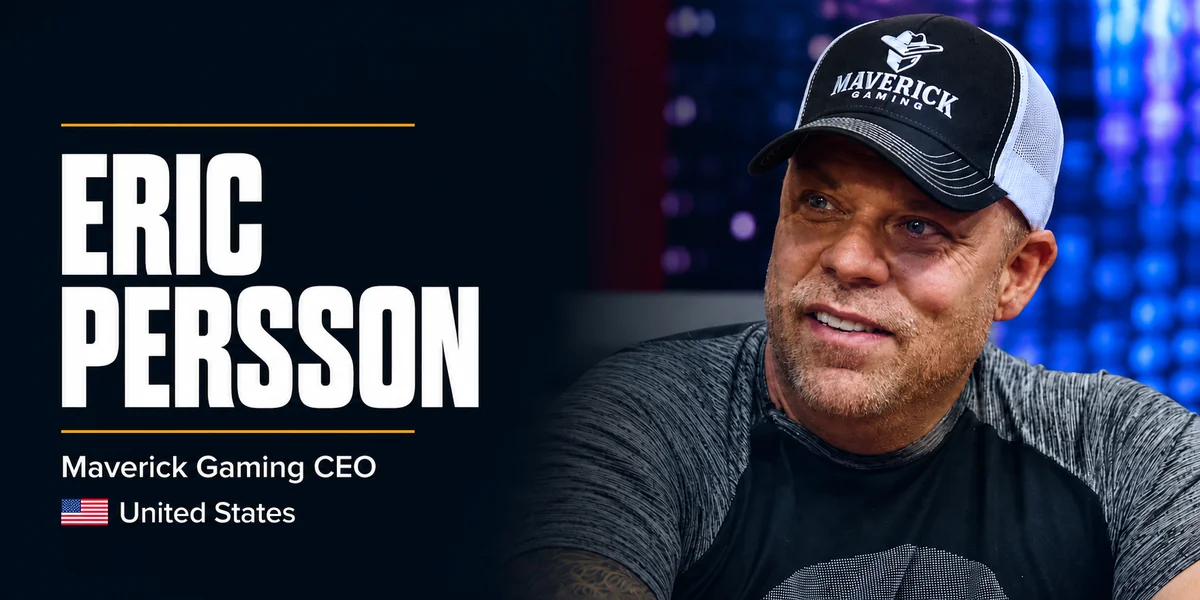
His net worth is the subject of conflicting claims. Persson himself put the figure near $1 billion in 2022, but that conflates personal wealth with Maverick Gaming’s enterprise valuation. After the company filed for Chapter 11 in July 2025, estimates dropped to roughly $40 million to several hundred million.
What follows is built on court filings, tracked broadcast data and verified tournament records, not the celebrity net-worth sites that recycle the same unverified numbers.
Eric Persson Quick Facts
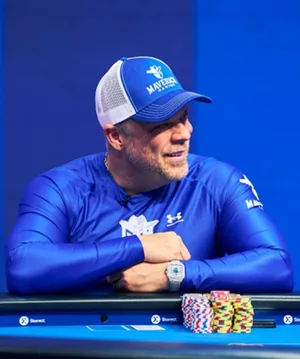
- Full Name: Eric Persson
- Born: March 21, 1975 (age 51)
- Birthplace: Hoquiam, Washington
- Nationality: American
- Tribal Heritage: Shoalwater Bay Indian Tribe
- Education: UNLV (BA, 1998); Georgetown University Law Center (JD, 2001)
- Married: Ann Persson (m. 2007)
- Children: 4
- Net Worth (Estimate): $40M to several hundred million (not publicly confirmed)
- Live Tournament Earnings: ~$3,677 (3 results, per Hendon Mob)
- Primary Format: High-stakes cash games (televised)
- Known For: Maverick Gaming CEO; televised high-stakes poker on HSP, HCL and NGNF
- Company: Maverick Gaming (Chapter 11 since July 2025)
Eric Persson's Net Worth
Eric Persson’s net worth is not publicly confirmed. Estimates from poker media and biography sites range from roughly $40 million to several hundred million, with Persson himself claiming a figure near $1 billion as recently as 2022.
The gap between those numbers is not a rounding error. It reflects a basic confusion between personal wealth and the enterprise value of a leveraged casino business carrying hundreds of millions in debt.
Most published estimates trace back to celebrity biography aggregators with no disclosed methodology. These sites frequently cite round figures like “$100 million” or “$150 million” without distinguishing between Persson’s personal fortune and Maverick Gaming’s headline valuation.
What is Eric Persson’s net worth?
The honest answer is that nobody outside Persson’s inner circle knows the exact number. The low end of published estimates sits around $40 million to $50 million, sourced from poker and celebrity biography sites. The high end reflects Maverick Gaming’s peak enterprise valuation, not a verified personal fortune.
Persson is not the only casino owner whose table presence has fuelled net-worth speculation. For a look at another casino mogul’s poker fortune, Tony G’s self-reported $300 million figure shows how common these inflated claims are in the industry.
Is Eric Persson really worth $1 billion?
In a 2022 interview, Persson stated his net worth was “nearing $1 billion.” That figure almost certainly reflects the combined enterprise valuation of Maverick Gaming at its peak, when the company operated casinos across three states.
Personal net worth and enterprise value are not the same thing. Maverick carried roughly $306 million in secured debt, meaning Persson’s equity stake was a fraction of the headline number even before the bankruptcy filing.
The Chapter 11 filing in July 2025 materially reduced the high-end estimates. Maverick’s assets have been liquidated piecemeal through Section 363 sales totalling over $119 million, and two more Washington casinos announced closure in June 2026. Whatever Persson’s net worth was at the peak, it is substantially lower today.
What we can verify: tracked earnings
Persson’s tracked live tournament earnings total approximately $3,677 across three results, per his Hendon Mob profile. He is not a tournament player and has never treated tournaments as a meaningful part of his poker activity.
His tracked broadcast cash-game result is −$6,072,950 across 64 episodes and 204 hours, per third-party livestream trackers. That figure covers only filmed sessions and does not include private games.
Persson has stated that his overall poker results are net positive when off-camera play is included. There is no independent way to verify that claim.
Why the real number is unknowable
Five factors make any single net-worth figure unreliable for Persson:
- Maverick Gaming equity is in Chapter 11 proceedings, with asset values still being determined through court-supervised sales
- Persson's entity bought back PokerCo Washington cardrooms for $28M and EGads for $1.4M during bankruptcy, but the current value of those assets is unknown
- Legal costs from the failed tribal sports-betting lawsuit and the bankruptcy itself are not public
- Private poker results are unverified; only broadcast sessions are tracked
- Pre-Maverick savings from his gaming-industry career (Las Vegas Sands, Aruze) are not disclosed
Maverick Gaming: The Casino Empire Behind the Bankroll
Maverick Gaming is the casino company Persson co-founded in December 2017 with business partner Justin Beltram. The playbook was buy-and-consolidate: snap up small to mid-sized casinos across the western United States and extract value through scale.
At its peak, the Maverick Gaming group operated 31 properties across Washington, Nevada and Colorado. The signature deal was the $80.5 million acquisition of the Evergreen portfolio, a collection of Washington State cardrooms and casinos that became the backbone of the company’s footprint.
The parent entity behind the operation is RunItOneTime LLC, a name borrowed from poker slang. Persson has said the brand itself was inspired by his son, Maverick.
- 2017: Persson and Beltram found Maverick Gaming
- 2019: $80.5M Evergreen portfolio acquisition
- Peak: 31 properties across three states
- July 2025: Chapter 11 bankruptcy filed
- June 2026: Two more casinos announce closure
What happened to Maverick Gaming?
Maverick Gaming filed for Chapter 11 bankruptcy on July 14, 2025, in the Southern District of Texas (Case 25-90191). The filing listed $100 million to $500 million in both assets and liabilities, with approximately $306 million in secured debt.
The company has been liquidated piecemeal through court-supervised Section 363 sales. Nine deals have closed for a combined total exceeding $119 million, stripping the portfolio back to a fraction of its former size.
Persson did not walk away entirely. His own entity bought back the PokerCo Washington cardrooms for $28 million in September 2025 and a smaller property, EGads, for $1.4 million. The full restructuring docket is publicly available through Kroll’s case portal.
The contraction continued into 2026. On June 5, Maverick announced two more Washington casinos would close permanently on July 31, 2026, eliminating 132 jobs. As of mid-2026, the Chapter 11 proceedings remain open and Maverick has not emerged from bankruptcy.
The tribal sports-betting lawsuit
Before the bankruptcy, Persson pursued an aggressive legal strategy to challenge tribal gaming exclusivity. Maverick Gaming filed Maverick Gaming v. United States, arguing that federal law giving tribes a monopoly on sports betting in Washington violated the Equal Protection Clause.
The case was dismissed at the district level. The Ninth Circuit Court of Appeals affirmed that dismissal on December 13, 2024, and the U.S. Supreme Court denied certiorari on October 6, 2025.
The legal costs and political fallout from the multi-year challenge are cited as contributing factors in Maverick’s financial collapse.
From the Vegas Strip to Casino CEO
Persson’s wealth did not come from poker. It came from two decades in casino operations, culminating in the founding of Maverick Gaming.
He grew up in Hoquiam, Washington, and earned a bachelor’s degree from UNLV in 1998. A law degree from Georgetown University Law Center followed in 2001. Persson has claimed he funded both through poker winnings, though this is unverified.
His gaming-industry career began at Prairie Band Casino in Kansas. From there he moved to Las Vegas Sands, where he rose to Senior Vice President of slots, and then to Aruze Gaming, where he served as President and COO.
How did Eric Persson make his money?
Persson made his money through executive roles in the casino industry, not through poker. His tracked poker results show a net loss, and his tournament earnings total under $4,000.
The real wealth came from the operations side. His positions at Las Vegas Sands and Aruze provided the experience and capital to launch Maverick Gaming in 2017, which grew into a multi-state casino portfolio before its Chapter 11 filing.
By the time Persson started appearing on televised poker shows in the early 2020s, he was already a casino CEO with a portfolio valued in the hundreds of millions. The poker table was never his income source.
Eric Persson's Poker Career
Persson’s poker career defies conventional classification. He has no title wins, a negligible tournament record and a tracked broadcast result deep in the red. Yet he is one of the most recognised cash-game players on television.
Is Eric Persson a professional poker player?
No. Persson is a recreational player by every standard definition. He has never relied on poker as a primary income source and has openly described his table appearances as marketing for Maverick Gaming.
In interviews, he has said that every hour at a televised poker table generates more brand exposure than any advertising campaign he could buy. Whether that calculus still holds after the Chapter 11 filing is an open question.
His tournament record barely registers. Hendon Mob lists three lifetime results totalling approximately $3,677. The “$2.1 million in career earnings” figure that appears on some biography sites is false, likely conflating his profile with another player or including unverified claims.
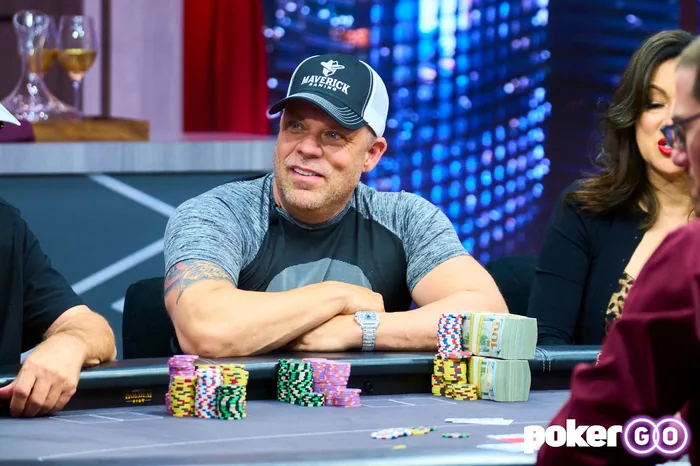
How much has Eric Persson won at poker?
In tracked, verifiable terms, Persson has lost money at poker. His negligible tournament record is dwarfed by a broadcast cash-game result of −$6,072,950 across 64 filmed episodes.
Those sessions include some of the biggest pots ever caught on camera. Persson’s willingness to play for seven-figure sums against elite competition is what keeps producers calling.
He maintains that his overall results are positive when private sessions are included. Without independent verification, the only honest answer is that his public record shows a net loss.
On the broadcast circuit
Persson’s televised career spans three major platforms: High Stakes Poker, Hustler Casino Live and No Gamble No Future. He has been a recurring presence since the early 2020s, appearing in 64 tracked episodes.
On High Stakes Poker, he became a fixture in later seasons. His most talked-about moment came in Season 11, when he absorbed his $700K loss in a million-dollar pot without flinching.
Hustler Casino Live gave Persson a different stage and a bigger audience. He played in the million-dollar buy-in cash game that drew mainstream attention to the Los Angeles cardroom scene.
On No Gamble No Future, the PokerGO-produced show, he recorded some of his largest single-session losses. His regular opponents across all three platforms include the high roller who stacked him on stream, Andrew Robl, alongside Phil Hellmuth and Patrik Antonius.
Playing Style and Reputation
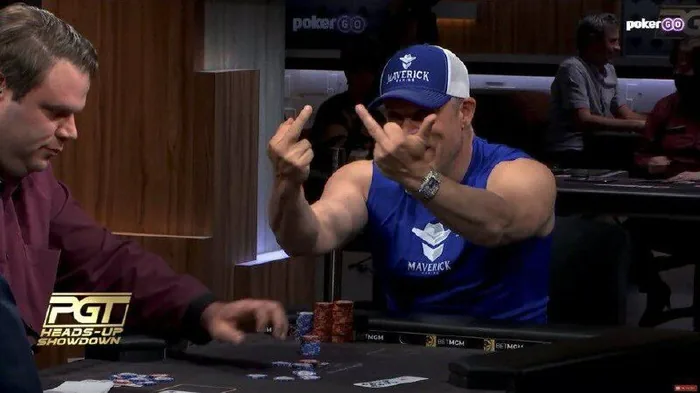
Persson plays poker the way he does everything else: loud, direct and with zero interest in being liked. He talks constantly at the table, berates opponents after bad beats and celebrates wins with a showmanship that splits the poker community down the middle.
His style is not accidental. Persson has stated repeatedly that every televised session is a branding opportunity for his casino business. The table talk and the theatrics are deliberate: they keep cameras pointed at him and generate the kind of attention money cannot buy.
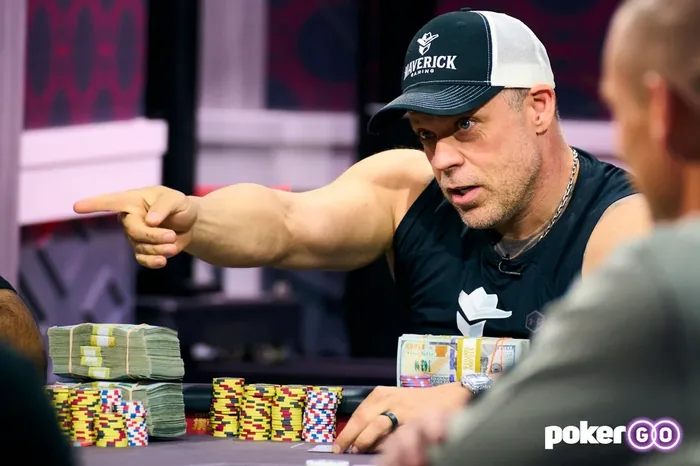
Why does Eric Persson trash talk so much?
Persson’s own explanation is simple: it works. He has said in interviews that his on-camera persona generates more visibility for Maverick Gaming than any traditional marketing spend.
The trash talk serves a second purpose. By needling professionals at the table, Persson tilts opponents who take the game far more seriously than he does. For a recreational player whose bankroll dwarfs his poker stakes, that dynamic works in his favour.
Not everyone appreciates the approach. He has clashed with multiple high-stakes regulars, including trading barbs with the durrrr legend, Tom Dwan, during several heated sessions.
Persson is not the only divisive personality in high-stakes cash games. Players like LA’s brashest high-stakes cash player, Nik Airball, have built similar followings by leaning into confrontation and spectacle.
Spectacle aside, solid poker still decides who takes the money home. For players looking to develop their own edge without the theatrics, our guide to beating cash games covers the fundamentals that apply at every stake.
Eric Persson's Biggest Poker Moments
Persson’s most memorable poker moments share a common thread: they are almost all losses. What makes them notable is the scale, the opponent and the reaction.
What is the biggest pot Eric Persson has played?
The largest pot Persson has played on camera was a $1,978,000 hand against Patrik Antonius on No Gamble No Future in February 2023. At the time, it was the biggest pot ever recorded on a US-based poker livestream.
The correct figure is $1,978,000. Several sources have misreported the pot as $1,780,000, but the on-screen totals from the broadcast confirm the higher number.
Persson lost the hand. His reaction was characteristically unfazed: he reloaded and continued playing.
The Hellmuth rivalry
Persson’s clashes with Phil Hellmuth have produced some of the most replayed moments in recent poker broadcasting. The two bring out the worst in each other at the table.
Their most explosive exchange was his on-camera blow-up with the Poker Brat, a confrontation that lit up poker social media for days.
The two also met in the PokerGO Heads-Up Showdown, a format that stripped away table dynamics and left nothing but ego and cards. It was pure one-on-one combat between two of poker’s loudest personalities.
The Negreanu sessions
Persson has faced Daniel Negreanu across multiple formats. Their most notable head-to-head was Round 1 of PokerGO’s High Stakes Duel 4 in May 2023, a $50,000 buy-in match that Persson lost.
The encounter was a televised duel with a poker icon that highlighted the contrast between Negreanu’s calculated approach and Persson’s raw aggression.
The dynamic works because of the mismatch. Negreanu reads hands for a living while Persson reads rooms for a casino company. When those two styles collide at a high-stakes table, it makes for compelling viewing.
Personal Life
Persson’s public persona is almost entirely tied to poker and business. He shares relatively little about his personal life outside of those contexts.
What tribe is Eric Persson?
Persson is a member of the Shoalwater Bay Indian Tribe, based in Tokeland, Washington. Some sources incorrectly list him as a member of the Lummi Nation, but this is an error.
The Shoalwater Bay connection is significant context for his casino career. Tribal gaming is a major industry in Washington State, and Persson’s background informed both his entry into the sector and the legal strategy behind the failed Maverick Gaming v. United States lawsuit.
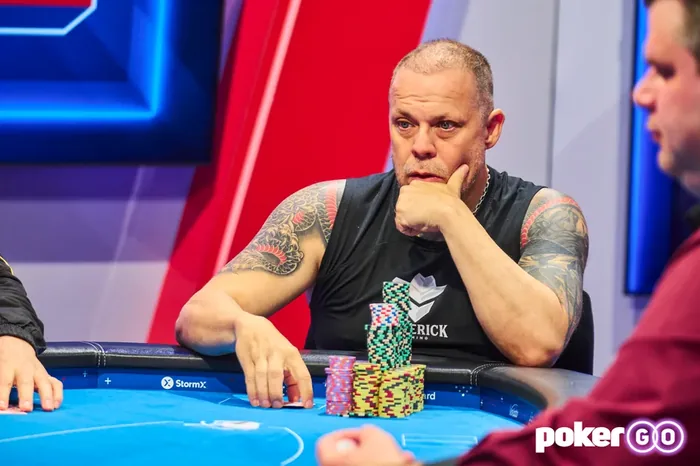
How old is Eric Persson?
Persson was born on March 21, 1975, making him 51 years old. He grew up in Hoquiam, a small timber and fishing town on the Washington coast.
Hoquiam sits at the mouth of the Chehalis River, population roughly 8,000. There is no obvious pipeline from that starting point to the Las Vegas casino industry, which makes Persson’s career path unusual by any measure.
Persson married his wife Ann in 2007. The couple have four children, including a son named Maverick, the inspiration behind the casino company’s name.
Latest News and Updates
Key developments involving Eric Persson and Maverick Gaming.
In June 2026, two more Maverick Gaming Washington casinos announced permanent closure effective July 31, eliminating 132 jobs. The U.S. Supreme Court denied certiorari in Maverick Gaming v. United States in October 2025, ending the tribal sports-betting challenge.
Maverick Gaming had filed for Chapter 11 bankruptcy in the Southern District of Texas in July 2025. Persson’s most notable poker moment came in February 2023, when he lost a $1,978,000 pot to Patrik Antonius on No Gamble No Future, the largest US-streamed pot at the time.
The kind of high-stakes action Persson plays on camera is not limited to televised tables. Several US-friendly platforms now host high-stakes cash games you can play online with meaningful buy-in levels and real competition.
For ongoing poker industry coverage, visit the latest high-stakes poker news.
Eric Persson FAQs
What is Eric Persson's net worth?
Eric Persson’s net worth is not publicly confirmed. Estimates range from roughly $40 million to several hundred million. His own 2022 claim of “nearing $1 billion” conflates personal wealth with the enterprise valuation of Maverick Gaming, which filed for Chapter 11 bankruptcy in July 2025.
Is Eric Persson a professional poker player?
No. Persson is a recreational player whose primary career is in casino operations. He has described his televised poker appearances as marketing for Maverick Gaming.
How did Eric Persson make his money?
Through executive roles in the casino industry, including Senior Vice President of slots at Las Vegas Sands and President/COO at Aruze Gaming, followed by founding Maverick Gaming in 2017.
What is Maverick Gaming?
A casino company Persson co-founded in December 2017 with Justin Beltram. At its peak it operated 31 properties across Washington, Nevada and Colorado. The company filed for Chapter 11 bankruptcy in July 2025 and has been liquidated through court-supervised sales.
What happened to Maverick Gaming?
Maverick filed for Chapter 11 on July 14, 2025, in the Southern District of Texas. Its assets have been sold through Section 363 sales totalling over $119 million. As of mid-2026, the proceedings remain open.
What is the biggest pot Eric Persson has played?
A $1,978,000 hand against Patrik Antonius on No Gamble No Future in February 2023. Persson lost the pot. The figure is sometimes misreported as $1,780,000, but the broadcast confirms the higher number.
Why does Eric Persson trash talk at the poker table?
Persson has said the on-camera persona is deliberate. He views every televised session as a branding opportunity and has stated the table talk generates more visibility than traditional advertising.
What tribe is Eric Persson a member of?
The Shoalwater Bay Indian Tribe, based in Tokeland, Washington. Some sources incorrectly list him as a member of the Lummi Nation.
How old is Eric Persson?
Persson was born on March 21, 1975, making him 51 years old.
What poker shows has Eric Persson appeared on?
High Stakes Poker, Hustler Casino Live and No Gamble No Future. He also competed in PokerGO’s High Stakes Duel 4 against Daniel Negreanu in May 2023. He has appeared in 64 tracked episodes totalling over 200 hours.
How much has Eric Persson lost at poker?
His tracked broadcast cash-game result is −$6,072,950 across 64 episodes, per third-party livestream trackers. His live tournament record shows three results totalling approximately $3,677.
Does Eric Persson have a law degree?
Yes. He holds a JD from Georgetown University Law Center (2001) and a bachelor’s degree from UNLV (1998).
Sources and Methodology
This profile is part of our coverage of poker’s biggest names and was compiled using verified public sources. The methodology below explains how we treat each category of information.
How we handle “net worth”
Persson’s net worth is not publicly audited. We report it as a range, never a single figure, and flag the distinction between personal wealth and enterprise valuation throughout. The Chapter 11 proceedings make any current estimate especially unreliable.
How we report earnings
Tournament data comes from Hendon Mob, the standard source for verified live results. Broadcast cash-game tracking comes from third-party livestream trackers. Both cover only publicly recorded sessions. Private game results are not included.
How we cover controversies
We report verifiable facts from court records, official filings and public statements. The Chapter 11 bankruptcy and tribal lawsuit details come from Kroll restructuring records and federal court documents. We do not speculate on motives or outcomes.
References
The sources below were used in researching this profile. Social media links are included for verification and attribution.
- The Hendon Mob - verified live tournament earnings, cashes and all-time rankings
- Kroll Restructuring - RunItOneTime LLC bankruptcy docket (Case 25-90191)
- PokerGO Tour - broadcast archive and Heads-Up Showdown results
- Maverick Gaming - official company site and corporate disclosures
- Wikipedia - basic biographical context (cross-checked where possible)
- X (Twitter): @iammaverick888 - official account