

SPR Poker: Stack-to-Pot Ratio Calculator and Strategy
SPR in poker is your stack-to-pot ratio: the effective stack divided by the pot on the flop. Open to 2.5bb, get called by the big blind, and you see the flop with 5.5bb in the pot and 97.5bb behind, an SPR of 17.7.

The lower the SPR, the weaker the hand you can happily get all in with. At SPR 2 an overpair is a clear stack off, while at SPR 17 the same overpair is worth one or two streets of value, and sets and two pair are the hands you play for stacks.
This page covers:
- A free SPR calculator that gives your zone, the equity you need to stack off and the bet sizes that get all in by the river
- The SPR formula with three worked examples, and why SPR is not the number of bets you have left
- Four commitment zones from low SPR to high SPR, and the hands that can stack off in each
- An SPR chart of the equity you need when all the money goes in
- How to set SPR with preflop sizing, plus tournaments, Spin & Gos and PLO
- Five common SPR mistakes and a worked hand at SPR 4
SPR Calculator
Enter your effective stack and the pot on the flop. The SPR calculator gives your stack-to-pot ratio and commitment zone, the equity you need if all the money goes in, and the bet size that gets the stacks in by the turn or the river.
For a heads up pot with no rake. The equity assumes all the money goes in now, and the bet sizes assume every bet gets called.
How to Use the SPR Calculator
- 1Effective stack: the smaller of the two stacks once the preflop betting is over. If you have 150 left and your opponent has 200, enter 150.
- 2Pot on the flop: everything in the middle when the flop is dealt, with the blinds, antes and every preflop bet included.
- 3Use one unit for both boxes: dollars, chips or big blinds all work. A decimal point or a decimal comma both work too, so 97.5 and 97,5 give the same answer.
- 4Press Calculate: change either number and the results update straight away. Copy the link to share the spot with a study partner.
What the Results Mean
The headline is your SPR and its zone. The four boxes below it turn that number into the decisions you face later in the hand.
| Result | What it tells you |
|---|---|
| SPR and zone | Your stack-to-pot ratio and which of the four commitment zones it falls in, with the hands that can stack off there. |
| If it all goes in now, you need | The equity a call needs when all the money goes in on the flop: SPR ÷ (2 × SPR + 1). |
| Pot sized bets to get all in | How many pot sized bets and calls it takes to get the stacks in. Each one triples the pot. |
| All in by the river (or turn) | The share of the pot to bet on every street so that the last bet puts you all in. |
Betting the same share of the pot on every street is called geometric sizing, and our bet sizing guide covers when that plan makes sense. We tested the calculator against a separate exact calculation in 12,011 entries, decimal commas and unusual inputs included.
What Is SPR in Poker?
SPR, short for stack-to-pot ratio, compares the effective stack with the pot on the flop. The formula is:
SPR = Effective Stack ÷ Pot on the Flop
The effective stack is the smaller of the two stacks in the hand, because that is the most either player can win or lose. If you have $500 and your opponent has $300, SPR uses the $300.
A high SPR (13 or more) means plenty of money behind compared with the pot, so there is room to play several streets. A low SPR (under 3) means the pot is already big compared with what is left, so you are close to committed before any postflop betting starts.
How to Calculate SPR: Three Examples
All three examples use 100bb stacks, the standard online buy in, and a heads up pot.
- 1Single raised pot: the button opens to 2.5bb, the big blind calls and the small blind folds. The pot is 5.5bb with 97.5bb behind, so SPR ≈ 17.7, enough for three pot sized bets with chips to spare.
- 23-bet pot: the cutoff opens to 2.5bb, the button 3-bets to 10bb and the cutoff calls. The pot is 21.5bb with 90bb behind, so SPR ≈ 4.2, about two pot sized bets.
- 34-bet pot: open to 2.5bb, 3-bet to 10bb, 4-bet to 25bb and call. The pot is 51.5bb with 75bb behind, so SPR ≈ 1.5, only a little more than one pot sized bet.
Each extra preflop raise cuts the SPR sharply. That makes preflop sizing the main way to set your SPR, covered in its own section below.
SPR Is Not the Number of Bets Left
A common shortcut says SPR 17 means 17 pot sized bets left. It does not, because every pot sized bet and call adds two pots to the middle, so the pot triples each time.
| SPR | Pot sized bets to get all in | Stack used, in starting pots |
|---|---|---|
| 1 | 1 | 1 |
| 4 | 2 | 1 + 3 |
| 13 | 3 | 1 + 3 + 9 |
| 17.7 | About 3.3 | Three pot sized bets still leave chips behind |
| 40 | 4 | 1 + 3 + 9 + 27 |
The pot sized bets box in the calculator works this out for any spot.
Low SPR vs High SPR: The Four Commitment Zones
Every flop SPR falls into one of four zones, from low SPR where you are already committed to high SPR where one pair should slow down. Each zone tells you which hands are strong enough to stack off and which should keep the pot small.
| Zone | SPR Range | Hands That Can Stack Off | Default Action |
|---|---|---|---|
| Commit | 0 to 3 | Top pair, overpairs, sets, big draws | Get the money in |
| Decision | 3 to 6 | TPTK (top pair, top kicker), overpairs, sets, combo draws | Depends on board and reads |
| Pot Control | 6 to 13 | Two pair+, sets, nut draws | Bet for value, not for stacks |
| Deep | 13+ | Sets, two pair, nut draws with redraws | Implied odds territory |
SPR 0 to 3: The Commit Zone
Below SPR 3 you are already committed. The pot is so big compared with what is behind that folding a strong one pair hand is almost always a mistake, so these hands should all go in on the flop:
- Top pair
- Overpairs: a pocket pair above every board card, such as Q-Q on a J-8-3 flop
- Sets and strong draws
Slow playing here wastes equity. With less than two pot sized bets behind, every check hands your opponent a free card.
SPR 3 to 6: The Decision Zone
TPTK, such as A-K on a K-9-4 board, and overpairs are usually good enough to commit here. The difference from the Commit Zone is that board texture and your opponent now decide the close spots.
On a dry board like K♦ 7♠ 2♣, TPTK at SPR 5 is a comfortable stack off. On a wet board like J♥ 10♥ 9♣, the same hand needs more care, because straights, flushes and combo draws (a straight draw and a flush draw together) are all live. This is the zone where most 3-bet pots play out at 100bb.
Below SPR 6, strong one pair hands can commit. Above SPR 6, they should check a street and keep the pot small.
SPR 6 to 13: The Pot Control Zone
One pair hands should bet once for value and then check. Getting all in at these depths needs 46% to 48% equity against the range that continues, and top pair rarely has that against raises and big bets on later streets.
The hands that play for stacks here are:
- Two pair or better: two pair, sets, straights and flushes
- Strong combo draws with 12 or more outs (the cards that complete your draw)
Our pot control guide covers the one pair hands that land here.
SPR 13+: The Deep Zone
Deep stacks favour speculative hands over one pair. Above SPR 13, even three pot sized bets do not get the stacks in, so an opponent who gets all in against you has usually raised along the way, with a range full of sets, two pair and big draws.
Top pair here is a one street value hand: bet the flop, check the turn and decide on the river. Sets, disguised two pair and nut draws with redraws (a flush draw that also has a straight draw) are the clean stack off hands.
SPR Chart: The Equity You Need to Stack Off
When all the money goes in on the flop, a call needs a minimum share of the final pot to break even, and that share depends only on SPR. It is the same idea as pot odds, worked out for your whole stack:
Breakeven Equity = SPR ÷ (2 × SPR + 1)
You do not need to memorise the formula. This SPR chart covers the spots you will see most:
| SPR | You Risk | Final Pot | Equity Needed |
|---|---|---|---|
| 1 | 1× | 3× | 33.3% |
| 2 | 2× | 5× | 40.0% |
| 3 | 3× | 7× | 42.9% |
| 4 | 4× | 9× | 44.4% |
| 6 | 6× | 13× | 46.2% |
| 10 | 10× | 21× | 47.6% |
| 13 | 13× | 27× | 48.1% |
How to Read the SPR Chart
The You Risk column always equals the SPR, counted in pots. At SPR 4 you risk 4 pots to win a final pot of 9 (your 4, their 4 and the 1 already in the middle), so you need at least 44.4% equity.
To see whether your hand clears that bar against a real range, run it through our poker equity calculator.
Two Things the SPR Chart Shows
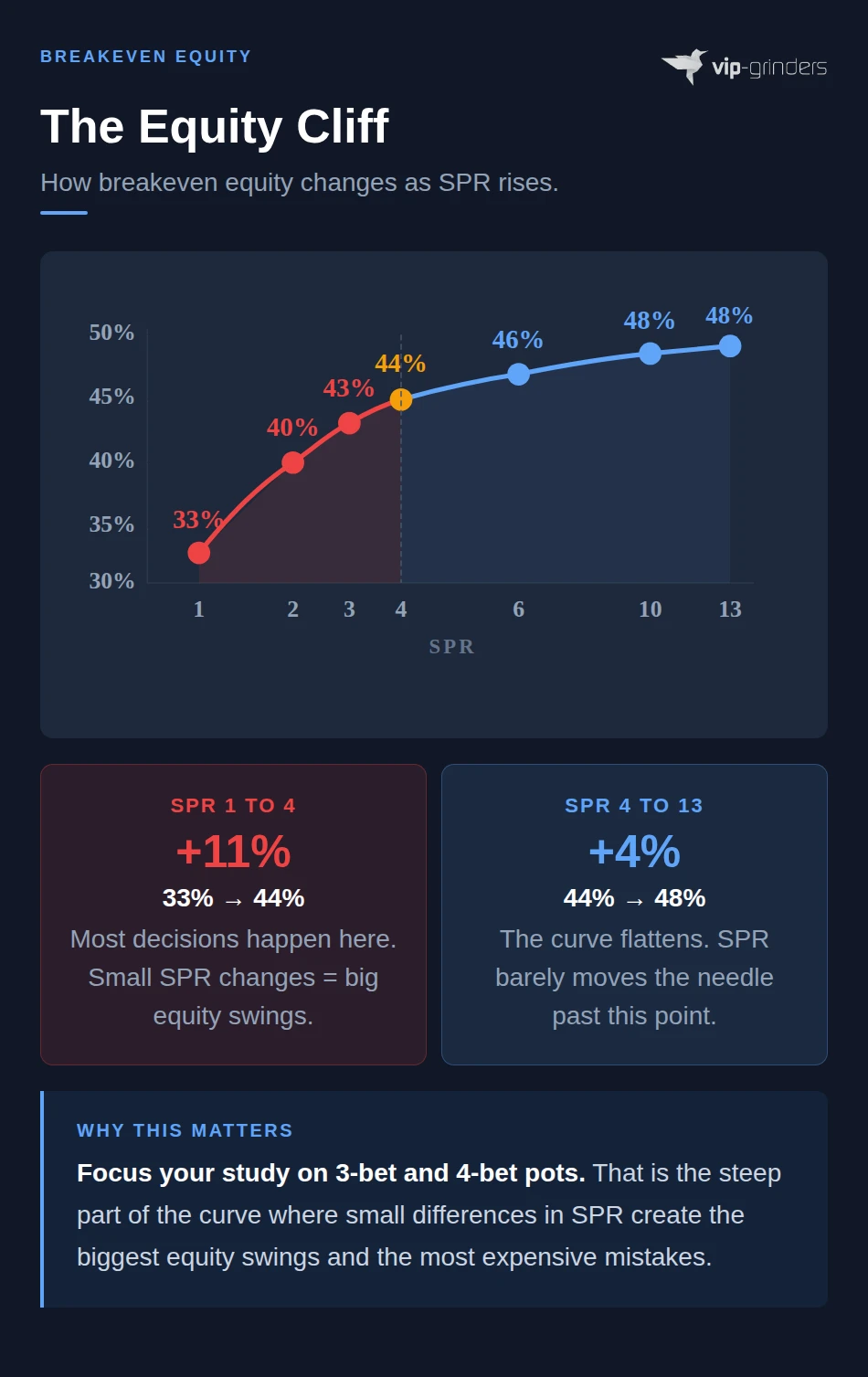
- The bar rises fast, then flattens. From SPR 1 to SPR 4 it climbs 11 points, from 33.3% to 44.4%. From SPR 4 to SPR 13 it climbs only about 4 more, to 48.1%.
- Your opponent’s range gets stronger as SPR rises. At SPR 1, players get it in with flush draws, gutshots (inside straight draws) and top pair. At SPR 13 the same all in is usually a set or better, so you need more equity against a range where it is harder to find.
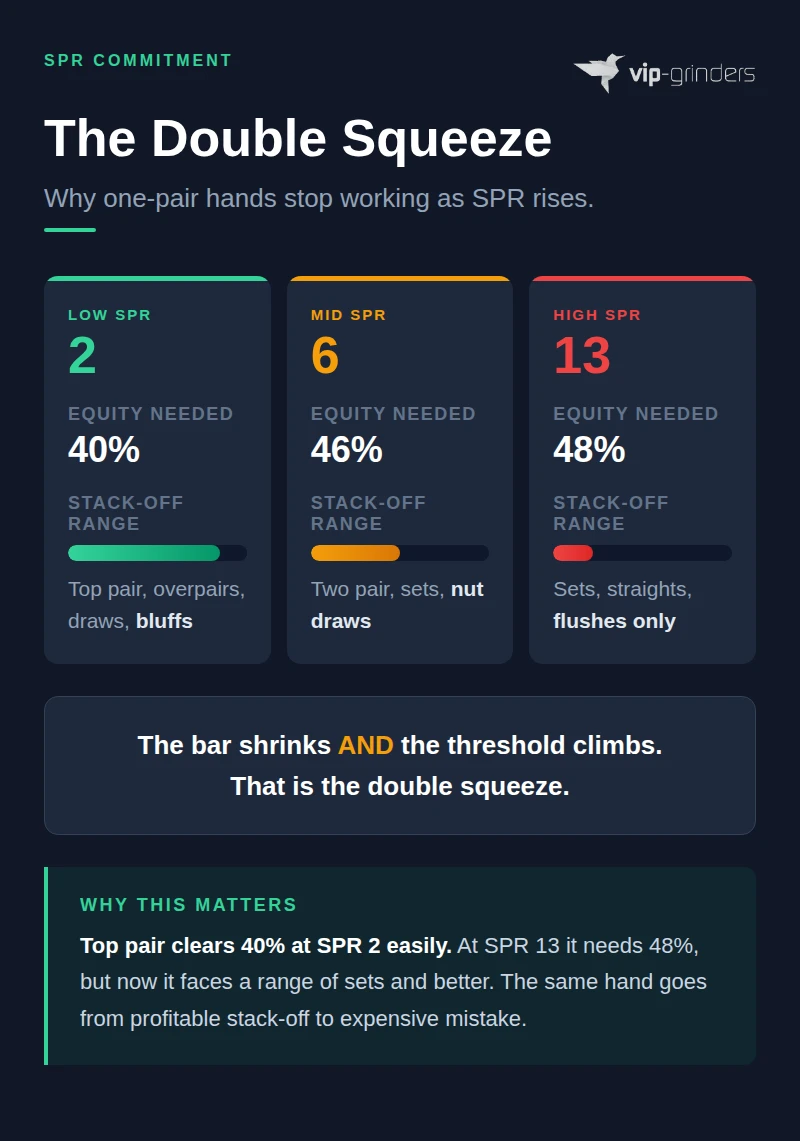
That is why one pair loses its stack off value as SPR rises. At SPR 2, top pair with a good kicker usually clears the 40% bar, while at SPR 10 the same hand needs 47.6% against a range with little below two pair in it.
Typical SPR by Pot Type
With 100bb stacks in a cash game, most flops land in a narrow band for each type of pot. Use the table as a quick benchmark before you call or raise preflop.
| Pot Type | Typical Flop SPR | What It Means |
|---|---|---|
| Limped pot | About 20 to 50 | Very deep. Depends on how many players limp. |
| Single raised pot (open and call) | About 13 to 18 | Deep. Speculative hands and set mining do well. |
| 3-bet pot | About 4 to 6 | Medium. TPTK and overpairs are stack off hands. |
| 4-bet pot | About 1.5 | Shallow. You are nearly committed before the flop. |
| 5-bet or preflop all in | Under 1 | No postflop decisions left. |
The 3-bet pot range depends on the size of the 3-bet: a 3x 3-bet in position that gets called leaves about SPR 5.6, while a 10bb 3-bet over a 2.5bb open leaves about 4.2. Bigger opens and shorter stacks move every row as well, which the preflop sizing and tournament sections below cover.
Which Hands Want Which SPR
Each type of hand does best at a different stack depth, and knowing which SPR your hand wants links the zones above to your preflop choices. If you are building your opening ranges, this table explains why some hands belong in 3-bet pots and others in flat calls.
| Hand Type | Target SPR | Why |
|---|---|---|
| AA, KK | 1 to 5 | Usually flop one pair. A low SPR lets you commit cleanly. |
| AK, AQ | 3 to 8 | TPTK hands. Their sweet spot is the 3-bet pot. |
| TT to 88 | 5 to 10 | Sometimes an overpair, sometimes a set mine. A medium SPR keeps both lines open. |
| 77 to 22 | 15+ | Set mining hands. They need deep implied odds to profit. |
| Suited connectors (such as 7-6 suited) | 10+ | Make flushes, straights and disguised two pair. They need room to win a big pot. |
Why Small Pairs Need Deep Stacks
A pocket pair flops a set or better only 11.8% of the time, about once in every 8.5 flops. To make calling a raise pay, the flops where you hit have to win enough to cover all the times you miss and fold, and that takes deep stacks.
At SPR 15 and above, the payout when you hit is big enough to justify the call. At SPR 4, the depth of a typical 3-bet pot, there is not enough behind, which is why flatting small pairs against 3-bets usually loses at 100bb. Our pot odds calculator includes implied odds, so you can check how much a set has to win in your own spots.
Small pairs and premium pairs want opposite SPRs. 3-bet the premiums to lower the SPR, and flat call the small pairs to keep it deep.
Why AA and KK Want Low SPR
Premium pairs flop a set only 11.8% of the time as well, so they usually hold a single pair on the flop. One pair is strong enough to commit in the Commit and Decision zones, but it becomes a marginal hand at SPR 13 and above, where opponents stack off mostly with two pair or better.
That is the main reason AA and KK should usually 3-bet: it pulls the SPR into the zone where they are strongest. Flat calling AA to trap tends to create the wrong SPR, a single raised pot at SPR 17 with a hand that plays best around SPR 4.
How to Set SPR With Preflop Sizing
SPR is not something that just happens to you. You set it before the flop with your open size, the choice between 3-betting and flat calling, and the size of your 3-bet.
Three Sizing Levers
- 1Open size. With 100bb stacks, a 2.5bb open leads to a flop SPR of about 15 to 18, a 3bb open to about 13 to 15, and a 4bb open, common in live games, to about 10 or 11. Bigger opens suit premium pairs that want a low SPR.
- 23-betting or flat calling. A standard 3-bet cuts the SPR from about 17 to about 4 to 6 in one action, which is why AA, KK and AK usually 3-bet: they want the Decision Zone, not the Deep Zone. Flat calling keeps the SPR high, the right line for small pairs and suited connectors that need room to realise their equity.
- 33-bet size. Over a 2.5bb open, a 3-bet to 8bb leaves a flop SPR of about 5.3, and a 3-bet to 10bb leaves about 4.2. With AA or KK, aim for a flop SPR between 3 and 5.
For the right 3-bet sizes in position and out of position, see our 3-bet guide.
How a Live Straddle Changes SPR
A straddle is a voluntary blind, usually twice the big blind, posted before the cards are dealt. At $1/$2 with a $200 stack, your stack is about 67 times the blinds, and a $4 straddle drops that to about 29.
The flop SPR falls just as hard. An open to $12 called by the straddle makes a $27 pot with $188 behind, an SPR of about 7, where a $6 open called by the big blind without a straddle leaves about 15.
When a straddle is on, treat your stack as half its usual depth. Tighten your speculative calls and 3-bet your premium hands more often.
SPR in Tournaments, Spin & Gos and PLO
Three things change SPR decisions in tournaments that cash games do not have:
- 1Rising blinds shrink your stack in big blinds every level, and your flop SPR falls with it.
- 2Antes make the pot bigger. A 1bb big blind ante makes the flop pot after an open and a call about 18% larger, which at 40bb is enough to move you from the Pot Control Zone (SPR 6.8) into the Decision Zone (SPR 5.8).
- 3ICM raises the cost of busting. Near the bubble or at a final table, losing your stack costs more than winning the same chips gains, so players fold hands they would get in with in a cash game at the same SPR.
Two Tournament Examples
| Spot | Stack and Pot | SPR | Zone |
|---|---|---|---|
| 40bb, 2.5bb open and a big blind call, 1bb ante | 37.5bb behind a 6.5bb pot | 5.8 | Decision |
| 10bb, min raise and a big blind call, 1bb ante | 8bb behind a 5.5bb pot | 1.5 | Commit |
At 40bb with antes, a standard open and one call already put you in the Decision Zone, so top pair is a stack off hand. At 10bb, any raise and call leaves an SPR under 2, which is why short stack play comes down to push or fold charts.
Our ICM guide explains how chip values change near pay jumps and how to tighten your stack off hands there.
In tournaments the blinds lower your SPR for you. In cash games you lower it yourself with preflop sizing.
SPR in Spin & Gos
Most Spin & Go formats start with 25bb. A 2bb min raise called by the big blind makes a 4.5bb pot with 23bb behind, an SPR of about 5.
That is the Decision Zone from the very first hand, which is why top pair and overpairs are stack off hands so often in Spins. For how stack depth shapes your play across a whole event, see our tournament strategy guide.
SPR in PLO
The SPR formula is the same in Pot Limit Omaha, but two things change:
- No overbets. Pot limit betting means you cannot overbet to reset the SPR later in the hand.
- Closer equities. PLO hands run much closer in equity, so stacking off takes a stronger hand than in Hold’em at the same SPR.
The raise sizes that give each type of PLO hand the SPR it wants are in our Pot Limit Omaha guide.
Five Common SPR Mistakes
These five SPR mistakes cost money at every stake, and most of them come from never checking the number at all.
- Stacking off with TPTK at SPR 13 or more. Against a range of sets, two pair and a few gutshot bluffs on a rainbow K-8-4, A-K has about 31% equity, far short of the 48.1% that SPR 13 needs. Bet it for value, then let raises at this depth slow you down.
- Folding overpairs at SPR 2. At SPR 2 you need only 40% equity to get all in. Even against a strong range of AA, KK, QQ, sets, top pair, A-K, A-Q and straight draws, J-J on T-8-3 has about 53%, so folding here burns money without a very specific read.
- Flatting speculative hands when the flop SPR will be low. Calling a 3-bet with 5-4 suited at 100bb leaves a flop SPR of about 4, too shallow to win enough when you hit. Work out the flop SPR before you call, not after.
- Changing the plan for no reason. Decide on the flop whether you are willing to get all in, using the flop SPR. The SPR keeps falling as bets go in and guides your turn and river sizes, but only a card or an action that changes your hand strength should change the plan.
- 3-betting KK too small. A min 3-bet to 5bb over a 2.5bb open leaves a flop SPR of about 8, which puts KK in the Pot Control Zone. Size the 3-bet for an SPR of 3 to 5, where premium pairs commit cleanly.
All five are fixed the same way: estimate the flop SPR during the preflop action. After a few sessions you will know it before the flop lands.
Worked Hand: 3-Bet Pot at SPR 4
This hand follows SPR from the preflop plan to the final decision, with every number worked out.
The Setup
$1/$2 cash game, $200 effective stacks. The cutoff opens to $6, you 3-bet to $20 on the button with A♣ K♥, the blinds fold and the cutoff calls.
The flop pot is $43 ($20 + $20 + the $1 and $2 blinds), with $180 behind.
SPR = $180 ÷ $43 ≈ 4.2 (Decision Zone)
Before the flop comes, the plan is already set: top pair or an overpair on a safe board is a hand to get all in with.
The Flop
Flop: K♦ 9♠ 4♥
You have top pair, top kicker on a dry rainbow board, the best case for TPTK at SPR 4. The cutoff checks, you bet $25 into $43, and the cutoff check-raises to $75.
The Decision
A check-raise looks strong, and the instinct is to slow down. Say the cutoff does this with sets of nines and fours, K-9, K-Q and K-J suited, plus draws and bluffs like Q-J, J-T, T-8 and 9-8 suited.
| Number | Value | Where It Comes From |
|---|---|---|
| Equity to get all in from the start of the flop | 44.7% | Risk $180 for a final pot of $403 |
| Price of the jam after the check-raise | 38.5% | $155 more to win a $403 pot, if they always call |
| A-K against the check-raise range | About 61% | Sets, K-9, K-Q, K-J and the draws and bluffs above |
A-K clears the price by a wide margin, so you jam. The plan was made before the flop, and the check-raise did not change it.
The read still matters: if this player only ever check-raises with sets and K-9, A-K has under 4% and folding is right. For the most expensive leaks across the whole game, ranked by what they cost in bb/100, see our common mistakes guide.
SPR FAQ
What does SPR mean in poker?
SPR stands for stack-to-pot ratio: the effective stack divided by the pot on the flop. It tells you how committed you are before any postflop betting, so 97.5bb behind a 5.5bb pot is an SPR of 17.7.
How do you calculate SPR in poker?
Divide the effective stack, the smaller of the two stacks, by the pot when the flop is dealt. With $180 behind and $43 in the pot, SPR is 180 ÷ 43 = 4.2, and the SPR calculator on this page works it out for you.
What is a good SPR in poker?
There is no single good SPR, because the right one depends on your hand. AA and KK want a low SPR of about 1 to 5 so they can commit with one pair, while small pairs and suited connectors want 13 or more for implied odds.
What is a high SPR in poker?
A high SPR is 13 or more, which is normal in single raised pots with 100bb stacks. At that depth even three pot sized bets do not get the stacks in, so top pair is usually worth one street of value. A low SPR, under 3, is the opposite: top pair and overpairs can get all in.
Do you calculate SPR on the turn or river?
You can, because the SPR keeps falling as bets go in, and the turn and river SPR help you size your bets. The flop SPR is the one that sets your plan, though, because it tells you before any postflop betting whether your hand is worth getting all in.
How does SPR change in 3-bet pots?
A 3-bet cuts the SPR sharply. With 100bb stacks a single raised pot usually reaches the flop at about 13 to 18, while a 3-bet pot reaches it at about 4 to 6, which is why top pair and overpairs become stack off hands.
Does SPR work the same in tournaments and PLO?
The formula is the same, but the hands you can stack off with change. In tournaments, rising blinds and antes push the SPR down while ICM makes busting more costly. In PLO, hands run closer in equity, so stacking off takes a stronger hand at the same SPR.
How many pot sized bets does it take to get all in?
Each pot sized bet and call triples the pot, so SPR 1 takes one bet, SPR 4 takes two and SPR 13 takes three. A single raised pot at SPR 17.7 needs about 3.3 pot sized bets, more than three streets of pot sized betting can get in.