

How Rakeback Changes Your Poker Strategy & Bankroll Math 2026
Most players treat rakeback as a nice extra that shows up at the end of the month. That is the wrong way to think about it. Your rakeback deal is a variable in every strategic decision you make: which format to play, how many tables to run, and what stakes your bankroll supports.
A player earning 2bb/100 at NL50 with a 35% deal has a higher effective win rate than a 4bb/100 winner with no deal at all. If you are not factoring your deal into these decisions, you are leaving value on the table.
For the raw $/hour calculations, see the hourly rate guide. For bankroll sizing rules by format, start with the bankroll management guide.
Here is what this guide covers:
- Effective win rate and why your tracker number understates your real edge
- Adjusted bankroll thresholds showing how a stronger deal lowers the buy-ins you need
- Format selection based on rake generated per hour at each deal level
- Table count optimization showing when volume beats win rate
Rakeback Is Not a Bonus. It Is Part of Your Win Rate.
Your tracking software shows your win rate as bb/100 earned at the table. That number does not include rakeback. But rakeback is income you earned by playing those exact hands, so your effective win rate is always higher than what your tracker displays.
The calculation is straightforward. A typical mid-stakes NLHE player generates around 10bb in rake per 100 hands (see our rake cost by stake breakdown for exact numbers by level). At a 35% deal, that returns 3.5bb/100 on top of your table win rate.
A player showing 2bb/100 in their tracker with a 35% deal is actually earning 5.5bb/100 in total. The table below shows how this scales across four win rate profiles.
| Table Win Rate | Rake Paid (bb/100) | Rakeback at 0% | Rakeback at 20% | Rakeback at 35% | Effective Win Rate at 35% |
|---|---|---|---|---|---|
| 0 bb/100 (break-even) | 10 | 0 | +2.0 bb/100 | +3.5 bb/100 | 3.5 bb/100 |
| 2 bb/100 (marginal) | 10 | 0 | +2.0 bb/100 | +3.5 bb/100 | 5.5 bb/100 |
| 4 bb/100 (solid) | 10 | 0 | +2.0 bb/100 | +3.5 bb/100 | 7.5 bb/100 |
| 6 bb/100 (strong) | 10 | 0 | +2.0 bb/100 | +3.5 bb/100 | 9.5 bb/100 |
Look at the break-even row. A 0bb/100 player with a 35% deal has an effective win rate of 3.5bb/100. That is not a losing player subsidized by a perk but a winning player whose edge comes from their deal rather than their table results.
Every decision in this guide flows from this reframe. Your bankroll requirements, format selection, table count, and volume targets should all be based on your effective win rate, not your tracker number alone. You can calculate your exact rate using the rakeback calculator.
How Your Deal Changes Your Bankroll Requirements
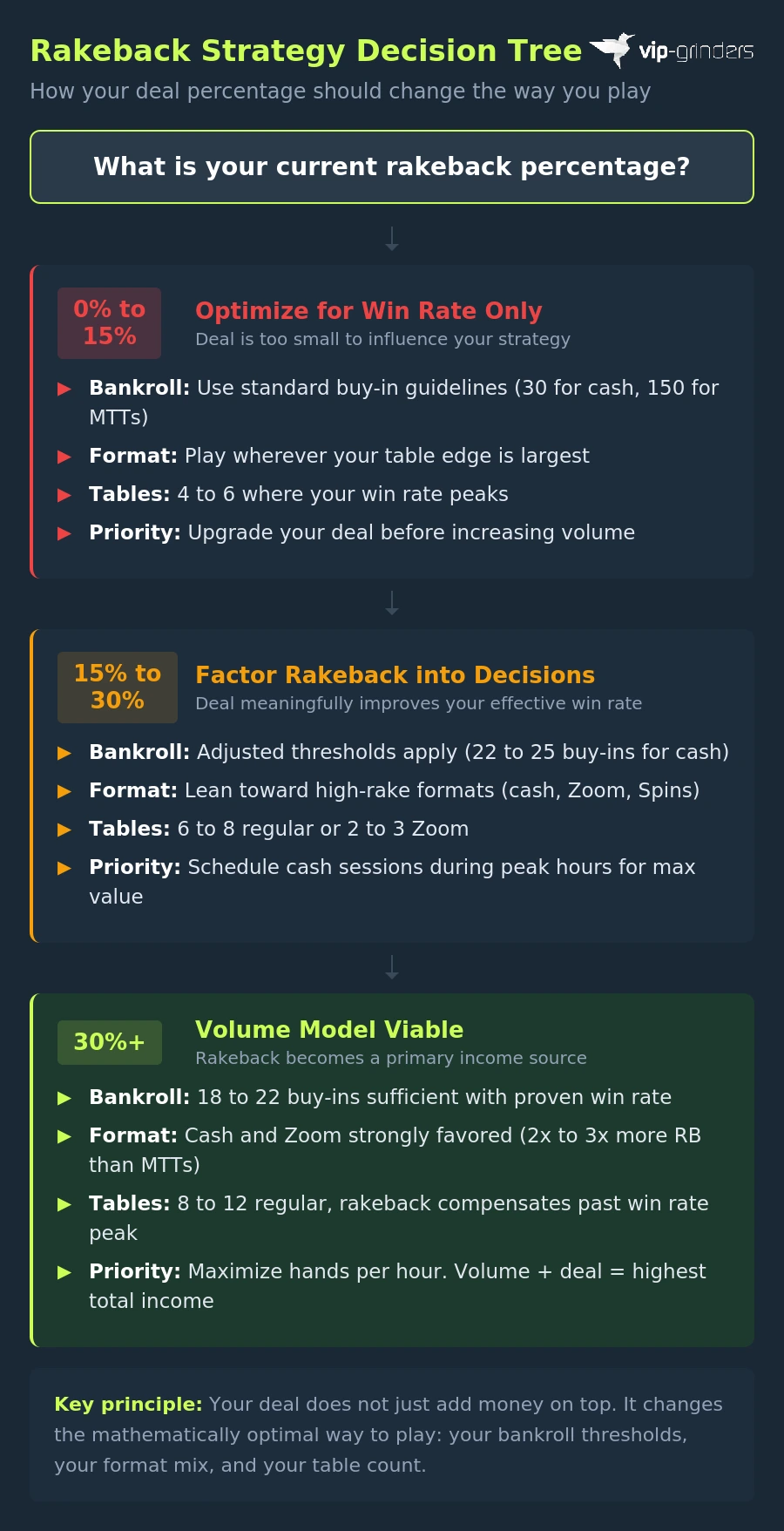
The standard bankroll guidelines (30 buy-ins for cash, 150 for MTTs) assume a player with a moderate win rate and no guaranteed income floor. Rakeback changes that assumption because it provides predictable monthly income regardless of your table results. Even during a 20 buy-in downswing, you are still generating rake and still receiving rakeback.
That passive income stream lowers your effective risk of ruin at every bankroll size. A player with a 35% deal who generates $15/hour in rake receives $5.25/hour back no matter what. Over a 100-hour month, that is $525 flowing into the bankroll whether the month was profitable at the tables or not.
Adjusted Bankroll Thresholds
The table below shows how rakeback affects the bankroll needed to maintain a 5% or lower risk of ruin for a NL50 cash game player at different deal levels. The baseline uses the standard 30 buy-in guideline for a 3bb/100 table winner.
| Rakeback % | Effective Win Rate | Risk of Ruin at 30 buy-ins | Buy-ins Needed for 5% Risk |
|---|---|---|---|
| 0% | 3.0 bb/100 | ~10% | 30 |
| 15% | 4.5 bb/100 | ~5% | 25 |
| 25% | 5.5 bb/100 | ~3% | 22 |
| 40% | 7.0 bb/100 | ~1% | 18 |
A player with no deal needs 30 buy-ins to keep their risk of ruin around 10%. The same player with a 40% deal only needs 18 buy-ins for a 5% risk, because their effective win rate has more than doubled. That freed-up bankroll can either sit as extra cushion or fund a faster move to the next stake.
What This Means for Moving Up
A grinder at NL25 with a 35% deal and a $1,500 bankroll has 60 buy-ins for NL25 but also 30 buy-ins for NL50, padded by higher rakeback from the bigger stake’s rake. If a shot fails, rakeback at the lower stake helps rebuild faster. Our guide to moving up stakes covers how rakeback accelerates each stake jump.
These adjusted thresholds apply to players with a proven win rate over 50,000+ hands. If your sample is small, stick with standard bankroll guidelines regardless of your deal.
Format Selection Based on Your Deal
Not all poker formats generate the same amount of rake per hour. Cash games and Zoom produce significantly more rake than MTTs at equivalent buy-in levels because you play more hands and more pots per session. PLO generates even more rake than NLHE at the same stake because pots run larger, which makes a strong rakeback deal especially valuable for PLO grinders.
If your deal is strong, formats with higher rake generation deliver more total income even if your table edge is slightly lower.
This is a strategic decision most players never consider. They choose formats based on what they enjoy or where they think they have the biggest edge, without factoring in how much their deal amplifies (or fails to amplify) each format’s output.
Rake Generated Per Hour by Format
The table below shows approximate rake generated per hour for a player at equivalent buy-in levels ($10 to $25 range), playing a realistic number of simultaneous games. The rakeback columns show what comes back at two common deal levels.
| Format | Tables | Rake/Hour | RB at 25% | RB at 40% | Monthly RB (100 hrs, 40%) |
|---|---|---|---|---|---|
| NLHE Cash 6-max (NL50) | 4 | $12.00 | $3.00 | $4.80 | $480 |
| NLHE Zoom (NL50) | 2 | $16.00 | $4.00 | $6.40 | $640 |
| Spin & Gos ($5) | 4 | $14.00 | $3.50 | $5.60 | $560 |
| MTTs ($11 avg) | 6 | $6.00 | $1.50 | $2.40 | $240 |
| Standard SNGs ($7) | 4 | $4.00 | $1.00 | $1.60 | $160 |
Zoom and other fast-fold formats generate the most rakeback per hour because the hand volume per table is roughly 2.5x that of regular cash. At a 40% deal, a Zoom grinder on just 2 tables earns $640/month in rakeback alone. An MTT player firing 6 simultaneous tournaments earns $240, less than half.
This does not mean everyone should play Zoom. Your table win rate still matters, and many players have a significantly higher edge in one format over another. If your win rates are comparable across formats, your deal should be the tiebreaker.
When Your Deal Should Shift Your Format Mix
- Deal above 30%: high-rake formats (cash, Zoom, Spins) become significantly more profitable relative to low-rake formats (MTTs, SNGs). If you currently split time between cash and MTTs, your deal is rewarding the cash hours much more heavily.
- Deal below 15%: rakeback adds little to any format, so your format choice should be driven entirely by where your table edge is largest. The deal is not a meaningful factor in your decision.
- Mixed-format grinders: if you play both cash and MTTs, schedule your cash sessions during peak hours (softer fields, higher win rate) and use MTTs as a supplement rather than a primary format. Your deal amplifies the cash hours far more.
The exception is players with a genuine edge in tournaments that they cannot replicate in cash games. A 20% ROI MTT specialist should not switch to cash just because the rakeback math favours it. But a player who wins at roughly the same rate across multiple formats should weight their schedule toward the format that generates the most rake per hour.
Table Count and Volume Decisions
The hourly rate guide showed that adding tables past a certain point drops your win rate faster than volume compensates. But that analysis assumed a fixed rakeback percentage. The optimal table count shifts depending on the strength of your deal, because a better deal increases the value of every additional table.
| Tables | Est. Win Rate | Table Profit/hr | RB/hr at 0% | Total at 0% | RB/hr at 40% | Total at 40% |
|---|---|---|---|---|---|---|
| 4 | 3.5 bb/100 | $5.25 | $0.00 | $5.25 | $4.80 | $10.05 |
| 6 | 2.8 bb/100 | $6.30 | $0.00 | $6.30 | $7.20 | $13.50 |
| 8 | 2.0 bb/100 | $6.00 | $0.00 | $6.00 | $9.60 | $15.60 |
| 10 | 1.2 bb/100 | $4.50 | $0.00 | $4.50 | $12.00 | $16.50 |
| 12 | 0.5 bb/100 | $2.25 | $0.00 | $2.25 | $14.40 | $16.65 |
At 0% rakeback, the optimal count is 6 tables ($6.30/hour). At 40%, total hourly keeps climbing all the way to 12 tables ($16.65/hour) because the rakeback income from each additional table more than offsets the win rate loss.
This is the “rakeback pro” model: deliberately accepting a lower win rate per table in exchange for higher total income through volume. It is viable under specific conditions.
- Minimum deal threshold: the volume-first approach only works at 30%+ rakeback. Below that, the rakeback income from extra tables is too small to compensate for the win rate loss.
- You must still be a winning player: the model works when your table win rate is small but positive (0.5 to 2bb/100). If adding tables pushes you to zero or negative, you are paying more in table losses than you earn in rakeback.
- NL25 and above only: at NL5 or NL10, the absolute dollar amounts are too small for volume to compensate. Rakeback pro math needs meaningful rake per table.
Our multi-tabling guide covers room caps, format recommendations, and the add/remove checklist. Signing up through VIP-Grinders rakeback deals is what makes the volume model viable in the first place. The $1,000/month guide shows how deal percentage affects the hours needed at each stake.
Common Mistakes with Rakeback and Strategy
Knowing that rakeback changes your decisions is the first step. Applying it correctly without overreaching is where most players go wrong.
- Treating rakeback as a bonus instead of income: if you do not include rakeback in your win rate and hourly rate calculations, you are making every downstream decision (stakes, volume, format) based on incomplete data.
- Choosing a room for game quality while ignoring the deal: softer games matter, but a room with slightly tougher games and a 40% deal often produces higher total income than a room with softer games and 10% rewards. Run the numbers before deciding.
- Not tracking rake generated: if you do not know how much rake you produce per month, you cannot calculate your effective win rate or evaluate whether your current deal is strong enough for your volume.
Every one of these mistakes is fixable by running the numbers once. Calculate your effective win rate with rakeback included, compare the rake generated across your formats, and check whether your current table count is optimal for your deal level. One afternoon of math can redirect hundreds of dollars per month.
Frequently Asked Questions
How does rakeback affect my win rate?
Rakeback adds directly to your effective win rate. A typical mid-stakes NLHE player generates around 10bb in rake per 100 hands, so a 30% deal returns 3bb/100 in rakeback on top of your table results. A player showing 2bb/100 in their tracker with a 30% deal is effectively earning 5bb/100 in total. Exact rake cost varies by stake.
Should I change my bankroll management based on my rakeback deal?
Yes. A stronger deal lowers your effective risk of ruin because it provides guaranteed income during downswings. A player with a 40% deal and a 3bb/100 table win rate has an effective win rate of 7bb/100, which means they need fewer buy-ins to maintain the same safety margin as a player with no deal.
Which poker format generates the most rakeback?
Zoom and fast-fold formats generate the most rake per hour because of their high hand volume. At NL50, 2 Zoom tables produce roughly $16/hour in rake compared to $12/hour from 4 regular cash tables. Spins also generate strong rake per hour. MTTs generate the least rakeback relative to time invested.
What is a rakeback pro?
A rakeback pro is a player who deliberately plays a high number of tables with a small per-table edge and earns the majority of their income from rakeback rather than table profit. This model requires a deal of 30%+ and the ability to maintain at least a small positive win rate across 8 to 12 simultaneous tables.
How many tables should I play to maximize my rakeback income?
It depends on your deal. At 0% rakeback, your optimal table count is wherever your table profit peaks (usually 4 to 6 tables). At 30% to 40%, the optimal count shifts higher because each additional table generates meaningful rakeback even if your per-table win rate drops. Test by adding one table at a time and comparing your total hourly including rakeback.
Does my rakeback deal matter more than game softness?
Neither one dominates in every situation. A room with very soft games and a 10% deal can still beat a tougher room with a 40% deal if the edge difference is large enough. But for players who win at similar rates across rooms, the deal is often the larger factor in total income because it scales with every hand you play.
Can a break-even player profit from rakeback alone?
Yes. A 0bb/100 player at NL50 on 4 tables with a 25% deal earns roughly $300/month in rakeback. With a 40% deal, that rises to $480/month. This is viable at NL25 and above where the absolute rake amounts are large enough to produce meaningful income.
How do I get a better rakeback deal?
The best deals are available through tracked affiliates who negotiate directly with poker rooms. Signing up through VIP-Grinders gives you access to deals between 25% and 60% at major rooms, plus exclusive freerolls and personal support. Players who register directly at a room without an affiliate code typically receive 10% to 15% default rewards.