

Variance in Poker: What It Is, Why It Hurts & How to Survive 2026
You can play every hand perfectly for a month and still lose money. That is not a flaw in your game. It is variance: the mathematical reality that short-term results in poker are dominated by luck, not skill.
A solid winner at NL50 can drop 20 buy-ins in two weeks without making a single strategic error. A tournament grinder can go 100 events without a cash. The math says these stretches are completely normal.
If your bankroll is not sized to handle them, start with our bankroll management guide first.
Here is what this guide covers:
- Standard deviation by format and what it means for your swings
- Downswing depth tables showing how bad things can realistically get
- Sample size thresholds for when your win rate actually means something
- How to use a variance simulator with your own numbers
What Is Variance in Poker?
Variance is the difference between what you expect to win over time and what you actually win over any given stretch. If your true win rate is 5bb/100 at NL50, you expect to earn roughly $250 over 10,000 hands. But your actual result could be anywhere from +$800 to negative $300 depending on how the cards fell.
That spread is variance. It exists because poker has a luck component built into every single hand. You control your decisions, but you do not control the cards.
A concrete example: you get all in preflop with pocket Aces against pocket Kings. You are an 82% favourite, so you expect to win roughly 4 out of 5. But losing 4 out of 5 has about a 7% probability, and over thousands of sessions, it will happen to you multiple times.
- Variance is not bad luck: bad luck is one hand going wrong. Variance is the entire pattern of your results deviating from expectation across hundreds or thousands of hands.
- It goes both ways: positive variance (running above expectation) is just as real and just as misleading as negative variance. Players on an upswing overestimate their skill. Players on a downswing question it.
Over a large enough sample, your decisions determine your profit. Over a small sample, luck determines almost everything.
Standard Deviation: The Number Behind the Swings
If variance is the concept, standard deviation is the number that measures it. Standard deviation (SD) tells you how widely your results scatter around your win rate from session to session. A higher SD means wilder swings, and a lower SD means smoother results.
In poker, standard deviation is measured in bb/100 for cash games (big blinds per 100 hands) and in % ROI for tournaments.
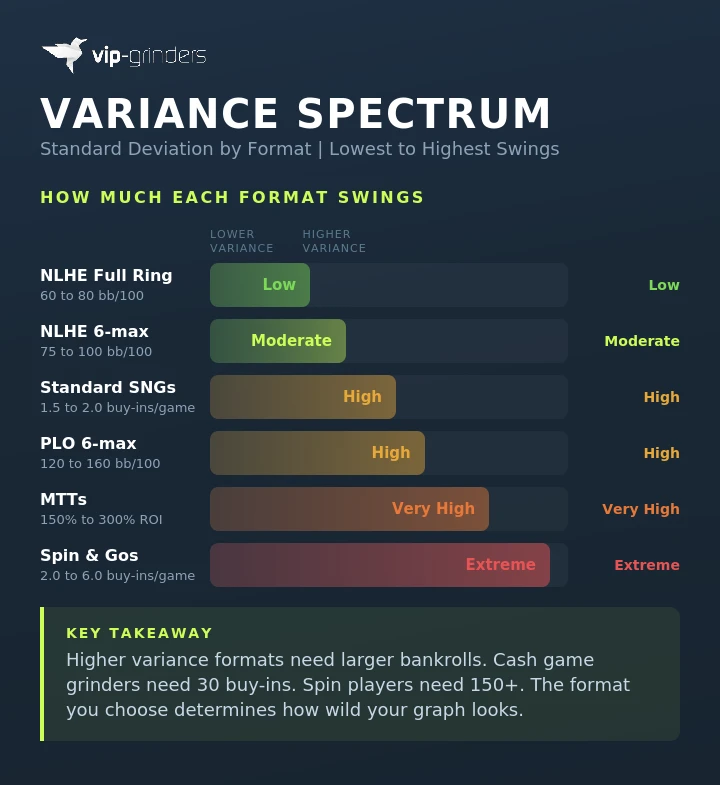
Typical Standard Deviation by Format
| Format | Typical Standard Deviation | What This Means in Practice |
|---|---|---|
| NLHE Cash (6-max) | 75 to 100 bb/100 | A 5bb/100 winner will regularly have 10,000 hand stretches where they lose money. Swings of 10 to 20 buy-ins are normal. |
| NLHE Cash (full ring) | 60 to 80 bb/100 | Slightly lower variance than 6-max because you play fewer hands per orbit and face fewer marginal spots. |
| PLO Cash (6-max) | 120 to 160 bb/100 | Pots are bigger and equities run closer. Swings of 30+ buy-ins happen routinely even for strong winners. |
| MTTs | 150% to 300% ROI | Enormous variance. A 20% ROI player can go 200+ tournaments without a significant cash. Top-heavy payouts drive the swings. |
| Standard SNGs (9-max) | 1.5 to 2.0 buy-ins per game | Lower than MTTs because fields are smaller. Still high enough for 50+ buy-in downswings over a few hundred games. |
| Spin & Gos | 2.0 to 6.0 buy-ins per game | The random multiplier adds a layer of variance on top of the hyper-turbo structure. The highest variance format in poker. |
The numbers in the SD column are what you input into a variance simulator. If you do not know your personal standard deviation, most tracking software (PokerTracker, Hold’em Manager) calculates it automatically from your hand history. If you do not use tracking software, the “typical” values in this table are close enough for planning purposes.
What Standard Deviation Actually Tells You
Think of your win rate as the centre line on your results graph. Standard deviation tells you how far your actual results bounce above and below that line over any given stretch of hands.
- 68% of the time: your results will fall within 1 standard deviation of your win rate. For a 5bb/100 winner with 80 bb/100 SD over 10,000 hands, that means results between roughly negative 10bb/100 and positive 20bb/100.
- 95% of the time: your results will fall within 2 standard deviations. Same player, same sample: results between roughly negative 25bb/100 and positive 35bb/100.
- 5% of the time: your results will be outside that range. This is where the truly brutal downswings (and the euphoric heaters) live. They are rare but mathematically guaranteed to happen eventually.
The win rate is the signal. The standard deviation is the noise. At small sample sizes, the noise drowns out the signal completely.
How Big Can Downswings Get?
This is the question every player asks during a losing stretch: “Is this normal, or am I actually a losing player?” The answer depends on your win rate, your standard deviation, and how many hands you have played. The table below shows the expected worst downswing for a NLHE 6-max cash game player (SD of 85 bb/100) at different win rates and sample sizes.
| Win Rate | After 25,000 hands | After 50,000 hands | After 100,000 hands | After 250,000 hands |
|---|---|---|---|---|
| 2 bb/100 | 15 to 20 buy-ins | 20 to 30 buy-ins | 25 to 35 buy-ins | 30 to 45 buy-ins |
| 3 bb/100 | 12 to 18 buy-ins | 15 to 25 buy-ins | 20 to 30 buy-ins | 25 to 40 buy-ins |
| 5 bb/100 | 10 to 15 buy-ins | 12 to 20 buy-ins | 15 to 25 buy-ins | 20 to 30 buy-ins |
| 8 bb/100 | 7 to 12 buy-ins | 10 to 15 buy-ins | 12 to 18 buy-ins | 15 to 22 buy-ins |
Read the 3bb/100 row. Over 100,000 hands (roughly 2 to 3 months of regular play), a solid winner should expect their worst downswing to reach 20 to 30 buy-ins. That is not a worst case scenario but the expected worst point in their graph.
The longer you play, the deeper your worst downswing gets. In relative terms, a bigger sample smooths your graph. In absolute terms, 250,000 hands will produce a deeper trough than 50,000 simply because there are more opportunities for bad stretches to cluster.
- If you are in a downswing right now: check the table above against your win rate and sample size. If your current downswing is within the expected range, the math says you are fine. Keep playing your game.
- If your downswing exceeds the expected range: it could still be variance (the table shows typical ranges, not hard limits), but it is also a signal to review your play. A 40 buy-in downswing over 50,000 hands at a supposed 5bb/100 win rate suggests your actual win rate may be lower than you think.
Sample Size: When Do Your Results Mean Something?
“How many hands do I need before I can trust my win rate?” More than you think. At small sample sizes your observed win rate is mostly noise, and it takes a surprisingly large number of hands before the signal (your true skill) becomes visible through the variance.
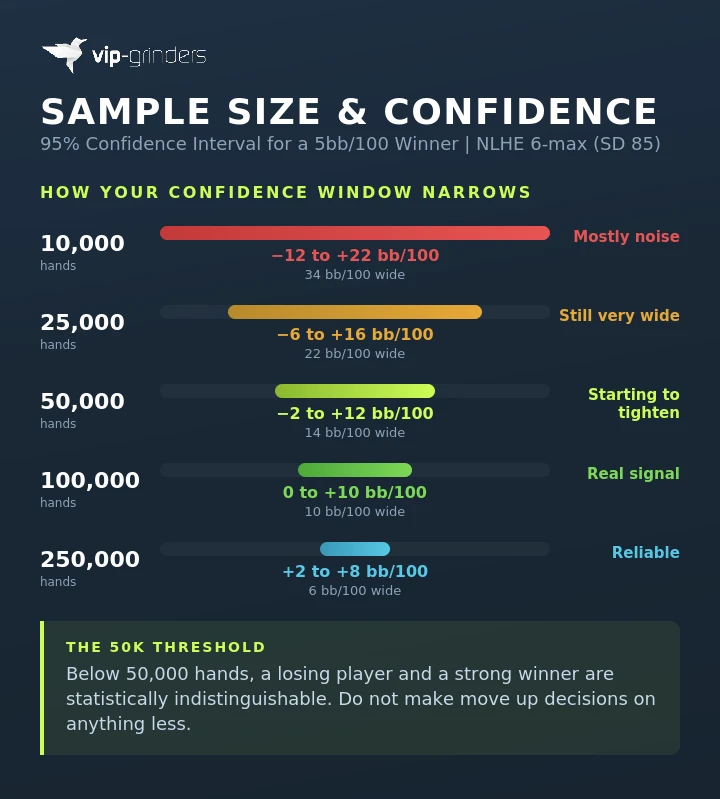
The table below shows the 95% confidence interval around an observed win rate of 5bb/100 at different sample sizes, assuming a standard deviation of 85 bb/100 (typical for NLHE 6-max).
| Sample Size | 95% Confidence Range | What This Means |
|---|---|---|
| 10,000 hands | negative 12 to positive 22 bb/100 | Your observed win rate is almost meaningless. A losing player could show 5bb/100 over this sample. |
| 25,000 hands | negative 6 to positive 16 bb/100 | Still very wide. You cannot distinguish a 2bb/100 winner from a 10bb/100 crusher. |
| 50,000 hands | negative 2 to positive 12 bb/100 | Starting to tighten. If you are still positive here, you are likely a winner, but the exact rate is unclear. |
| 100,000 hands | positive 0 to positive 10 bb/100 | Now you have a real signal. A positive result over 100,000 hands is strong evidence of a genuine edge. |
| 250,000 hands | positive 2 to positive 8 bb/100 | Your true win rate is narrowed to a tight range. This is where reliable conclusions live. |
At 10,000 hands, your confidence interval stretches from negative 12 to positive 22 bb/100. That is a 34 bb/100 wide window. A break-even player and a strong winner are statistically indistinguishable over this sample.
Anyone making decisions about moving up or changing their game based on 10,000 hands is working with almost no real information. The same applies to hourly rate calculations, which depend on a reliable win rate as input.
It applies to elite players too. Doug Polk finished a single tabled month at $1,421, a result that says almost nothing about how well he played, and our breakdown of seven documented bankroll challenges works through what a month can and cannot prove.
Format-Specific Sample Thresholds
| Format | Minimum Useful Sample | Reliable Conclusions |
|---|---|---|
| NLHE Cash Games | 30,000 to 50,000 hands | 100,000+ hands |
| PLO Cash Games | 50,000 to 75,000 hands | 150,000+ hands |
| MTTs | 300 to 500 tournaments | 1,000+ tournaments |
| Standard SNGs | 500 to 1,000 games | 2,000+ games |
| Spin & Gos | 3,000 to 5,000 games | 10,000+ games |
PLO requires more hands than NLHE because its higher standard deviation creates wider confidence intervals at every sample size. Our NLHE vs PLO comparison breaks down the full variance and cost gap between the two formats.
Spins need thousands of games because the random multiplier adds a layer of variance that does not exist in other formats. MTTs require the least in raw game count but the most in calendar time, since each tournament can last hours.
How to Use a Variance Simulator
The tables in this guide give you general ranges. A variance simulator gives you your specific scenario with your win rate, your standard deviation, and your sample size. If you have never run a simulation before, it takes about 30 seconds and the output will change how you think about your results.
What to Input
| Input | Where to Find It | If You Do Not Know It |
|---|---|---|
| Win rate (bb/100 or % ROI) | PokerTracker, Hold’em Manager, or your tracking spreadsheet. | Use 3bb/100 for cash games, 10% ROI for MTTs as a starting estimate. |
| Standard deviation | Same tracking software, under “More Stats” or “Session Stats.” | Use the typical values from the SD table earlier: 85 bb/100 for NLHE 6-max, 140 for PLO. |
| Number of hands or games | Your current sample size, or the number you plan to play over the next month. | Start with 50,000 hands for cash or 500 tournaments for MTTs. |
How to Read the Output
Most simulators run a Monte Carlo simulation: they generate hundreds of random “lifetimes” using your inputs and plot them on a graph. Each line represents one possible version of your results over that sample size. The key things to look for:
- The green band (or middle cluster): this is where most of your possible outcomes fall. If your actual results sit inside this band, you are running normally.
- The worst-case line: the bottom edge of the graph shows how bad things can get while still being within expected variance. Compare this to your bankroll size. If the worst-case line dips below your bankroll, you are underfunded for your stake.
- Risk of ruin percentage: some simulators calculate this directly. It tells you the probability of losing your entire bankroll given your inputs. Anything above 5% means you need more buy-ins or a higher win rate.
The single most useful exercise is to run the simulation twice: once with your estimated win rate, and once with a win rate 2bb/100 lower. If you think you are a 5bb/100 winner, see what the graph looks like at 3bb/100. Most players overestimate their edge, and the lower estimate often matches their actual experience more closely.
Our Variance Tools
We maintain two free simulators built specifically for this purpose. The poker variance simulator handles cash game inputs (win rate in bb/100, standard deviation, hands to simulate) and generates a Monte Carlo graph with confidence bands and risk of ruin. The MTT variance calculator is built for tournament players and uses ROI, field size, and payout structure to model tournament-specific variance.
Both tools are free, require no download, and take less than a minute to run. The output will either confirm that your current downswing is normal or show you that your bankroll needs adjusting.
What Variance Is Not
Variance explains a lot, but it does not explain everything. If you use variance as a blanket excuse for every losing stretch, you stop looking for leaks and your win rate stays flat.
The test is simple: review your biggest losing hands and check whether you would make the same decision again. If the answer is yes, you are running bad. If the answer is no, you found a leak.
If you are losing over 100,000+ hands, the probability that variance alone explains your results drops sharply. Your actual win rate is likely lower than you estimated.
The emotional side of handling downswings goes beyond what math can cover. For tilt prevention, session routines, and separating decision quality from results, see our mental game guide.
Frequently Asked Questions
What is variance in poker?
Variance is the difference between your expected results and your actual results over any given sample of hands or tournaments. It is caused by the luck element in poker: you control your decisions, but you do not control the cards. Over a large sample, skill determines your profit. Over a small sample, luck dominates.
How many hands do I need to know my real win rate?
For NLHE cash games, you need at least 50,000 to 100,000 hands before your observed win rate becomes a reliable indicator of your true edge. Below 50,000 hands, the confidence interval is so wide that a losing player and a strong winner can produce identical results. For MTTs, the threshold is 500 to 1,000 tournaments. For Spins, 5,000 to 10,000 games.
What is standard deviation in poker?
Standard deviation measures how widely your results scatter around your win rate. For NLHE 6-max cash games, a typical SD is 75 to 100 bb/100. For PLO, it is 120 to 160 bb/100. A higher standard deviation means bigger swings between sessions, even if your long-term win rate stays the same.
How big can a downswing get for a winning player?
A solid 3bb/100 cash game winner should expect a worst downswing of 20 to 30 buy-ins over 100,000 hands. Over 250,000 hands, that range extends to 25 to 40 buy-ins. These are not rare catastrophes. They are the expected worst points in a normal winning graph.
Is poker more luck or skill?
Both, but the balance depends on the sample size. Over 100 hands, luck dominates almost completely. Over 100,000 hands, skill is the primary driver of results. The short-term luck element is what creates variance, and the long-term skill element is what creates profit for winning players.
Does playing more tables reduce variance?
Not per hand, but it increases your total hand count per hour, which means you reach meaningful sample sizes faster. Playing 4 tables instead of 1 does not change the variance on any individual hand. It does mean you play 40,000 hands per month instead of 10,000, which tightens your confidence interval four times as fast.
Can I reduce variance by playing tighter?
To a degree. A tighter playing style involves fewer marginal spots and fewer large pots, which lowers your standard deviation. But playing too tight also reduces your win rate by folding profitable hands. The goal is not to minimize variance. It is to maximize your win rate while keeping your bankroll sized to handle the resulting variance.
What is the best way to deal with a downswing?
Review your play to confirm you are still making good decisions. If your decisions are sound, trust the math and keep playing. If your bankroll drops below 20 buy-ins for your current stake, move down. The worst response to a downswing is to move up in stakes or change your strategy based on short-term results.