

NLHE vs PLO: Which Poker Game Should You Play in 2026?
If you want the fastest learning curve, the cheapest study tools, and the lowest bankroll requirement, play NLHE (No-Limit Hold’em). If you want softer fields at low and mid stakes, higher potential win rates, and you thrive on action, play PLO (Pot-Limit Omaha).
Both games use the same hand rankings, the same positional concepts, and the same bankroll discipline. The differences are in how much variance you face, what it costs to play and study, and how developed the competition is.
This guide covers exactly how they compare.
- The rule differences between two-card and four-card poker
- Variance, bankroll, and why PLO swings 1.5 to 2 times harder
- Win rates, rake costs, and where the soft games are in 2026
- Study tools, what they cost, and which game has more free content
Both games are covered in depth in their own guides: Texas Hold’em rules and strategy and Pot-Limit Omaha strategy.
Use the table below to find your match. Every row is backed by the numbers in the sections that follow.
| Your Situation | Pick |
|---|---|
| New to poker, learning the fundamentals | NLHE |
| Limited bankroll (under 50 buy-ins for your stake) | NLHE |
| Want the cheapest study tools and the most free content | NLHE |
| Want to play live (most cardrooms spread NLHE, few spread PLO) | NLHE |
| Love action, big draws, and multiway pots | PLO |
| Strong tilt control, comfortable with large swings | PLO |
| Looking for softer fields at low and mid stakes in 2026 | PLO |
| Already solid at NLHE and want a new edge | PLO |
You don’t have to pick one forever. Many grinders play NLHE as their main format and add PLO tables when the action is soft. The core skills (position, pot odds, bankroll discipline) transfer between both games.
Two Cards vs Four: How the Rules Differ
Both games deal community cards to the middle of the table and use standard poker hand rankings. The differences are mechanical.
| NLHE | PLO | |
|---|---|---|
| Hole cards dealt | 2 | 4 |
| Cards you must use from your hand | Any (0, 1, or 2) | Exactly 2 |
| Community cards used | Any combo to make best 5 | Exactly 3 |
| Betting structure | No-Limit (bet up to your full stack) | Pot-Limit (max bet = current pot size) |
| Starting hand combinations | 1,326 | 270,725 |
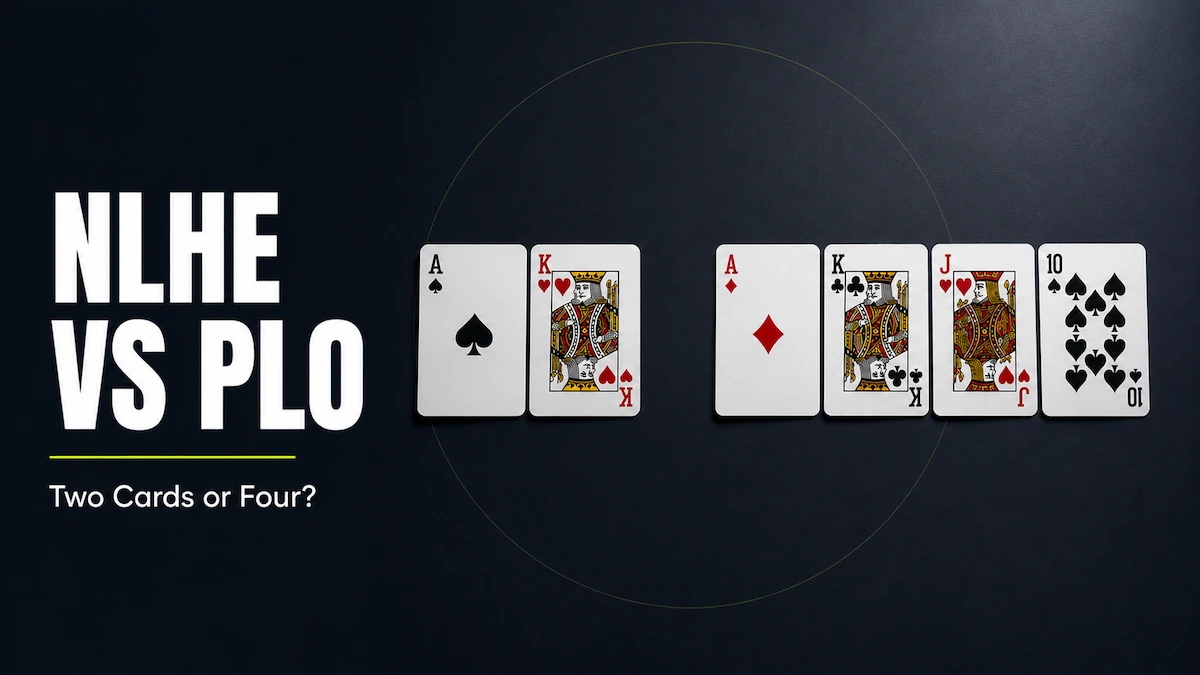
An NLHE hand looks like this: A♠ K♥. A PLO hand looks like this: A♠ K♥ J♦ 10♣. The extra two cards change everything about how the game plays.
The most important rule difference: in PLO, you must use exactly two of your four hole cards and exactly three from the board. This rule does not exist in NLHE, where you can use any combination of your hole cards and the board.
Here’s why it matters. If the board shows four hearts and you hold one heart, you do not have a flush in PLO. You need two hearts in your hand. In NLHE, that single heart would complete the flush.
Why 270,725 Combinations Matter
NLHE has 1,326 possible two-card starting hands, which collapse into 169 strategically distinct groups. That’s small enough to memorize as a preflop range chart.
PLO has 270,725 four-card combinations. No human can memorize ranges that large, which is why PLO relies more on hand categories (double-suited rundowns, paired aces with suits, broadway wraps) than on exact hand charts.
Position matters in both games, but the impact is amplified in PLO. With four hole cards creating more possible hands, the information advantage of acting last on every street is even larger than in NLHE.
Variance and Bankroll
This is the factor that should drive your decision more than any other.
| NLHE 6-max | PLO 6-max | |
|---|---|---|
| Standard deviation per 100 hands | 75 to 100 bb/100 | 120 to 160 bb/100 |
| Bankroll needed | 30 to 50 buy-ins | 50 to 100 buy-ins |
Standard deviation (SD) measures how far your results swing above and below your true win rate over a sample of hands. bb/100 means big blinds per 100 hands: the standard unit for measuring both win rates and variance in poker. PLO’s SD is roughly 1.5 to 2 times higher than NLHE’s.
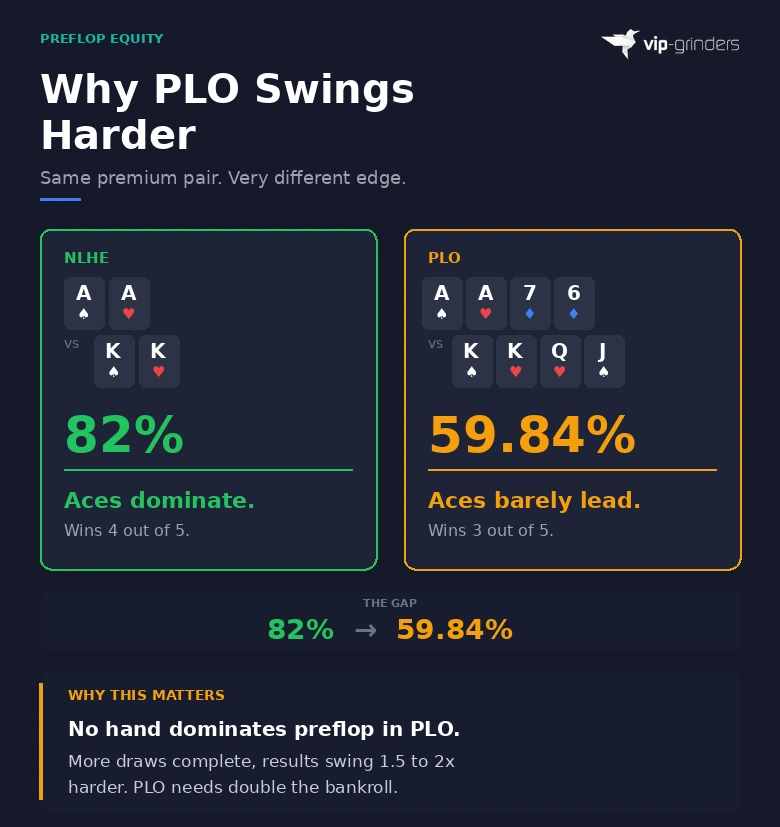
The reason is equity. In NLHE, A♠ A♥ against K♠ K♥ wins roughly 82% of the time preflop. In PLO, A♠ A♥ 7♦ 6♦ against K♠ K♥ Q♥ J♠ wins 59.84%.
No PLO starting hand is ever better than a 2 to 1 favourite before the flop. More hands go to showdown, more draws get there, and results swing harder.
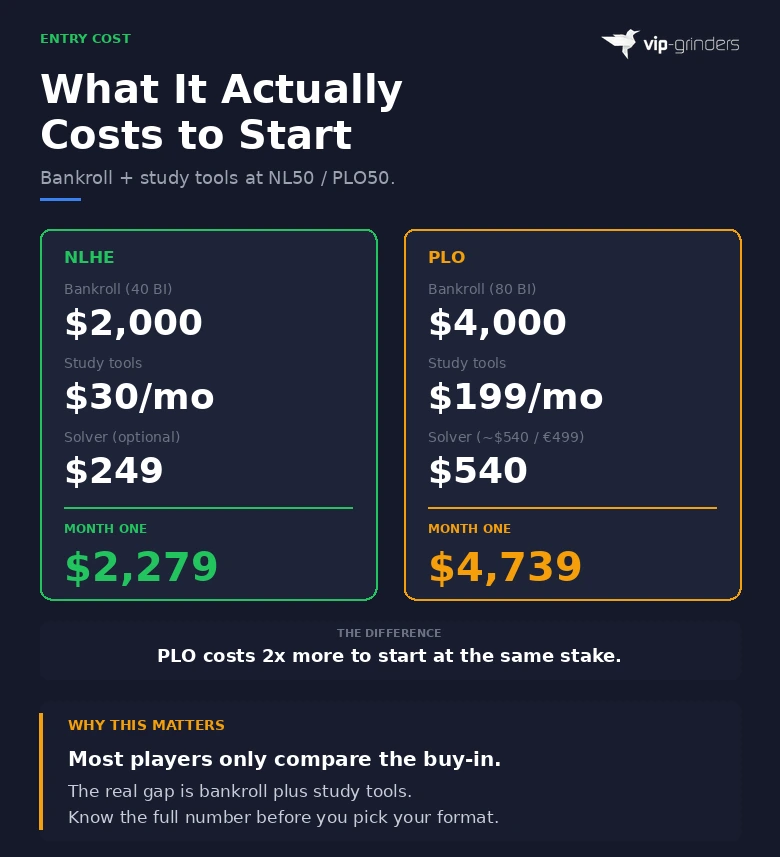
A $2,000 bankroll at $0.25/$0.50 gives you 40 buy-ins (the standard buy-in is $50). That’s within range for NLHE (30 to 50 needed) but short for PLO (50 to 100 needed), and our bankroll management guide breaks down the full requirements by format and stake.
Win Rates, Rake, and Where the Soft Games Are
What You Can Expect to Win
| Stake Level | NLHE Solid Winner | PLO Solid Winner |
|---|---|---|
| Micro (NL2 to NL10) | 5 to 10 bb/100 | 5 to 10 bb/100 |
| Low (NL25 to NL50) | 3 to 6 bb/100 | 3 to 7 bb/100 |
| Mid (NL100 to NL200) | 2 to 4 bb/100 | 2 to 5 bb/100 |
These are post-rake win rates for a consistent winner over a large sample (50,000+ hands). PLO shows slightly higher ceilings at low and mid stakes because the player pools are less studied. For a broader look at whether the grind still pays, our guide on whether poker is still profitable in 2026 covers both formats.
Higher variance in PLO means you need a much larger sample (100,000+ hands minimum) before your results reflect your true skill. A solid PLO winner can still experience 50 buy-in downswings that an equivalent NLHE winner would rarely see.
Why PLO Costs More in Rake
Rake is the fee the poker room takes from each pot, usually 5% up to a fixed cap. Both NLHE and PLO use the same nominal percentage, but PLO players pay more in practice.
PLO pots are larger on average because more players see the flop, pots go multiway more often, and the rake cap gets hit more frequently. At $0.10/$0.25 on PokerStars, PLO historically cost 112% more in rake per 100 hands than NLHE at the same stake. The gap narrows at higher limits but never disappears.
Rakeback (a percentage of your rake returned as cash) helps offset this. The full breakdown of how rake works and what it costs you covers every stake level.
Because PLO’s effective rake is higher, how rakeback changes your bankroll math matters even more in Omaha than in Hold’em.
Game Softness in 2026
A “soft” game means weaker opponents at the table. At low and mid stakes, PLO fields are generally softer than NLHE because fewer players have studied solver output (computer-generated optimal strategies) for four-card poker. Many PLO tables attract casino crossover players who enjoy the action but haven’t learned the math.
At higher stakes, the gap has closed. In late 2023, top PLO professionals boycotted GGPoker’s high-stakes tables after calculating that their net rake post-rakeback (~5 bb/100) exceeded their average net winnings (~2.5 bb/100). The games were structurally unbeatable for regulars at those limits.
The claim that PLO is soft holds at micro and low stakes in 2026. At mid-stakes and above, table selection becomes critical before you assume the games are beatable.
Study Tools and What They Cost
A solver is software that calculates the mathematically optimal play for a given situation. Here’s what the main study tools cost in each format.
| NLHE | PLO | |
|---|---|---|
| Main solver | PioSolver ($249 to $549) | MonkerSolver (€499) |
| Cloud trainers | GTO Wizard ($30 to $100/mo) | PLO Mastermind ($199/mo per format) |
| Free content | 20+ years of videos, articles, courses | Growing, but limited compared to NLHE |
| HUD support (opponent tracking software) | Full (PokerTracker 4, Hold’em Manager 3) | Supported, but requires custom stat setup |
NLHE has a 20-year head start in study material. A serious student can begin for $30 per month on GTO Wizard and find thousands of free video breakdowns on YouTube. PioSolver starts at $249 and runs comfortably on a mid-range computer.
PLO study costs more and offers less. MonkerSolver is the only mainstream four-card solver at €499, and it requires powerful hardware to run complex simulations.
PLO Mastermind, the most established PLO training platform, charges $199 per month per format with a 20% annual discount.
Because fewer PLO players train with solvers, the edge from even basic solver work is larger in PLO. In NLHE, GTO and solver-based strategies have been mainstream for years, and most regulars at NL25 and above already use them.
Frequently Asked Questions
Is PLO more profitable than NLHE?
At low and mid stakes, PLO currently offers slightly higher achievable win rates because the fields are softer. But the higher variance means you need a bigger bankroll and stronger emotional control to realize that edge. Neither game is universally more profitable: it depends on your skill, your bankroll, and your tolerance for swings.
Should I learn NLHE before playing PLO?
For most players, yes. NLHE builds the core skills (position, pot odds, hand reading, bankroll discipline) faster and cheaper because the study tools cost less and the two-card structure is simpler to analyze. Once those fundamentals are solid, transitioning to PLO is much smoother because the strategic logic transfers.
Is PLO harder to learn than NLHE?
PLO is more complex: 270,725 starting combinations versus 1,326, and no mainstream solver existed for four-card poker until MonkerSolver launched. But because the player pool is less developed, you don’t need to master the game as deeply to find an edge at low stakes. NLHE is simpler to learn but harder to beat because the competition is more studied.
Can I use the same HUD for both games?
Yes. PokerTracker 4 and Hold’em Manager 3 both support PLO tracking. You will need to customize your HUD layout with PLO-specific stats like VPIP by position and 3-bet frequency, since the default NLHE configurations don’t capture four-card dynamics well.
Which game has more players online?
NLHE by a wide margin at every stake level. PLO traffic is smaller but tends to peak during European evening hours and concentrates at micro and low stakes. If table availability matters to you, especially if you multi-table, NLHE offers more options around the clock.