

A Williamson County grand jury has declined to indict three of the Lodge Card Club's top shareholders on illegal gambling and organised crime charges. The no-bill, returned on April 28, 2026, ended the criminal case that began with the March 10 TABC raid on Texas's largest poker room.
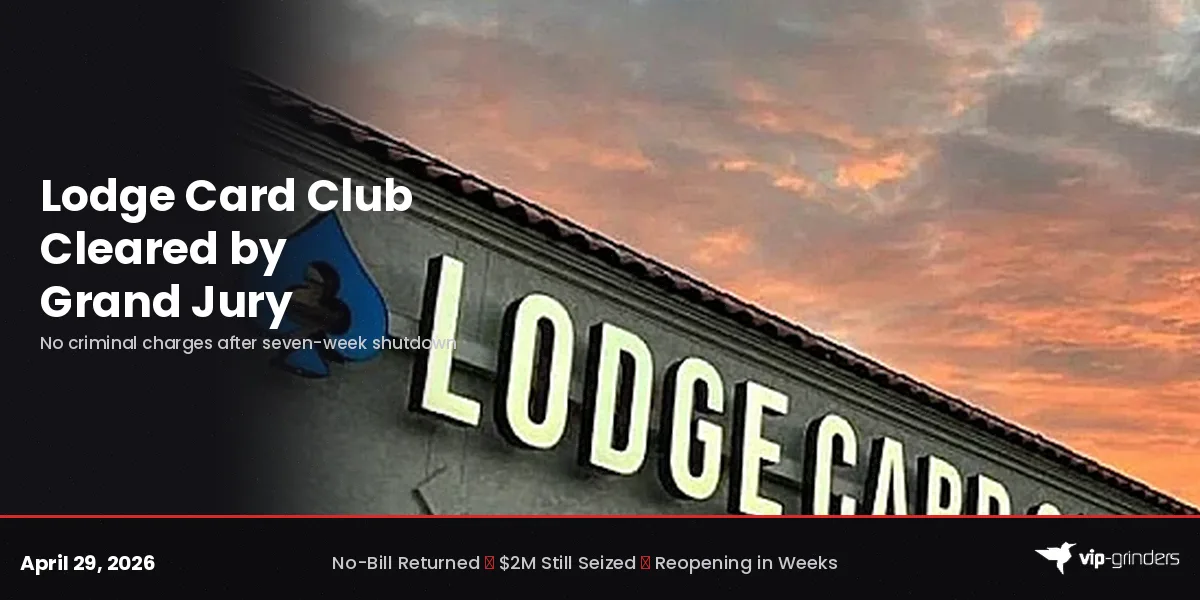
Lodge co-owner and three-time WSOP bracelet winner Doug Polk confirmed the outcome on X within hours and said the seized money and equipment would be returned. The Round Rock room reopened four weeks later, on May 26, 2026.
The decision capped a brutal seven-week ordeal. It included a leaked 22-page search warrant, mass layoffs, and the seizure of more than $2 million in assets. Money laundering, the lead allegation that drove March's headlines, was quietly abandoned by the state before the case ever reached a jury.
Grand Jury Returns No-Bill on Lodge Card Club
The grand jury convened to consider felony and misdemeanour charges against three of the Lodge's top shareholders: Doug Polk, Jake Abdalla, and Jason Levin. Fellow investors Brad Owen, Andrew Neeme, Nik Airball, and poker vlogger Ethan “Rampage” Yau were not named as targets.
Under Texas law, at least nine of twelve grand jurors must vote to indict. Fewer than nine did so, resulting in a no-bill.
- Date: April 28, 2026.
- Targets: Doug Polk, Jake Abdalla, and Jason Levin (three of the Lodge's top shareholders).
- Charges considered: organised criminal activity and illegal gambling.
- Outcome: no-bill returned. No indictments. No criminal charges filed.
The Lodge sent a representative to present arguments under Texas's closed grand jury rules. Defence attorneys and media were excluded from the proceedings.
What the No-Bill Does and Does Not Settle
The criminal threat is over for now, but this is not a full dismissal. A no-bill can theoretically be re-presented within the statute of limitations if new evidence surfaces. In practice, that almost never happens after a grand jury has already reviewed the case.
The bigger open issue at the time was the civil forfeiture. On April 8, one day before the 30-day statutory deadline, TABC lead agent Douglas Bell filed a nine-page civil asset forfeiture petition in the 480th Judicial District Court of Williamson County.
That filing rested solely on alleged violations of Texas Penal Code sections 47.03 and 47.04: keeping a gambling place, a Class A misdemeanour. It explicitly omitted money laundering.
The seized assets broke down as follows: roughly $1.35 million in cash taken from the premises, a $435,000 IRS refund cheque found during the raid, and approximately $721,000 frozen from Tempus Holding Inc. bank accounts.
The Lodge's legal team then had 20 days from service to file a Verified Answer contesting the forfeiture. In the end, the assets were released after the no-bill, clearing the way for the room to reopen.
Lodge Card Club Reopened on May 26
Polk's immediate priority after the no-bill was getting the doors open again. He set a target of two to three weeks on X, and the Round Rock room reopened on May 26, 2026, at 9am.
The main obstacle was staffing. Co-owner Jason Levin laid off the entire workforce on March 24, citing a communication from the Williamson County District Attorney's office that the club's business model did not comply with Texas law. Local outlet Community Impact put the number of laid-off staff at 144.
The Lodge's separately incorporated San Antonio location stayed open throughout the shutdown. Polk cited this as evidence that the action was targeted at the Round Rock operation specifically, not at the Lodge brand as a whole. At the time of the no-bill, three player issues were still open.
- Player funds: as of April 29, no players had been able to withdraw money from Lodge accounts, and no formal refund procedure had been announced.
- Wayne Harmon: won the Lodge Championship Series Main Event for $204,145 on March 9, one day before the raid, and had not been paid as of April 29.
- Polk's guarantee: he had pledged to personally cover seven figures in player liabilities if the Lodge could not pay. The expected return of the seized assets was set to make that unnecessary.

How the Case Collapsed From Five Felonies to a Misdemeanour
The original March 10 search warrant contemplated five charges: organised criminal activity, money laundering, promotion of gambling, keeping a gambling place, and possession of a gambling device. By April 8, every felony-level allegation had been dropped.
The warrant, obtained by media outlets on March 17, alleged $1.35 million in suspicious cash deposits routed through a collection centre during January and February 2025. Undercover agents had played $1/$2 No-Limit Hold'em at the Lodge at least six times between April 2025 and January 2026.
Polk addressed the warrant in his video addressing the April 9 deadline. He framed the money laundering allegation as circular: if the state considers the gambling illegal, every associated wire transfer becomes money laundering by definition.
He described the flagged transfers as a player safety measure designed to prevent customers from carrying large amounts of cash.
- March 10: TABC, IRS, and Williamson County Sheriff's Office execute search warrant. Five potential charges listed.
- March 16: Polk issues a formal statement denying any knowledge of money laundering.
- March 17: 22-page warrant becomes public. $1.35M in flagged deposits revealed.
- March 24: Lodge lays off all staff. Indefinite closure announced.
- March 31: Polk releases a video update and reveals the April 9 deadline.
- April 8: state files civil forfeiture. All felony allegations dropped. Case reduced to misdemeanour illegal gambling.
- April 28: grand jury returns no-bill. No indictments.
- May 26: the Lodge reopens in Round Rock.
- July 3: Polk ends any active role at the Lodge but remains a shareholder.
We covered each step as it happened: Polk's March 16 statement, the search warrant details, the asset freeze, the closure and staff layoffs and the civil forfeiture filing.
The state's remaining civil theory argued that the Lodge derived an economic benefit from gambling by selling food, drinks, merchandise, and streaming poker play. That was a narrower and weaker claim than money laundering, and the grand jury's refusal to indict on even the gambling charge significantly undermined it.
What This Means for Texas Poker Rooms
As of April 29, no other Texas card room had been raided since March 10, and dozens of rooms continued to operate under the same seat-fee model. The most striking contrast came on April 23, when Texas Card House Austin hosted the first-ever WSOP Circuit stop in Texas history, an 18-event series held in the same Williamson County jurisdiction.
Governor Greg Abbott told reporters on March 31 that gambling is unconstitutional in Texas and he does not see that changing in the next legislative session. The Texas Legislature meets only in odd-numbered years, so the next session begins in January 2027.
One additional legal thread was open at the time. Chicago-based class action firm Strauss Borrelli PLLC announced on April 2 that it was investigating Tempus Holding Inc. for potential federal WARN Act violations.
Federal law requires 60 days' notice for mass layoffs at employers with 100 or more workers. No complaint had been filed as of April 29.
What Happened Next
After the no-bill, the seized and frozen assets were released, and the Lodge reopened on May 26 with cash games and tournaments from the first day.
On July 3, Polk said he would remain a shareholder but step away from any active role at the Lodge, citing other projects and his growing family.
Fellow shareholder Andrew Neeme has announced no change to his minority holding, and the vlogger's net worth and Lodge stake are covered in his profile.
For US-based players who also want online action, ACR Poker's tournament schedule for US players offers a full slate of guaranteed events with satellites starting from $0.01.
For more on this story and the rest of the poker world, follow our ongoing poker news coverage.
