

Brazil banned fixed-odds betting by provisional measure on 25 September 2026, forced every licensed betting site offline on 6 October, and the measure never mentions poker. For Brazil's grinders the question is whether the machinery enforcing it can tell a poker client from a slot.
Medida Provisória 1.394 bans one product, the fixed-odds bet, and defines it in two sentences that peer-to-peer poker does not fit. The law is the easy part. Enforcement runs through bank payments and internet blocking, and one room has already reported Brazilian players locked out.
There sits the risk for Brazil's grinders. A room can be legally untouched and still unreachable, or reachable with a cashier that no longer works.
- What the measure bans: running, offering, brokering or advertising fixed-odds betting in Brazil, including from abroad, covering sports bets and online games.
- What it does not mention: poker, which falls outside both of the measure's definitions.
- In force since: 25 September, the day it was published in an extra edition of the Diário Oficial.
- Betting sites offline from: 6 October, ten days after publication.
- Still to come: a Supreme Court ruling on a suspension request, and a Congress vote within 60 days, extendable by 60 more.
Is There a Brazil Online Poker Ban? What MP 1.394 Covers
Article 1 of the measure prohibits the exploração, oferta, intermediação e publicidade of fixed-odds lotteries anywhere in Brazil, physical or virtual, and extends that to operators based abroad who serve people inside the country. The full text is on the Planalto legislation portal, 30 articles, signed by President Lula.
Article 3 does the work that matters for poker. A fixed-odds bet is money risked for a prize set by a multiplication factor. An online game is one whose result comes from a random number generator built into the rules.
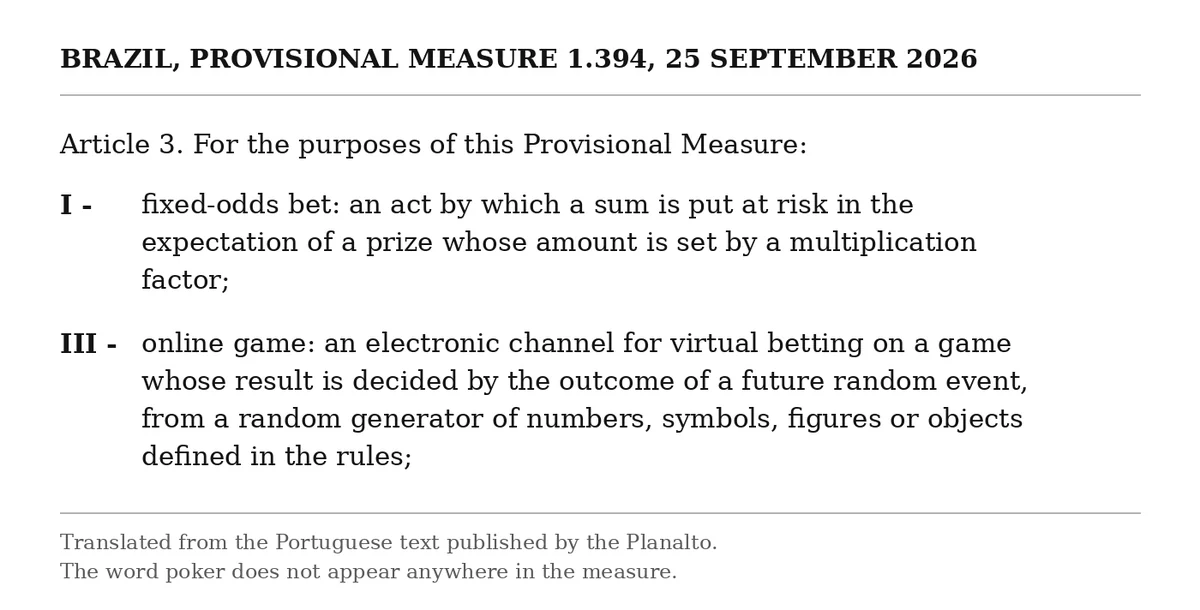
Peer-to-peer poker fits neither definition. The prize is the pot built from the players' own buy-ins, the house keeps a rake rather than paying a multiplied return, and no generator decides the hand against the operator. The word pôquer appears nowhere in the 30 articles.
| Product | Covered by MP 1.394 | Why |
|---|---|---|
| Sports betting | Yes | Art. 1 §1, real sporting events |
| Online casino, slots, crash games | Yes | Art. 3 III, outcome from a random generator |
| Caixa lotteries | No | Art. 1 §2 excludes other legal lottery formats |
| Peer-to-peer poker | Not named | Outside both definitions in Art. 3 |
It is an exclusion by definition, not an explicit carve-out. Nothing in the text says poker is permitted; it says what is banned, and poker is not on the list. The gap is where a future amendment, or an enforcement order, could land.
The Dates That Matter
The measure took effect on publication and set its own transition clock, counted in days from 25 September. Each deadline below comes from the article of the measure that sets it.
| Date | What happens | Article |
|---|---|---|
| 25 Sep | Measure in force, no new deposits at betting sites | Art. 30, Art. 7 §1 |
| 5 Oct | Last day betting sites may stay open | Art. 7, ten days |
| 6 Oct | Sites and apps offline, open bets voided and refunded | Art. 7 §2 |
| By 8 Oct | Operators send refund lists to banks, by CPF | Art. 8, two days |
| By 15 Oct | Banks refund balances to the player's own account | Art. 9, seven days |
| 25 Oct | All licences extinguished, no refund of licence fees | Art. 4, thirty days |
Balances that cannot be returned go to a dedicated account at Caixa Econômica Federal under Finance Ministry supervision. The summary on the Senado Federal legislative studies page puts the cost to the Treasury at R$1.541 billion in 2026 and R$5.150 billion in 2027, figures from the executive's statement of motives.
A provisional measure holds for 60 days and can be extended once for 60 more. If Congress does not convert it into law in that window, it lapses. The regulated market it replaces had only existed since the first licences went live in January 2025.
Room by Room: What Brazilian Players Can Still Reach
No poker room has been ordered offline, because none is a licensed betting operator under the measure. What differs is who has said anything, and who has reported trouble.
| Room | Player statement | Access | Payments |
|---|---|---|---|
| GGPoker | None found | None reported | No statement |
| CoinPoker | None found | None found | Crypto only |
| WPT Global | None found | None found | No statement |
| ACR Poker | None found | None found | No statement |
| PokerStars | Yes | Some players report difficulty | Monitoring payment services |
PokerStars is the only room to have put anything in writing. Its note to players said the peer-to-peer poker offering is not covered by the measure. That is the legal position, and nothing in the text contradicts it.
The practical position is different. The same note said some players in Brazil have been unable to reach the site since 6 October, and that the room is investigating whether internet providers are blocking it. A site can be outside the law and still behind a block list.
It also said player funds remain secure, that it is monitoring payment services, and that it will tell players about any change affecting deposits or withdrawals. The payments line matters more than the access line.
One question is open for PokerStars alone. It held a Brazilian licence as a poker-only operator when the regulated market opened in January 2025, and whether that licence is among those extinguished on 25 October, and what that means for a .com client, it has not said.
Pix and ISP Blocks: How the Ban Is Enforced
The measure does not rely on operators obeying it. Chapter IV hands the enforcement to banks and telecoms, and those are the provisions a poker player should read.
Article 14 bars banks, payment institutions and every participant in a payment arrangement, including instant payment, from processing betting transactions. That is Pix by description. Article 15 tells the Central Bank to build a system that rejects such transfers and returns the money automatically.
The reach is wider than the big banks. Article 14 §1 makes each payment arrangement bind every participant, including those not subject to Central Bank authorisation, and exclude any that does not comply. A processor serving both a sportsbook and a poker room sits inside that net.
- Article 14: no bank, payment institution or Pix participant may process betting transactions, with the Central Bank to regulate the detail.
- Article 15: the Central Bank builds an automatic reject-and-return system for Pix transfers linked to illegal betting.
- Article 23: the Finance and Justice ministries can order sites blocked or redirected; Anatel passes the orders to ISPs and CGI.br handles .br domains.
- Articles 19 to 22: platforms, app stores and operating systems must remove banned products, with fines up to 10% of Brazilian revenue, capped at R$50 million per offence.
Article 23 is the access rail. Block orders go from two ministries to Anatel, which passes them to every internet provider. A poker room sharing a domain, a processor or a wallet provider with a casino product can be caught by a list written for sportsbooks.
Why Crypto Rooms Sit Outside Article 14
A room that takes no Pix and no bank transfer gives the payment ban nothing to reject. Deposits in USDT or another token never touch a Brazilian payment arrangement, so the reject-and-return system has no transaction to see. Crypto rooms will feel this measure differently from fiat rooms.
It is resilience, not legal cover. Article 1 covers operators based abroad who offer betting products to people in Brazil, and a crypto room with a casino lobby is offering exactly that. The poker tables are outside the definitions; the slots next to them are not.
For a Brazilian who plays poker and nothing else, the practical difference is the cashier. A fiat room depends on Pix clearing a filter written for sportsbooks. A crypto room depends on nothing the measure can switch off.
What Happens Next
Two tracks decide whether the measure survives, and neither has reported. The betting trade bodies ANJL and IBJR asked Supreme Court justice Luiz Fux on 28 September to suspend it. Fux gave the Attorney General's office 72 hours on 2 October, and no ruling had appeared by 8 October.
| Track | Where it stands | Next date |
|---|---|---|
| Supreme Court | Fux has the AGU response, suspension request pending | No date set |
| Congress | Measure in force, 60-day clock running from 25 Sep | Around 24 Nov, extendable once |
The trade bodies' own filing gives a sense of the market being shut. Monthly deposits with licensed operators peaked at R$22.59 billion in October 2025 and had fallen to R$13.06 billion by June 2026, a 42% decline the petition uses to argue there was no urgency.
There is a precedent for watching an operator exit on a fixed clock. PokerStars US closed on 1 April with a 30-day withdrawal window, and the Brazilian timeline above runs on the same shape: shut the client, list the balances, refund by bank.
For poker the next hard fact will be a cashier. If a Brazilian Pix deposit to a poker room bounces, or a room publishes a payment notice, the measure has reached poker whatever its text says. We will carry that in our latest poker news as it lands.
