

Are Online Casinos Rigged? How Games Are Tested and What the Certificates Prove
Games at licensed online casinos are very unlikely to be rigged. Before release, an independent lab normally tests each game’s random number generator and payout rate. The strictest regulators then make casinos compare what every game pays with what it should.
That does not mean nothing ever goes wrong. Faulty games, unapproved versions and fake copies of real slots all exist, and regulators have fined casinos and suppliers for the first two. Fake copies turn up mostly on unlicensed sites.
How much of this protects you depends on the license. A UK or Ontario license comes with detailed testing rules, while Curaçao relies on standards written by other regulators and Anjouan’s published rules give game testing one sentence.
This guide covers:
- How online casino games are tested, and who tests them
- Whether a casino can change the odds while you play
- How live dealer games are checked, from the cards to the cameras
- How to check a game certificate, and what it does not prove
- Our simulation of how many spins it takes before your results can show anything
- Real cases of games that went wrong, and how to spot a fake one
Why Licensed Casinos Do Not Need to Rig Games
Nearly every casino game pays back less than it takes in over time, and that gap is the casino’s profit. On a slot with a 96% RTP, the casino keeps 4% of every bet on average, so $1 million wagered leaves it about $40,000.
That margin is written into the game’s rules, so the casino earns it without needing to know who wins any single spin. Our guide to the house edge on every casino game shows how much each game keeps.
Cheating players would add little to that margin and put the license at risk. These are the situations where a game can still end up unfair:
| Where You Play | What Checks the Game | What Can Still Go Wrong |
|---|---|---|
| Licensed casino, certified game | A lab test before release, and payout checks after launch under the strictest licenses | A software fault, which UK and Ontario rules make the casino fix before the game goes back online |
| Licensed casino, game not yet approved | The regulator, once it finds the game | A version that no lab has tested for that market |
| Unlicensed site | No lab and no regulator | A fake copy of a real game with changed payouts, and nowhere to complain |
How Online Casino Games Are Tested
In online slots and digital table games, software decides every result, so that is what a lab tests.
What a Random Number Generator Does
A random number generator, or RNG, produces the numbers a game turns into results, such as a reel position or a card. If those numbers can be predicted, so can the game.
Online poker learned this early. In 1999, security researchers found that Planet Poker’s shuffle was seeded from the server clock, which cut the possible decks to about 200,000. With their own two cards and the three flop cards, they could work out the whole deck.
That is why GLI’s standard says an RNG “shall not be seeded from a time value alone” and must be computationally infeasible to predict.
What the Lab Checks Before Release
Where testing is required, the lab runs these checks before a game goes live:
- 1The source code. The lab reads the code behind the RNG and confirms it does what its documentation says.
- 2Statistical tests. The raw numbers go through tests such as chi square, runs and serial correlation, which GLI's standard evaluates together at a 99% confidence level.
- 3The mapping. Every number the RNG can produce must be equally likely, and the code that turns numbers into symbols, cards or pockets must not add any bias.
- 4The payout. The lab simulates millions of rounds to confirm the game returns the RTP it was designed for.
- 5The exact build. In the UK, the test report records the game's name, RTP, software number and digital signature, so the version on the casino can be matched to the one that passed.
Who Tests Casino Games
A handful of labs test most online casino games, and each regulator keeps its own list of the labs it accepts. This is where the main labs stand on three of those lists:
| Lab | UK | Ontario | Kahnawake |
|---|---|---|---|
| GLI (Gaming Laboratories International) | Listed | Listed | Not listed |
| eCOGRA | Listed | Listed | Listed |
| BMM Testlabs | Listed | Listed | Not listed |
| Gaming Associates | Listed | Listed | Listed |
| Quinel | Listed | Listed | Listed |
| iTech Labs | Not listed | Not listed | Listed |
The UK and Ontario lists also include Eclipse, Global Lab and RiskCherry. iTech Labs has been owned by GLI since May 2023, and it is approved by Kahnawake rather than by the UK or Ontario.
What Each License Requires
Testing is only required where the license says so, and the rules differ a lot between regulators.
| License | Before a Game Goes Live | After Launch |
|---|---|---|
| UK Gambling Commission | Tested by an approved test house, with the report sent to the Commission before release | An annual games testing audit and ongoing checks of each game’s actual RTP |
| Ontario (AGCO) | Approved by the Registrar or certified by a registered lab | Monitoring for the life of the game, and a faulty game taken offline |
| Malta (MGA) | An RNG test certificate from an independent EU or EEA lab for new games | Games must return at least 85% on average over a calendar year |
| Kahnawake | Games run on a control system the Commission approves | Approved agents check that games in play stay fair and random |
| Curaçao (CGA) | No technical standards of its own, but it accepts UK, Malta, Ontario, New Jersey, Pennsylvania and British Columbia standards | Game certificates and test reports must be produced on request |
| Anjouan | RNGs must be certified by an approved independent testing facility, with no labs named | No published rule |
Many crypto casinos hold a Curaçao or Anjouan license, so the lab behind the games tells you more than the license alone.
After Launch: Retests and Payout Checks
A certificate covers the game as it was tested, so the strictest licenses keep checking once it is live:
- Retests. Under UK rules, any update that may affect fairness, such as a change to the RNG or the game rules, must be retested by an approved test house before release.
- Payout checks. UK casinos must compare each game's actual RTP with its advertised RTP, for underpayment and overpayment. Daily checks over the last 30 days of play are one accepted method, with a tolerance set by each game's volatility.
- Faults. In Ontario, operators must monitor the payback of games in play and make a game unavailable while a suspected fault is checked.
Can a Casino Change the Odds While You Play?
The most common rigging claim is that a casino tightens a game once you start winning. Under the strictest rules, that is banned outright.
What the Rules Ban
The UK Gambling Commission’s technical standards say: “Adaptive behaviour (that is, a compensated game) is not permitted.” Its guidance rules out “automatic or manual interventions that change the probabilities of game outcomes occurring during play.”
GLI’s standard adds that the RNG must not discard or change results based on earlier ones. At a Curaçao or Anjouan casino, this protection depends on whether the game was certified to standards like these. For third party slots, that certificate sits with the provider, and the certificate section below shows how to check it.
Common Rigging Myths Checked Against the Rules
These are the claims players raise most often on gambling forums, checked against UK and Ontario rules.
| The Claim | What the Rules Say |
|---|---|
| The casino lowers the RTP after a big win | Banned in the UK as a compensated game |
| New players win more at first | Banned in Ontario, where the odds cannot depend on the player or on earlier results |
| Big bets get worse odds than small ones | Banned in Ontario, unless the casino discloses it |
| The game shows near misses to keep you playing | Banned in the UK, although real near misses happen by chance |
| The casino changes a game’s settings during your session | Under UK rules, a game’s rules, payouts and odds cannot change while it is open for play |
| Demo mode pays better than real money | UK demo games must follow the paid rules, and a provider’s boosted demo should be labeled as one |
None of these rules stops a losing streak, which is how the house edge plays out over a short session.
Why the Same Slot Can Pay Differently at Two Casinos
There is one legal way for the same game to pay less at one casino than at another. Many providers certify several RTP versions, and the casino picks one before the game goes live.
Hacksaw Gaming, for example, lists four RTPs for Wanted Dead or a Wild. This is what each version keeps on average from every $100 wagered:
| RTP Version | Kept per $100 Wagered |
|---|---|
| 96.38% | $3.62 |
| 94.55% | $5.45 |
| 92.33% | $7.67 |
| 88.42% | $11.58 |
Our guide explains why the same slot can have a different RTP and how to find the version you are playing.
Choosing a version is not rigging, because each version is tested on its own. UK casinos must also show the RTP before you bet, and switching versions while a game is running would change its payouts, which UK rules only allow with the game offline and a notice to players.
Are Live Dealer Games Rigged?
Live dealer games use real cards, wheels and dealers streamed from a studio, so the result comes from physical equipment instead of an RNG. That moves the checks from the code to the studio itself.
How Live Studios Are Checked
UK rules set the standard in one line: “Live dealer operations must be fair and independently auditable.” Regulators in the UK, Malta and Kahnawake turn that into checks like these:
- Cameras on every game. UK studios must record all dealer activity, Kahnawake requires a continuous recording of every game kept for at least 15 days, and Malta can ask for a live feed from the studio.
- Card counts. Kahnawake requires a card count check in every shuffling procedure, and Malta's studio audit asks how each deck is checked for missing or extra cards.
- One use per card. Malta's audit also asks how the studio makes sure each card is used only once in a game.
- Roulette wheels. Malta's audit asks how often wheels are leveled and whether the winning numbers are analyzed for bias.
- Result reviews. UK studios must turn game logs into statistics to spot trends, and Kahnawake requires regular reviews of payout percentages.
Labs inspect the studios as well. GLI combines remote testing of each live game with an inspection of the studio itself, and eCOGRA reviews the procedures for shuffling, dealing and spinning roulette wheels.
When a Live Dealer Makes a Mistake
Dealers are people, so a misread card, a dropped card or a bad spin can happen. Kahnawake makes studios write down how they handle each of these, and automated card readers need a manual mode to correct a wrong result, with players told when it is used.
Under UK rules, if a game is interrupted before the result is decided, your stake goes back to your balance. Regulators also publish penalties when studios break their procedures:
| Regulator | What Happened | Fine |
|---|---|---|
| Pennsylvania, 2024 | Evolution’s Philadelphia studio failed to save surveillance video for nearly two days after a power outage, although the live cameras at its 14 tables kept running | $25,000 |
| New Jersey, 2025 | Evolution’s New Jersey studio was penalized for “various dealer error violations” | $12,000 |
Both penalties were for breaking studio procedures, and both regulators published them.
How to Check a Casino Game Certificate
A lab logo on a casino site only means something if the certificate behind it is real. You can check some of them yourself:
- 1Find the seal. Look in the footer of the casino or the game provider's site for a lab logo such as GLI, eCOGRA or iTech Labs.
- 2Click it. A working seal opens a page on the lab's own website, which for GLI is access.gaminglabs.com. A logo that links nowhere, or only to a PDF on another domain, cannot be checked with the lab.
- 3Check the name. The certificate should name the casino or game provider, or the company that owns it.
- 4Check what was tested. An RNG certificate covers the number generator, while each game and its RTP get their own test report.
- 5Check the result and the dates. Look for a pass result and a certification date. An expired GLI certificate shows as no longer available.
Not every lab publishes certificates this way. iTech Labs runs a portal for clients and regulators instead of a public search, and eCOGRA provides its certificate documents to relevant parties on request.
Pragmatic Play’s GLI certificate shows what a working one looks like. It opens from the GLI logo on Pragmatic’s own site:
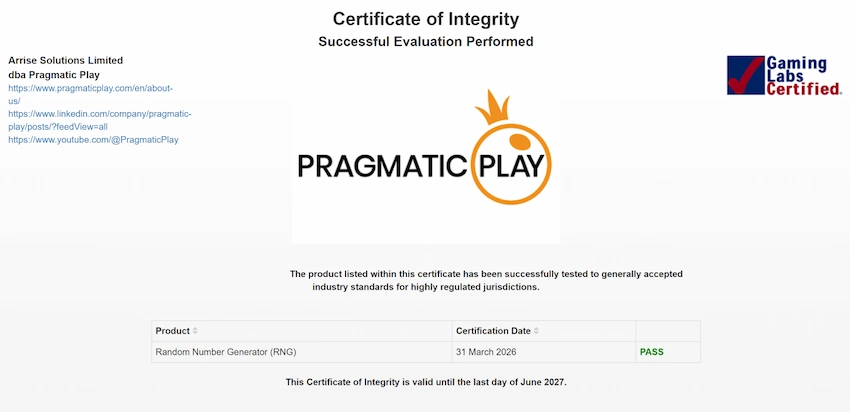
The certificate is issued to Arrise Solutions Limited, the company behind Pragmatic Play, and covers its RNG. It shows a PASS dated 31 March 2026, tested to “generally accepted industry standards for highly regulated jurisdictions.”
The “valid until” date of June 2027 is about the right to show the GLI logo, not the test itself. GLI says a certification stays valid as long as the product is used as it was tested.
What a Certificate Does Not Prove
GLI’s own certificate says it is not an approval or a warranty of the product, only a record that it was evaluated against the standards. It also has limits that matter to players:
- It covers a moment in time. eCOGRA calls its certifications point in time, and a major update needs a new assessment.
- It covers only what was tested. An RNG certificate does not cover the RTP version a casino chose for a game.
- It says nothing about the casino. Withdrawals, bonus terms and how your account is handled sit outside the lab's test.
- It cannot prove which copy you are playing. A lab logo can be pasted onto any site, so it does not show that the game in front of you is the version that passed.
Can Your Own Results Prove a Slot Is Rigged?
Most people who ask whether online slots are rigged are reacting to a bad run. Slot results swing so widely that your own history says very little about a game’s RTP, so we ran a simulation to measure how much play it takes before it does.
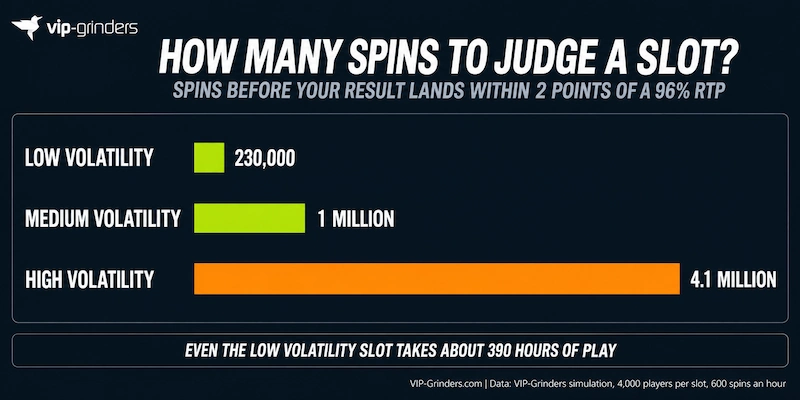
The answer is far more than most players ever get through. Even on a low volatility slot, it took about 230,000 spins before 95% of our simulated players saw a result within 2 points of the real RTP:
| Volatility | Spins to Get Within 2 Points | Spins to Tell 96% From 94% | Hours at 600 Spins an Hour |
|---|---|---|---|
| Low | About 230,000 | About 470,000 | About 390 |
| Medium | About 1 million | About 2.1 million | About 1,750 |
| High | About 4.1 million | About 8.4 million | About 6,800 |
How We Built the Test
The simulation used three example games and two tests.
- Three example slots. Each pays exactly 96% RTP, with top prizes of 200x, 1,000x and 5,000x the stake for low, medium and high volatility.
- 4,000 players per game. We counted how many spins it took before 95% of them had a result within 2 points of 96%.
- A 94% copy of each game. We cut every win's chance until the same game paid 94%, then counted the spins needed for 8 players in 10 to tell it apart from the 96% version.
Real slots differ, but the pattern holds for every game: the more a slot swings, the more spins it takes before your results mean anything.
Why the Casino Can See What You Cannot
A casino checking a game’s payout sees every spin from every player, which is why UK rules make it compare actual RTP with the advertised figure. A fault that no single player could spot shows up in that data far sooner.
A bad run on its own is not evidence of rigging. If losses start to feel like something you need to win back, our page on responsible gambling tools and limits covers what to use.
When Casino Games Did Go Wrong
Problems do happen, and the documented cases fall into two groups: insiders cheating players, and games that were faulty or never approved. The best known cheating cases come from online poker, the game VIP-Grinders has covered since 2013:
| Case | What Went Wrong | Outcome |
|---|---|---|
| UltimateBet, 2003 to 2007 | Insiders used 23 accounts to see opponents’ hole cards | Kahnawake fined the owner $1.5 million, and over $22 million was repaid to players |
| Absolute Poker, 2007 | A user linked to the site saw every player’s hole cards for about six weeks | Kahnawake fined it $500,000 and ordered two years of audits |
| Betfred UK, 2018 | A reported fault in a Playtech blackjack game, after which Betfred refused to pay a £1.7 million balance | The High Court gave the player summary judgment in 2021 |
| New Jersey, 2019 | NYX ran game software that had not been approved | A $100,000 penalty |
| Ontario, 2023 | Three operators offered games that no registered lab had certified | $70,000 in penalties |
| Connecticut, 2023 | A DraftKings slot paid no wins for a week after a software file failed to load | 522 players refunded, a $19,000 fine for DraftKings and $3,500 for supplier White Hat Gaming |
Only the two poker cases were deliberate cheating, and both came from insiders with access to hidden data, not from the RNG. The rest were faults or unapproved games, penalized by regulators or decided in court.
The Connecticut fault was easy to spot because the game paid nothing at all, yet players who complained were told their losses were normal randomness. A game paying 94% instead of 96% would never stand out that way, as the simulation above shows.
What to Do if You Think a Game Is Unfair
If a game looks wrong to you, collect evidence before you contact anyone:
- 1Save the details. Note the game, the provider, the date and time, and the round or bet IDs from your bet history.
- 2Check the RTP. Compare the figure in the game's info screen with the provider's own page, since a lower figure may be a different version.
- 3Ask support in writing. Ask the casino to have the provider check those rounds, and keep the reply.
- 4Escalate through the license. If the answer does not settle it, the next step depends on who licenses the casino.
Our guide to where to complain under each casino license lists the routes, from the casino’s own complaint process to the regulator. In the UK, a confirmed fault means the game comes down until it is fixed and retested, and affected players are repaid.
Fake Casino Games on Unlicensed Sites
A fake game copies the look of a real slot but runs on code the provider never released, so its payouts can be set to anything. GameCheck, a firm that works with game providers to find fakes, warns that graphics, animations and even the displayed RTP “can be copied or altered.”
Regulators and providers have flagged both fake games and real games turning up where they should not:
| Who | When | What They Said |
|---|---|---|
| UK Gambling Commission | October 2025 | Listed “copied gaming content” among the trends on illegal gambling sites |
| Spribe, maker of Aviator | February 2026 | Told Sweden’s regulator that one site was running games that were not its verified software |
| UK Gambling Commission | January 2025 | Warned that genuine games from licensed suppliers were reaching unlicensed sites through resellers |
So a familiar game title on a site proves nothing either way.
How to Check a Game Is Genuine
No single check is proof, but together these cut the risk:
- 1Start with the license. A license you can verify is the first filter, not the last.
- 2Compare the RTP. Check the figure in the game's info screen against the provider's own page. A match is a good sign, not proof, since a fake can copy the number.
- 3Use the provider's tool where one exists. PG Soft added a verification tool in 2024 that you open from the casino lobby to check a round's transaction ID with PG Soft.
- 4Look the casino up on GameCheck. Anyone can search a casino's domain, and the result shows whether providers have confirmed fake games there. Its seal covers a random sample of games, rechecked monthly, not every game.
Rainbet, for example, shows a GameCheck seal, and its profile showed no fake games at the last check on 29 September 2026. Provably fair checks do not answer this question either, because, as GameCheck puts it, a matching hash “says nothing about the game’s origin.”
How Crypto Casinos Prove Their Games Are Fair
Crypto casinos usually run two kinds of games, and each is checked differently. Slots and live tables come from providers such as Pragmatic Play or Evolution, whose games are tested by labs, while in house originals such as crash, dice and plinko are usually provably fair.
Provably fair means you can check each result yourself, in three steps:
- 1Before you bet. The casino shows a hash, which works like a fingerprint of a secret server seed.
- 2When you bet. Your result comes from that server seed, your own client seed and a bet counter.
- 3After the seed is revealed. You confirm it matches the fingerprint, so the result could not have been changed after you bet.
Our guide to verifying a provably fair bet yourself walks through it with a built in checker.
How Four Crypto Casinos Show It
We checked the fairness pages of four casinos we work with on 14 October 2026:
| Casino | How You Check Its Originals | Other Check on the Site |
|---|---|---|
| BC.Game | Server seed, client seed and nonce for every BC Originals round | Says its RNG is audited |
| Duel | A provably fair window that shows the next server seed’s hash before you bet | A ProvablyFair.org audit, certified June 2026, which we rechecked bet by bet |
| Rainbet | Fair Play and Verify tabs inside each Rainbet Original | A GameCheck seal for its third party games |
| Roobet | A provably fair page that explains how each game sets its result | A validation link for its Curaçao license |
None of the four shows a certificate from a testing lab such as GLI for its own originals, and that is normal. For in house games, provably fair is the check, while the lab certificates sit with the providers of the slots and live games. GLI’s July 2026 draft of its online gaming standard adds rules for provably fair RNGs, so labs may soon test both.
For casinos we have tested ourselves, see our crypto casino rankings, and our page on what we check before we list a casino explains the method.
Frequently Asked Questions
Are online slots rigged?
Slots at licensed casinos are tested by independent labs before release, and UK rules ban games that change their odds based on your play. Slot results swing widely, so a losing session is normal: in our simulation, even a low volatility slot needed about 230,000 spins before most players’ results landed within 2 points of its RTP. The bigger risk is a fake copy of a popular slot on an unlicensed site.
Do online casinos lower your odds after a big win?
Not at a casino regulated in the UK, where compensated games that adjust results during play are banned outright. Ontario also requires each outcome’s odds to stay the same whatever the game history or the player. A casino can only choose a game’s RTP version before it goes live, and changing it while the game is running needs the game taken offline in the UK.
Is online blackjack rigged?
Digital blackjack at a licensed casino uses a tested RNG, and lab standards require the shuffle to be unbiased. Live blackjack uses real cards, and studios must check their card counts and record every game on camera. The house edge comes from the rules and your decisions, not from a rigged deck.
Is live roulette rigged?
Live roulette uses a real wheel, so the checks cover the studio rather than software. Malta’s studio audit asks how often wheels are leveled and whether winning numbers are analyzed for bias, and UK studios must record all dealer activity and review game statistics. Every number keeps the same chance on each spin, so a run of reds or a number that has not come up for a while is not a sign of rigging.
What does RNG certified mean?
It means an independent lab has tested the game’s random number generator, reviewing its source code and running statistical tests to confirm its results cannot be predicted. Under GLI’s standard, those tests are evaluated together at a 99% confidence level. An RNG certificate covers the number generator only, not each game’s RTP or the casino itself.
How can I tell if a slot game is fake?
There is no single test, but you can compare the RTP the game shows with the figure on the provider’s website, use a provider verification tool where one exists and look the casino up on GameCheck. A fake can copy the displayed RTP, so a match is a good sign rather than proof.
Are crypto casinos rigged?
Many crypto casinos combine slots and live games tested through their providers with in house originals that are provably fair, so you can check each original’s result yourself. Most hold licenses with less detailed testing rules than the UK or Ontario, so the protection depends more on who made and certified the games than on the license alone. Provably fair proves a result was not changed, but it does not cover withdrawals or account terms.
What happens if a casino game is faulty?
In the UK, a confirmed fault must be reported to the Gambling Commission within five working days, and the game must be taken down until it is fixed and retested. Affected players should be repaid, and money that cannot be returned goes to a responsible gambling charity. In Ontario, the operator must make a faulty game unavailable until the issue is resolved.