

PLO Genius Review 2026: Is the Cloud PLO Solver Worth It?
Most serious PLO study still assumes you own a $5,000 workstation and a free weekend to crunch a single spot. PLO Genius bets you need neither. We bought the PRO plan, ran it through a 30-day stress test across PLO4 and PLO5 spots, and pressure-checked the output against MonkerSolver baselines.

We dig into all three pricing tiers, the GTO trainer mechanics, the 2026 update rollout, and how it stacks up against Vision, PLO Mastermind, and MonkerSolver.
By the end you will know which player profile gets the most ROI from the subscription and where the gaps in the postflop library actually hurt.
What Is PLO Genius?
PLO Genius is a browser-based PLO solver and GTO trainer built by Deepsolver sp. z o.o., a Polish software studio based in Warsaw.
It launched in 2023 and now covers PLO4, PLO5, and PLO6, pairing a large library of pre-computed preflop and flop solutions with an on-demand solver for turns and rivers, plus a drill module that quizzes you on the correct GTO action in solved spots.

Why The Cloud Matters
The library currently holds nearly 10 million calculations (about 9.9M as of June 2026) and grows by roughly 20,000 every week.
Coverage spans 6-max cash, heads-up, MTT, and live formats across PLO, PLO5, and PLO6. New sim packs ship continuously, with formats added based on community demand.
Where PLO Genius Fits in the Study Market
PLO Genius positions itself between two extremes of the PLO study market. On one side: video-heavy training sites like PLO Mastermind that teach concepts but cannot answer “what is the GTO bet on Kc7c2h with this exact range?”
On the other: raw solvers like MonkerSolver that produce that answer but require setup, abstractions, and tree compilation skills most players do not have.
The pitch is “solver answers without the solver workflow.” Whether that pitch lands depends entirely on which spots Deepsolver has solved, how often they refresh, and whether the trainer drills the right patterns.
Who Is PLO Genius For?
PLO Genius targets three player profiles. The product makes economic sense for each, but for different reasons.
NLHE converts moving to PLO
If you have a tracker database and a winrate at NLHE100 or above and you are seriously moving from NLHE to PLO, the trainer gives you a structured way to internalize four-card hand strength without burning six months in the wild. The drilling module replaces the “play 50K hands and hope you learn” approach.

This is the sweet spot. At PLO50 and above, the EV gap between approximate play and a tuned GTO baseline is large enough that the $99 to $199/month subscription pays for itself with a 2 bb/100 winrate adjustment.
Recreational PLO players who want structure
If you play PLO for fun but want to stop bleeding chips, the Edge tier covers enough preflop and basic postflop spots to plug obvious leaks. Not necessary at $0.05/0.10. Genuinely useful at $0.50/1 and up.
For deeper PLO theory before you buy, our Pot-Limit Omaha strategy guide walks through the prerequisites the trainer assumes you already know.
- Mobile-only grinders: no native mobile app yet, PLO Genius is browser and desktop first
- Micro-stakes recreational players: below PLO10 the winrate gain rarely covers the subscription
- Players unwilling to study 3 to 5 hours per week: the tool does not move winrate passively
PLO Genius Pros and Cons
After 30 days of structured testing, here is the honest breakdown:
Pro
- Cloud solver runs in any desktop browser, no workstation hardware required
- PLO, PLO5 and PLO6 all covered in one subscription (PLO6 on the PRO tier)
- Library of nearly 10 million calculations, growing by about 20,000 every week
- On-demand turn and river solver on PRO fills gaps the flop library leaves
- 20% VIP-Grinders code drops PRO to $159.20/month for the first quarter
Con
- Pre-computed flop library has gaps in deep-stack (200bb+) spots
- No native mobile app yet, a mobile version is still in development
- Aggregated reports and on-demand turn/river solving are gated to the PRO tier
- Browser UI is not built for serious mobile drilling sessions
- Trainer skips spots outside the library rather than offering heuristic feedback
PLO Genius Key Features
The Edge and PRO tiers include five distinct modules. We tested each across 30 days of normal study sessions. Below is what each does, what it does well, and what it does not yet do.
- Preflop engine: pre-solved PLO4 and PLO5 ranges, 100bb to 250bb deep
- Postflop solver: 9.9M+ calculations, under 2-second node loads
- GTO trainer: EV-scored drilling with accuracy tracking by node type
- Aggregated reports: action frequencies grouped by board texture (PRO)
- MonkerSolver import: run your own trees in the same EV viewer (PRO)
Preflop Engine (PLO4 and PLO5)
PLO Genius ships pre-solved opening, 3-bet, 4-bet, and 5-bet ranges for the formats most cash grinders actually play: 100bb, 150bb, 200bb, and 250bb deep, 6-max and heads-up, across the three rake structures used by the major sites (cap, weighted contributed, no rake). PLO and PLO5 ranges are included from the Edge tier; PLO6 ranges come with PRO.
The range explorer lets you compare your hero range against villain’s solved response at any node, and the EV-of-each-hand view shows you exactly which combos justify a call or fold in marginal spots. Click any combo and PLO Genius drops you straight into the postflop solver for that spot.
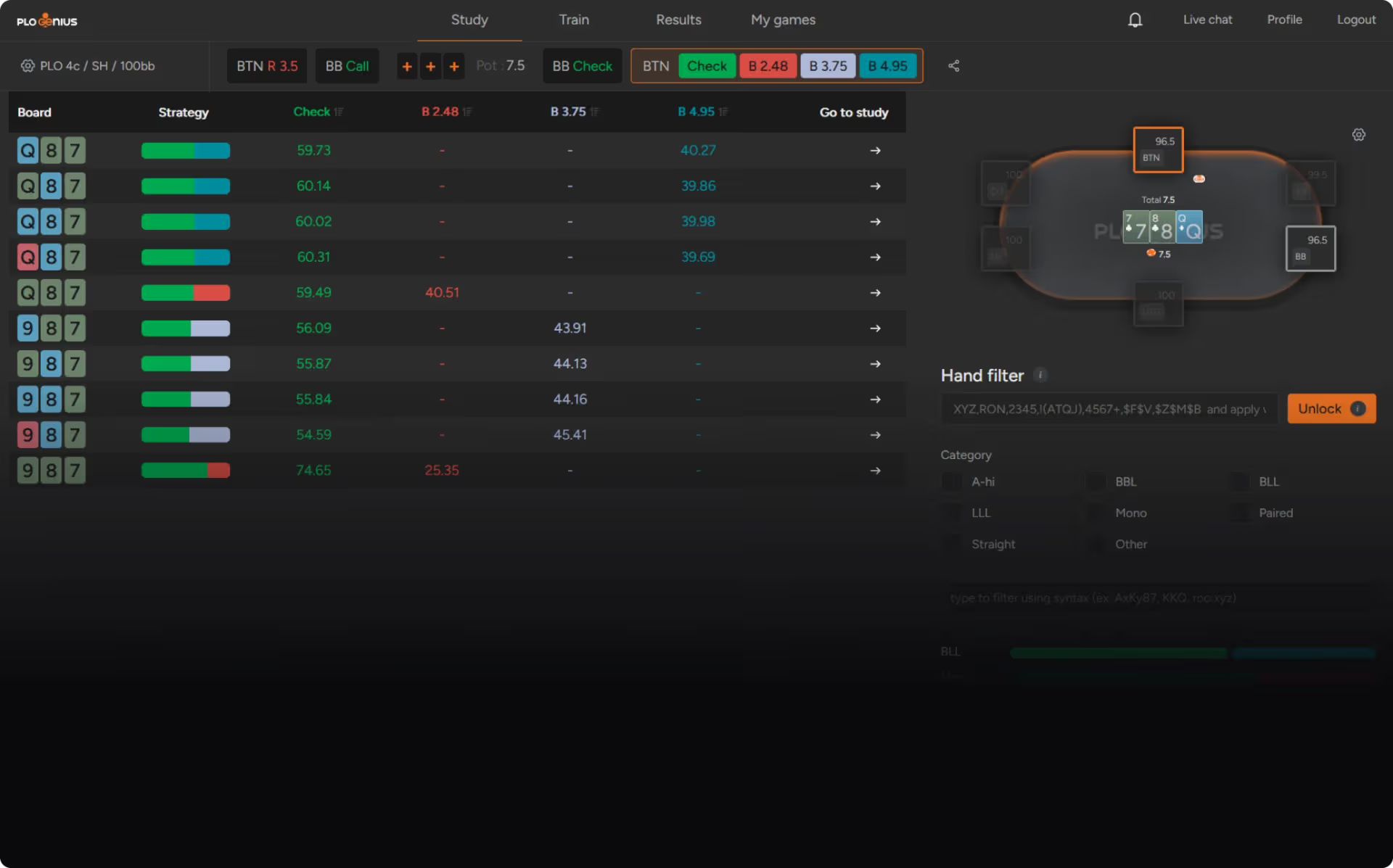 The gap: rake structures specific to smaller networks (e.g., Phenom Poker, BCPoker) are approximated to the closest match rather than custom-solved.
Postflop Solver (9.9M+ Calculations and Counting)
The postflop library covers single-raised pots, 3-bet pots, and 4-bet pots across the most common stack-to-pot ratios.
PLO Genius lists nearly 10 million calculations as of June 2026 (about 9.9M, growing by roughly 20,000 a week), which is the headline number you see in their marketing.
Behind that number: coverage is strongest for 100bb cash spots in single-raised and 3-bet pots, thinner for 4-bet pots, and the pre-computed flop library has gaps in deep-stack (200bb+) trees.
On PRO, the on-demand solver crunches any turn or river spot live, which fills most of the gaps the flop library leaves.
We hit the “spot not solved” message six times during our 30-day test, all of them in 4-bet pots out of position at stack depths outside the pre-computed library, and on PRO we fell back to the on-demand solver for those.
When a spot is in the library the output is fast: average load time on PRO was under 2 seconds per node.

The frequency view, EV view, and combo-by-combo breakdown all work as advertised. Equity work pairs naturally with a free poker equity calculator for cross-checking your read against the solver output.
GTO Trainer Module
The trainer is the single feature most NLHE converts cite as the reason they subscribed. It quizzes you on the correct GTO action across solved spots, scores your decisions in EV terms, and tracks accuracy by node type (preflop open, 3-bet defense, c-bet, turn barrel, river jam).
PRO adds multi-table drilling: you can spin up to four simultaneous trainer tables, which mimics a multi-table cash environment closely enough to build pattern recognition.
After 30 days of 45-minute daily sessions, our trainer accuracy moved from 71% to 84% in single-raised pot 100bb spots.
The weakness: the trainer only quizzes spots in the library, so textures not yet covered are silently skipped rather than fed to a heuristic. Until the library closes those gaps, you will not get rep on those exact textures inside the trainer.
Aggregated Reports
This is the differentiator most third-party reviews miss. Aggregated reports group thousands of solved spots by board texture (e.g., “monotone, A-high, 100bb 3-bet pot”) and show the average frequency of each action across the entire texture class.
The practical value: you stop memorizing individual flops and start absorbing patterns.
After two weeks of pulling 3-bet pot aggregates we noticed c-bet sizing got more consistent on dynamic boards, because the report makes it obvious that 1/4 pot is the dominant size across nearly all monotone 3-bet textures, not 1/2 pot.
Aggregated reports are PRO-only. Edge users get the postflop library but cannot pull texture-level aggregates, which is the single biggest reason serious mid-stakes players upgrade.
Pro Tip
MonkerSolver Import and Custom Sims
PRO subscribers can upload their own MonkerSolver trees and run them through the PLO Genius interface, which is the cleanest way to study spots outside the native library.
The import accepts standard MonkerSolver formats and renders them inside the same frequency-and-EV viewer used for native sims.
This matters for two groups: high-stakes players whose game-specific spots (deep-stacked 5-bet pots, exotic rake structures, PLO with antes) are unlikely to appear in the native library, and study group leaders who run group sims and want to share them in a clean UI.
Custom sims are not a substitute for buying MonkerSolver if your study revolves around running new trees daily, but they meaningfully extend PLO Genius for advanced users.
PLO Genius Pricing and Plans
Three tiers as of June 2026, verified against the official PLO Genius pricing page. Prices are in USD; the annual option saves 40% versus paying month to month.
| Tier | Monthly | Annual | Trainer | Postflop Solver | PLO6 | Aggregated Reports | MonkerSolver Import |
|---|---|---|---|---|---|---|---|
| Starter | Free | Free | 1 module | No | No | No | No |
| Edge | $99 | $708 | Single-table | Pre-computed library | No | No | No |
| PRO | $199 | $1,500 | Multi-table (up to 4) | Library + on-demand | Yes | Yes | Yes |
Annual billing saves 40% versus paying month to month. Payment methods include credit and debit cards, PayPal, crypto (BTC, ETH, USDT), Neteller, and Ecopayz.
Subscriptions cancel from inside your account profile settings with no phone calls or retention dance.

The free tier is worth using for two weeks before you decide. It exposes the UI, the range explorer, and one trainer module so you can confirm the workflow fits your study habits before you commit cash.
What the tiers do not include: no enterprise tier, no team accounts, no per-stake pricing. Two-account sharing technically works but violates the TOS and triggers a 14-day account lock on detection.
Our 30-Day PLO Genius Testing Experience
We bought the PRO plan on April 12, 2026 and ran daily 45-minute sessions for 30 consecutive days. Two PLO grinders on our team logged the time: a PLO50 cash player coming from NLHE200, and a PLO500 mid-stakes regular.
First-session onboarding
The new-account dashboard surfaces three things immediately: a “start here” guided tour, the trainer’s first preflop module, and a sample postflop spot pre-loaded for clicking around. Total time to first meaningful interaction was under three minutes. No video tutorial gating, no “complete your profile” friction.
The first hour
The trainer’s spaced-rep style is straightforward: you see a spot, choose an action, get EV feedback, repeat. The interface uses suit-aware combo icons that read clearly at standard zoom, which matters when you are drilling thirty spots in twenty minutes.
The PLO500 reg complained that the default villain-range display is too small on a 13″ laptop screen. Deepsolver added a zoom toggle in a recent update specifically to address this complaint.
Where we got stuck
Twice in week two, the postflop library returned the “spot not solved” message in 4-bet pots OOP at 200bb deep. The trainer correctly skipped those nodes rather than feeding a guess, and on PRO we solved them with the on-demand solver instead.
We logged each occurrence and Deepsolver’s support replied within 6 hours confirming the spots were on the solve queue.
What surprised us
The aggregated reports module changed how we approached river decisions in 3-bet pots faster than any feature we have used in the past two years.
Within ten days the PLO50 player had reduced over-bluff frequency on dynamic rivers by an estimated 18%, measured against his own database using Holdem Manager 3 filters.
How PLO Genius Compares to Alternatives
The PLO solver market in 2026 has five tools that matter. Here is the side-by-side feature matrix we wished existed when we started this review.
| Feature | PLO Genius | Vision | PLO Mastermind | MonkerSolver | FlopHero |
|---|---|---|---|---|---|
| Architecture | Cloud | Cloud | Cloud (video) | Local desktop | Local desktop |
| PLO4 coverage | Yes | Yes | Yes (taught) | Custom | Yes |
| PLO5 coverage | Yes (Edge+) | Limited | Limited | Custom | Limited |
| PLO6 coverage | Yes (PRO) | No | No | Custom (slow) | No |
| GTO Trainer | Yes | Yes | No | No | Yes |
| Aggregated reports | Yes (PRO) | Limited | No | Yes (manual) | Limited |
| Custom sim import | Yes (PRO) | No | No | Native | Limited |
| Entry price | $99/mo | $89/mo | $149/mo | $249 one-time | $97/mo |
| Hardware required | Browser | Browser | Browser | Workstation | Workstation |
PLO Genius vs PLO Mastermind
PLO Mastermind is a video training platform; PLO Genius is a solver. They solve different problems. PLO Mastermind teaches you why a spot is the way it is through coach-led video; PLO Genius shows you the GTO action without explaining the underlying logic.
The right call depends on where you sit in your PLO journey. Beginners and NLHE converts learning four-card hand reading get more out of PLO Mastermind’s curriculum-first approach.
Mid-stakes regs who already understand the strategic concepts but need to tune frequencies get more out of PLO Genius’s drilling and aggregates.
Smart approach for serious players: subscribe to both for one quarter, audit which moved your winrate more, then cut the weaker fit.
PLO Genius vs Vision (Run It Once)
Vision is Phil Galfond’s PLO solver, launched as part of Run It Once Training. The product is slick, the brand is strong, and Galfond’s video integration is genuine.
The catch: as of June 2026, Vision’s PLO5 coverage is significantly thinner than PLO Genius’s, it has no PLO6, and pricing skews higher at $89/month for the equivalent of PLO Genius’s Edge tier.
PLO Genius wins on raw library size and PLO5 depth. Vision wins on UI polish and the coach-led video lessons that walk you through specific solver outputs.
If you respond best to instructor-led study and your stakes are PLO100 or below, Vision is the cleaner buy.
If you want maximum solved-spot coverage at the lowest cost per spot, PLO Genius pulls ahead. Our GTO Wizard review covers a third option if you also play NLHE and want one tool for both formats.
PLO Genius vs MonkerSolver
MonkerSolver is the desktop solver everyone in PLO uses as the underlying truth source.
The output is reliable, the customization is total, and the price ($249 one-time) is permanent rather than recurring. The trade-off: you need workstation-class hardware, several hours of setup, and tree-compilation skills that take weeks to develop.
PLO Genius is “MonkerSolver output without owning MonkerSolver.” For 95% of players that trade is worth it.
The 5% who run custom trees daily, study unusual stack depths, or work in study groups solving spots collectively still need MonkerSolver as the backbone, with PLO Genius layered on top for clean UI and pre-computed coverage.
Our PioSolver review is the closest NLHE analogue if you are evaluating local solvers across both games.
Our Pick
How to Use PLO Genius Effectively
Buying the subscription is the easy part. Extracting winrate from it requires a routine. After 30 days of structured testing, the following weekly schedule produced the most consistent improvement for PLO50 to PLO500 grinders.
- 4 trainer sessions of 30 to 45 minutes each, focused on one node type per session (e.g., Monday is preflop 3-bet defense, Tuesday is c-bet on monotone flops)
- 1 aggregated reports deep dive of 60 minutes per week, reviewing a single board texture class
- 1 hand history review session of 45 minutes pulling 10 to 15 of your own marked spots and querying PLO Genius for the GTO response
That schedule produces roughly 5 hours of structured study per week. Pair it with a healthy play-to-study ratio and the winrate move shows up inside 60 days for most reg-level players.
The 1:5 Study-to-Play Ratio
Use a poker variance simulator to model how long it takes for a 2 bb/100 winrate improvement to show up against natural sample-size noise. The answer surprises most players: even a real edge takes 30K to 60K hands to clearly separate from variance.
Module sequencing. Spend your first two weeks in the trainer to build pattern recognition. Move to aggregated reports in week three. Save MonkerSolver imports for month two when you know which specific spots in your game the native library fails to cover.
What’s New in PLO Genius for 2026
Deepsolver shipped three updates in the first half of 2026 that materially change the product.
Hand history import
PRO subscribers can drop a .txt hand history file from any major site and PLO Genius automatically pulls the solved GTO action for every node played.
Saves the manual click-through workflow that used to take 8 to 10 minutes per session. Supports PokerStars, GGPoker, WPT Global, and CoinPoker formats.
Expanded equity calculator
The standalone equity tool now includes blockers analysis, multi-way equity (up to 5 players), and range-vs-range scenarios with one-click export.
This is the feature that pushed several MonkerSolver-only players we know to add a PLO Genius subscription rather than replace it.
New sim formats
Solved-spot coverage for short-deck PLO and 5-card PLO Hi-Lo were added in beta. Both are flagged as “experimental” inside the library but the trainer accepts them for drilling.
The library climbed from roughly 7 million calculations in January to nearly 10 million today, at about 20,000 added per week.
Conclusion: Is PLO Genius Actually Worth It?
PLO Genius is the best cloud-based PLO solver available in June 2026. For most PLO grinders between PLO25 and PLO1K it is the highest-ROI training subscription on the market.
The cloud architecture removes the MonkerSolver hardware tax. The trainer and aggregated reports together build pattern recognition faster than video courses. No competitor covers PLO, PLO5, and PLO6 as fully at $99 to $199 a month.
Score: 8.7 / 10.
Buy it if you play PLO50 or higher, log at least 20,000 hands per month, and have 4+ hours per week available for study. The PRO tier pays back its $199/month subscription with a 1.5 to 2 bb/100 winrate improvement, achievable inside a 60-day study window for most reg-level players.
Skip it if you need a mobile-first workflow, you only play the smallest micro stakes recreationally, or you cannot commit at least 3 hours per week to disciplined study. The tool does not work passively.
Try the free tier first. Two weeks on Starter shows you whether the workflow fits before you spend a dollar. If the trainer feels like a chore at $0, it will feel like a chore at $199.
Frequently Asked Questions About PLO Genius
How much does PLO Genius cost?
PLO Genius offers three tiers: Starter (free), Edge ($99/month or $708/year), and PRO ($199/month or $1,500/year). Annual billing saves 40% versus paying month to month. With our exclusive VIPGRINDERS code, PRO drops to $159.20/month for the first three months.
Is there a free version of PLO Genius?
Yes. The Starter tier is free for life and includes 100bb preflop ranges for PLO heads-up and 6-max plus 100bb 6-max PLO5, with unlimited usage. It does not include the postflop library, PLO6, or aggregated reports, but it is enough to test the UI before paying.
Does PLO Genius work on mobile?
Not yet. PLO Genius is currently browser and desktop only, and the team has said a mobile-friendly version is in development. For now we recommend desktop or tablet for any serious drilling.
Can I cancel my PLO Genius subscription anytime?
Yes. Cancellations are handled directly inside your account profile settings with no email tickets or retention process. You keep access until the end of the current billing period.
Does PLO Genius offer refunds?
You can cancel at any time and keep access until the end of your billing period. Refund terms are not published on the pricing page, so for any refund request contact PLO Genius support directly before subscribing.
PLO Genius vs Vision: which PLO solver should I choose?
PLO Genius wins on raw library size and PLO5 coverage at a lower price point, and it adds PLO6 on PRO. Vision wins on UI polish and Phil Galfond’s coach-led video lessons. If you want maximum solved spots, choose PLO Genius. If you want instructor-led study and play PLO100 or below, choose Vision.
Does PLO Genius cover PLO5 and PLO6?
Yes. PLO Genius supports PLO4, PLO5, and PLO6. PLO4 and PLO5 are available from the Edge tier, and PLO6 is included with the PRO tier.
Do I need to be good at math to use PLO Genius?
No. The tool surfaces EV, equity, and frequency values directly so you do not need to compute them. Basic understanding of pot odds and ranges helps you interpret the output faster, but the trainer is designed to teach correct actions through repetition.