

Small Blind Strategy: How to Lose Less and Win More from the SB 2026
The small blind (SB) is the most expensive seat at any poker table. Even strong winning players lose 10 to 15 bb/100 (big blinds per 100 hands) from this position. The goal here is not to profit: it’s to lose as little as possible.
This guide covers exactly how to do that.
- How wide to open-raise when folded to you, and what size to use
- Why limping loses money in most cash games (and when it works in MTTs)
- The 3-bet-or-fold framework when facing a raise, with ranges by opener position
- How to play postflop from the SB in raised and 3-bet pots
Every concept specific to the small blind is explained from scratch. If you’re new to terms like bb/100, OOP, or 3-bet, each one is defined the first time it appears. For a broader look at how all six seats compare, see our guide to position in poker.
Opening When Everyone Folds to You
Every other player has folded, and you’re heads-up against the big blind (BB). Since only one opponent remains, you can open a much wider range than from any other seat.
How Wide to Open
In a 6-max cash game at 100bb deep, most solver-based strategies recommend opening around 40% to 50% of all hands from the SB. That’s wider than any other seat at the table, because you only need to get through one player.
Here’s what that looks like in practice:
| Action | Example Hands |
|---|---|
| Always open | A♠ A♥ K♥ Q♠ A♦ 9♦ J♥ 10♥ |
| Open (wider range) | 8♠ 7♠ K♦ 5♦ 10♦ 9♣ 6♥ 6♦ |
| Fold | 9♣ 3♥ 7♦ 2♠ J♣ 4♦ 8♥ 3♣ |
For a full walkthrough of how range charts work, see our guide to poker ranges. In 9-max games, the frequency is similar (40% to 45%) since only the BB is left to act.
What Size to Raise
The standard open-raise from the SB is 3 big blinds. Some players use 2.5bb at higher stakes, but 3bb is the most common and the safest default.
- Why not smaller (2bb)? The BB gets 3:1 pot odds on a min-raise, making a call profitable with almost any two cards. At 3bb the BB only gets 2:1, which forces real folds.
- Why not bigger (4bb+)? You risk more chips every time the BB 3-bets you and you have to fold.
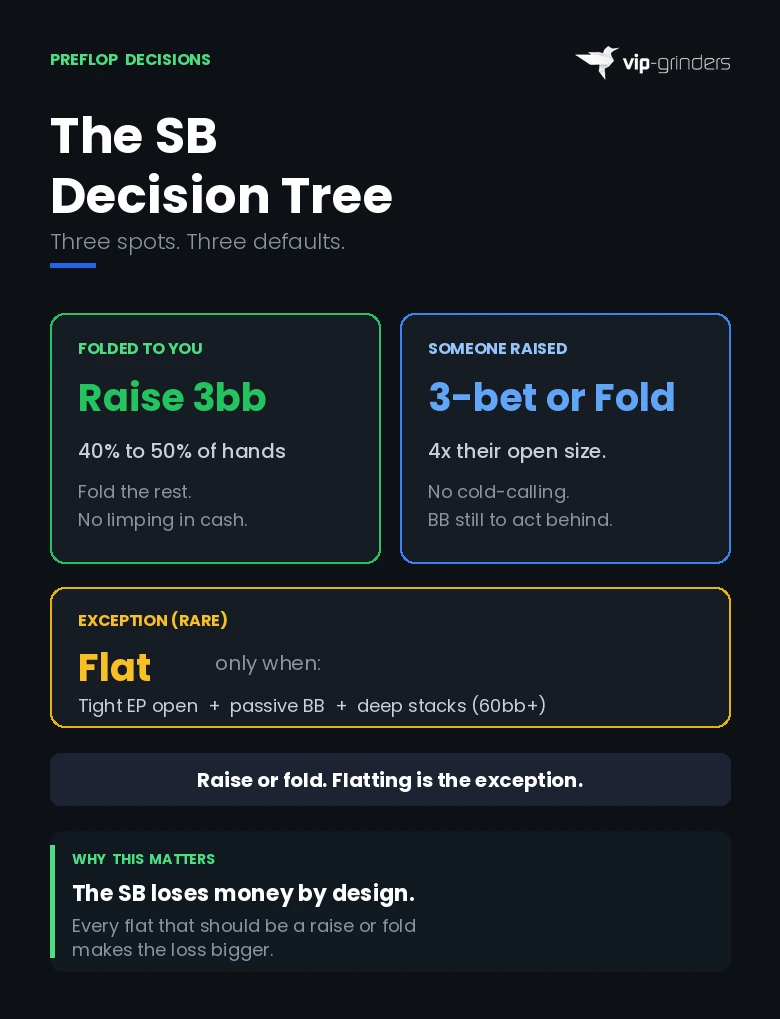
When folded to you in the SB: raise to 3bb with about 40% to 50% of your hands. Fold the rest.
The Limp Debate: Should You Ever Limp the Small Blind?
This is the most common question about SB play, and the answer depends entirely on whether you’re playing cash games or tournaments.
Why Limping Loses Money in Cash Games
When you limp (just call the big blind instead of raising), three things work against you:
- 1Rake hits harder. Limped pots are smaller, so the rake (the fee the poker room takes from each pot) eats a larger percentage of your winnings.
- 2The BB checks behind for free. You give up the chance to win the pot preflop with a raise. A 3bb open wins the blinds immediately a large percentage of the time.
- 3You play OOP with a weak range. OOP (out of position) means you act first on every street. A limped range is capped (it contains no strong hands), which makes you easy to exploit postflop.
When Limping Works (Tournaments)
In MTTs (multi-table tournaments), the math changes because of antes and shorter stacks. Antes add dead money to every pot, which improves the price you get when limping. Shorter stacks reduce the postflop disadvantage because hands end sooner.
| Effective Stack | SB Strategy |
|---|---|
| 60bb+ (deep) | Mostly raise, some limps mixed in |
| 30bb to 60bb | Mixed strategy: roughly 50% limp, 50% raise |
| Under 20bb | Limp or shove. Standard raises become too large relative to your stack. |
At 20bb effective, solver outputs show the SB limps around 56% of hands, raises about 18%, shoves around 11%, and folds the rest. The deeper your stack, the more raising takes over. For a deeper look at the math behind calling prices, see our pot odds guide.
Facing a Raise: The 3-Bet-or-Fold Default
When another player has already raised and the action reaches you in the SB, your default should be to 3-bet or fold. A 3-bet means re-raising the original raiser. Cold-calling (just matching the raise) is usually a mistake from this seat.
Why Cold-Calling Loses Money from the SB
- 1Your range looks weak. When you flat instead of 3-betting, the BB knows you don't have a premium hand. This invites a squeeze (a big re-raise from the BB) that forces you to fold your investment.
- 2You're OOP against everyone. If the BB calls behind, you're now playing a multiway pot out of position against two opponents. That's the hardest scenario in poker.
- 3Rake compounds the problem. Flatted pots go to the flop more often, meaning more raked pots where you're at a positional disadvantage.
By 3-betting instead, you generate fold equity (the chance your opponent folds before the flop), take control of the pot, and build a stronger range for postflop play.
SB 3-Bet Ranges by Opener Position
How wide you 3-bet depends on who opened. The later their position, the wider their range, and the wider you can 3-bet.
| Opener | Your 3-Bet % | Example Hands |
|---|---|---|
| BTN | 12% to 16% | Q♠ Q♥ A♥ J♥ A♠ 5♠ K♦ Q♦ |
| CO | 10% to 12% | K♠ K♦ A♥ Q♠ A♠ 4♠ J♥ 10♥ |
| HJ | 8% to 10% | A♠ A♥ A♦ K♦ K♥ Q♠ A♠ 5♠ |
| EP | 6% to 8% | A♠ A♥ K♠ K♥ A♥ K♦ Q♠ Q♦ |
Notice that the SB 3-bet range is depolarized, meaning it’s a mix of strong value hands and hands with good blocker properties (like A5s and A4s that block your opponent from holding Aces). This is different from the BB, which 3-bets with a more polarized range. For the full theory behind 3-bet construction, see our 3-bet strategy guide.
How to Size Your SB 3-Bet
The standard is 4x the original raise. If the opener raises to 2.5bb, you 3-bet to 10bb. If they raise to 3bb, you 3-bet to 12bb.
This is larger than an in-position 3-bet (which typically uses 3x) because you’re OOP and want a lower SPR (stack-to-pot ratio) postflop. A lower SPR means fewer streets of complex OOP decisions and more hands that can simply go all-in on the flop or turn.
When Flatting from the SB Works
The 3-bet-or-fold rule has exceptions. In specific spots, cold-calling from the SB is the better play.
The most common scenario: a tight player opens from EP and the BB behind you is passive (unlikely to squeeze). Here, hands like 7♠ 7♦, 6♥ 6♦, or 8♠ 7♠ can call for set-mine and draw value.
You’re not calling because you expect to win postflop often. You’re calling because when you hit, the payout is large relative to the price you paid.
This logic only works when two conditions are met:
- 1The BB won't squeeze. If the BB is aggressive, your flat gets punished by a re-raise and you fold your investment.
- 2Stacks are deep enough. You need at least 60bb to 80bb effective for the implied odds (the extra money you expect to win on later streets) to justify the call.
In MTTs with antes, flatting widens slightly because the dead money in the pot improves your calling price. But even there, 3-betting remains the default for most hands. Treat flatting as the exception, not the starting point.
Postflop Play from the Small Blind
Every postflop hand from the SB shares one problem: you act first on every street. That means you reveal information before your opponent and can’t react to their action. The way you handle this depends on which type of pot you’re in.
When You Raised and the BB Called
This is the most common postflop scenario from the SB. You raised preflop, the BB called, and now you’re heads-up OOP in a single-raised pot.
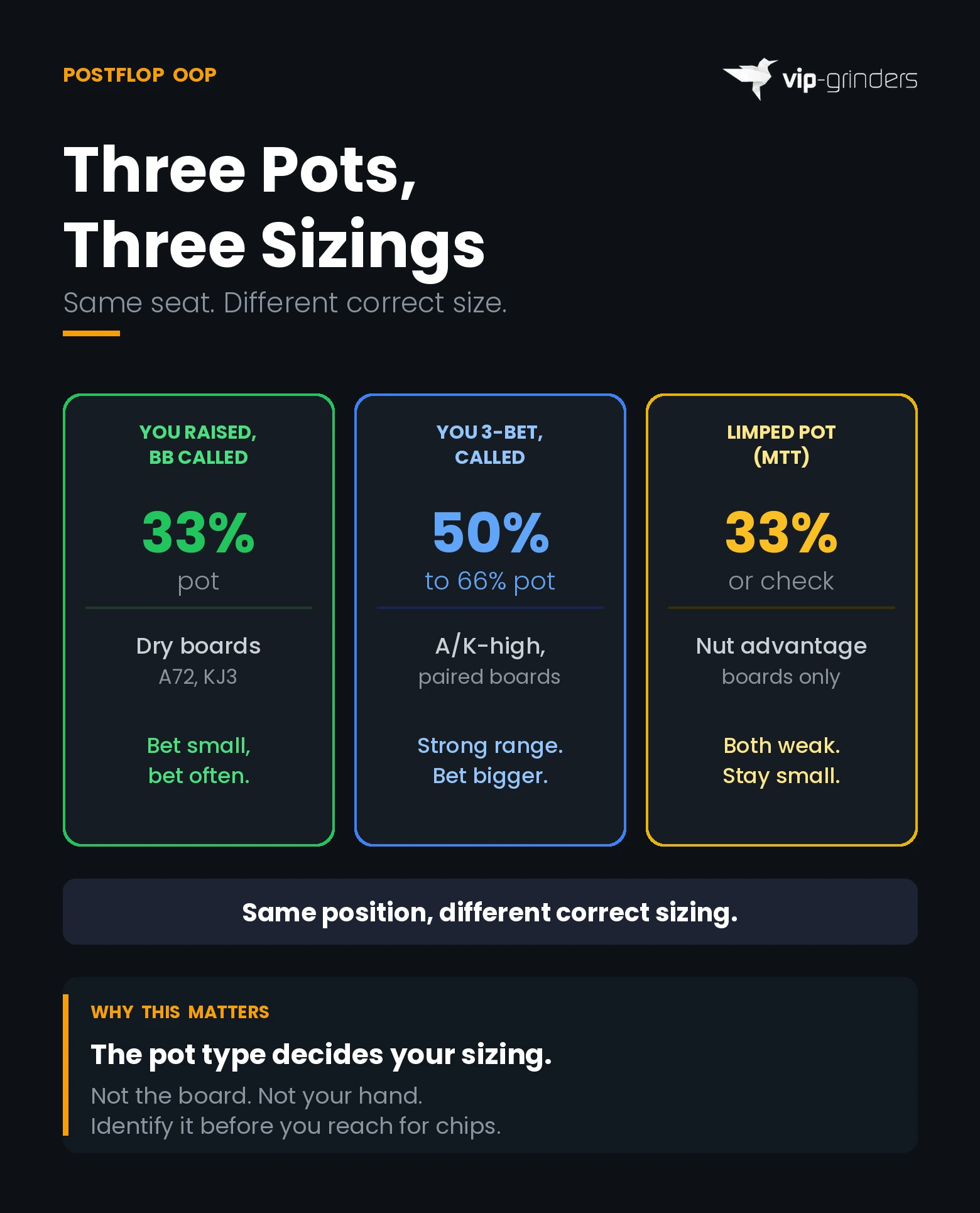
On dry, high-card boards (like A72 or KJ3 with no flush draw), you hold a range advantage because your opening range contains more strong Aces and Kings than the BB’s calling range. Use a small c-bet (continuation bet, about 33% of the pot) with most of your range. This size is cheap enough to bet frequently while still denying equity.
On connected, mid-card boards (like T87 or 976 with a flush draw), check more often. The BB’s calling range connects better with these textures, so betting wide becomes unprofitable. When you do have a strong hand on these boards, check-raising is often more profitable than leading out.
When You 3-Bet and Got Called
Your range is strong and tight here. C-bet larger (50% to 66% pot) on boards that favor you: A-high, K-high, and paired boards where your premium hands connect well. Check more on low connected boards (765, 543) where the caller’s range has better equity.
The key difference from single-raised pots: you can bet bigger because your range is stronger and the SPR is lower (less money behind relative to the pot).
Limped Pots (Mostly MTTs)
When both blinds see a flop for one big blind each, both ranges are wide and weak. Two rules keep you out of trouble:
- 1Don't lead big. Betting large into the BB when neither player showed preflop strength is a common low-stakes leak. If you bet, keep it small (33% pot) on boards where you have a nut advantage (more of the strongest possible hands in your range).
- 2Check-raise selectively. On dynamic boards where your range includes strong draws or sets, checking to the BB and raising their bet lets you build the pot with your strongest hands while staying balanced.
Across all three pot types, the core principle is the same: when you’re OOP, keep pots small with medium hands and build pots only when your range has a clear advantage. For more on when to slow down with marginal holdings, see our pot control guide.
Frequently Asked Questions
What is the small blind in poker?
The small blind (SB) is a forced bet posted by the player directly to the left of the dealer button before any cards are dealt. It’s typically half the size of the big blind. The SB acts first on every postflop street, making it the least profitable position at the table.
How much should I raise from the small blind?
When folded to you, raise to 3 big blinds as your default size. When 3-betting against another player’s open-raise, use 4x their raise size (for example, 10bb against a 2.5bb open). Both sizes are larger than what you’d use from in-position seats because you’ll be OOP for the rest of the hand.
Should I ever limp from the small blind?
In cash games, especially at stakes of NL50 and below, raise or fold. The rake makes limped pots unprofitable from the SB. In tournaments, limping becomes correct as stacks get shorter: at 20bb effective, solvers recommend limping around 56% of the time from the SB.
What is a good win rate from the small blind?
A strong player in online 6-max cash games loses between 10 and 15 bb/100 from the SB. A decent player loses 15 to 20 bb/100. Losing less than 15 bb/100 over a large sample means your SB strategy is working well. Breaking even or winning from the SB is not a realistic long-term target at most stakes.
Is the small blind harder to play than the big blind?
Yes. The BB gets better pot odds when defending, has a wider profitable calling range, and closes the preflop action (so nobody can squeeze behind). The SB has none of these advantages and must also post forced money. For a detailed look at BB play, see our big blind defense guide.
Does small blind strategy change with antes?
Yes. Antes add dead money to the pot, which changes the math in two ways: your steals become more profitable (more to win), and your calls become cheaper (better pot odds). In MTTs with antes, the SB opens wider, limps more frequently at shorter stacks, and can occasionally flat against raises where a cash game player would strictly 3-bet or fold.