

Implied Odds Explained: When to Chase & When to Fold 2026
Pot odds tell you whether a call breaks even on the current street. Implied odds tell you whether the call wins money across the whole hand, once you factor in the chips you expect to win on later streets when you hit your draw.

That distinction is the difference between a flush draw that’s a clear call against a short stack and the same draw against a deep-stacked opponent who will stack off with top pair. Both have identical pot odds, but only one has the implied odds to justify the chase.
Here is what this guide covers:
What Are Implied Odds in Poker?
Implied odds are the chips you expect to win on future streets when your drawing hand completes, added to the chips already in the pot. They extend pot odds math beyond the current street by factoring in the payoff you’ll extract when you hit your draw.
In practice, implied odds let you profitably call bets that would be losers based on pot odds alone. Here’s how the same spot changes depending on what’s behind:
- 1The situation: pot is $100, opponent bets $50, you have a flush draw on the turn.
- 2Pot odds only: you call $50 into a $200 total pot. You need 25% equity to break even.
- 3Add implied odds: if you expect to win another $150 on the river when your flush hits, the effective pot is $350.
- 4The new threshold: your required equity drops to below 15%. The call is clearly profitable, even with a weaker draw.
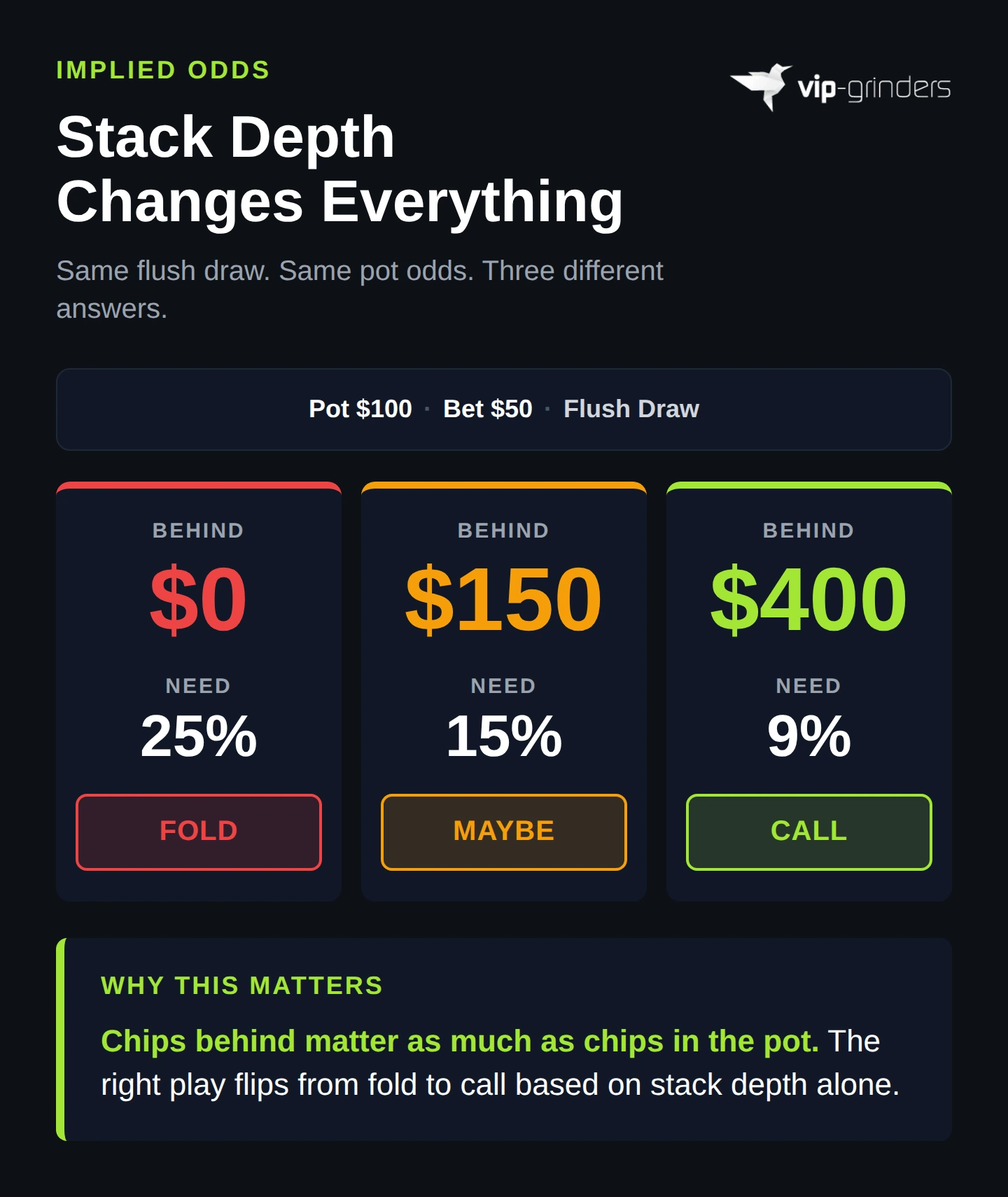
The concept only matters in situations where more money can go in the pot. All-in decisions, river calls, and short-stacked spots do not create implied odds because there are no future streets to extract value from.
The table below shows how implied odds fit alongside pot odds and reverse implied odds. All three work together on every drawing decision.
| Concept | Direction | Core Question |
|---|---|---|
| Pot Odds | Current street | Does this call break even right now? |
| Implied Odds | Future streets (for you) | How much more will I win if I hit? |
| Reverse Implied Odds | Future streets (against you) | How much more will I lose if I hit but they’re better? |
Each concept shows up in a different kind of spot:
- Pot odds spot: you call $50 into a $150 pot. You need 33% equity to break even. Math done.
- Implied odds spot: same call, but $200 behind that your opponent stacks off with when you hit. Effective equity drops to 15%.
- Reverse implied odds spot: you hit your J-high flush on the river, opponent shows A-high flush, you lose your stack instead of winning it.
For a complete breakdown of pot odds math including the Rule of 4 and 2, see our pot odds strategy guide.
The Implied Odds Formula (3 Ways to Calculate)
There is no single implied odds formula. Poker players calculate implied odds three different ways depending on which variable they care about most: required equity, extra dollars needed, or the adjusted break-even threshold.
All three methods produce the same decision. Which one you use comes down to what’s easiest to estimate at the table.
Method 1: The Adjusted Pot Odds Formula
The cleanest method adds your expected future winnings directly into the pot odds calculation. Replace the current pot with the effective pot and recalculate.
- Formula: Required Equity = Call Amount / (Current Pot + Call Amount + Expected Future Winnings)
- Example: $50 call into a $150 total pot, expecting $200 more if you hit. Required equity = $50 / ($150 + $200) = 14.3%.
- When to use: when you already know your hand's equity and want a clean call-or-fold threshold.
Method 2: The Dollars-Needed Formula
This method flips the calculation. Instead of asking “what equity do I need,” you ask “how much extra do I need to win on future streets for this call to break even?”
- Formula: Extra Dollars Needed = (Call Amount / Your Equity) - Current Pot - Call Amount
- Example: $50 call with 20% equity into a $150 total pot. Extra needed = ($50 / 0.20) - $150 = $100.
- When to use: when you want to check if the remaining stacks are deep enough to justify the call.
If the opponent only has $60 behind, a call needing $100 in implied odds is unprofitable. If they have $300 behind and will stack off when you hit, the call is clearly profitable.
Method 3: The Stack-to-Pot Shortcut
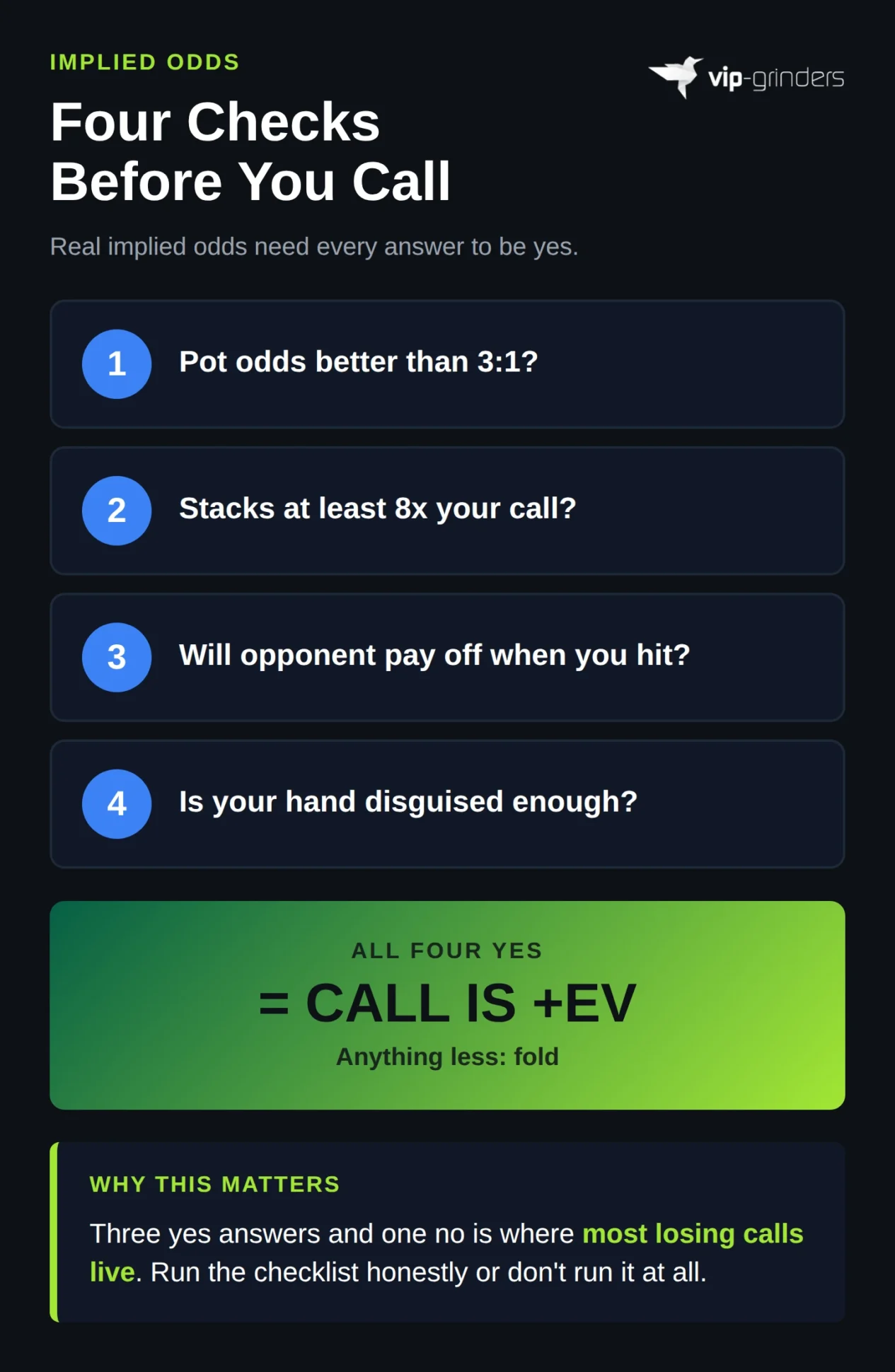
For flop decisions with a set-mining hand or strong draw, the simplest method is a stack-to-pot ratio check. You don’t need exact equity numbers. You just need to know if the remaining stack is big enough to pay you off.
- Set mining: you need at least 20x your call amount in effective stacks behind to profitably set-mine a small pair.
- Strong draws: flush and open-ender draws need roughly 8x to 10x your call amount behind to justify chasing with weak pot odds.
- Why it works: the ratio bakes in both your typical equity and a realistic extraction rate. It's a battle-tested rule of thumb, not a proof.
For live calculations without the math, run the inputs through our Implied Odds Calculator. The tool returns the required equity, the extra dollars needed, and the call decision instantly.
The 4 Factors That Change Implied Odds
Implied odds aren’t a fixed number. The same draw in the same pot can have excellent implied odds in one spot and zero in the next, depending on four variables you have to estimate at the table.
Get these factors right and your calls become precise. Miss any one of them and the “math” you just ran is built on the wrong assumptions.
1. Effective Stack Depth
Implied odds cap at the shorter of the two stacks. You can’t win more than your opponent has behind, no matter how strong your draw hits.
At 200 big blinds deep, a flush draw on the flop has massive implied odds because there are two full streets and a huge stack behind to extract from. At 30 big blinds deep, the same draw has almost zero implied odds because any meaningful bet on the turn or river commits the remaining stack.
2. Opponent Willingness to Stack Off
Implied odds depend on whether your opponent will pay you off when you hit. A calling station with top pair creates large implied odds. A tight player who folds to any turn action creates almost none.
The quality of the read matters more than the size of the stack. A $500 effective stack against an opponent who folds when the flush card hits might as well be a $50 stack. The chips have to actually come in.
3. Hand Disguise
Draws that complete into obvious hands reduce implied odds. When the third flush card hits and you lead the river, competent opponents fold everything except a better flush.
Disguised draws are different. Backdoor straights, small sets, and double-suited Omaha hands often get paid off because the opponent can’t easily identify the danger. The more obvious your winning hand looks, the less your opponent pays.
4. Position
In position, you control the size of the pot on future streets. You can check back weak hands, bet for value when you hit, and dictate the extraction.
Out of position, you’re guessing. Check-calling bleeds pot odds when you miss, and donk-betting when you hit often collapses the implied odds by signaling strength too early. Position is worth roughly 1-2 big blinds of implied odds on any deep-stacked draw.
- Big implied odds: deep stacks + loose opponent + disguised draw + in position.
- Zero implied odds: short stacks, tight opponent, obvious draw, out of position.
- The trap: running the implied odds formula with optimistic assumptions on all four factors at once. Honest estimates beat wishful math every time.
Factor 2 is where most players lose money. Estimating opponent willingness to stack off requires reading your opponent’s range accurately, which is its own skill. Without a range read, implied odds calculations are guesses dressed up as math.
Set Mining and the 20x Rule
Set mining is calling a raise with a small or medium pocket pair, hoping to flop a set (three of a kind). It’s the cleanest implied odds scenario in poker because the math is simple and the payoff pattern is predictable.
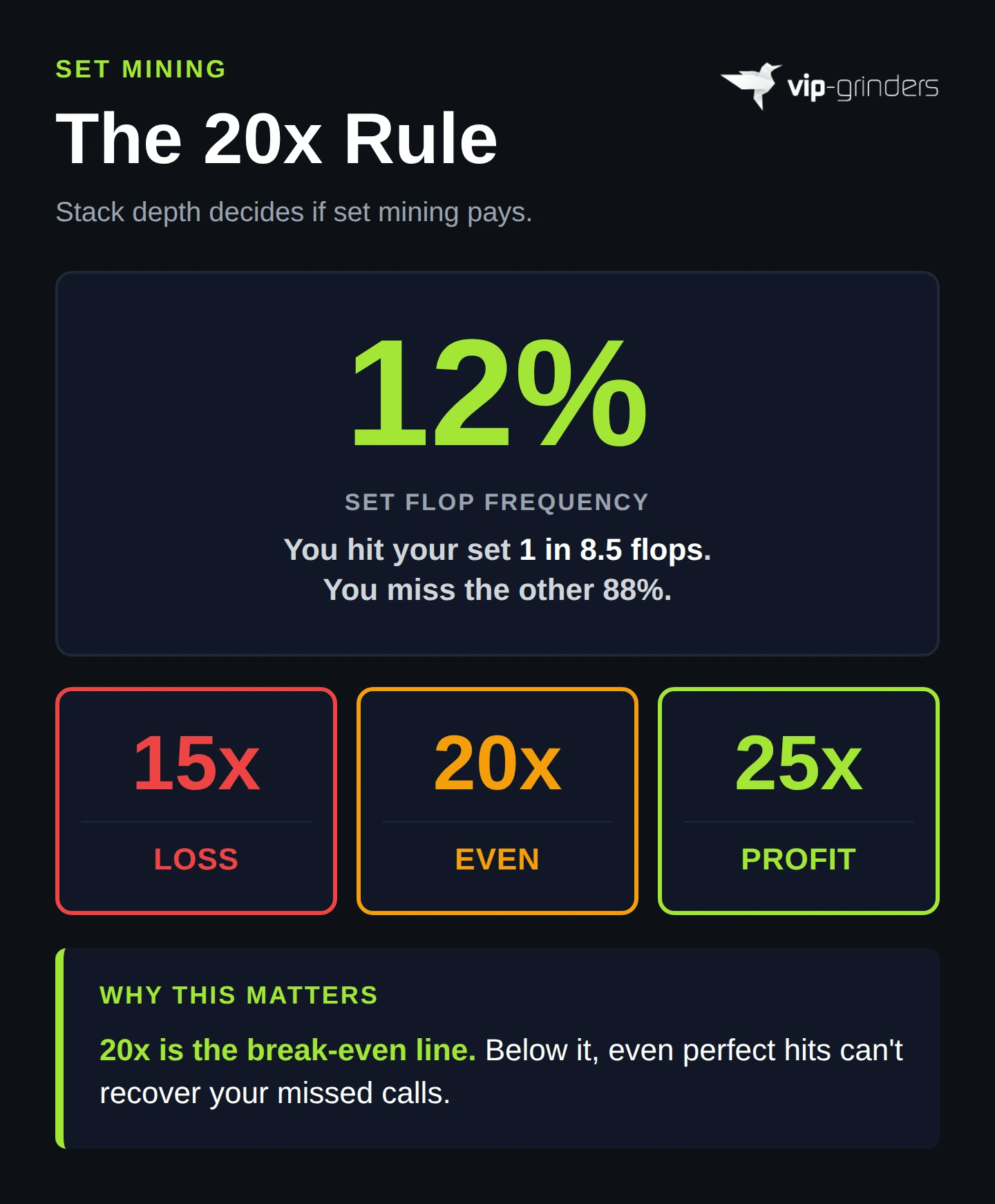
You flop a set roughly once every 8.5 times you see a flop with a pocket pair. That’s about 11.8% of the time, or odds of 7.5:1 against.
The 20x Rule
The standard rule of thumb for profitable set mining is that the effective stack must be at least 20 times the call amount. Below that depth, the math doesn’t work even when you hit.
- 1You need to hit the set: ~12% of the time. The other 88% you fold the flop and lose your call.
- 2You need to get paid when you hit: sets are heavily disguised and often win large pots against top pair or overpair hands.
- 3The math balances at 20x: the ~12% hit rate times the ~20x payoff when you stack off pays for all the misses.
Example: Pocket Fours Facing a Raise
You have 4-4 in the big blind. The button opens to $15 in a $1/$2 cash game and both players cover your $800 stack. The call is $13 more for you (you’ve already posted $2).
Effective stack test: $800 behind divided by $13 call = 61x your call amount. Well above the 20x threshold. Profitable set mine.
Now change one variable: same spot, but effective stacks are $200 instead of $800. Stack-to-call ratio drops to ~15x, below the 20x line. The fold becomes correct because you won’t win enough on the rare flop you hit to cover the 88% of flops you miss.
When the 20x Rule Tightens
Some spots require more than 20x even when you have the stack depth. Any of these conditions pushes the threshold higher:
- Multi-way pots: more opponents means more chances for someone to have a better hand on flop textures that crush sets (straight or flush possibilities).
- Low pairs (22-55): higher risk of set-over-set when you do hit. Require closer to 25x.
- Tight opponents: if the raiser rarely stacks off with one pair, your implied odds shrink and you need deeper stacks to compensate.
The 20x rule is a starting point, not a ceiling. Against the right opponent in the right structure, set mining at 15x can be profitable. Against the wrong opponent, even 30x isn’t enough.
Reverse Implied Odds: When to Fold Despite Pot Odds
Reverse implied odds are the chips you expect to lose on future streets when your draw completes but your opponent’s hand is still stronger. They’re the dark side of implied odds math: the spots where calling with “correct” pot odds costs you your entire stack anyway.
A hand can have mathematically correct pot odds, decent implied odds on paper, and still be a long-term losing call once reverse implied odds enter the picture.
The Dominated Draw Problem
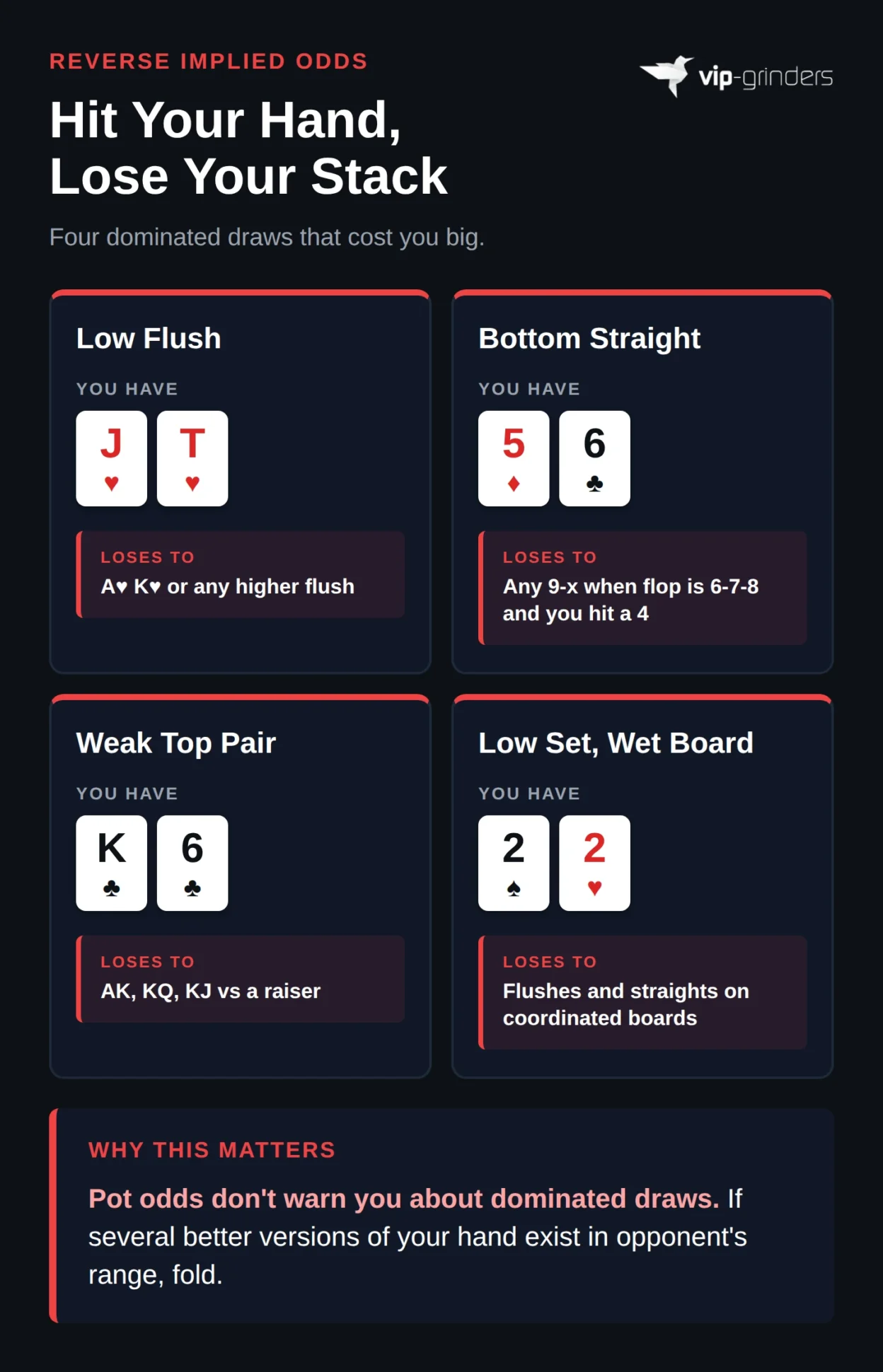
The textbook reverse-implied-odds spot is a dominated draw: a draw that completes into a hand that’s still second-best. You hit your card, you bet or call for value, and you lose your stack to a better version of the same hand.
Classic dominated draws include:
- Low flush draws: J-high or lower flushes against opponents who play suited Aces and Kings heavily.
- Low-end straight draws: the bottom end of open-enders (like 5-6 on a 6-7-8 board) where hitting a four makes a 4-5-6-7-8 straight that loses to any 9-x.
- Weak top pair kickers: K-6 on a king-high board against an opponent who raised preflop. You flop top pair and lose to every better Kx.
- Low sets on coordinated boards: a set of twos on a 8-9-2 two-tone board loses to straights, flushes, and bigger sets that all get there by the river.
The J♥ 10♥ Kicker Trap
You hold J♥ 10♥ in a deep cash game. The flop comes A♠ 7♥ 3♥, giving you a J-high flush draw. Pot odds say call and implied odds look strong with deep stacks and an aggressive opponent.
The river completes your flush. You call a big bet, and your opponent shows A♥ K♥ for the nut flush. Your “profitable” call becomes a stack-sized mistake because when you hit, you still lose 15 to 20% of the time to a better flush.
The reverse implied odds aren’t that you missed the flush 65% of the time. They’re that when you hit the flush, you still lose 15-20% of the time to a better one.
Implied Odds in Cash Games vs Tournaments
The math is identical across formats but the inputs behave differently. Cash games keep stacks deep and opponents loose, which maximizes implied odds. Tournaments shrink both as blinds rise and ICM pressure builds.
| Factor | Cash Games | Tournaments |
|---|---|---|
| Effective stacks | Typically 100bb+ throughout | Shrinks from 100bb to 20bb as blinds grow |
| Implied odds magnitude | Large and stable | Large early, collapses late |
| Set mining | Profitable at most stack depths | Only profitable at deep stages (early levels) |
| Reload risk | You can rebuy anytime | One stack, one life |
| Opponent payoff rate | Higher (less ICM pressure) | Lower (ICM makes opponents fold to pressure) |
Below 40bb in a tournament, implied odds shrink sharply because ICM pressure makes opponents fold hands they would pay off in a cash game. Below 20bb, they collapse to zero and your calls have to stand on pot odds alone.
Frequently Asked Questions
What are implied odds in poker?
Implied odds are the chips you expect to win on future streets when your drawing hand completes, added to the chips already in the pot. They extend pot odds math beyond the current street by factoring in the payoff you’ll extract when you hit your draw.
How do you calculate implied odds?
The cleanest formula is: Required Equity = Call Amount / (Current Pot + Call Amount + Expected Future Winnings). For example, a $50 call into a $150 pot with $200 expected on future streets = $50 / $350 = 14.3% required equity. If your hand’s equity is higher than that, the call is profitable.
What's the difference between pot odds and implied odds?
Pot odds measure only the current street: the ratio between your call and the total pot after calling. Implied odds extend the math forward by adding the chips you expect to win on later streets when your draw completes. Pot odds answer “does this call break even right now?” Implied odds answer “does this call make money across the whole hand?”
What are reverse implied odds?
Reverse implied odds are the chips you expect to lose on future streets when your draw completes but your opponent’s hand is still stronger. Classic examples include low flush draws losing to nut flushes and low-end straight draws losing to higher straights. They’re the reason some “mathematically correct” calls are long-term losers.
What is the 20x rule for set mining?
The 20x rule says effective stacks must be at least 20 times your call amount for set mining a small or medium pair to be profitable. You flop a set roughly 12% of the time, so you need the 88% of flops you miss to be covered by the large pots you win when you hit. Below 20x, the math doesn’t work even against an opponent who stacks off.
Do implied odds apply in tournaments?
Yes, but they shrink as the tournament progresses. Implied odds are largest in the early levels when stacks are deep and ICM pressure is minimal. By the time effective stacks drop below 40bb, implied odds shrink significantly, and below 20bb they essentially collapse to zero.
How do implied odds change with stack depth?
Implied odds are proportional to effective stack depth. At 200bb deep, a flush draw on the flop has massive implied odds. At 30bb deep, the same draw has almost none because there isn’t enough money behind to meaningfully change the math. Implied odds always cap at the shorter of the two stacks.
When should I fold despite good pot odds?
Fold when reverse implied odds dominate. If your hand is a dominated draw (low flush, low-end straight, weak top-pair kicker) and the board texture suggests your opponent could hold a better version, the future-street losses outweigh the pot-odds discount. Ask which better hands your opponent could reasonably have before calling.