

Can You Still Make Money Playing Online Poker in 2026?
The question gets asked thousands of times every month. Most answers are either a confident “yes, anyone can do it” from someone selling a course, or a flat “no, the games are too tough now” from someone who quit. Neither is correct.
The real answer to “can you make money playing online poker in 2026?” is yes, but only for a specific group of players, and only when they understand what actually drives profitability.
Roughly 30% of serious online poker players finish their careers in the black. Add a proper rakeback deal and that figure rises to about 35%. The other 65% lose money, and they lose it in patterns that are predictable, measurable, and avoidable.
This guide is the verdict page for readers who want the data first and the decision second. Here is what it covers:
- The real winner percentage backed by tracked player data, and how rakeback shifts it
- The four variables that decide which side of the profit line you fall on
- Realistic earnings by format and stake, including whether you can make a living from poker
- A 90-day self-test you can run to find out if online poker is profitable for you specifically
Yes, Online Poker Is Still Profitable in 2026
The 30% figure from the intro is not a guess. It comes from tracked datasets like a sample of 609 online players with at least 10,000 hands each, where roughly three out of every ten players finish as long-term winners. The other seven lose money, and the losses are not distributed evenly across that 70%.
What makes online poker different from a casino game is that the 30% who win do so because of skill, not luck. Variance shifts results in the short term, but the better player always pulls ahead over enough hands. The real question is whether you can realistically join the 30% who make it work.
The Six Tiers of Online Poker Players
Treating poker players as either “winners” or “losers” hides the more useful picture. The same dataset above broke results down into six distinct tiers, and the spread between them is wider than most players expect.
| Player Tier | Win Rate | % of Player Pool |
|---|---|---|
| Crushers | Over 10 bb/100 | ~5% |
| Solid Winners | 3 to 10 bb/100 | ~13% |
| Small Winners | 0 to 3 bb/100 | ~12% |
| Small Losers | 0 to −3 bb/100 | ~21% |
| Moderate Losers | −3 to −10 bb/100 | ~26% |
| Donators | Worse than −10 bb/100 | ~23% |
The top 5% earn the kind of money people imagine when they ask whether poker is a good way to make money. The next 25%, the Solid and Small Winners, are profitable but at very different income levels. The bottom 70% subsidize everyone above them, and learning to identify and exploit the recreational players who make up that bottom tier is where most of your profit actually comes from.
How Rakeback Shifts the Winner Percentage
The 30% figure assumes default rake conditions and no affiliate deal. In practice, every serious player has access to some form of rakeback, and rakeback changes the math. A typical deal returning 25% to 40% of paid rake adds roughly 1 to 2 bb/100 to a player’s effective win rate.
That single adjustment moves a meaningful slice of the Small Loser tier into the black, pushing the total winner percentage from around 30% to approximately 35%. For players hovering near break-even at the table, a strong rakeback deal is the difference between “I lose slowly” and “I win slowly.”
How Online Poker Profitability Has Changed Since 2003
Online poker has been profitable since the moment Chris Moneymaker won the World Series of Poker Main Event in 2003 and triggered the boom. What has changed is who the winners are and how hard they have to work for it.
In the 2003 to 2010 era, simple tight-aggressive play was enough to print money at almost any stake. After Black Friday in 2011 and the rise of solvers in the mid-2010s, the average skill level at the top climbed sharply. The bottom of the player pool barely changed, which is why the 30% verdict has held steady through every era of online poker.
The real shift is that the winners have specialized: the era of beating every format with one strategy is over, but the era of picking one format, one stake range, and one rakeback deal and grinding it correctly is very much alive. If your first decision is between Hold’em and Omaha, our NLHE vs PLO comparison covers the variance, bankroll, and cost differences that should drive that choice.
The Four Variables of Poker Profitability
Most poker advice focuses almost entirely on skill: ranges, bet sizing, GTO theory, board texture. All of that matters, but a player with elite technical skill and zero rakeback can earn less than a competent grinder with a strong deal. Profitability is a system, not a single number.
The equation looks like this:
Skill Edge × Volume + Rakeback − Costs = Net Profit
Multiply your edge by the hands you play, add what your rakeback deal returns, then subtract the rake and overhead you pay along the way. The number that comes out is your actual monthly profit, not the figure on your results graph.
Here is what the equation looks like for a typical NL25 grinder playing 50 hours per month on four tables.
| Component (NL25, 50 hours/month, 4 tables) | $ Impact |
|---|---|
| Skill Edge × Volume (3 bb/100 across 15,000 hands) | +$112.50 |
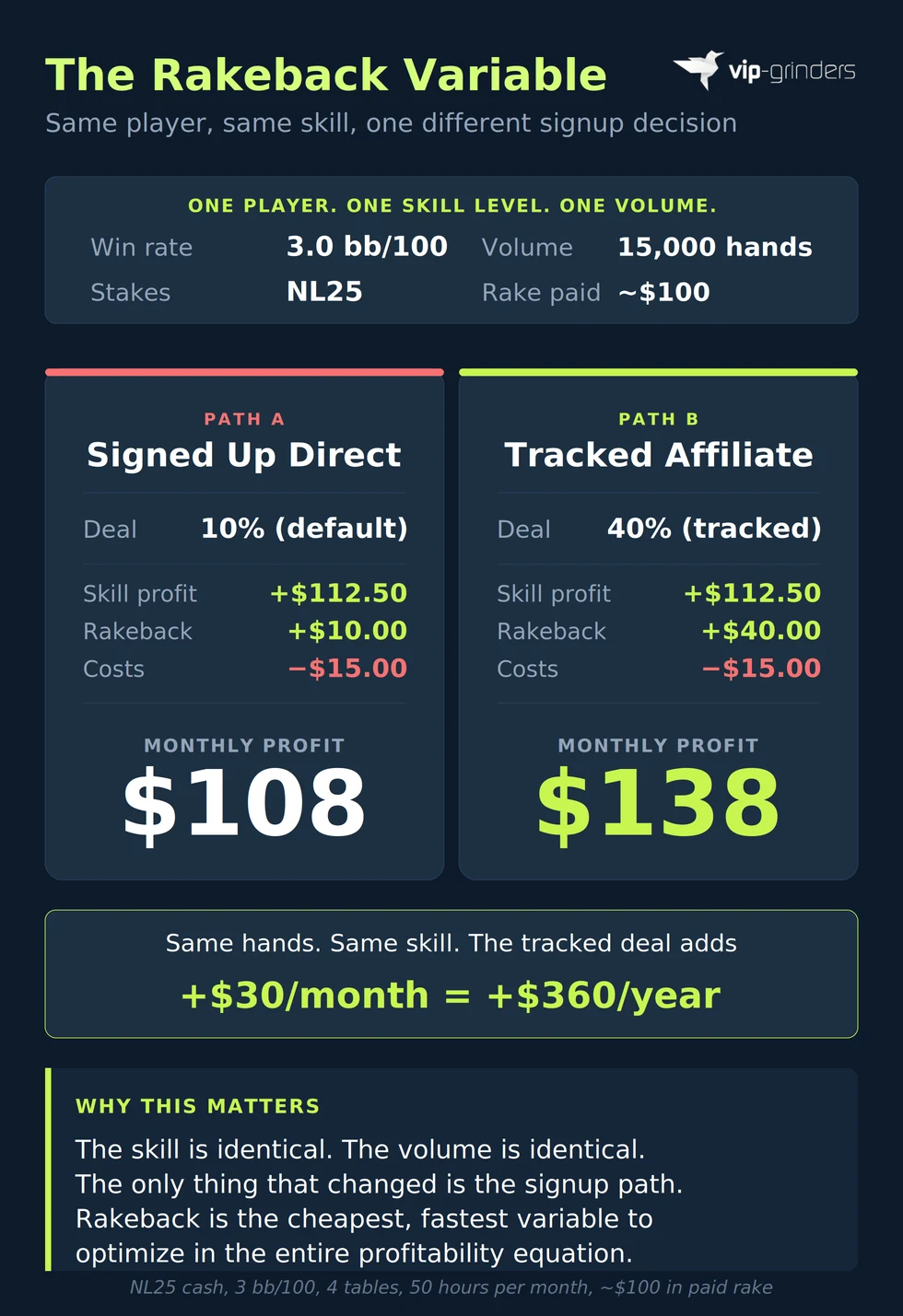
| Rakeback (30% deal on ~$100 paid in rake) | +$30.00 |
| Costs (software, tools, training) | −$15.00 |
| Net Monthly Profit | $127.50 |
$127.50 a month is not life-changing, but it is real profit at a stake most players treat as a learning ground. The point is not the dollar figure. Every row of that table can be improved, and improving any of them moves the bottom number.
Variable 1: Skill Edge
Your skill edge is your win rate measured in big blinds per 100 hands (bb/100). A 3 bb/100 winner at NL25 is solid, and a 5 bb/100 winner is strong. Improving your edge takes months of study and hand review, which is why the players who climb stakes fastest also optimize the other three variables in parallel.
The single fastest way to raise your effective win rate is not studying harder but choosing softer tables. Our table selection guide covers the exact process for finding the most profitable games at any stake.
Variable 2: Volume
Volume is how many hands you play, and it multiplies your skill edge directly. Doubling your hands doubles your profit if your win rate holds, but win rate often drops as you add tables. Past your personal limit, more volume can actually produce less profit.
The full breakdown of how table count and session length affect your real income is covered in the hourly rate guide.
Variable 3: Rakeback
Rakeback returns a percentage of the rake you pay back to your bankroll. A break-even player with a 35% deal becomes a winning player on the rakeback alone.
The difference between signing up at a room directly and signing up through a tracked affiliate can mean hundreds of dollars per year on the same volume. The mechanics of how rakeback should change your strategy and bankroll math live in the rakeback and strategy guide.
Variable 4: Costs
Costs include the rake you pay, the software and tools you use, and the bankroll buffer you keep aside for downswings. Most players ignore everything except rake, which is the biggest single cost but not the only one.
The bankroll buffer is what separates grinders who survive a 20 buy-in downswing from those who tilt off their roll, and the rules for sizing it correctly live in the bankroll management guide.
How Much Do Online Poker Players Actually Make?
The honest answer is a range, not a single number. Online poker earnings depend on your format, your stakes, your hours, and your rakeback deal.
A winning grinder making $200 a month at NL25 cash and a winning grinder making $1,800 a month at $5 Spins are both profitable, but their paths look almost nothing alike.
The table below shows realistic monthly earnings ranges for a competent winning player at low to mid stakes, assuming around 50 hours of play per month and a standard rakeback deal.
| Format | Realistic Monthly Income | Variance | Skill Ceiling |
|---|---|---|---|
| NL Cash Games (online) | $150 to $1,500 | Low to medium | Very high |
| MTTs (online) | $100 to $2,500 | Very high | Very high |
| Spin & Gos | $200 to $1,800 | Extreme | High |
| Sit & Gos | $150 to $800 | Medium | Medium |
| Live Cash ($1/$2 to $2/$5) | $400 to $2,500 | Low to medium | Medium |
| Live MTTs | $0 to $5,000+ | Extreme | High |
Two patterns stand out from this table:
- The upper ranges overlap with professional income, but require serious commitment: online MTTs and live cash at the top end match entry-level pro earnings, but reaching those numbers consistently demands hours and lifestyle trade-offs most players underestimate.
- Higher variance equals higher ceilings: the formats with the widest income swings also have the highest peak earnings, which is the price the games charge for being beatable.
For the specific roadmap of how to build a $1,000-a-month online poker income, see the $1,000 a month grinding guide.
Online vs Live: Where the Soft Money Is
Online and live poker are not the same game in terms of profitability. Online offers higher hands per hour, smaller pots relative to stakes, and tougher player pools at every level above micro. Live offers fewer hands per hour, larger pots, and a recreational player base that has barely been touched by the solver era.
For a player with limited hours, live $1/$2 cash often produces a higher hourly rate than online NL25 because the average opponent makes bigger and more frequent mistakes. For a player with serious volume and a strong rakeback deal, online cash produces the higher total monthly income because the hands per hour are 3 to 4 times what you can play live.
The full strategy breakdown for online cash games lives in the cash games guide.
Mobile Poker and Crypto Rooms in 2026
More than 70% of online poker traffic now happens on mobile devices, and the trend has not slowed since 2022. Crypto poker sites in particular have built mobile-first lobbies with one-handed play, fast deposits, and casino crossover traffic that keeps the games soft.
For a player deciding whether online poker is still profitable, the rise of mobile is good news on three fronts:
- Softer fields: mobile lobbies attract casino crossover players who treat poker like any other app on their phone.
- Lower friction: a session starts with one tap instead of a desktop client launch, which keeps recreational players engaged longer.
- Same rakeback math: your deal works the same way on mobile as on desktop, so none of your profitability edge gets left behind.
The format mix on mobile leans toward Spins and short-stack hyper-turbos, but the fundamentals of profitability are unchanged.
Can You Make a Living Playing Online Poker?
Yes, but only for a small fraction of players, and the requirements are stricter than most people realize. Roughly 5% of online poker players earn enough to support themselves from poker alone, and even fewer sustain it past three to five years.
A high win rate alone is not enough. The math only works at stakes high enough to convert that win rate into a real income, which is why most pros overlap with the Crushers and Solid Winners from the earlier tier breakdown.
Making a living from online poker is not the same thing as being a winning player. A winning player produces positive results over time. A poker pro depends on those results to pay rent, cover food, and absorb downswings without panic.
What Playing Poker for a Living Actually Requires
The minimum threshold to consider going pro involves three things, and skill at the tables is only one of them.
- A proven win rate at your target stake across a large sample, not a hot stretch from a few thousand hands.
- A bankroll cushion that can absorb a multi-month downswing without forcing you to drop down.
- The temperament to handle isolation, irregular income, and zero employer safety net.
The Lifestyle Reality Most Players Ignore
The technical side of grinding online poker for a living is well documented. The day to day reality is not.
- Income volatility: profitable months and losing months can happen back to back, and your rent does not care which one you are in.
- Isolation: no colleagues, no built-in social structure, no office routine to anchor your day.
- No safety net: no health insurance, no paid leave, no employer pension. Everything is on you.
- Tax complexity: poker income is treated differently in almost every country, and most pros need an accountant who understands the nuances.
- Constant mental load: tilt management becomes a full-time skill rather than a session-by-session adjustment.
None of this makes playing poker for a living impossible. It means the players who do it successfully treat the profession as a profession, not as an escape from regular work. The path exists for those who can meet the requirements and accept the lifestyle costs honestly, which is why professional poker remains a small and self-selecting group.
Why “Poker Is Dead” Gets It Wrong in 2026
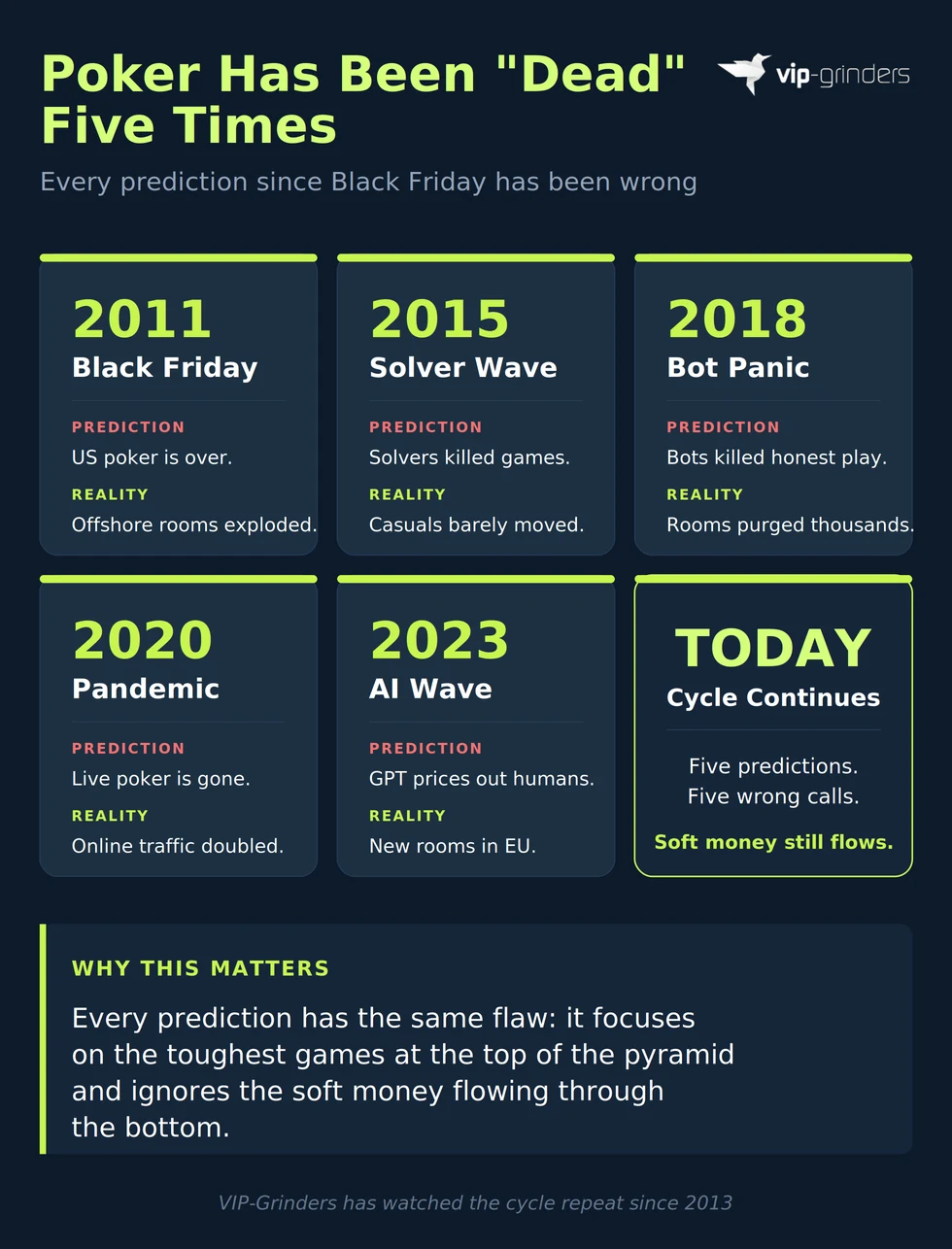
Every few years, someone declares online poker dead. The argument is always the same: solvers killed the games, regulators chased the players away, and the boom era is never coming back. The claim sounds reasonable in a forum post, but it does not match what is actually happening in the industry right now.
The signals on the ground point in the opposite direction. New rooms continue to launch, existing rooms continue to invest in their poker products, and the recreational player base has not collapsed the way the doomsayers predicted in 2011, in 2015, or in 2020.
What the Industry Is Actually Doing
The clearest evidence that online poker is alive is what the rooms themselves are doing with their money.
- New rooms keep launching: WPT Global, BCPoker, CoinPoker, and other platforms have entered or expanded in the last few years, chasing the same player base supposedly no longer exists.
- Casino crossover traffic keeps feeding the pools: rooms attached to major crypto casinos pull a constant stream of recreational players into poker lobbies, which is exactly what keeps low and mid stakes soft.
- Growth markets are opening up: regulated poker continues to expand in countries like Poland, Italy, and Czechia, bringing fresh player pools into the wider ecosystem.
- Rakeback deals remain the core pitch: rooms continue to pay affiliates for player acquisition, which would not happen if there were no players left worth acquiring.
None of those four points happen in a dying industry. They happen in an industry that knows the player base is still there and still profitable enough to compete for.
13 Years of Watching the Cycle
We launched VIP-Grinders in 2013, two years after Black Friday and right in the middle of the first wave of “online poker is dead” predictions. Since then we have watched the cycle repeat in 2015, in 2018, in 2020, and again in 2023. Every time, the prediction failed for the same reason: people focus on the toughest games at the top of the pyramid and ignore the soft money still flowing through the bottom.
The players who profited consistently across that decade and a half had two things in common. They picked one format and one stake range and stuck with it long enough to develop a real edge, and they locked in the best possible rakeback deal they could find before they put in the volume. Both of those edges are still available in 2026, and both still work.
A 90-Day Self-Test: Is Online Poker Profitable for You?
The fastest way to find out whether you can win at online poker is to run a structured 90-day test rather than guess. Three months gives you a meaningful sample at most stakes without risking serious money if the answer turns out to be no.
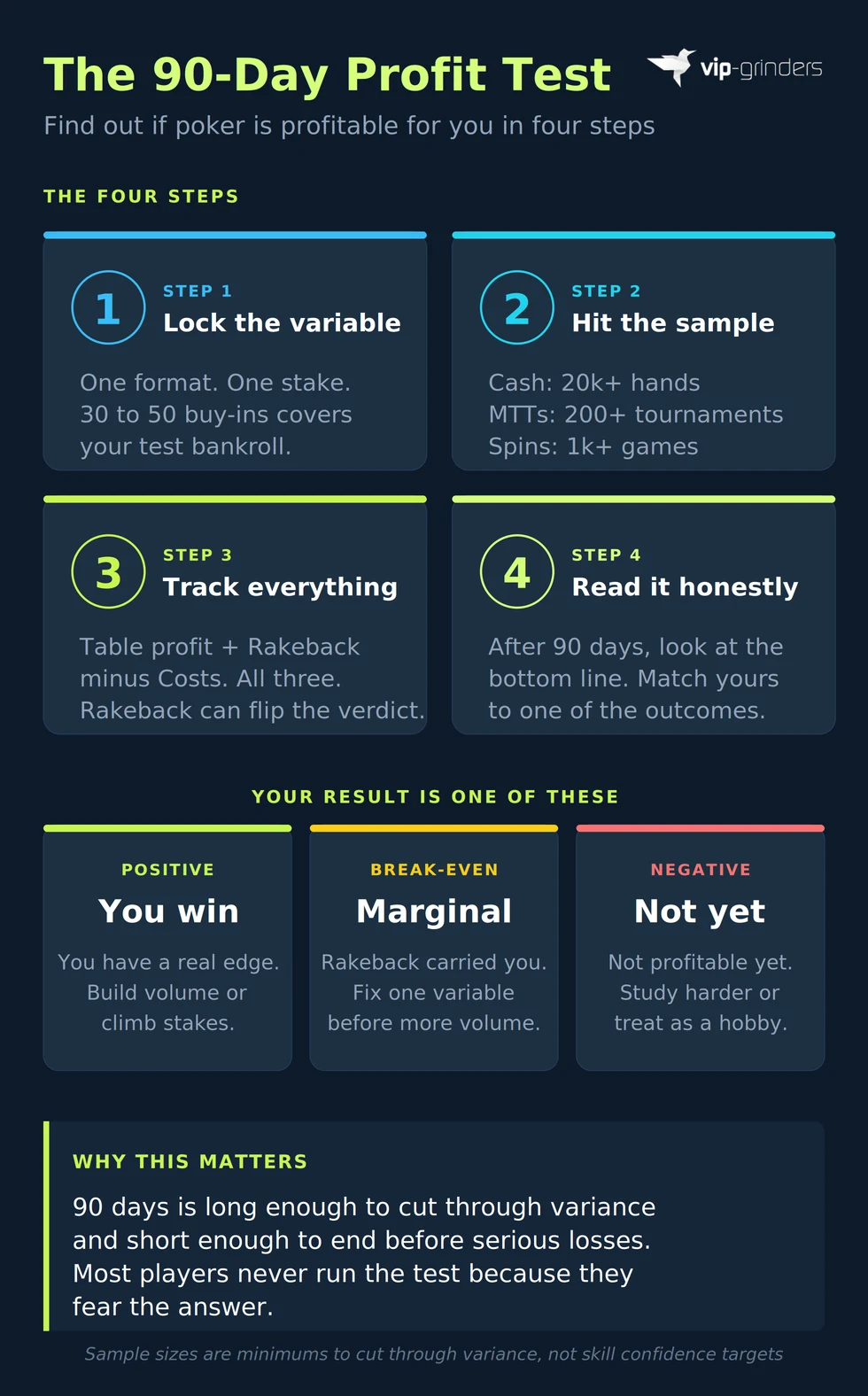
The test has four steps. Each one removes a variable that would otherwise let you fool yourself about your real results.
Step 1: Pick One Format and One Stake
Choose a single format (cash, MTTs, Spins, or SNGs) and a single stake low enough that 30 to 50 buy-ins covers your test bankroll. Switching formats mid-test or jumping stakes midway through invalidates the sample. The goal is a clean read on whether you can beat one specific game, not a tour of the lobby.
Step 2: Hit a Real Sample Size
A 1,000-hand sample tells you almost nothing because variance dominates short-term results. The minimums for a meaningful test are roughly 20,000 to 30,000 hands for cash games, 200 to 300 tournaments for MTTs, or 1,000 to 2,000 games for Spin and Gos. Anything less and you are reading noise.
Step 3: Track Total Income, Not Just Table Results
Your real result is the full equation from earlier in this guide: table profit plus rakeback minus costs. Track all three. A grinder who is break-even at the table but earns $100 in rakeback over 90 days is a winning player, not a losing one.
Step 4: Evaluate Honestly at the End
After 90 days, look at the bottom line and decide what it tells you.
- Positive net result: you have a real edge at this game. The question now is whether to build volume, climb stakes, or both.
- Break-even with rakeback doing the work: your table edge is marginal, but your deal is carrying you. Improve one variable before you commit to more volume.
- Negative after a full sample: the honest answer is that this format at this stake is not profitable for you yet. Either study harder before running the test again, or accept that poker is a hobby and not an income source.
The 90-day self-test removes the two biggest reasons players misjudge their own poker results: not enough hands to cut through variance, and ignoring rakeback when calculating profit. Run it once, run it honestly, and you will have a clearer answer about whether online poker is profitable for you than any article on the internet can give you.
Frequently Asked Questions
Is online poker still profitable?
Yes. Roughly 30% of serious online players finish as long-term winners, and that figure rises to about 35% once a proper rakeback deal is factored in. The games at the top are tougher than they used to be, but the bottom of the player pool is still soft enough for skilled grinders at low and mid stakes to earn consistent profit.
Can you make a living playing online poker?
Yes, but only for a small fraction of players. Roughly 5% of online poker players earn enough to support themselves from poker alone, and even fewer sustain it past three to five years. Making a living requires a proven win rate at your target stake, a bankroll cushion that can absorb multi-month downswings, and the temperament to handle isolation and irregular income.
How much do online poker players actually make?
Realistic monthly earnings for a competent winning player at low to mid stakes range from $150 at NL cash games up to $2,500 at online MTTs, depending on format, hours, and rakeback deal. Top professionals earn six figures and above, but they represent a tiny fraction of the player pool. Most winning players sit in the $200 to $1,500 monthly range and treat poker as a serious side income rather than a full salary.
What percentage of poker players are profitable?
Roughly 30% of serious online poker players finish their careers as long-term winners. The remaining 70% lose money over time. The breakdown across the player pool is approximately 5% Crushers, 13% Solid Winners, 12% Small Winners, 21% Small Losers, 26% Moderate Losers, and 23% Donators. Adding rakeback shifts a meaningful slice of the Small Loser tier into the black, pushing the total winner percentage to around 35%.
Can you get rich playing poker?
A small minority of poker players become wealthy from the game, but it is rare and almost always involves high-stakes cash games, deep tournament runs, or both. For most winning players, poker is a profitable supplemental income or a modest full-time living, not a path to wealth. The players who do get rich combine elite skill with a high tolerance for variance and the bankroll to play at stakes where the swings can be career-defining.
How hard is it to make money playing online poker?
Hard enough that 70% of players never get there. The skill barrier is real, the variance is brutal, and most players underestimate how much study and volume are required to develop a consistent edge. The good news is that the 30% who do make it work are not all geniuses. They are players who picked one format, stuck with it, locked in a strong rakeback deal, and put in the hours.
Is online poker worth it?
It depends on what you want from it. As a way to earn pocket money or a serious side income from a game you enjoy, online poker is absolutely worth it for the players willing to study and grind. As a get-rich-quick scheme or a replacement for a stable salary on day one, it is not worth the financial and lifestyle risk. The honest test is the 90-day self-test described above.
How long does it take to become a profitable online poker player?
For most players, six to twelve months of dedicated study and volume is the minimum to build a winning edge at micro stakes. Reaching a level where poker produces meaningful side income usually takes one to two years. Becoming a full-time professional, if you decide that is the goal, typically requires three to five years of sustained progression. The exact timeline depends on how many hours per week you can commit and how disciplined you are about studying away from the tables.