

Poker Hourly Rate: How to Maximize Your $/Hour at the Tables 2026
Most poker players track their win rate in bb/100 but never convert it into dollars per hour. A 5bb/100 winner at NL10 playing 2 tables makes a fraction of what the same win rate produces at NL50 across 4 tables with a 30% rakeback deal.

Your real hourly rate is a function of five variables: win rate, stakes, hands per hour, number of tables, and rakeback. Change any one of them and your monthly income shifts. If your bankroll does not support the stakes discussed here, start with the bankroll management guide first.
Here is what this guide covers:
- The $/hour formula with a worked NL50 example breaking down every variable
- Hourly rate tables by stake, win rate, and format (cash, Zoom, MTTs, Spins)
- The multi-tabling sweet spot where volume and win rate maximize total income
- Rakeback impact showing why your deal is worth thousands per year
The Hourly Rate Formula
Your poker hourly rate breaks down into two components: what you earn at the tables and what comes back through your rakeback deal. The full formula looks like this:
$/Hour = (Win Rate × BB Value × Hands/Hour × Tables) + (Rake/Hour × Rakeback %)
That looks complicated, but each piece is straightforward once you see it in action. Here is a worked example for a NL50 6-max grinder playing 4 tables with a 25% rakeback deal.
| Variable | Value | Where It Comes From |
|---|---|---|
| Win rate | 4 bb/100 | Your tracking software (PokerTracker, Hold’em Manager) or session logs. |
| Big blind value | $0.50 | The big blind at your stake. NL50 = $0.50 BB. |
| Hands per hour (per table) | 75 | Standard for 6-max. Full ring is ~60. Zoom is ~200. |
| Number of tables | 4 | How many tables you play simultaneously. |
| Rake per hour (all tables) | ~$12 | Estimated from your tracking software or the room’s rake schedule. |
| Rakeback percentage | 25% | Your affiliate deal or the room’s VIP program. |
Running the Numbers
Table profit: 4 bb/100 × $0.50 per bb × 75 hands/hour × 4 tables = $6.00/hour from your edge at the tables.
Rakeback income: $12/hour in rake × 25% = $3.00/hour returned through your deal.
Total hourly rate: $6.00 + $3.00 = $9.00/hour.
That $3.00/hour from rakeback is not a bonus. It is 33% of this player’s total income. Without a deal, they earn $6.00/hour, with a 25% deal they earn $9.00, and with a 40% deal the same grind produces $10.80/hour.
The tables in the next section show how these numbers scale across every stake.
Your win rate is the hardest variable to know precisely. If you have fewer than 50,000 hands at your current stake, your observed win rate may be significantly different from your true win rate. The variance guide explains why small samples are unreliable and how many hands you need before trusting your numbers.
Hourly Rate by Stake (Cash Games)
Here is what a solid 3bb/100 winner earns per hour at each stake when playing 4 tables of 6-max with a 25% rakeback deal. These numbers are not aspirational. They represent what a competent grinder with a proven edge actually takes home.
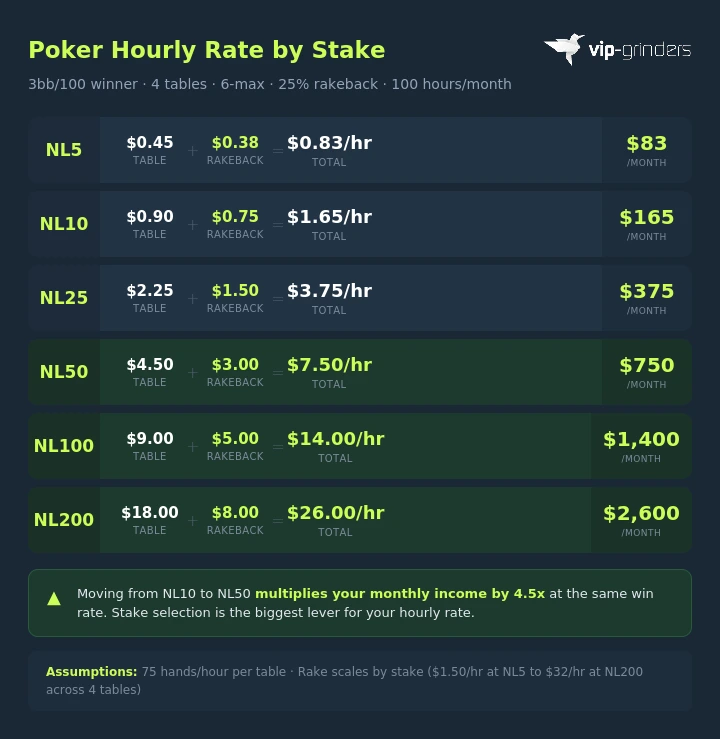
The full breakdown with rake generated and rakeback columns for each stake is in the reference table below.
| Stake | Table Profit/hr | Rake Generated/hr | Rakeback/hr (25%) | Total $/hr | Monthly (100 hrs) |
|---|---|---|---|---|---|
| NL5 ($0.02/$0.05) | $0.45 | $1.50 | $0.38 | $0.83 | $83 |
| NL10 ($0.05/$0.10) | $0.90 | $3.00 | $0.75 | $1.65 | $165 |
| NL25 ($0.10/$0.25) | $2.25 | $6.00 | $1.50 | $3.75 | $375 |
| NL50 ($0.25/$0.50) | $4.50 | $12.00 | $3.00 | $7.50 | $750 |
| NL100 ($0.50/$1.00) | $9.00 | $20.00 | $5.00 | $14.00 | $1,400 |
| NL200 ($1/$2) | $18.00 | $32.00 | $8.00 | $26.00 | $2,600 |
The jump between stakes is dramatic. A 3bb/100 winner at NL10 earns $165/month, the same win rate at NL50 produces $750/month, and at NL200 it reaches $2,600.
Moving up stakes (when your bankroll and sample size support it) is the single biggest lever for increasing your hourly rate. The $1,000/month guide shows exactly how these hourly numbers translate into specific income targets at each stake.
- Rake estimates are approximate: actual rake varies by room, table size, and how many pots you contest. Your tracking software shows your exact rake generated if you want precise numbers.
- Win rates decrease at higher stakes: maintaining 3bb/100 at NL200 is significantly harder than at NL25. The table uses a fixed win rate for comparison, but your actual rate will likely drop as you move up.
- 100 hours per month: that is roughly 25 hours per week or 3.5 hours per day. Sustainable for most serious part-time grinders. Full-time players often log 150 to 200 hours.
What If Your Win Rate Is Higher or Lower?
The table above uses 3bb/100 as a baseline because it represents a realistic, sustainable edge at low and mid stakes. If your win rate is different, the adjustment is simple: every 1bb/100 change moves your table profit proportionally.
| Win Rate | NL25 $/hr (4 tables, 25% RB) | NL50 $/hr (4 tables, 25% RB) | NL100 $/hr (4 tables, 25% RB) |
|---|---|---|---|
| 1 bb/100 (marginal) | $2.25 | $4.50 | $8.00 |
| 3 bb/100 (solid) | $3.75 | $7.50 | $14.00 |
| 5 bb/100 (strong) | $5.25 | $10.50 | $20.00 |
| 8 bb/100 (crusher) | $7.50 | $15.00 | $29.00 |
Notice that even a 1bb/100 marginal winner at NL100 earns $8.00/hour when rakeback is included. That is the power of the formula: rakeback turns marginal table results into meaningful income at higher stakes.
The fastest way to shift your win rate upward without extra study hours is sitting at softer tables. Our table selection guide covers how to read the lobby, pick the right seat, and time your sessions for peak recreational traffic.
Hourly Rate by Format
Cash games are not the only way to grind. MTTs, SNGs, and Spins each produce a different hourly rate for the same player skill level because the variables in the formula change: games per hour, rake structure, average edge, and how rakeback applies to each format.
The table below compares a competent grinder across four formats, all at roughly equivalent buy-in levels ($10 to $25 range), playing a realistic number of simultaneous games with 25% rakeback.
| Format | Buy-in / Stake | Tables | Edge | Table Profit/hr | Rakeback/hr | Total $/hr |
|---|---|---|---|---|---|---|
| NLHE Cash 6-max | NL50 | 4 | 3 bb/100 | $4.50 | $3.00 | $7.50 |
| NLHE Zoom | NL50 | 2 | 2 bb/100 | $4.00 | $4.00 | $8.00 |
| MTTs | $11 avg | 6 | 15% ROI | $1.65 | $1.50 | $3.15 |
| Standard SNGs | $7 | 4 | 5% ROI | $1.40 | $1.00 | $2.40 |
| Spin & Gos | $5 | 4 | 2% ROI | $4.00 | $2.80 | $6.80 |
The key is games per hour. A Spin player on 4 tables completes roughly 40 games per hour. At $5 per game with 2% ROI, that is $4/hour in table profit before rakeback. A Zoom player sees 200 hands per hour per table instead of 75, which compensates for the lower win rate that fast-fold formats typically produce. For the full breakdown of why fast-fold win rates run lower and how to adjust your ranges to maximize them, see our dedicated guide.
Why MTTs Look Worse Per Hour
Tournament players often have the highest edge in ROI percentage, but their hourly lags because each event takes hours to complete. A player firing 6 MTTs simultaneously might finish 1 to 2 per hour, and most of those finish with a loss. The profit comes from deep runs that happen infrequently.
Players who value consistent income over high-variance spikes are usually better served by cash or Spins.
The Multi-Tabling Sweet Spot
Every table you add increases your total hands per hour, your rake generated, and your rakeback earned. But it also splits your attention, which lowers your win rate per table. At some point, the win rate loss outweighs the volume gain, and your hourly rate starts dropping.
The table below shows a NL50 6-max player with a 4bb/100 win rate on a single table, estimating how that rate decreases as tables are added. The win rate decay is approximate and varies by player, but the pattern is consistent across skill levels.
| Tables | Est. Win Rate | Table Profit/hr | Rakeback/hr (25%) | Total $/hr |
|---|---|---|---|---|
| 1 | 4.0 bb/100 | $1.50 | $0.75 | $2.25 |
| 2 | 3.8 bb/100 | $2.85 | $1.50 | $4.35 |
| 4 | 3.5 bb/100 | $5.25 | $3.00 | $8.25 |
| 6 | 2.8 bb/100 | $6.30 | $4.50 | $10.80 |
| 8 | 2.0 bb/100 | $6.00 | $6.00 | $12.00 |
| 10 | 1.2 bb/100 | $4.50 | $7.50 | $12.00 |
| 12 | 0.5 bb/100 | $2.25 | $9.00 | $11.25 |
Table profit peaks around 6 tables ($6.30/hour) and actually declines after that because the win rate drops faster than volume increases. Total hourly keeps climbing past 6 because rakeback compensates, with the overall peak around 8 to 10 tables.
At 12 tables, table profit has collapsed to $2.25/hour (less than a 2-table setup), but rakeback rescues the session. This is the “rakeback pro” profile: thin table edge, high volume, strong deal. Our multi-tabling guide covers format-by-format recommendations and the add/remove checklist.
- Cash games (regular tables): most players maximize hourly between 4 and 8 tables. Beyond 8, only players with strong rakeback deals and disciplined ABC strategies continue to benefit.
- Zoom and fast-fold: the sweet spot is typically 2 to 4 tables. Each Zoom table already deals 200+ hands per hour, so adding more creates extreme decision volume that tanks most players' win rates.
- Spins: 4 to 6 tables works for most grinders. Games are short and decision-light (push/fold), so the win rate decay per added table is smaller than in cash games.
How Rakeback Changes Your Hourly Rate
The multi-tabling section above showed that rakeback becomes a larger share of your income as you add tables. This section makes the point even sharper: the difference between a weak deal and a strong deal is not a minor detail. It is hundreds of dollars per month at every stake above NL10.
The visual below shows the same NL50 player (3bb/100, 4 tables, 75 hands/hour) with four different rakeback percentages. The only variable that changes is the deal.
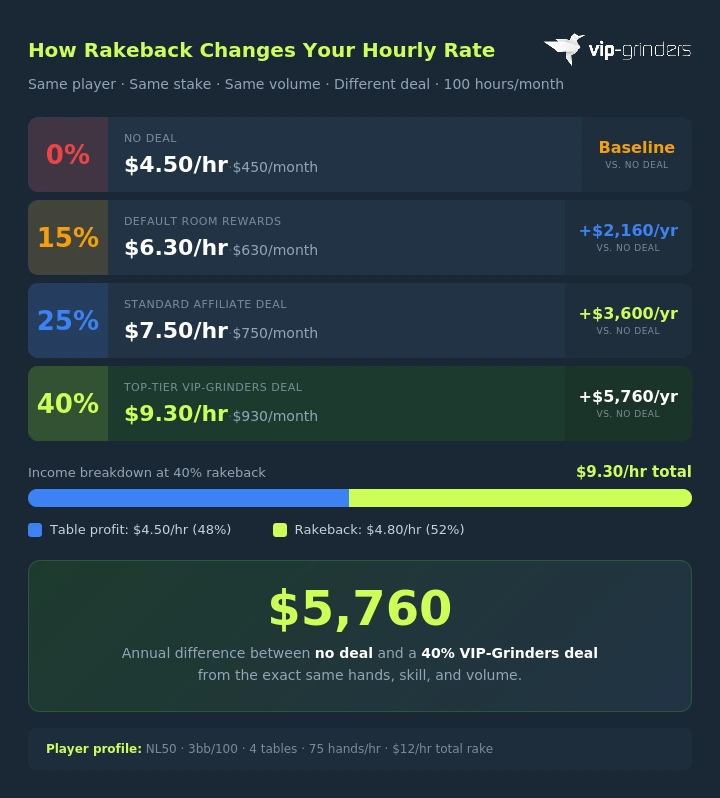
The reference table adds monthly and annual figures so you can see the cumulative cost of a weak deal over time.
| Rakeback % | Table Profit/hr | Rakeback/hr | Total $/hr | Monthly (100 hrs) | Annual Difference vs. 0% |
|---|---|---|---|---|---|
| 0% (no deal) | $4.50 | $0.00 | $4.50 | $450 | Baseline |
| 15% (default room rewards) | $4.50 | $1.80 | $6.30 | $630 | +$2,160 |
| 25% (standard affiliate deal) | $4.50 | $3.00 | $7.50 | $750 | +$3,600 |
| 40% (top-tier VIP-Grinders deal) | $4.50 | $4.80 | $9.30 | $930 | +$5,760 |
The player with no deal earns $450/month. The same player with a 40% deal earns $930/month. That is a $480/month difference ($5,760/year) from the exact same hands, the exact same skill, and the exact same volume.
You can calculate your exact numbers using our rakeback calculator. The rakeback and strategy guide covers how your deal should also influence format selection, table count, and volume planning.
Common Mistakes That Kill Your Hourly Rate
Most grinders lose more hourly rate to off-table mistakes than to bad poker decisions. The formula only works if every variable is optimized, and ignoring even one of them can cut your income by 30% or more without you realizing it.
- Playing too many stakes at once: splitting your sessions between NL25 and NL50 dilutes your focus and makes it harder to track your win rate at either level. Pick one primary stake and build your sample there.
- Ignoring session timing: player pools are softer during evening hours in your target market and tougher during off-peak times when only regulars are online. Playing 10am on a Tuesday produces a lower effective win rate than 8pm on a Saturday. Our session management guide covers peak hours by network and how to schedule your week.
- Not tracking rake generated: if you do not know how much rake you produce per month, you cannot calculate your true hourly rate. You are making decisions about stakes and volume based on incomplete data.
- Withdrawing before rakeback clears: some VIP programs require minimum activity thresholds to unlock monthly rewards. Withdrawing mid-month and stopping play can forfeit rakeback you already earned.
- Choosing the wrong format for your skill set: a player who excels at postflop play will extract more value from cash games than from Spins where most decisions are push/fold. Your format should match where your edge is largest, not where the volume is highest.
The cumulative impact of fixing these is often larger than any strategy improvement at the table. One variable sits outside the formula entirely: the mental game gap between your A-game and C-game decides whether these numbers ever land in your account.
Frequently Asked Questions
What is a good poker hourly rate?
It depends on your stake, format, and table count. A solid 3bb/100 cash game winner at NL50 on 4 tables earns roughly $7 to $9/hour including rakeback. At NL100, the same profile reaches $14 to $20/hour. These numbers assume a proven win rate over 50,000+ hands and a 25% rakeback deal.
How do I calculate my poker hourly rate?
Use the formula: (Win Rate × BB Value × Hands/Hour × Tables) + (Rake/Hour × Rakeback %). Your tracking software provides your win rate and rake generated. Multiply by your table count and hands per hour (75 for 6-max, 200 for Zoom), then add your rakeback percentage of the total rake.
Does rakeback count toward my hourly rate?
Yes, and it should. Rakeback is real income earned from your play. For many grinders at low and mid stakes, rakeback represents 25% to 50% of their total hourly income. A player who ignores rakeback in their calculations is significantly underestimating what they actually earn.
How many tables should I play to maximize my hourly?
For most cash game players, the sweet spot is 4 to 8 regular tables or 2 to 4 Zoom tables. Adding tables beyond that point usually drops your win rate faster than volume compensates. The exception is players with strong rakeback deals who benefit from the extra rake generated even at a lower per-table win rate.
Which poker format has the highest hourly rate?
Cash games and Zoom typically produce the most consistent hourly rate because of high hand volume and steady rakeback. Spins can compete at equivalent buy-in levels due to their fast game speed. MTTs have the highest potential per-session earnings but the lowest and most inconsistent hourly rate because of long game times and top-heavy payouts.
Can a break-even player still make money from poker?
Yes, through rakeback. A 0bb/100 player at NL50 on 4 tables with a 25% rakeback deal earns roughly $300/month from rakeback alone. This is the “rakeback pro” model: players who generate high volume with a thin or zero table edge and profit entirely from their deal.
How much do professional poker players make per hour?
Online professionals at mid stakes (NL100 to NL200) typically earn $15 to $40/hour including rakeback, depending on their win rate and table count. Live professionals at $2/$5 or $5/$10 earn a similar range but with far fewer hands per hour and higher variance per session. Elite high-stakes players can earn significantly more, but those stakes require massive bankrolls and are not realistic benchmarks for most grinders.
Is moving up in stakes always better for my hourly rate?
Not always. Moving up only improves your hourly if you can maintain a meaningful win rate at the higher stake. A player who crushes NL25 at 5bb/100 earns $5.25/hour (with rakeback), but if they move to NL50 and their win rate drops to 1bb/100, their hourly drops to $4.50. Only move up when your bankroll and sample size confirm you can sustain an edge at the next level.