

WSOP Player of the Year 2026: Standings, Points System and Full History
The WSOP Player of the Year is an annual consistency award. It goes to the player who accumulates the most points across eligible bracelet events throughout the World Series of Poker season.
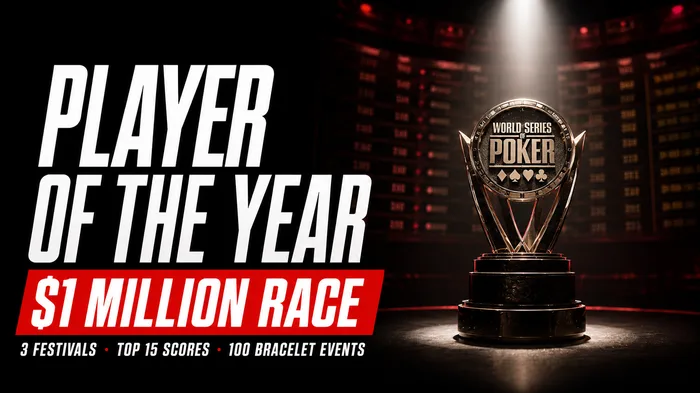
The 2026 race marks the first time the award carries a $1,000,000 prize pool, with points counting across three festivals worldwide. The money has already changed the calculus: several players who typically skip festivals outside Vegas have committed to all three legs in 2026.
Defending champion two-time POY winner Shaun Deeb ends the Las Vegas leg on top with 3,410 points, just 22 clear of Naoya Kihara on 3,388. Alex Foxen slipped from first to third on 3,381 on the final day of the series.
With the Las Vegas leg complete and WSOP Paradise still to come in December, the race is far from settled.
WSOP Player of the Year 2026 Standings
The table below mirrors the official WSOP leaderboard, combining WSOP Europe Prague (Mar 31 to Apr 12) with the completed Las Vegas leg. In Vegas, 94 of the 100 bracelet events were POY-eligible after six non-open exclusions. The Main Event final nine return for the ESPN finale from August 3 to 5.
Standings were updated weekly during the Las Vegas series and will be refreshed after the Main Event finale in August and after each WSOP Paradise bracelet event in December.
For real-time updates, check the official WSOP Player of the Year leaderboard.
VIP-Grinders has covered every WSOP since 2013. This page is updated throughout the race with standings, analysis and context on new bracelet winners.
| Rank | Player | Country | Points |
|---|---|---|---|
| 1 | Shaun Deeb | USA | 3,410 |
| 2 | Naoya Kihara | Japan | 3,388 |
| 3 | Alex Foxen | USA | 3,381 |
| 4 | Justin Liberto | USA | 2,828 |
| 5 | Josh Arieh | USA | 2,750 |
| 6 | Daniel Negreanu | Canada | 2,698 |
| 7 | Jesse Lonis | USA | 2,674 |
| 8 | Eelis Parssinen | Finland | 2,638 |
| 9 | Michael Moncek | USA | 2,592 |
| 10 | Josh Reichard | USA | 2,574 |
Last updated: 16 July 2026.
The Las Vegas leg is complete, and Shaun Deeb ends it on top with 3,410 points. The $25,000 H.O.R.S.E. High Roller finale decided the final Vegas order, Deeb’s eighth place carrying him past Alex Foxen and 22 points clear of Naoya Kihara, whose third place for $394,433 fell agonisingly short.
Alex Foxen bubbled the unofficial final table in 10th and slipped from first to third on 3,381, leaving just 29 points across the top three. His exit prompted Deeb to walk over and personally thank eventual champion Alexander Kostritsyn.
As Kihara kept climbing with Deeb still seated, Ari Engel summed up the tension at the table: “Naoya, Shaun is very happy for you.”
Justin Liberto closed the leg fourth on 2,828, with Daniel Negreanu up to sixth on 2,698. Nothing is settled yet: the title is only decided when WSOP Paradise concludes on 18 December.
For daily bracelet coverage, see our WSOP 2026 results tracker.
How the 2026 Points System Works
The 2026 WSOP Player of the Year format is the most significant overhaul in the award’s 22-year history. Three changes define it: a global calendar, online exclusion, and a scoring cap.
Which Events Count: 3 Festivals, 94 Eligible in Vegas
Three festivals feed the 2026 leaderboard: WSOP Europe Prague (Mar 31 to Apr 12, 14 POY-eligible bracelets), WSOP Las Vegas (May 26 to Jul 15, 94 of 100 qualifying), and WSOP Paradise in the Bahamas (Dec 1 to 18).
Only open live bracelet events count. All online bracelet events on WSOP.com and GGPoker are excluded for the first time. Only a player’s top 15 scores count toward the final leaderboard, up from 10 in 2024 and 2025 and unlimited before that.
The following six non-open Vegas events are excluded from POY:
- Industry Employees NLH (#3)
- Seniors High Roller NLH (#39)
- Seniors Championship NLH (#46)
- Super Seniors NLH (#61)
- Tag Team NLH (#66)
- Ladies Championship NLH (#68)
The 2026 Points Formula Explained
POY Points = C x ⁴·⁵√Buy-in x |ln(Rank Ratio)|¹·⁷
Where C = multiplier based on finishing position, Rank Ratio = final position / total entries, and ln = natural logarithm.
The official formula graphic from WSOP.com:
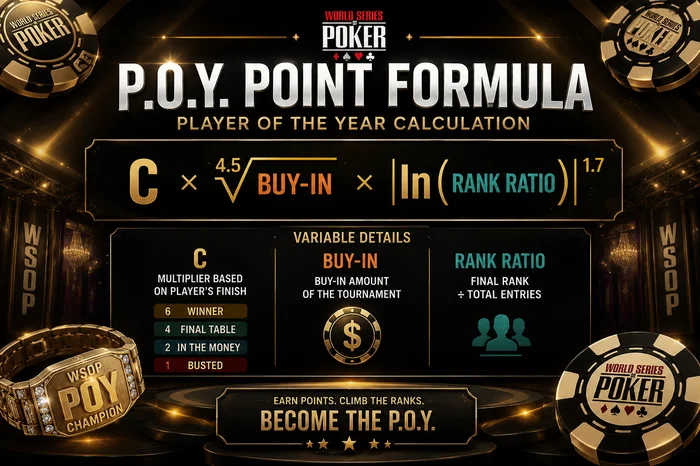
The C multiplier is the biggest lever in the formula. It rewards winners six times more than players who bust without cashing:
| Finish | C Multiplier |
|---|---|
| Winner | 6x |
| Final Table | 4x |
| In the Money | 2x |
| Busted (no cash) | 1x |
Rank Ratio equals Final Rank divided by Total Entries. The 4.5th root dampens the buy-in effect significantly: a $10,000 event generates roughly 1.7 times the base points of a $1,000 event, not 10 times.
The natural log component rewards deep runs disproportionately. A win scores several times more than a final table, which scores several times more than a min-cash.
The exact ratios vary by field size. The WSOP’s interactive calculator at wsop.com lets players test specific scenarios.
Tiebreakers: How Equal Positions and Multi-Cash Events Are Scored
Players eliminated in the same round (5th through 8th in a heads-up bracket, for example) receive equal points. The points for those positions are averaged across the tied places.
Multi-cash events like The Closer award POY points once per player, based on final overall finishing position. No specific tiebreaker protocol exists for equal point totals, but the continuous-variable formula makes exact ties near-impossible in practice.
The $1 Million Prize Pool
Before 2026, the Player of the Year winner received a trophy, a personalised banner hung in the rafters at Paris Las Vegas, and a $10,000 Main Event entry. The total package was worth roughly $10,000 plus the prestige. That changed when the WSOP announced a $1M global prize pool for 2026.
| Place | Prize |
|---|---|
| 1st | $100K WSOP Paradise Package + POY Title + Trophy + Banner |
| 2nd to 3rd | $100K WSOP Paradise Package each |
| 4th to 15th | $30K Super Main Event Package |
| 16th to 50th | $5K Circuit Championship Package (1 random $30K upgrade) |
| 51st to 100th | $2.5K Circuit Championship Ticket (6 random $5K upgrades) |
The top-100 payout structure creates a genuine financial incentive for mid-volume grinders. A player who finishes 50th still earns a $5,000 package. Even 100th place receives a $2,500 Circuit Championship ticket.
The prize money has changed behaviour at the tables. Lower buy-in events are drawing deeper fields as players chase every possible POY point, not just bracelet glory.
2026 POY Contenders
The Player of the Year leaderboard features familiar names alongside first-time contenders. The Las Vegas leg is complete, and WSOP Paradise in December will decide the title.
Alex Foxen (USA) closed the Vegas leg third on 3,381 points after six final tables, one bracelet and a deep Main Event run. His fourth career bracelet came in the $10,000 Super Turbo Bounty ($594,246, 466 entries), where he eliminated six of his eight opponents at the final table.
His wife Kristen Foxen won the $25,000 High Roller for her sixth bracelet just one week earlier, making them the first married couple to both win bracelets in the same WSOP summer. Together they have cashed for over $3.3 million this series.
Foxen’s consistency across NLH and big-bet formats suits the top-15 scoring cap. His fifth-place finish in the $10,000 8-Game Mixed Championship showed he can compete across mixed-game disciplines too.
Naoya Kihara (Japan) sits second on 3,388 points after winning back-to-back $10,000 championships, the 2-7 Lowball Draw ($428,923) and Seven Card Stud ($301,970), in the same week. Only five players had ever done it before: Doyle Brunson, Stu Ungar, Greg Merson, George Danzer and Jason Mercier.
He generated points to the very last day. His third place in the $25,000 H.O.R.S.E. High Roller finale, worth $394,433, closed the gap to 22 points but left a third bracelet of the summer just out of reach.
Shaun Deeb (USA) leads the race on 3,410 points after winning the $1,500 8-Game Mixed for his ninth bracelet and $181,625. The defending two-time champion (2018, 2025) now has nine bracelets and five consecutive top-six POY finishes from 2018 to 2023.
He came back from just 300,000 chips on Day 3 to defeat Dean Joe heads-up, ending a run of three runner-up finishes in 2026 bracelet events. His ninth bracelet ties Benny Glaser and Michael Mizrachi.
He turned 40 in March 2026, making him eligible for the Poker Hall of Fame for the first time. He has committed to all three festivals, and his Main Event run ended in 15th for $410,475. His eighth place in the H.O.R.S.E. finale then carried him to the top of the Vegas-leg standings.
POY isn’t about highlight reels.
Shaun Deeb, on X after the 2025 POY controversy
Deeb’s point was that consistency across a full schedule matters more than individual headline wins. His 2025 and 2026 campaigns both reflect that philosophy.
Justin Liberto (USA) is the newest name in the top five, holding fourth on 2,828 points. His fifth-place finish in the $10,000 6-Handed Championship followed a second career bracelet in the $1,500 Mixed Omaha earlier in the series.
Jesse Lonis (USA) sits seventh on 2,674 points after finishing runner-up in the $3,000 T.O.R.S.E. for $160,862. The two-time bracelet winner entered that final table with around 40 percent of the chips in play.
It was his first T.O.R.S.E. event, and he played parts of the final day while multi-tabling online tournaments on his phone.
Marius Kudzmanas (Lithuania) dropped just outside the top 10 after winning the WSOPE Main Event (2,617 entries, first prize of EUR 2,000,000). It was his third career bracelet after two online wins in 2023 and 2024.
He is the first Lithuanian to win the WSOPE Main Event. Whether he plays a full Vegas and Paradise schedule remains unclear.
The other two-time champion is inaugural winner Daniel Negreanu (Canada, 2004 and 2013), who now holds eight bracelets after winning the $100,000 PLO High Roller for $2,257,718 during the current series. He has confirmed a 40-event schedule for Las Vegas. His mixed-game strength gives him entries in disciplines that most NLH specialists skip.
That volume is paying off. His eighth place in the $50,000 High Roller on July 11 kept the charge alive, and he closed the Vegas leg sixth on 2,698 points despite busting the $25,000 H.O.R.S.E. High Roller without cashing.
Benny Glaser (UK) has slipped just outside the top 10 on 2,554 after winning the $50,000 Poker Players Championship for his ninth career bracelet and $1,343,764. He is the most decorated European player in WSOP history.
His mixed-game range suits the top-15 scoring format and his PPC victory generated one of the largest single-event points hauls of the series.
All-time bracelet leader Phil Hellmuth sits outside the top 10 despite finishing runner-up in the final $5,000 8-Handed for $464,286, one spot short of an 18th bracelet. He has finished runner-up in the POY race four times (2006, 2011, 2012, 2021) without ever winning.
Dark Horses From Prague
Several WSOPE Prague standouts enter Vegas with realistic shots at a top-15 finish if they play full summer schedules:
Three episodes reshaped how the WSOP calculates and administers the Player of the Year race. Each one led directly to formula changes.
The 2017 Chris Ferguson Controversy
Ferguson won POY six years after the Full Tilt Poker scandal. The DOJ filed a civil complaint in 2011 alleging Full Tilt operated as a Ponzi scheme that paid out $444M of customer funds to its directors.
Ferguson was never criminally charged. His case was dismissed on 19 February 2013 via a settlement forfeiting $2,350,000 with no admission of wrongdoing.
He recorded 23 cashes across the WSOP and WSOPE, won one bracelet, and earned $496,343. He ranked 279th on the money list but finished first in POY under the new ROI-style formula.
The community reaction was fierce, and the WSOP did not strip the title. Ferguson issued a brief video apology in May 2018.
Hellmuth’s Four Runner-Up Finishes
Phil Hellmuth has 17 bracelets but has never won POY. He has finished second four times, each under different circumstances.
In 2006, he was briefly declared the winner before the WSOP ruled that post-Main-Event tournaments did not count, handing the title to Jeff Madsen. In 2011, Ben Lamb’s third-place Main Event finish overtook him.
In 2012, Greg Merson’s Main Event win put him ahead after WSOPE. In 2021, Josh Arieh’s two PLO bracelets edged him out.
Hellmuth publicly criticised the POY format after the 2025 result, arguing that Mizrachi’s Main Event and PPC double should have earned the title over Deeb’s volume-based campaign.
The 2019 Scoring Error
Daniel Negreanu was declared the 2019 POY winner after WSOPE Rozvadov and posted a celebratory vlog. Four days later, a data-entry error in Online Event #68 was discovered. Negreanu had been credited with points for a cash that belonged to another player.
After correction, Robert Campbell was declared the rightful winner. Deeb finished third and later said that under the correct numbers, he would have won had he adjusted his strategy in the closing Colossus event. The episode led directly to tighter scoring oversight and, eventually, the cap-based system introduced in 2024.
WSOP Player of the Year Winners (2004 to 2025)
The award has been given every year since 2004 except 2020, when the live WSOP was cancelled due to COVID-19. In 22 editions, only two players have won it twice.
The scoring formula has changed more than ten times. Greg Merson (2012) remains the only player to win both the Main Event and POY in the same summer.
All earnings figures below reflect POY-eligible events only and are sourced from the official WSOP historical table and verified tournament results on Hendon Mob.
| Year | Winner | Country | Bracelets | Cashes | Earnings | Notes |
|---|---|---|---|---|---|---|
| 2004 | Daniel Negreanu | Canada | 1 | 6 | $346,280 | Inaugural POY |
| 2005 | Allen Cunningham | USA | 1 | 5 | $1,006,935 | |
| 2006 | Jeff Madsen | USA | 2 | 4 | $1,467,852 | Youngest POY at 21 |
| 2007 | Tom Schneider | USA | 2 | 3 | $416,829 | |
| 2008 | Erick Lindgren | USA | 1 | 5 | $1,348,528 | |
| 2009 | Jeff Lisandro | Australia | 3 | 6 | $807,521 | First 3-bracelet POY |
| 2010 | Frank Kassela | USA | 2 | 6 | $1,255,314 | |
| 2011 | Ben Lamb | USA | 1 | 5 | $5,352,970 | 3rd in ME overtook Hellmuth |
| 2012 | Greg Merson | USA | 2 | 4 | $9,755,180 | Won ME + POY same year |
| 2013 | Daniel Negreanu | Canada | 2 | 10 | $2,214,304 | First two-time POY |
| 2014 | George Danzer | Germany | 3 | 10 | $878,993 | 3 bracelets (one at APAC) |
| 2015 | Mike Gorodinsky | USA | 1 | 8 | $1,766,796 | |
| 2016 | Jason Mercier | USA | 2 | 11 | $960,424 | |
| 2017 | Chris Ferguson | USA | 1 | 23 | $496,343 | Controversial (Full Tilt) |
| 2018 | Shaun Deeb | USA | 2 | 20 | $2,534,511 | First Deeb title |
| 2019 | Robert Campbell | Australia | 2 | 13 | $743,377 | Awarded after scoring error |
| 2020 | Not awarded | COVID-19 | ||||
| 2021 | Josh Arieh | USA | 2 | 12 | $1,198,416 | Hellmuth 4th runner-up |
| 2022 | Dan Zack | USA | 2 | 17 | $1,460,427 | |
| 2023 | Ian Matakis | USA | 1 | 22 | $881,052 | Online-only bracelet |
| 2024 | Scott Seiver | USA | 3 | 17 | $1,449,736 | Called his shot. 3 bracelets. |
| 2025 | Shaun Deeb | USA | 1 | 24 | $4,006,440 | Beat Glaser by ~40 pts |
How the Formula Has Changed (2004 to 2026)
No other poker award has been recalculated as often. The POY formula has passed through five different administrators since 2004, with each era bringing fundamental changes to how points are calculated.
| Era | Administered By | Key Changes |
|---|---|---|
| 2004 to 2009 | WSOP staff | Six formula versions. Flat points to prize-money weighting to field-size adjustment. ME excluded then re-included. First controversy (Hellmuth 2006 error). |
| 2010 to 2014 | Bluff Magazine | Buy-in and field-size weighting introduced. WSOPE and WSOP Asia-Pacific events count. |
| 2015 to 2016 | GPI (Mediarex) | GPI algorithm replaces Bluff system. |
| 2017 to 2018 | Kings Casino | ROI-style formula. Ferguson wins 2017 POY (Full Tilt controversy). |
| 2019 to 2026 | WSOP in-house | 2019 scoring error (Campbell declared winner). Top-10 cap introduced (2024). Top-15 cap, online excluded, $1M prize pool, three festivals (2026). |
The WSOP Player of the Year formula has changed more than ten times in 22 years. The 2026 system is the most significant structural overhaul since the award’s creation.
Notable WSOP Player of the Year Records
- Most POY wins: Daniel Negreanu and Shaun Deeb (2 each). The only two-time winners in the award's history.
- Most runner-up finishes: Phil Hellmuth (4: 2006, 2011, 2012, 2021). 17 bracelets but never POY.
- Only POY + Main Event winner in same year: Greg Merson (2012). Won both in the same summer.
- Youngest POY: Jeff Madsen (21 years old in 2006). Won two bracelets in his first full WSOP.
- Oldest POY: Chris Ferguson (54 in 2017). Won on volume with 23 cashes and one bracelet.
- Highest POY-year earnings: Greg Merson, $9,755,180 (2012). Driven by his $8.5M Main Event win.
- Lowest POY-year earnings: Daniel Negreanu, $346,280 (2004). The inaugural winner in a smaller schedule.
- Most bracelets in a POY-winning year: 3, shared by Jeff Lisandro (2009), George Danzer (2014), and Scott Seiver (2024).
- Most consecutive top-six finishes: Shaun Deeb, 5 straight (2018 to 2023, excluding 2020 when no award was given).
- POY winners by nationality: USA dominates with roughly 17 of 21 awards. Canada (Negreanu, 2), Australia (Lisandro and Campbell), and Germany (Danzer) account for the rest.
For profiles of past POY winners and other leading tournament players, see our poker player profiles.
Frequently Asked Questions
Who leads the 2026 WSOP Player of the Year race?
Shaun Deeb leads on 3,410 points after the completed Las Vegas leg, 22 ahead of Naoya Kihara (3,388), with Alex Foxen third on 3,381. The title is only decided when WSOP Paradise concludes on 18 December.
Who has won the most WSOP Player of the Year awards?
Daniel Negreanu (2004, 2013) and Shaun Deeb (2018, 2025) are the only two-time winners. No player has won more than twice in the award’s 22-year history.
How are WSOP POY points calculated in 2026?
The formula uses three variables: a multiplier based on finishing position (6x for a win, 4x for a final table, 2x for a cash), the 4.5th root of the buy-in, and the natural log of the rank ratio raised to the power of 1.7. The WSOP hosts an interactive calculator on its official leaderboard page.
Has Phil Hellmuth ever won WSOP Player of the Year?
No. Despite holding the all-time record of 17 WSOP bracelets, Hellmuth has finished runner-up in the POY race four times (2006, 2011, 2012, 2021) without ever winning.
Do online bracelet events count toward the 2026 POY?
No. For the first time in the award’s history, all online bracelet events on WSOP.com and GGPoker are excluded from the 2026 POY standings. Only open live bracelet events across the three festivals count.
Can you win POY without winning a bracelet?
Yes. Ian Matakis won the 2023 POY with only an online bracelet (no live bracelet that year). His campaign was built on 22 cashes across high-volume NLH and PLO events. The top-15 scoring cap introduced in 2026 makes a bracelet-less title harder but not impossible.
What does the 2026 WSOP POY winner receive?
The winner receives a $100,000 WSOP Paradise package, the POY trophy, and a personalised banner hung at Paris Las Vegas. Second and third place each receive a $100,000 Paradise package. Prizes extend to the top 100 finishers from a total pool of $1,000,000.
For the full WSOP 2026 schedule, bracelet records and daily results coverage, see our full WSOP reference section.