

Equity Denial: Why Betting Beats Checking More Than You Think 2026
You hold top pair on a wet board. You are ahead right now. But your opponent holds a flush draw with roughly 35% equity, which means they make their flush about one in three times if they see two more cards for free.
Betting here is not for value: you do not want a call from a completed flush. It is not a bluff: you have the best hand. It is equity denial, forcing a fold from a hand that has live equity against yours before it can realize that equity at showdown.
Equity denial sits between value betting and bluffing as the third bet type every poker player needs to understand. A value bet wants a call from worse. A bluff wants a fold from better.
A denial bet wants a fold from a hand that is currently behind but has enough outs to catch up. The profit comes not from what your opponent puts in, but from what they do not get to win by seeing free cards.
Here is what this guide covers:
- The denial premium formula and the EV math that proves when betting beats checking
- Which hands to deny with and which are too strong or too weak to benefit
- Denial sizing by board texture from dry to wet with the draw equity cheat sheet
- Street-by-street denial from flop through turn, plus why denial does not exist on the river
- Multiway and tournament denial math including ICM sizing adjustments
What Equity Denial Means (and What It Does Not)
Every bet in poker serves one of three purposes: extract value from worse hands, bluff better hands into folding, or deny equity from hands that are behind but have outs. Most players understand the first two. The third is where the money hides, because failing to deny equity costs you fractions of a big blind on every wet board you check, and those fractions compound across thousands of hands.
Every time your opponent folds a hand with 20% or 30% or 40% equity, that entire percentage is removed from the hand. They cannot win what they never get to see. That is the core of denial: a free card is more expensive than the chips you risk by betting.
Equity Denial vs Value Bet vs Bluff
Three bet types exist in poker, and confusing them leads to sizing errors, frequency errors, and misread hand histories. The table below draws the line between all three.
| Bet Type | Who Has the Best Hand? | What You Want | If Opponent Calls | Example |
|---|---|---|---|---|
| Value bet | You | A call from worse | You profit from their mistake | Top set on a dry board, bet 75% pot |
| Bluff | Opponent | A fold from better | You lose the bet | Missed draw on the river, bet 66% pot |
| Equity denial | You | A fold from a drawing hand | Mixed: you are ahead but they have outs | Top pair on a wet flop, bet 66% pot |
The critical difference between value and denial is what happens when your opponent calls. A value bet profits from the call itself. A denial bet does not necessarily profit from the call: the opponent who calls with a flush draw still has 35% equity against you.
The profit from denial comes from fold equity: the folds, not the calls.
This is why denial bets and value bets often use different sizing. A value bet sizes to maximize calls from worse. A denial bet sizes to maximize folds from draws.
In practice, many bets serve both purposes at once. Top pair on a wet board extracts value from worse pairs AND denies equity to draws. Knowing which motive dominates changes how you think about the size.
The Equity Realization Connection
Every poker hand has raw equity: its percentage chance of winning if all remaining cards are dealt and both players check to showdown. A flush draw on the flop has roughly 35% raw equity. But raw equity is theoretical.
What matters is realized equity: the percentage of that raw equity the hand actually captures in practice.
A flush draw with 35% raw equity might only realize 20% to 25% of it because the holder folds to bets before seeing the river. The gap between raw and realized equity is created by betting.
Equity denial is the act of widening that gap deliberately. You win 100% of the pot when they fold. They realize 0% of their 35% equity.
This is the clearest way to think about denial: you are not just protecting your hand, you are attacking their ability to profit from theirs.
The EV Math: When Denial Beats Checking
The intuition behind equity denial is simple: betting folds out hands that could beat you. The math behind it is what tells you exactly when that bet is worth more than checking and letting the hand play out.
The Denial Premium
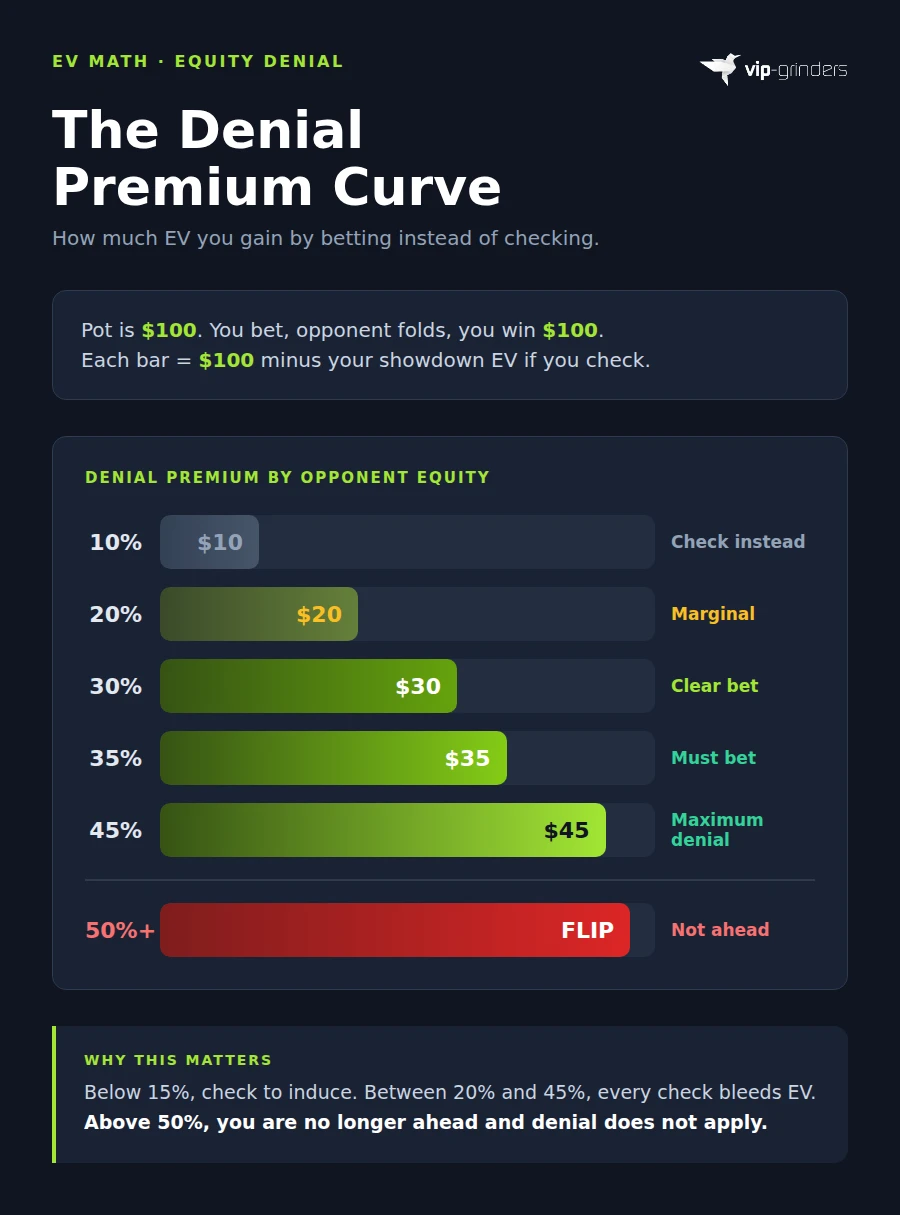
The denial premium is the difference between what you win by betting (opponent folds, you take the pot) and what you win by checking (you go to showdown with your current equity). The bigger the gap, the more profitable the denial bet.
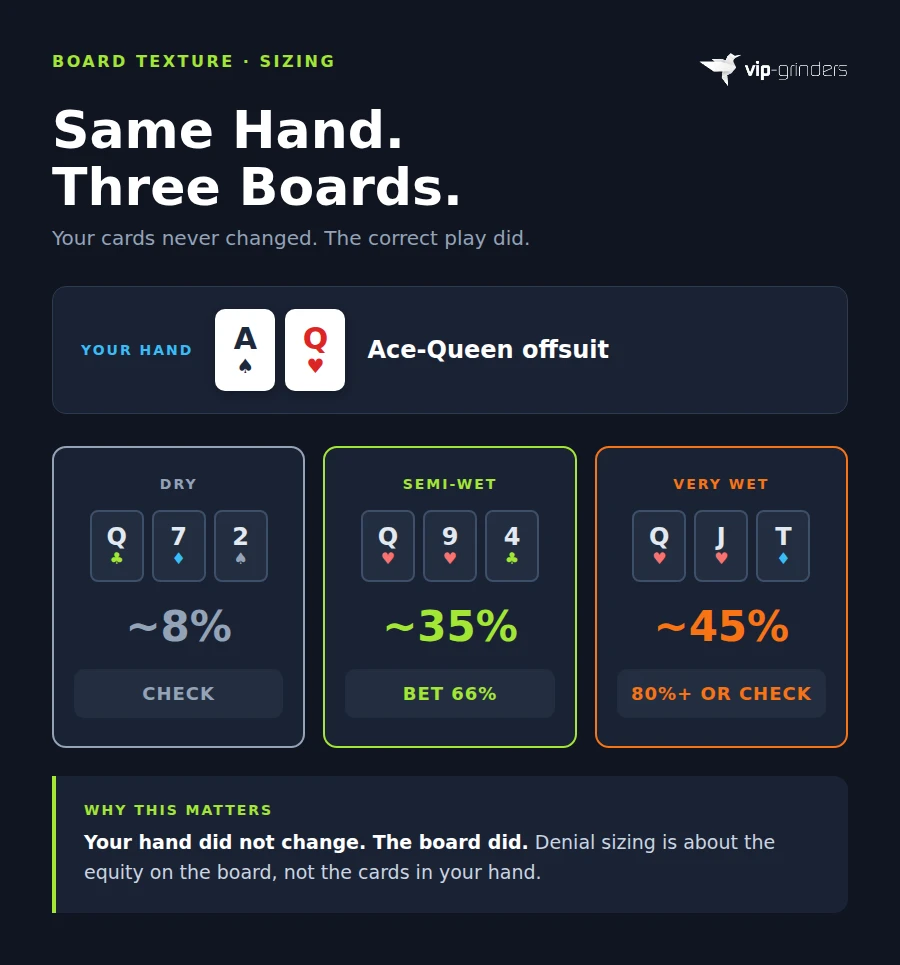
A worked example makes this concrete. You hold A-Q on a Q-9-4 board with two hearts. You have top pair, top kicker against a flush draw with roughly 35% equity on the flop (two cards to come).
| Action | Pot Size | Your Share | Result |
|---|---|---|---|
| Check down (no further betting) | $100 | 65% ($65) | You win $65 on average |
| Bet $75, opponent folds | $100 | 100% ($100) | You win $100 |
The denial premium here is $35. That is the money you gain by forcing a fold instead of letting your opponent realize their 35% equity for free. Every time you check in this spot, you are handing $35 in expected value back to your opponent.
This is not a small number. Across 100 identical spots in a month, that is $3,500 in EV left on the table by players who check top pair on wet boards because “they already have the best hand.”
When Denial Beats Value
Not every bet with the best hand should prioritize denial. Some spots are better framed as value bets where you want a call. The crossover point depends on what your opponent’s continuing range looks like.
| Opponent’s Continuing Range | Primary Motive | Sizing Approach |
|---|---|---|
| Mostly worse made hands (weak pairs, Ace-high) | Value | Size to get called: 50% to 75% pot |
| Mostly draws (flush draws, straight draws) | Denial | Size to fold out draws: 66% to 80% pot |
| Mix of worse hands and draws | Both (most common) | 66% pot balances value extraction and denial |
The test is straightforward: ask what your opponent calls with. If the answer is mostly worse made hands that cannot improve past you, your bet is value and you should size to get called. If the answer is mostly draws with significant equity, your bet is denial and you should size to fold them out.
Most real spots are a blend of both, which is why 66% pot shows up so often as the default on semi-wet boards.
The Draw Equity Cheat Sheet
Denial sizing only works if you know how much equity you are denying. The table below gives the standard equity numbers for every common draw type on the flop and turn.
| Draw Type | Flop Equity (2 cards to come) | Turn Equity (1 card to come) |
|---|---|---|
| Flush draw (9 outs) | ~35% | ~18% |
| Open-ended straight draw (8 outs) | ~32% | ~16% |
| Gutshot straight draw (4 outs) | ~17% | ~8% |
| Two overcards (6 outs) | ~24% | ~12% |
| Combo draw: flush + OESD (15 outs) | ~54% | ~30% |
| Backdoor flush + backdoor straight | ~6% to 10% | n/a (completed or missed) |
Two takeaways from this table. First, flop denial matters far more than turn denial because draw equity roughly halves from flop to turn. A flush draw drops from 35% to 18% once one card is dealt.
Second, combo draws are the most dangerous hands to give free cards to. A flush draw plus open-ended straight draw has 54% equity on the flop, which means your top pair is actually behind. Against combo draws, standard denial sizing is not enough: you need to size into overbet territory or check with the intent to fold, which is covered in the overbetting guide.
Which Hands to Deny With (and Which to Check)
Knowing what equity denial is and when the math supports it does not answer the most practical question: which specific hands in your range should you bet for denial, and which should you check? Not every hand that is “ahead” benefits from betting. Some are too strong to need denial, others too weak to benefit from it.
Strong Denial Candidates
The best denial hands share two features: they are currently ahead and they are vulnerable to free cards. If both are true, betting folds out the equity that threatens you.
- Top pair on wet boards: the textbook denial hand. You are ahead of draws and worse pairs, but flush draws, straight draws, and overcard combinations all threaten you. A-Q on Q-9-4 with two hearts is the classic example.
- Overpairs on connected boards: pocket Jacks on a 9-8-5 two-tone board are ahead of most of your opponent's range, but straight draws (7-6, T-7, J-T) and flush draws have significant equity. Every free card risks losing your edge.
- Underpairs that hate overcards: pocket Eights on a 7-4-2 rainbow board. You are ahead of your opponent's overcards (A-K, A-Q, K-Q), but any Ace, King, or Queen on the turn gives them top pair for free. That is roughly 24% equity you deny by betting.
- Second pair with a backdoor draw: a hand like T-9 of hearts on a Q-T-4 board with one heart. You have second pair (vulnerable to overcards and draws) plus a backdoor flush draw that gives you backup equity if called. The backdoor draw makes this a better denial candidate than second pair with no draw.
The common thread is vulnerability. The more cards in the deck that can beat your hand on the next street, the more you benefit from folding out the hands that hold those outs.
Poor Denial Candidates
Not every “best hand” benefits from betting. Three categories of hands should check instead of denying.
- Hands too strong to need denial: a set on a dry board (K-K on K-7-2 rainbow) beats almost everything and is barely threatened by any turn card. Checking to let your opponent catch a pair or pick up a draw often extracts more than betting to fold out hands with 5% equity.
- Hands too weak to benefit: complete air with no showdown value and no backup equity. If you have 7-6 offsuit on a K-Q-3 board, you are not denying equity because you do not have the best hand. That is a bluff, not denial.
- Hands that block the draws you want to fold out: if you hold A-K of hearts on a Q-9-4 board with two hearts, you block the nut flush draw yourself. Your opponent is less likely to hold a flush draw, which means there is less equity to deny. Checking and re-evaluating the turn is often better.
The Check-to-Induce Counter-Case
There is one specific spot where checking with the best hand is clearly better than denying: when your hand is strong and not vulnerable, and your opponent’s range is so weak that they need to improve before they will put money in.
The classic example is K-Q on K-7-2 rainbow. You have top pair, good kicker, and the board is bone dry: no flush draws, no straight draws. The only realistic way your opponent catches up is by hitting a two-outer for a set or pairing their kicker, which is roughly 5% to 8% equity.
Betting here denies almost nothing because your opponent’s equity is already tiny. Checking lets them pick up a pair on the turn or bluff at the pot, both of which give you a chance to win extra chips from a hand that would have folded to a flop bet.
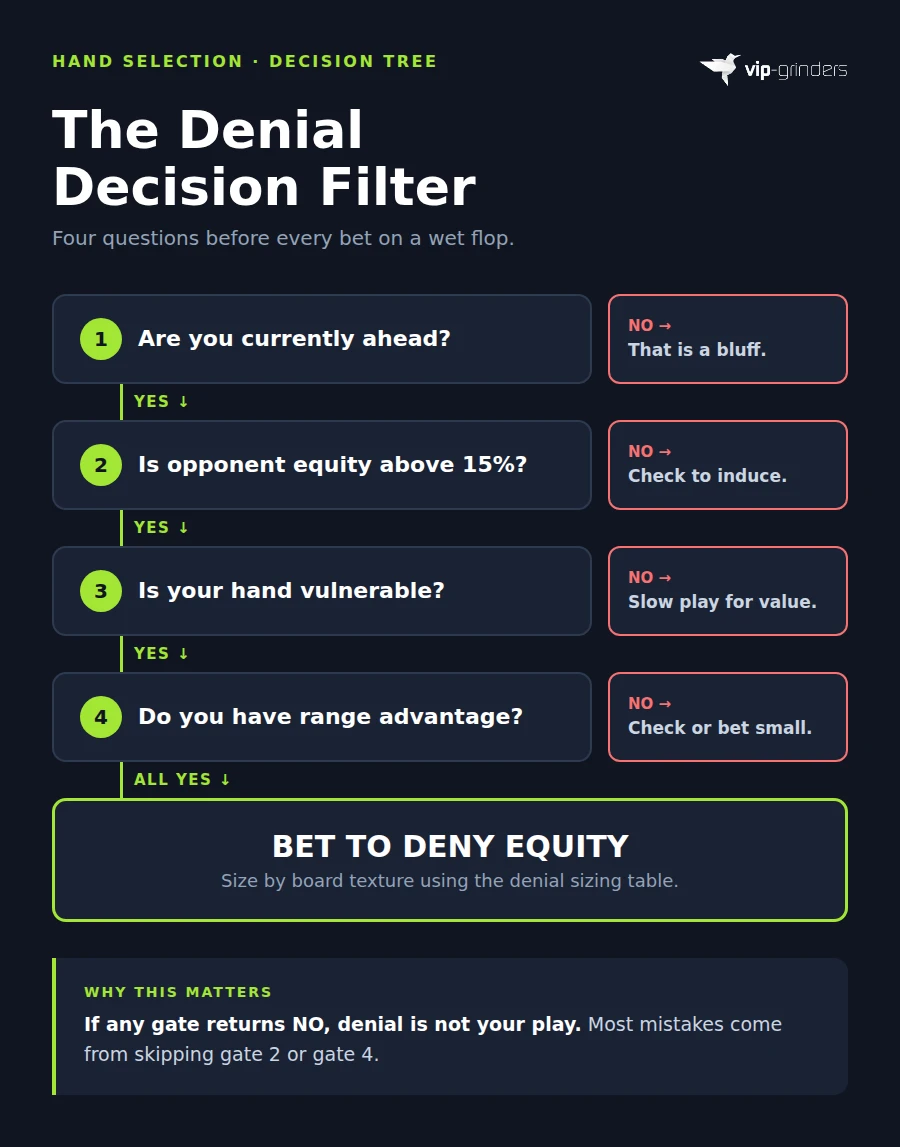
The rule: if opponent equity is below 15% on the current board, inducing beats denying. Above 15%, the denial premium grows large enough to justify a bet.
When opponent equity sits below that 15% line, pot control is usually the better play.
Denial Sizing by Board Texture
The size of your denial bet is not about your hand. It is about how much equity exists on the board and how large a bet you need to make continuing unprofitable for the draws present. The bet sizing guide covers the full street-by-street system; this section focuses on how denial changes the size.
The core principle: your bet must require more equity to call than the draws on the board provide. If the most common draw has 35% equity and your bet only requires 25% to call, you are paying your opponent to chase.
Dry Boards: 25% to 40% Pot
On boards like A-5-3 rainbow or K-8-2 rainbow, the only draws are backdoor flush draws and overcard outs. Combined opponent equity against your top pair is typically 6% to 15%. A small bet denies what little equity exists, and the main purpose of betting is range-based frequency (you bet most of your range cheaply because your opponent folds often) rather than targeted denial.
At these sizes, even the weakest draws cannot profitably continue. A 33% pot bet requires roughly 20% equity to call, which prices out backdoor draws and overcards.
Semi-Wet Boards: 50% to 66% Pot
On boards like Q-9-4 with one suit or K-T-5 two-tone, one major draw is present (a flush draw or an open-ender, but not both). Opponent equity sits in the 20% to 35% range, which means a small bet gives them a profitable call.
A 50% pot bet requires 25% equity to call. That prices out gutshots and overcard draws but leaves flush draws borderline. Sizing up to 66% pot pushes the threshold to 28.5%, which makes naked flush draws unprofitable even with some implied odds.
Wet Boards: 66% to 80% Pot
On boards like J-T-8 two-tone or 9-7-5 with two suits, multiple draws overlap. Flush draws, straight draws, and combination hands give your opponent 30% to 45% equity. This is where denial matters most, and where undersizing costs the most money.
A 66% pot bet requires 28.5% equity to call. That folds out most single draws. Sizing up to 80% pot pushes the requirement to 31%, which forces even strong open-ended straight draws to fold.
| Board Texture | Example | Typical Opponent Equity | Denial Size | Required Equity to Call |
|---|---|---|---|---|
| Dry rainbow | A-5-3 rainbow | 6% to 15% | 25% to 40% pot | 17% to 22% |
| Semi-wet (one draw) | Q-9-4 one suit | 20% to 35% | 50% to 66% pot | 25% to 28.5% |
| Wet (two draws) | J-T-8 two-tone | 30% to 45% | 66% to 80% pot | 28.5% to 31% |
| Extremely wet (combo draws) | 8-7-6 two-tone | 40% to 55% | 80%+ pot or overbet | 31%+ |
Extremely Wet Boards: Overbet or Check
On boards like 8-7-6 two-tone or 9-8-7 monotone, combo draws hold 45% to 55% equity. Standard sizing does not deny enough. A 66% pot bet still gives a combo draw a profitable call because their equity exceeds the required threshold.
Two options exist in these spots. The first is an overbet of 100% to 150% pot, which pushes the required equity above 33% and makes even strong combo draws unprofitable. The overbetting guide covers when this is correct and when it backfires.
The second option is to check. On extremely wet boards where both ranges connect heavily (like 8-7-6 two-tone from a big blind vs cutoff pot), neither player has a clear range advantage. Betting large risks building a pot you cannot control, and checking protects your stack while keeping your checking range strong.
Street-by-Street Equity Denial
Denial is not equally important on every street. The value of a denial bet depends on how many cards are left to come, because that determines how much equity your opponent can still realize. Two cards to come means maximum equity. One card means roughly half. Zero cards means denial does not exist.
Flop: Where Denial Matters Most
The flop is the most important street for equity denial because two cards remain, giving your opponent the maximum chance to improve. A flush draw holds 35%, an open-ender 32%, two overcards 24%. These are large numbers, and checking gives your opponent access to all of them for free.
Most c-bets on dynamic boards are denial bets whether you realize it or not. When you open from the cutoff, the big blind calls, and the flop comes Q-9-4 with two hearts, your 66% pot c-bet with A-Q extracts value from worse queens and denies equity to flush draws and straight draws at the same time.
The continuation betting guide covers when to c-bet and when to check. The check-raising guide covers how the out-of-position player uses check-raises as denial weapons against those same c-bets.
The flop is also where denial and range advantage intersect. On boards that favor your range (A-K-4 rainbow after you opened from the cutoff), you can bet a high percentage of your hands at a small size because your opponent’s range is weak and the little equity they hold gets denied cheaply. On boards where ranges are closer (8-7-5 two-tone against a big blind caller), denial bets need to be larger and more selective.
Turn: Equity Halves, Denial Still Matters
On the turn, draw equity roughly halves. A flush draw drops from 35% to ~18%, an open-ender from 32% to ~16%, a gutshot from 17% to ~8%.
This means turn denial bets can sometimes be smaller than flop denial bets against the same draw. A flush draw that needed 66% pot to fold on the flop can be priced out with 50% pot on the turn, because the required equity to call stays the same but the draw’s actual equity dropped.
There is one exception. If the turn card added a new draw on top of the existing one (a second flush suit, a straight-completing texture), your opponent’s equity may have stayed flat or even increased. In those spots, turn denial sizing stays at 66% pot or higher.
Delayed Denial After a Flop Check-Back
Not every denial play happens on the street where you first have the chance to bet. A common and profitable line is to check the flop and deny on the turn.
This works when the flop texture is too connected for a profitable c-bet (you lack range advantage), but the turn card is a brick that does not improve your opponent’s range. Your flop check kept your entire range intact while their check or call capped theirs. The turn brick confirmed they did not improve, so now you bet to deny the remaining equity they hold.
The sizing for delayed denial is 50% to 66% pot. You are not slamming the pot after checking because that looks polarized and folds out the medium hands you might want to keep in.
River: Denial Does Not Exist
This is a hard boundary. On the river, no more cards are coming. Your opponent’s hand is final, so there is no equity left to deny.
Every river bet is either a value bet (you want a call from worse) or a bluff (you want a fold from better). If you bet the river “to deny equity,” you are mislabeling your bet. There is no third category on the river.
This matters because players who think of river bets as “denial” tend to undersize. They bet 40% pot “to protect” when they should either be value betting 66% to 75% pot or checking. Recognizing that denial ends on the turn clears up river sizing decisions.
Preflop Equity Denial
Most players think of equity denial as a postflop concept. It is not. The first denial decision in every hand happens before the flop, and it is the reason open-raising exists in the first place.
Why Open-Raising Denies Equity
When you limp into a pot, the big blind sees a free flop with any two cards. A hand like 8-5 offsuit has roughly 35% equity against a strong hand like A-K preflop. If that hand sees a flop for free, it will occasionally flop two pair, trips, or a strong draw that beats your premium holding.
An open-raise to 2.5x forces the big blind to either pay a price or fold. The hands that fold (the weakest 50% to 60% of their range) are denied the chance to realize any equity at all. That is preflop denial in its purest form: removing hands from the pot before they can get lucky.
This is the structural reason not to limp. Every limp invites hands with 30% to 40% raw equity to see a flop for free. Every raise forces those hands to either pay a premium or surrender their equity entirely.
3-Betting as Denial
A 3-bet extends the same principle one level further. When your opponent opens to 2.5x and you 3-bet to 8x, every hand that folds is denied its preflop equity. Suited connectors with 40% to 45% equity against your range, small pairs hoping to set-mine, and suited gappers with backdoor potential all get priced out.
The denial math is especially strong with hands like A-A and K-K, where your opponent’s raw equity is lowest. But it also applies to 3-bet bluffs with hands like A-5 suited: you are currently behind some of the opener’s range, but the 3-bet folds out the bottom of their range (hands with 35% to 45% equity against you), which makes the remaining pot smaller and easier to navigate. For the full 3-bet range construction and hand selection, see the 3-bet strategy guide.
Multiway Equity Denial
Heads-up, you only need to deny equity from one opponent. In a multiway pot, the math changes dramatically because each opponent contributes their own equity against you, and the combined total can be devastating if you let everyone see free cards.
Combined Equity Against You
Three opponents each holding 15% equity does not mean you face 15% risk. It means you face roughly 40% to 45% combined equity, because any one of them can make a hand that beats you (the exact number depends on how much their draws overlap). Your top pair that was 85% to win heads-up is now closer to 55% to 60% to survive against three opponents with live draws.
The cost of checking in multiway pots is proportionally larger than heads-up. In a heads-up pot with $100, checking against an opponent with 30% equity costs you $30 in denial premium. In a three-way pot with $100, checking against three opponents with 15% equity each costs you $40 to $45 in combined denial premium.
Sizing Up Multiway
The standard adjustment for multiway denial is +10% to 15% pot per extra opponent beyond heads-up. If you would bet 50% pot for denial heads-up on a semi-wet board, bet 60% to 65% three-way and 70% to 75% four-way.
| Players in Pot | Combined Opponent Equity (typical) | Denial Sizing Adjustment |
|---|---|---|
| Heads-up (2 players) | 20% to 35% | Standard (use board texture table) |
| 3-way | 35% to 50% | +10% to 15% pot vs heads-up size |
| 4-way or more | 45% to 65% | +20% to 30% pot vs heads-up size |
The biggest multiway denial mistake is checking a vulnerable hand into three opponents because “I want to see what develops.” What develops is that one of them makes a hand that beats you. In multiway pots, the cost of giving free cards multiplies with every opponent, which makes denial bets more important, not less.
The second biggest mistake is using the same size you would heads-up. A 33% pot bet that folds out one opponent’s draws gives two other opponents a cheap look. Each opponent evaluates their own pot odds independently, so the price you charge must be high enough to make continuing unprofitable for each of them.
Denial in Tournaments and Short Stacks
Everything above applies to cash games where every chip is worth the same amount and stacks reset between hands. In tournaments, two forces change the denial math: shrinking stacks compress how many streets you can bet, and ICM pressure changes how often opponents fold to your bets.
Short-Stack Denial Shoves
At 15bb to 25bb effective, a standard denial bet of 66% pot commits a large portion of your stack. A 66% pot bet on the flop in a single-raised pot at 20bb is roughly 3.5bb to 4bb, which is about 20% of your remaining chips. Folding to a raise after investing that much is painful, and calling a raise commits the rest.
The decision simplifies to shove or check. A shove denies 100% of your opponent’s equity when it works. A check keeps your stack intact when you are unsure.
The denial math actually favors short-stack shoves more than deep-stack denial bets. At 20bb, winning a 10bb pot by shoving represents a 50% increase to your stack. That survival value makes the shove correct in many spots where a deep-stacked player would bet 66% pot and play future streets.
ICM and Bubble Denial
Near the money bubble, ICM pressure makes opponents fold hands they would call with in a cash game. A medium stack trying to ladder into the money folds top pair to a large bet because busting costs more in prize equity than the chips they gain by calling and winning.
This creates a denial shortcut: smaller bets accomplish the same denial because ICM does part of the work for you. A 40% to 50% pot bet on the bubble folds out the same draws that would require 66% pot in a cash game.
| Tournament Stage | Denial Sizing Adjustment | Why |
|---|---|---|
| Early and middle stages (deep stacks) | Same as cash games | ICM pressure is minimal. Chip EV equals prize EV. |
| Approaching the bubble | Size down 10% to 15% | Medium stacks overfold to protect their position. |
| On the bubble | 40% to 50% pot works like 66% in cash | ICM makes continuing a hand a tournament life decision. |
| Final table pay jumps | Size down against medium stacks, standard against chip leader | Medium stacks ladder. Chip leader faces minimal ICM pressure. |
The biggest tournament denial mistake is using cash-game sizing near the bubble. A 75% pot denial bet on the bubble folds out everything except the hands that beat you, which turns your denial bet into an expensive way to win a pot you would have won with a much smaller bet.
When Checking Beats Denial
Equity denial is not always the correct play. Three specific situations make checking higher EV than betting, even when you hold the best hand and your opponent has live equity.
Your Opponent Is a Calling Station
Denial requires folds. Calling stations do not fold. Against an opponent with a WTSD above 30% who calls with any pair, any draw, and most ace-high hands, a denial bet just builds a pot where your vulnerable hand has to survive against a wide range.
Against stations, stop thinking about denial and start thinking about pure value. Bet because they call with worse, not because you want them to fold draws. Size up to 75% to 100% pot and cut your denial frequency to near zero.
The Board Is Too Connected for Either Player
On boards like 8-7-6 two-tone or 9-8-7 with two suits, both ranges connect heavily. The big blind’s calling range hits these boards with straights, two pair, sets, and combo draws just as often as the preflop raiser’s range. Neither player has a clear range advantage, which means a large denial bet risks building a pot your opponent controls as often as you do.
The strategic takeaway is broader: denial only works when you have range advantage. When ranges are roughly equal, large bets get called and raised by the hands that beat you, while folding out only the hands that had too little equity to matter.
You Want Your Opponent to Improve
This is the flip side of the check-to-induce case. Sometimes your hand is strong enough and your opponent’s range is weak enough that letting them catch up is worth more than folding them out now.
A set on a dry board is the classic example. If you hold 9-9 on a 9-5-2 rainbow board, your opponent’s draws have roughly 5% to 10% combined equity. Denying that tiny amount costs you the chance to let them pair their ace, king, or queen on the turn, giving them a hand they will call two more streets with.
The rule applies here too: below 15% opponent equity, checking to induce usually beats betting to deny.
The 5 Most Expensive Denial Mistakes
Most denial leaks are invisible in individual hands. They cost fractions of a big blind per decision, which compounds across thousands of hands into the difference between a winning player and a breakeven one.
- 1Checking vulnerable hands on wet boards. The most common and most expensive denial leak. Top pair on a two-tone connected flop faces 30% to 45% combined draw equity from your opponent's range. Checking gives them a free shot at all of it. Fix: if your hand is ahead and vulnerable, bet. Use the board texture sizing table from this guide to pick the right size.
- 2Undersizing on wet flops. A 33% pot bet on J-T-8 two-tone requires only 20% equity to call. A flush draw has 35%. An open-ender has 32%. You are literally offering a discount on draws that should be priced out. Fix: on boards with two or more draws, start at 66% pot minimum.
- 3Denial betting when you should value bet. Players who learn about denial sometimes start undersizing with strong hands because they want a fold. If you hold a set on a wet board, you do not want folds. You want calls from worse hands and draws that are paying too much. Fix: check whether your hand is too strong to need denial. Sets and better are almost always value bets, not denial bets.
- 4Ignoring multiway denial. Checking top pair into three opponents who collectively hold 40% to 45% combined equity is one of the most expensive free cards you can give. Fix: in multiway pots, size up by 10% to 15% pot per extra opponent and bet with any vulnerable made hand.
- 5Using cash-game denial sizing in tournaments. Near the bubble, ICM pressure makes opponents fold wider than pot odds alone would suggest. A 75% pot denial bet that is correct in a cash game folds out everything on the bubble except the hands that beat you. Fix: size down to 40% to 50% pot near pay jumps. ICM does the rest.
Mistake number one deserves extra emphasis. At stakes below NL200, the most common pattern is a player who bets top pair on dry boards (where denial barely matters) and checks top pair on wet boards (where denial matters most). The instinct is backwards, and fixing it alone is worth multiple bb/100.
Frequently Asked Questions
What is equity denial in poker?
Equity denial is a bet made when you have the best hand and your opponent holds a hand with live equity (outs that could improve to beat you). The bet forces a fold before your opponent can realize that equity by seeing more cards. It is not a bluff (you have the best hand) and not a standard value bet (you do not necessarily want a call from a draw with 35% equity). The profit comes from winning 100% of the pot now instead of winning only 65% on average at showdown.
Is equity denial a bluff?
No. A bluff is a bet with the worst hand, hoping a better hand folds. Equity denial is a bet with the best hand, hoping a drawing hand folds before it can improve. The distinction matters for sizing: bluffs size to maximize fold frequency, denial bets size to make continuing unprofitable for draws based on their specific equity.
When should I deny equity instead of betting for value?
Deny when your opponent’s continuing range is mostly draws with significant equity (flush draws, straight draws, overcard combinations). Value bet when their continuing range is mostly worse made hands that cannot improve past you. Most spots are a blend of both, and 66% pot is the default that balances denial and value extraction.
How big should a denial bet be?
Size depends on board texture and the draws present. Dry boards with only backdoor equity need 25% to 40% pot. Semi-wet boards with one major draw need 50% to 66% pot. Wet boards with multiple draws need 66% to 80% pot. Extremely wet boards with combo draws need 80%+ pot or an overbet. The rule is to pick the smallest size that requires more equity to call than the strongest draw on the board provides.
Does equity denial work on the river?
No. Equity denial only exists when future cards can still be dealt. On the river, no more cards are coming, so there is no equity left to deny. Every river bet is either a value bet (you want a call from worse) or a bluff (you want a fold from better). Betting the river “to protect” is a mislabel that leads to undersizing mistakes.
Is equity denial more important in cash games or tournaments?
The concept applies equally to both, but the sizing adjustments differ. In cash games, use standard denial sizing based on board texture. In tournaments, ICM pressure near the bubble and at final tables makes opponents fold wider, which means smaller denial bets accomplish the same result. At short stacks (below 20bb), denial bets often simplify to shove or check because standard sizing commits too much of your stack.
What is equity realization?
Equity realization is the percentage of raw (theoretical) equity a hand actually captures in practice. A flush draw with 35% raw equity might only realize 20% to 25% because it folds to bets before seeing the river. Equity denial works by widening this gap: every time you bet and your opponent folds a hand with live equity, their realized equity drops toward zero while yours increases toward 100%.
Should I deny equity against calling stations?
No. Denial requires folds, and calling stations do not fold. Against opponents who call with any pair, any draw, and most ace-high hands, switch from denial to pure value betting. Bet because they call with worse, not because you want them to fold draws. Size up to 75% to 100% pot against these players because their calling range stays wide regardless of your bet size.