

Using a Card at a Crypto Casino: Buy Crypto, Fees and Declines
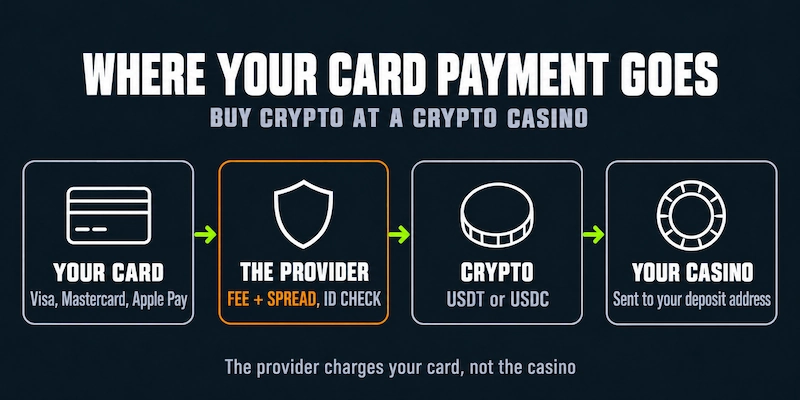
Many crypto casinos let you pay with a Visa or Mastercard credit or debit card, Apple Pay or Google Pay, through a Buy Crypto option in the cashier. With Buy Crypto, your card pays a separate company such as MoonPay or Swapped, not the casino, and that company sends the crypto to your casino deposit address. That company sets the fee and can ask for your ID, even at a casino that asks for none.
The amount in the casino’s cashier is an estimate, not what you receive. In our test on 26 October 2026, the providers’ own screens quoted between 91.34 and 95.87 stablecoins for $100 by card at two crypto casinos, a cost of 4.1% to 8.7%, while the cashiers had estimated up to 98.71.
Published card fees run from 1.75% + €0.35 at Swapped and 1.99% at Banxa to up to 5.5% at Mercuryo. Five of the six providers we checked also say their price can include a spread, a markup on the coin’s price that no fee line shows.
This guide covers:
- How Buy Crypto works, and which casinos offer it through which provider
- What a card purchase costs, with fees for 6 providers and our own $100 test
- Why cards get declined, and what to try next
- Credit cards, cash advance fees and chargebacks
- eWallets such as Skrill, MiFinity and AstroPay
- Why a provider can ask for your ID at a no KYC casino
- How to get winnings back to a card
How Buy Crypto Works at a Crypto Casino
Buy Crypto is a tab in the cashier at Shuffle and an option in the wallet menu at Stake and BC.Game. You choose the amount and the coin, and the casino hands you to the provider’s own window to pay. These are the steps:
- 1Open Buy Crypto in the cashier or wallet, and enter the amount you want to spend.
- 2Pick the coin. A stablecoin such as USDT or USDC keeps its dollar value while you play, unlike bitcoin.
- 3Pick a provider if the casino offers more than one. Stake says that if both MoonPay and Swapped offer the purchase, it "will highlight which one gives you a better rate".
- 4Read the provider's own quote before you pay. In our test, it came in up to $5.17 below the casino's estimate on a $100 purchase.
- 5Verify your ID with the provider if it asks, usually on your first purchase.
- 6Pay with your card, Apple Pay or Google Pay, and approve the payment in your banking app if your bank asks.
- 7Wait for the coins. They go to your casino deposit address, and BC.Game's cashier says they "may take a few minutes to 1 hour to arrive".
The casino is not part of the payment itself. In Shuffle’s words, “The providers charge their own fees and run their own identity checks, separate from Shuffle.” For questions about a purchase, Stake sends players to the provider’s own support.
Some casinos add one more layer. At BC.Game, Buy Crypto opens Onramper, a service that compares providers such as MoonPay, Banxa, TransFi and Alchemy Pay and recommends one for your card, coin and country.
Buy Crypto or a Direct Card Deposit
A few crypto casinos also take your card directly, in your own currency, with no crypto step in between. Stake takes Visa and Mastercard under its Local Currency option, Roobet takes cards from $10 to $5,000, and Winz.io from €20 to €4,000. The two routes work differently:
| Difference | Buy Crypto | Direct Card Deposit |
|---|---|---|
| Who your card pays | A provider such as MoonPay or Swapped | The casino, through its payment processor |
| What it costs | The provider’s fee plus its spread | Set by the casino; Winz.io lists no fee for card deposits |
| Who checks your ID | The provider, under its own rules | The casino, under its KYC rules |
| How winnings come back | In crypto, which you sell yourself | To your card at some casinos, such as Stake, Roobet and Winz.io |
For casinos that take cards and eWallets this way, see our guide to casino payment methods that skip the crypto step. The rest of this guide covers the Buy Crypto route.
Which Crypto Casinos Offer Buy Crypto, and Through Which Provider
Each casino picks its own providers, so the same card can meet different fees, minimums and coins from one cashier to the next. We checked these seven crypto casinos in October 2026, on their help centers and payment pages and, for BC.Game and Shuffle, in the cashier:
| Casino | Buy Crypto Through | Buy Crypto Minimum | Card Without Buy Crypto |
|---|---|---|---|
| Stake | MoonPay or Swapped | Not stated | Yes, Visa and Mastercard in local currency |
| Roobet | Swapped | $10 | Yes, Visa and Mastercard from $10 to $5,000 |
| Shuffle | MoonPay or Swapped | Not stated | No card; Interac in Canada and Pix in Brazil |
| BC.Game | Onramper, comparing MoonPay, Banxa, TransFi and Alchemy Pay | Not stated | None in our cashier |
| Gamdom | Swapped, processed in USDC | About $9 | No; Visa cards go through Swapped |
| Thrill | A bank account option, provider not named | Not stated | No; fiat “is not currently accepted” |
| Winz.io | Not offered | Not offered | Yes, Visa and Mastercard from €20 to €4,000 |
Providers come and go as casinos change partners, so check the cashier before your first purchase, and keep these points in mind:
- Minimums differ even with the same provider. Swapped's own terms start at €7, while Gamdom states about $9 and Roobet $10 for purchases through Swapped.
- EU players may get a different coin. In our test from Malta, Swapped offered USDC instead of USDT, saying USDT is no longer supported in the EEA under MiCA, and Gamdom processes all Swapped deposits in USDC.
- A provider on the list is not always one you can use. At BC.Game, Banxa, TransFi and Alchemy Pay all showed "No payment methods available for the selection" for our card purchase of USDT.
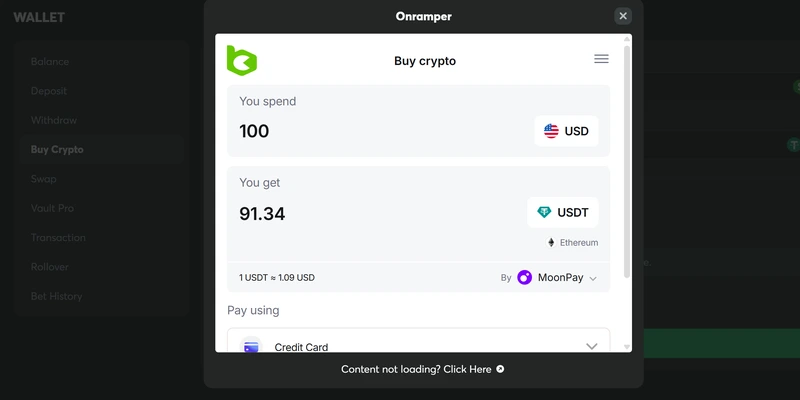
This is the quote BC.Game’s Buy Crypto window showed us for $100 of USDT by card, through Onramper:
The next section shows what these providers charge, and how far their quotes fell from the casinos’ estimates in our test.
What Buying Crypto by Card Costs: Fees and Spreads
A card purchase can carry three costs: the provider’s fee, a spread built into its exchange rate, and the network fee to send the coins. These are the card fees each provider publishes on its own pricing or help pages, checked in October 2026:
| Provider | Card Fee | Spread | Minimum Purchase |
|---|---|---|---|
| Swapped | 1.75% + €0.35 | Added, no figure given | €7 |
| Banxa | 1.99% | Typically 2% to 4%, up to 15% | Not published |
| Transak | 3.99% + $1 | 0% to 2.5% | Not published |
| TransFi | 4% | Not published | €60, or €500 for USDC |
| MoonPay | Up to 4.5% in the US, up to 5% in the EU | Possible, no figure given | $20 |
| Mercuryo | Up to 5.5%, at least €1 | Possible, no figure given | €25 |
A published fee is only part of the cost, so we tested the real figure.
What $100 Gets You: Our Card Test
On 26 October 2026, we asked for $100 of stablecoins by card at BC.Game and Shuffle and stopped at each provider’s quote screen, before entering any card details. Since 1 USDT or USDC is worth about $1, the coins quoted show the full cost:
| Casino and Provider | Casino Estimate | Provider’s Quote | Cost on $100 |
|---|---|---|---|
| BC.Game, MoonPay through Onramper | 96.51 USDT | 91.34 USDT | $8.66 (8.7%) |
| Shuffle, MoonPay | 98.71 USDT | 94.18 USDT | $5.82 (5.8%) |
| Shuffle, Swapped | 96.29 USDT | 95.87 USDC | $4.13 (4.1%) |
Both casinos call their figure an estimate, and Shuffle’s cashier warns that purchases are “subject to additional processing fees. Final quotes may vary by provider.” Shuffle’s list put MoonPay ahead, but on the providers’ own screens Swapped came out $1.69 cheaper, so the provider’s quote is the number to compare.
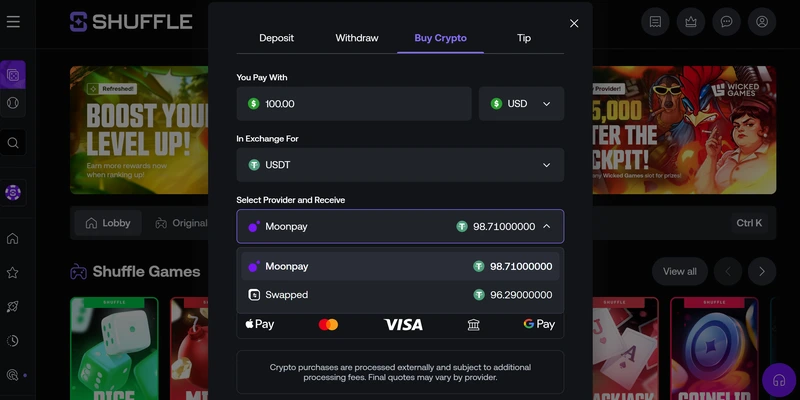
The same provider can also cost more at one casino than at another. MoonPay’s quote through BC.Game was $2.84 lower than through Shuffle, as the casino, the network and any service in between can all change the price.
“I never pay on the casino’s first number. Open each provider the cashier offers, go to the last screen before your card details and count the coins you would receive. With a stablecoin, that shows you the full cost in seconds.”
João Mourato, Head of iGaming Product at VIP-Grinders
What the Spread Adds to the Price
A spread is a markup built into the exchange rate you are quoted, so it never shows as a fee line. Swapped showed a “1.75% Fee” for our card purchase, yet its quote cost $4.13 on $100: about $2.15 in published fees, and the rest in the rate and any network fee. These are the spreads providers disclose:
- Banxa: typically 2% to 4%, up to 15%, plus a partner spread of 0% to 1%, up to 10%, and a recovery spread of up to €5
- Transak: 0% to 2.5% above the CoinGecko price, depending on how volatile the coin is
- Mercuryo: an infrastructure fee of 0% to 2%, up to 5%, plus a spread it does not put a number on
- MoonPay: says its price "may include a spread", with no figure
- Swapped: says a spread is added to the unit price and varies with the payment method, with no figure
- TransFi: no spread published
With a stablecoin, $100 should buy close to 100 USDT or USDC, so every coin short of that is a cost you can count.
Small Buys Cost More
Minimum fees make small purchases expensive. MoonPay’s pricing pages set a minimum fee of up to $4.50, or €4.50 in the EU, for purchases through a partner such as a casino, when the amount is below its threshold:
| Purchase | Minimum Fee of Up to $4.50 | Share of the Purchase |
|---|---|---|
| $20 | Up to $4.50 | Up to 22.5% |
| $50 | Up to $4.50 | Up to 9% |
| $100 | Up to $4.50 | Up to 4.5% |
Minimum purchases vary too: $20 at MoonPay, €25 at Mercuryo, €60 at TransFi and €7 at Swapped. One larger purchase costs less than several small top ups.
Pay in Your Card’s Own Currency
Our test was priced in US dollars, and the currency you pay in changes the cost. Your bank and the provider can both charge for it:
- Your bank may charge a foreign transaction fee when you pay in another currency, which shows on your statement, not in the provider's quote.
- Mercuryo adds 0.25% to 1% for any currency other than the euro.
- MoonPay raises its minimum fee by 0.25% to 10% for currencies other than US dollars, euros and pounds.
So a zloty or koruna card can pay a provider surcharge in its own currency, or a bank fee in euros or dollars. Shuffle and BC.Game both let you pick the currency you pay in, so check the quote both ways before you buy.
Apple Pay and Google Pay Fees
Apple Pay and Google Pay use the card stored in your phone, and the providers that list them charge the same as a card, or close to it:
- Swapped: 1.75% + €0.35 for both, the same as a card
- Banxa: 1.99% for Apple Pay, the same as a card
- Transak: 3.99% + $1 for Apple Pay, the same as a card, and 3.99% for Google Pay
Your bank still sees a card payment, so the decline and credit card rules in the next sections apply as well. For casinos that accept it without a crypto step, see casinos that take Apple Pay directly.
Card, Bank Transfer or Crypto You Already Own
A bank transfer usually costs less than a card at the providers that publish both:
| Provider | Card | Bank Transfer |
|---|---|---|
| Swapped | 1.75% + €0.35 | 0.50% |
| Banxa | 1.99% plus spread | No processing fee, spread still applies |
| Transak | 3.99% + $1 | 2% + $1 |
| Mercuryo | Up to 5.5%, at least €1 | Up to 3%, at least €2 |
If you already hold crypto, sending it from your own wallet costs only the network fee, which was under 1 cent on the cheapest networks when we checked on 23 October 2026. Our guide to sending crypto you already own to a casino covers the coins, networks and fees step by step.
Why Your Card Gets Declined When Buying Crypto at a Casino
A Buy Crypto payment has to pass your bank, the card network’s rules and the provider’s own checks. Visa’s Merchant Data Standards Manual of October 2026 says that for loading a gambling wallet, “MCC 7995 must be used and not 6051 as the nature of the transaction is an intent to gamble”. So your bank can treat a Buy Crypto purchase at a casino as a gambling payment, not as a plain crypto purchase.
These are the reasons banks and providers give for declines:
- Your bank blocks gambling payments. Some banks refuse the gambling code, and gambling blocks work on these merchant codes too, as Revolut explains for its own block.
- Your bank restricts crypto. MoonPay notes that some banks limit or block crypto purchases under their own risk rules.
- 3D Secure was not completed. If you miss or reject the approval prompt in your banking app, the payment fails.
- The card is not in your name. Banxa says "any card used must be in your own name", and Swapped says using a card that is not yours "may be treated as fraud".
- Your card limit is reached. A purchase above your daily or monthly card limit is declined by the bank.
- The provider's fraud checks. Gamdom warns that "Swapped may also decline payments for security reasons", and it may ask for more verification.
- Your country or card issuer is not covered. Banxa names "an issuing bank or a geographic location that is not supported" as a cause.
If you set a gambling block yourself, a decline means the block is working. Leave it on, and if you want to talk to someone about your play, our page on where to find gambling support lists free help services.
What to Do When the Card Is Declined
Other declines can often be fixed quickly:
- 1Read the decline message in the provider's window and in your banking app, since it often names the cause.
- 2Approve the 3D Secure prompt in your banking app straight away, then try once more.
- 3Use a debit card in your own name. A credit card can add cash advance fees, covered in the next section.
- 4Ask your bank whether it limits crypto purchases, and whether you can raise a daily limit.
- 5Do not keep retrying. MoonPay warns that repeated attempts in a short time "may trigger fraud controls", and your bank may block further attempts for a while.
- 6Try the casino's other provider if the decline came from the provider's own checks.
- 7Pay by bank transfer where the provider offers it, or send crypto you already own.
A declined payment can still show as pending in your bank. MoonPay says these holds “aren’t charges” and are released by your bank, which “typically takes up to 10 business days”, while Gamdom says Swapped usually returns declined deposits within 1 to 3 business days.
For declines on a direct card deposit, with no crypto provider involved, see why a direct Mastercard casino deposit gets declined.
Credit Cards at Crypto Casinos: Cash Advance Fees and Chargebacks
A credit card can work with Buy Crypto, but it may cost far more than the provider’s fee. Some card issuers treat both crypto purchases and gambling as cash advances, which carry their own fee and interest from the first day. The card agreements of Chase and Citi, two of the biggest US issuers, both say so:
| Issuer | Counts as a Cash Advance | Fee | Interest |
|---|---|---|---|
| Chase | “cryptocurrency, other similar digital or virtual currency” and “online betting transactions” | $10 or 5%, whichever is greater | From the transaction date, at a 28.49% APR as of 30 June 2026 |
| Citi | “cryptocurrency or other similar digital or virtual currency” and “gaming chips and other methods used for gambling” | $10 or 5%, whichever is greater | No grace period |
On a $100 purchase, a $10 cash advance fee on top of the provider’s costs turns the 4.1% to 8.7% from our test into 14.1% to 18.7%, before any interest. Card agreements outside the US vary, so search yours for “cash advance” before paying with credit. Three ways to avoid the charge:
- Use a debit card. It takes the money from your own account, so there is no borrowing and no cash advance interest.
- Pay by bank transfer where the provider offers it, which usually costs less than a card.
- Check the provider first. Some do not take credit cards at all: Coinbase's onramp does not support them in the US.
Can You Charge Back a Buy Crypto Payment?
A chargeback asks your card issuer to reverse a payment. With Buy Crypto, the payment went to the provider, not the casino, and once the coins are sent, the blockchain records that they were delivered. The providers’ own terms show how they treat disputes:
- Swapped: its terms say "All transactions on the platform are final", with refunds only in limited cases, such as a purchase it stops for fraud or compliance reasons.
- Banxa: its card processing fee covers "payment processing and chargeback costs", so card buyers already pay for disputes through that fee.
Casinos take a hard line too, and a chargeback on a deposit can mean confiscated funds or a closed account, as our guide on why a chargeback can get a casino account closed shows. If the coins never arrived or you were charged twice, contact the provider’s support with your transaction ID first, and keep a chargeback for payments you did not make or problems the provider will not fix.
eWallets at Crypto Casinos: Skrill, Neteller, MiFinity, Jeton and AstroPay
An eWallet can fund a crypto casino in three ways, and each costs something different:
| Route | Where It Works | What It Costs |
|---|---|---|
| Direct deposit | Hybrid casinos: Roobet takes AstroPay, Jeton and MuchBetter, and Winz.io takes Skrill, Neteller and MiFinity | The wallet’s own top up fee, with no crypto step |
| Through Buy Crypto | Swapped takes Skrill, Neteller and AstroPay | 4.50% + €0.60 for Skrill and Neteller, 6.70% for AstroPay |
| Crypto bought in the app | Revolut and Skrill sell crypto in their apps | 1.49% on Revolut’s Standard plan and 1.50% at Skrill, plus any fee to send it out |
Buy Crypto is the most expensive route for a wallet. AstroPay through Swapped costs almost four times Swapped’s 1.75% card fee, and Skrill or Neteller cost more than a card too. For hybrid casinos that take a wallet directly, see our list of casinos that take MiFinity without a crypto step.
What It Costs to Top Up an eWallet
Loading the wallet with a card adds its own fee before any casino sees the money. These are the card top up fees each wallet publishes:
| eWallet | Card Top Up Fee |
|---|---|
| MiFinity | 1.8% for EEA cards, 2.5% to 4% for others |
| Jeton | 2.5% to 5%, depending on the currency |
| Neteller | 2.5% by card |
| Skrill | Depends on your country, for example 1.25% in Finland |
Skrill also says credit cards issued in the UK, Sweden, Belgium and Australia “cannot be used for gambling transactions anywhere in the world”, and Neteller has the same rule. PayPal is rarely an option, since it prohibits gambling payments for US account holders and needs to approve any gambling merchant first.
Blik, Pix and Vouchers Through Buy Crypto
Swapped also takes local payment methods, which matters for players in Poland and Brazil. These are its published fees:
- Blik: 3.50% + €0.35
- Pix: 4.82% + €0.40
- Rapid Transfer: 3.00% + €0.60
- Paysafecard: 11.00% + €0.60, the most expensive method on its list
In Brazil, Shuffle also takes Pix directly and says it charges no fee on it, so there is no crypto step to pay for.
ID Checks: Why a No KYC Casino Can Still Ask for Your ID
A casino that skips ID checks cannot switch them off at the provider. Buy Crypto providers turn card money into crypto, so anti money laundering rules make them verify who is paying, and the casinos say so in their own help centers:
- Shuffle: "That verification belongs to the provider and is separate from your Shuffle account's verification levels."
- Gamdom: "If you see a KYC request while making a deposit via Swapped, this comes from their side."
In the EU, providers need a license to sell crypto, and MoonPay, for example, holds a MiCA license from the Dutch regulator, the AFM, granted in December 2024. This is what the two providers in our test can ask for:
| Provider | When It Checks | What It Can Ask For |
|---|---|---|
| MoonPay | When you place your first order, with more documents as your limits rise | Your name, a passport, ID card or driver’s license, a selfie or liveness check, and proof of address |
| Swapped | Before you use its services, and again at any time | Your name, date of birth and address, a photo ID with a matching selfie, proof of address and source of funds |
Banxa checks ID the first time a customer uses its checkout, and Mercuryo and TransFi also say you may need to verify before you buy. Swapped can freeze or end your access if it “is unable to verify your identity”.
So paying by card at one of the crypto casinos that skip ID checks still puts your ID on file with the provider. Crypto you already hold in your own wallet avoids that step, and our guide on how casino KYC differs from the provider’s check explains when the casino itself can still ask.
How to Spot a Fake Buy Crypto Page
Card details and ID photos are what scammers want most, so check the page before you type anything:
- Start from the casino's own cashier. Open Buy Crypto from your account on the casino's real site, never from a link in an email, an ad or a chat.
- Look for the provider's name. The window should name a real provider, such as "Powered by MoonPay" in our Shuffle test or swapped.com at the top of the Swapped window.
- Never send card details or ID photos by chat or email. Real providers collect them in their own window, and Roobet says it never stores your complete card details.
- Distrust "no fee, no ID" offers. Every provider in this guide lists fees, and MoonPay, Swapped and Banxa all check ID.
Getting Crypto Casino Winnings Back to Your Card
Money that goes in through Buy Crypto comes out as crypto. At Shuffle, BC.Game, Gamdom and Thrill, Buy Crypto players cash out to a crypto address, so getting the money onto a card takes one more step. Only a few of the casinos we checked pay out to cards directly:
| Casino | Card Withdrawals | Rules |
|---|---|---|
| Stake | Yes, Visa and Mastercard | Only after a card deposit and only back to that card; $5 to $1,000 in USD; up to 3 business days |
| Roobet | Yes, Visa and Mastercard | Amount must be over $15; fees may apply by card and region |
| Winz.io | Yes, Mastercard | €50 to €4,000; 1 to 5 days |
Stake also limits where the money goes, saying “Credit card withdrawals are processed back to the original card used for the deposit.” Everywhere else, you sell the crypto yourself.
How to Cash Out Crypto to Your Card
Selling crypto is the reverse of Buy Crypto, and some of the same providers do it:
- 1Withdraw a stablecoin such as USDT or USDC, so the amount keeps its dollar value while it moves.
- 2Send it to your own wallet or to an exchange account in your name, on a network the receiving side supports.
- 3Sell it through an off ramp provider that pays out to a card, or on the exchange.
- 4Receive the money on your card or in your bank account.
For the second step, our guide to setting up a crypto wallet for gambling shows which wallet suits each coin and network. These are the selling fees the providers publish, checked in October 2026:
| Provider | Fee to Sell Crypto | Minimum |
|---|---|---|
| Transak | 0.99% when paid out to a card | Not published |
| Banxa | No processing fee; spread typically 2% to 4%, up to 10% | Not published |
| Mercuryo | Up to 3.95%, at least €4 | €25 |
An exchange is the other route, where you sell and withdraw to your bank, paying its trading fee or spread and any payout fee. A stablecoin also saves you a second price risk, since bitcoin withdrawn today and sold next week can be worth more or less by then. Our page on crypto casinos that pay out in USDC shows where you can cash out in a dollar stablecoin.
If you would rather skip card fees altogether, fund your account with crypto you already hold, at one of the crypto casinos we have reviewed and tested.
Frequently Asked Questions
Can you use a credit card at a crypto casino?
Yes, at many crypto casinos, through the Buy Crypto option in the cashier, where a provider such as MoonPay or Swapped charges your card and sends crypto to your deposit address. A few casinos, such as Stake, Roobet and Winz.io, also take cards directly. Some card issuers count crypto and gambling purchases as cash advances, so a debit card usually costs less than a credit card.
Which crypto casinos let you buy crypto with a card?
Of the casinos we checked in October 2026, Stake and Shuffle offer MoonPay or Swapped, Roobet and Gamdom use Swapped, and BC.Game opens Onramper, which compares MoonPay, Banxa, TransFi and Alchemy Pay. Thrill offers Buy Crypto from a bank account. Providers change, so check the cashier before your first purchase.
How much does it cost to buy crypto with a card at a casino?
Published card fees run from 1.75% + €0.35 at Swapped and 1.99% at Banxa to up to 5.5% at Mercuryo, and most providers can add a spread on top. In our test on 26 October 2026, $100 by card was quoted at 91.34 to 95.87 stablecoins, a real cost of 4.1% to 8.7%. Compare the provider’s own quote, not the casino’s estimate.
Why was my card declined when buying crypto at a casino?
Common causes include a bank that blocks gambling or crypto payments, a missed 3D Secure prompt, a card not in your name, a card limit, or the provider’s own fraud checks. Under Visa’s rules, a provider loading a casino account must use the gambling code 7995, so gambling blocks can stop the payment. Read the decline message, approve 3D Secure, use a debit card in your own name and avoid repeated retries.
Is buying crypto with a credit card a cash advance?
It can be. Chase and Citi both count crypto purchases and gambling as cash advances, with a fee of $10 or 5%, whichever is greater, and interest with no grace period. On a $100 purchase, that fee alone adds 10% to the provider’s costs.
Can I use Apple Pay at a crypto casino?
Yes, at casinos whose Buy Crypto provider takes it, such as Shuffle through MoonPay or Swapped, and Roobet and Gamdom through Swapped. The provider charges about what it charges for a card, such as 1.75% + €0.35 at Swapped and 3.99% + $1 for Apple Pay at Transak. Your bank still sees a card payment, so the same decline and cash advance rules apply.
Do I need to verify my ID to buy crypto at a no KYC casino?
Usually, yes. The casino may skip ID checks, but the provider selling you crypto runs its own, and Gamdom says a KYC request during a Swapped deposit “comes from their side”. Sending crypto you already hold in your own wallet avoids the provider’s check.
Can I withdraw crypto casino winnings to my card?
Only at some casinos. Stake pays card withdrawals back to the card you deposited with, Roobet pays Visa and Mastercard withdrawals over $15, and Winz.io pays to Mastercard from €50. Elsewhere you withdraw crypto and sell it through a provider such as Transak, which charges 0.99% to pay out to a card, or on an exchange.