

In October 2026, players on the Two Plus Two forum flagged 2,587 suspected bot accounts at QQPK, and the site banned 724 accounts for automated play in its first sweep. Two days later, GGPoker banned all third party poker software and added a check that flags players whose decisions are right far too often against cards they should not be able to see.

Poker AI is not new. A University of Alberta program called Polaris beat a team of limit hold'em pros in Las Vegas in 2008, and Carnegie Mellon's Libratus won $1,766,250 in chips from four heads up no limit pros in 2017.
This guide to AI poker bots separates what AI can do in a research match from what actually happens at online tables, with every case, ban and refund backed by a named source. VIP-Grinders has covered online poker since 2013, and this guide is written by players who have spent years at the tables these bots target.
This page covers:
- What a poker bot is, and how it differs from real-time assistance (RTA)
- The landmark AI matches against poker pros, and whether Texas hold'em has been solved
- How solvers and chatbots changed the game, from the first private solvers to today's language models
- The biggest bot rings caught, with the bans and refunds that followed
- How poker sites detect bots, and what to do if you suspect one
- Whether AI will kill online poker, and what it means for your edge
What Is a Poker Bot?
A poker bot is software that plays online poker by itself. It reads each hand, chooses an action and clicks the buttons, with no person making the decisions.
Online rooms ban them. WPT Global's rules prohibit “robots or any other external player assistance (EPAs) program”, and GGPoker and ACR say every decision at the table must be the player's own.
How a Poker Bot Plays
Every bot does the same three jobs, hand after hand, at every table it sits at:
- 1It reads the table: the cards, the stack sizes and the bets, often straight off the screen
- 2It decides: fold, call or raise, and how much, using whatever strategy its owner has given it
- 3It acts: it clicks the button, and the better bots try to click the way a human would
Rooms go after each of those steps. According to Card Player, ACR runs regular client updates to disrupt bots that read pixels, and PokerStars said in 2023 that monitoring mouse clicks had helped it catch fully automated bots.
Bot makers know this. Matt Mazur, a developer who ran his own bot on PokerStars for nearly two years, wrote in 2009 that he modelled its clicks on his own clicking pattern so it would not hit the same spot every time.
Poker Bots vs RTA
Real-time assistance, or RTA, is anything that helps a player make decisions while a cash game or tournament is in progress. PokerNews lists solvers, range calculators, push or fold charts and preflop charts based on stack sizes or earlier action among the tools that count.
The difference is who plays the hand. With RTA, a real person still sits at the table and clicks every button while following outside advice, but a bot plays alone.
Both break the same rule. GGPoker's terms say “Any decision made at the poker table must be made solely by you”, and ACR's statement on an RTA case in September 2026 said “Every decision at an ACR Poker table must be made by the player.”
| Tool | Who Makes the Decisions | When | Allowed? |
|---|---|---|---|
| Poker bot | The software, with nobody at the controls | During play | No |
| Real-time assistance (RTA) | The player, following a solver or a chart | During play | No |
| Solver study | The player, working through spots alone | Between sessions, with the poker client closed | Yes |
Studying with a solver away from the tables is allowed, and PokerNews notes you can use one as much as you like when you are not playing. Check each room's rules first, because GGPoker now requires all third party poker software and automation tools to be closed before you open its client.
Some well known players have been caught using RTA, and our page on the biggest RTA cheating cases covers what happened in each one.
Can AI Beat Humans at Poker?
Yes. AI programs have beaten elite professionals at heads up limit hold'em, heads up no limit hold'em and six player no limit hold'em, all in research matches run by universities and Facebook AI.
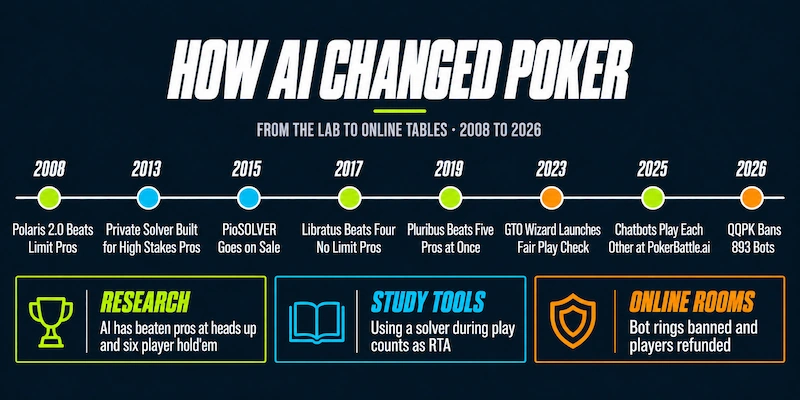
The games got harder as the programs improved, from limit hold'em against one opponent to no limit against five. The table lists every landmark match, and the sections below explain what each one proved:
| Year | Program | Built By | Game | Result |
|---|---|---|---|---|
| 2007 | Polaris | University of Alberta | Heads up limit hold'em | Lost to Phil Laak and Ali Eslami |
| 2008 | Polaris 2.0 | University of Alberta | Heads up limit hold'em | Beat a team of pros in Las Vegas |
| 2015 | Cepheus | University of Alberta | Heads up limit hold'em | Game essentially solved |
| 2015 | Claudico | Carnegie Mellon University | Heads up no limit hold'em | Statistical draw with four pros |
| 2016 | DeepStack | University of Alberta, Charles University and Czech Technical University | Heads up no limit hold'em | Beat 10 of 11 pros by a significant margin |
| 2017 | Libratus | Carnegie Mellon University | Heads up no limit hold'em | Won $1,766,250 in chips from four pros |
| 2019 | Pluribus | Carnegie Mellon University and Facebook AI | Six player no limit hold'em | Beat elite pros over 10,000 hands |
Polaris and the First Win at Limit Hold'em
The University of Alberta's Polaris took on two pros at the first Man-Machine Poker Championship in July 2007, held at an artificial intelligence conference in Vancouver. Phil Laak and Ali Eslami played duplicate limit hold'em against it, where each human was dealt the cards Polaris held in the other room. The humans won two of the four sessions, lost one and drew one.
A year later, Polaris 2.0 played a team of pros from Stoxpoker at the Rio in Las Vegas, during the World Series of Poker. It won two of the four matches there, lost one and drew one, and Guinness World Records lists it as the “First poker bot to beat human professionals in a live tournament”.
Has Texas Hold'em Been Solved?
Only one version, and only essentially. In January 2015, University of Alberta researchers published a paper in Science titled “Heads-up Limit Hold'em Poker is Solved”, built on a program called Cepheus.
Essentially solved means that even a lifetime of play could not show its strategy is flawed, with 95% confidence. In plain terms, no human could play enough hands against it to prove it makes a mistake.
No limit hold'em has not been solved. Carnegie Mellon puts the number of situations a player can face in heads up no limit at 10160, a 1 followed by 160 zeros, and even Libratus could not calculate a perfect strategy, so it worked with an approximation.
Libratus and DeepStack Take On No Limit Pros
No limit is a much bigger game, because players can bet any amount. Carnegie Mellon's first attempt, Claudico, played 80,000 hands against four pros at Rivers Casino in Pittsburgh in 2015, and the humans finished $732,713 ahead in chips. CMU said that margin was too small to be statistically significant, so the match counts as a draw.
Two years later, Libratus, built by Tuomas Sandholm and Noam Brown, went back to the same casino:
- Where: Rivers Casino in Pittsburgh, over 20 days in January 2017
- Opponents: Dong Kim, Jimmy Chou, Daniel McAulay and Jason Les
- Hands: 120,000 of heads up no limit hold'em
- Result: Libratus won by $1,766,250 in chips
- Hardware: about 600 of the 846 nodes of the Bridges supercomputer at the Pittsburgh Supercomputing Center
Around the same time, DeepStack, built by the University of Alberta with Charles University and the Czech Technical University in Prague, took on 33 pros from 17 countries in late 2016. Eleven of them completed 3,000 hands each, and DeepStack beat 10 of those 11 by a statistically significant margin, winning 49 big blinds per 100 hands overall.
Pluribus Takes On Five Pros at Once
Every program above played one opponent at a time. Pluribus, built by Carnegie Mellon and Facebook AI and published in Science in July 2019, beat elite pros at six player no limit hold'em:
- Main test: 10,000 hands over 12 days, against five pros at a time
- Second test: Darren Elias and Chris Ferguson each played 5,000 hands against five copies of Pluribus, and Pluribus came out ahead overall
- Win rate: about $5 per hand, or about $1,000 an hour, if each chip had been worth a dollar, according to Facebook AI
- Training cost: less than $150 on cloud servers
Pluribus's creators did not release the code: Noam Brown told MIT Technology Review it “could be very dangerous for the poker community”.
How Solvers Changed Poker
A solver is a program that calculates a balanced strategy for a poker situation from the inputs you give it, such as the ranges, stack sizes and bet sizes. Unlike the research programs above, solvers do not play: they show a player what to do, and since 2013 they have changed how professionals study the game.
The Private Solvers Sold to High Stakes Pros
Before 2013, the poker software on sale was limited. GipsyTeam reports that Cardrunners EV cost $50 and could not meet the needs of high stakes players.
By January 2013, Oleg Ostroumov, who had studied engineering and maths in Moscow, had built a no limit hold'em solver that worked out heads up play from the flop with set bet sizes. By his own account, he sold exclusive access to a group of six players led by Alex “Kanu7” Millar for $200,000, paid over about 18 months.
He later sold an Omaha solver for $300,000, according to GipsyTeam. Ostroumov describes his first program as the first no limit hold'em solver used by high stakes professionals.
Commercial Solvers Reach Every Player
Full solvers went on public sale two years later. PioSOLVER, created by Polish programmer and player Piotr Lopusiewicz, went on sale in 2015 for $249, and MonkerSolver followed in February 2017 with Omaha and pots of three or more players:
| Solver | Made By | Released | What It Covers |
|---|---|---|---|
| Ostroumov's private solver | Oleg Ostroumov | 2013 | Heads up no limit hold'em from the flop, sold only to a small group of pros |
| PioSOLVER | Piotr Lopusiewicz | 2015 | No limit hold'em spots, solved on your own computer |
| MonkerSolver | MonkerWare | 2017 | Hold'em and Omaha, including pots with three or more players |
Browser tools such as GTO Wizard came next, with libraries of presolved spots that work on any device. Bernard Marr writes that competition at higher stakes has become much stronger since solvers like PioSOLVER arrived.
Our guide on how to study with a solver shows how to use one, and our tools hub covers the solvers and trackers we have tested.
From Study Tool to Cheating Aid
Once solved spots could be looked up in seconds, the risk moved from study to the table. A player could check a spot while the hand was still being played, which is exactly what rooms ban as RTA.
GTO Wizard now helps rooms catch it:
- September 2023: GTO Wizard launches its Fair Play Check to fight RTA
- How it works: a player who suspects an opponent can check whether the spots they played were looked up on GTO Wizard while the game was running
- Rooms on board: WPN and WPT Global had both announced by then that they were working with GTO Wizard against cheating
- March 2025: GGPoker banned 31 accounts for fair play violations after working with GTO Wizard
Lookup checks are only one part of how rooms catch cheats, and the detection section further down covers what each one says it uses.
Chatbots at the Poker Table
The newest AI players are chatbots: general purpose language models such as ChatGPT, Claude, Gemini and Grok, which were not built for poker. Since 2025, a handful of public tests have put them at the table.
These are the public tests we found, with the results each source reported:
| Test | Run By | When | Players | Result |
|---|---|---|---|---|
| PokerBattle.ai | Max Pavlov | October 2025 | Nine chatbots, including o3, Claude Sonnet 4.5, Grok 4 and Gemini 2.5 Pro | o3 finished $36,691 up in play money; LLAMA 4 lost its whole $100,000 bankroll |
| Kaggle Game Arena | Google DeepMind and Kaggle | February 2026 | The top eight models on its poker leaderboard | An all OpenAI final, o3 against GPT-5.2 |
| Husky Hold'em Bench | Researchers presenting at NeurIPS 2025 | 2025 | Chatbots that write their own poker bots | Claude 4 Sonnet topped the leaderboard |
| Galfond vs Grok | Agreed in public on X | October 2025 | Phil Galfond against xAI's Grok | Agreed in principle, no match reported |
PokerBattle.ai and the Chatbot Poker Contest
PokerBattle.ai, built by former product manager Max Pavlov, sat nine chatbots at three $10/$20 no limit hold'em cash tables for five days in October 2025, using play money. Each started with a $100,000 bankroll, and OpenAI's o3 finished on top, $36,691 up over 3,799 hands, ahead of Claude Sonnet 4.5 and Grok 4.
Meta's LLAMA 4 lost its whole bankroll after 3,501 hands, voluntarily putting money in the pot preflop more than 60% of the time, which PokerNews put at nearly three times the rate of the others. Pavlov himself warned against reading too much into the results, given the small sample.
Kaggle Game Arena and the Google DeepMind Exhibition
In February 2026, Google DeepMind and Kaggle added heads up no limit hold'em to Game Arena, their benchmark where AI models compete, with Nick Schulman, Doug Polk and Liv Boeree commentating. The top eight models on the leaderboard played over three days, and the final on February 4 was all OpenAI: o3 against GPT-5.2. GipsyTeam reports that GPT-5.2 won it, at 35 big blinds per 100 hands.
Phil Galfond vs Grok
In late October 2025, Phil Galfond and xAI's chatbot Grok agreed in principle, in public on X, to a heads up match. The reported terms were:
- Length: 50,000 hands
- Side bet: $1 million
- Game: disputed, with Poker.org reporting pot limit Omaha and Card Player reporting no limit hold'em at $100/$200 with 200 big blind stacks
Galfond said “As long as it's a fair platform, I'm in, and happy to stream”, but no platform was agreed. Days later, Grok told Todd Witteles, who was trying to set up his own match with it, that it had overstepped and that xAI does not do poker side bets.
No match has been reported since, and our roundup of the Galfond vs Grok prop bet and other famous wagers covers the full story.
Chatbots That Write Their Own Poker Bots
Husky Hold'em Bench, presented at a NeurIPS 2025 workshop, tests something different. Each chatbot writes its own poker bot, the bots then play each other in six player tournaments, and the bot written by Claude 4 Sonnet topped the leaderboard.
It matters for online poker because it measures whether a chatbot can write the software that plays, not just play a hand itself. All three completed tests above pitted AI against AI, with no human players at the table.
Bot Rings and Bot Farms on Online Poker Sites
Online poker bots are often run in groups, known as bot farms or bot rings, with one operator controlling many accounts at once. Working together lets a ring do things a lone bot cannot, such as playing several seats at the same table.
How a Bot Farm Operates
The published cases show four main kinds of bot operation:
- Colluding rings: several accounts in the same game with set roles, some losing on purpose to pass chips to a target account, according to fraud prevention company SEON
- Mass multi tabling: a video shared on X by Martin Zamani in January 2026 showed more than 25 screens of accounts playing tournaments at once on Ignition and Bovada, and he claimed the farm ran 100 accounts
- Bot companies: Bloomberg's Kit Chellel reported that BF Corp., founded by Russian students in Omsk, grew into a business with HR teams that recruited maths and physics students and offered botting services to players and bots to poker sites
- Liquidity bots: the same reporting found that Deeplay built bots for operators rather than players, made to look like real money players, fill lobbies and win at a rate the operator can adjust
Ignition responded to the January video by saying the footage was from 2022 and that every account shown, along with others found in a review, had been deleted.
The Poker Bot Enforcement Record
Rooms do catch bot rings, and some publish what they found and what they paid back. These are the published cases we could confirm with named sources:
| Year | Room | What Was Found | Action Taken | Source |
|---|---|---|---|---|
| 2015 | PokerStars | Suspected bots at $0.50/$1 and $1/$2 PLO, estimated by players to have won almost $1.5 million | Closed a number of accounts for breaking its terms and offered credits to some affected players | PokerNews |
| 2018 to 2019 | partypoker | 277 bot accounts, December 2018 to March 2019 | Closed them and returned $734,852.15 to affected players | PokerNews |
| 2023 | 888 (then 888poker) | 161 accounts using AI or RTA | Refunded $362,893 to 4,068 players, $250,000 of it from its own funds | Pokerfuse |
| January 2026 | CoinPoker | 98 bot accounts | Banned them and refunded $156,446 to 1,360 players | CoinPoker on X, reported by VegasSlotsOnline and SoMuchPoker |
| January 2026 | Ignition | A viral video said to show a 100 account bot farm in its tournaments | Said the footage was from 2022 and deleted every account shown, plus others found in a review | VegasSlotsOnline |
| October 2026 | QQPK | 2,587 accounts flagged by Two Plus Two users | Banned 724 in its first sweep and 893 after a full review, with a $300,000 fund for players | Gambling.com, PokerListings |
Players often raise the alarm first: Two Plus Two users flagged the QQPK accounts, a post on X put the Ignition video in front of the community, and players tracking the PokerStars accounts produced the 2015 estimate. Podcasters keep pushing the issue too, and our profile covers Joe Ingram's bot investigations.
Are There Bots on Online Poker Sites Today?
Yes, and the people who fight them say so openly. John Andress, head of game integrity at A5 Labs, told PokerNews in 2024 that operators who claim nobody uses bots or RTA on their platforms “do not understand the evolution of the problem, or they are being dishonest”.
Bloomberg's Kit Chellel, who investigated Russian bot operations, put it more bluntly in a 2024 interview with PokerNews:
“It is simply impossible to have a poker site without bots.”
Kit Chellel, Bloomberg
He added that rooms can limit them but cannot prevent them, and the QQPK case in October 2026 shows how large a ring can still grow before it is caught. Rooms differ in how quickly they catch bots and what they do with the money, and the next section covers what each room says it uses.
Do Poker Bots Actually Make Money?
Some do, until they are caught. Players estimated that the suspected PokerStars ring won almost $1.5 million before accounts were closed, and Chellel noted that detection takes many hands, while burner accounts keep coming on, using bots and leaving again.
What happens to the money after a ring is caught depends on the room:
- partypoker returned $734,852.15 to players after closing 277 bot accounts
- QQPK confiscated $64,627 from the bots it banned, according to PokerListings
- 888 paid $250,000 of its own funds to cover players in 2023, because that money could not be recovered from the accounts
For anyone tempted to buy a bot, the account and the balance in it are what is at stake: in most of the cases above, rooms closed the accounts and paid money back to the players who lost to them.
How Poker Sites Detect Bots
Rooms keep most of their bot detection secret, and CoinPoker says it holds back the details so it does not hand tips to cheats. What they have said in public still shows how online poker sites detect bots: software flags suspicious accounts, and a security team decides what happens next.
The Signals Security Teams Watch
The measures the rooms have described point to five kinds of signal:
- 1Decisions that are too good: GGPoker checks each decision against the cards opponents actually held, and PokerStars measures how often a player picks the perfect GTO line
- 2Clicks and behaviour: PokerStars monitors mouse clicks at its tables, and A5 Labs, which provides WPT Global's platform and builds its security tools, uses machine learning on behaviour and gameplay
- 3Software on the device: PokerStars checks which programs run alongside its client, WPT Global's terms let it scan a player's running software, and ACR restricts virtual machines and remote access tools
- 4Links between accounts: shared devices, overlapping IP ranges, matching email patterns and accounts registered at the same time, according to fraud prevention company SEON
- 5Human checks: ACR uses CAPTCHAs during play, and PokerStars can ask a suspected player for a phone or video call
GGPoker's check on decisions is the newest of these, added in October 2026 alongside its existing checks for collusion, ghosting, botting and RTA. Our article on GGPoker's ban on third party software covers everything that changed.
What Each Room Says It Uses
These are the measures each room has described in public. The detection figures are the rooms' own, and we found no independent audit of them:
| Room | What It Says It Uses | Its Own Detection Figure | Source |
|---|---|---|---|
| GGPoker | A check of each decision against opponents' actual hole cards, a ban on all third party poker software, and optional Screen Guard and other client security tools | None found | Gambling.com, October 2026 |
| ACR | Regular client updates against bots that read pixels, CAPTCHAs during play, a ban on virtual machines and screen sharing tools, and ScreenShield to block screen capture | None found | Card Player, March 2026; PokerTube, September 2023; ACR, October 2026 |
| WPT Global | Machine learning on behaviour and gameplay from A5 Labs, an integrity team of about 50 working 24/7 in 2024, and rewards for player reports | More than 99% of issues found by automated systems (2024) | PokerNews, July 2024 and February 2026 |
| CoinPoker | “Monitor, analyze, confirm, and ban”, with its methods kept private; HUDs, RTA tools and virtual machines banned from June 2026 | None found | SoMuchPoker, February 2026; PokerListings, June 2026 |
| PokerStars | Mouse click monitoring, checks on programs running alongside the client, GTO line analysis and phone or video calls | Over 95% found proactively (2023) | Pokerfuse, 2023 |
Our articles on how WPT Global detects and bans bots and ACR's layered bot defences go into more detail on those two rooms.
What Happens When a Bot Is Caught
The rooms describe the same broad steps:
- 1Flag: automated systems raise most cases, and PokerStars said in 2023 that only about 5% of the accounts it had closed that year were first reported by players
- 2Review: the security team checks the account, and PokerStars may suspend it and ask the player for a call or a recorded session
- 3Close and confiscate: GGPoker's penalties for prohibited software go up to a permanent ban and forfeiture of funds, and CoinPoker can close accounts and take funds to pay affected players
- 4Pay back players: WPT Global's first cheating report showed $166,885.07 seized from January to May 2025, all returned to affected players, Pokerfuse reported
Players help too. WPT Global's Rewarding Integrity in Poker scheme had paid more than six figures to several hundred players for reports by February 2026, PokerNews reported, and the protection section below covers how to make a report a room can act on.
AI That Poker Sites and Broadcasts Use Openly
Not all AI at the poker table is cheating. Some rooms and broadcasters now use it in the open, with rules that keep it fair for everyone:
| Tool | Where | What the AI Does | The Rule That Keeps It Fair |
|---|---|---|---|
| ACR Skip-It | ACR tournaments, in beta from March 2026 | Plays the opening phase of the tournament for you | Every entrant gets identical AI Racers |
| Bluff reading model | ESPN's 2026 World Series of Poker coverage | Estimates from body language whether a player is bluffing | Reads are shown only after the player is out of the hand |
ACR Skip-It Tournaments
Skip-It tournaments went into beta at ACR in March 2026, costing $1.05, $5.25 or $10.50 to enter. Each one runs in three stages:
- 1Race phase: identical AI Racers play for every entrant and cut the field to about 20% in under five minutes
- 2Controlled phase: you take over and play down to 10% of the field, which takes about an hour, and you can hand control back to the AI, though ACR advises against it
- 3Day 2: stacks carry over to the final day on Sunday, where every remaining player is in the money
Players can also buy straight into Day 2 for $26.25, starting with fewer chips. Our article covers how Skip-It tournaments work in more detail.
The Bluff Reading Model on the WSOP Broadcast
ESPN's 2026 World Series of Poker coverage, produced by Peyton Manning's Omaha Productions, showed an AI model that estimates whether a player is bluffing or holding a strong hand. It was built over about six months by independent AI engineer Luke Geel, and it reads body language such as posture, facial movement and blink rate rather than the cards.
The reads are shown only after the player is out of the hand, so they cannot affect live play. Geel also said he saw no reason yet to run it on Daniel Negreanu, who has probably worked hard to remove his tells.
Players were divided. Quoted by PokerListings, Sam Greenwood called the model “likely over or under fit and not very good”, while Ian Simpson warned of the “scope for abuse off of the feature table” if it works.
Our article on WSOP AI bluff detection covers the tool and the debate around it.
How to Protect Yourself From Poker Bots
You cannot stop a bot from sitting at your table, but you can make sure the room hears about it and choose rooms that act. Most of the work happens on the room's side, so your part is to notice, report and pick your sites with care.
Can You Tell if a Player Is a Bot?
Sometimes, but it is harder than many guides suggest. SpadePoker lists three signs to watch for:
- The same decisions in the same spots, which can point to a bot or to assistance tools
- Reaction times that barely change, where a person would take longer over some decisions than others
- An anonymous player who keeps dominating without a single mistake
Those signs are getting weaker. Andrew Kuznetsov, a poker AI developer whose team builds bot detection, argued in August 2026 that modern bots vary their timing with how hard the spot is, stop sessions at set times or win rates and copy the bet sizes regulars use, while heavy multi tabling is now normal for human pros.
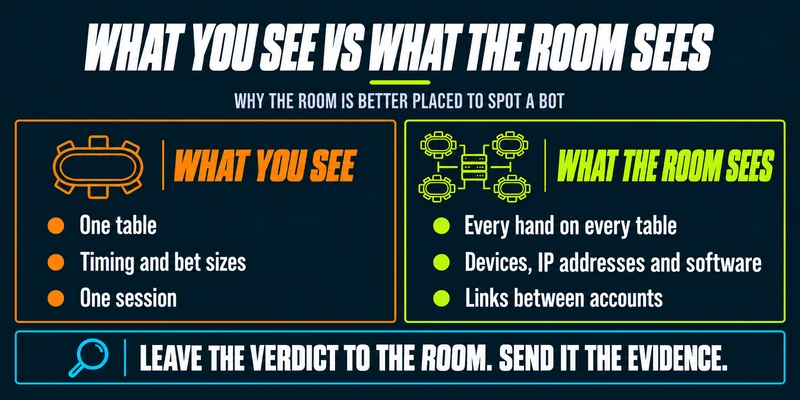
The bigger gap is what each side can see. You see one table, while the room's server sees every hand an account plays on every table, along with its devices, IP addresses and links to other accounts.
None of these signs is proof on its own. Strong human regulars can look robotic too, so leave the verdict to the room and send it the evidence.
How to Report a Suspected Bot
A report the room can act on is short and factual:
- 1Write down the details: the screen name, the date and time, the stakes or tournament, and the hand numbers
- 2Save the hand histories: Kuznetsov advises collecting them before you report, because they give the security team something to check
- 3Use the room's own channel: GGPoker said in 2020 that players can flag a hand from its replayer or PokerCraft, and WPT Global takes reports by email
- 4Stick to facts: SpadePoker advises giving the room specific facts and data, not just sharing screenshots on forums
- 5Ask about refunds: when a room confirms a bot, players who lost to it are often paid back, as the cases above show
Some rooms reward good reports. WPT Global accepts anonymous tips, but you need to give contact details to be eligible for a reward, and affected players are compensated first when a case is confirmed.
Choose Rooms That Publish Their Enforcement
Bloomberg's Kit Chellel said players cannot tell which sites keep bots out best, or whether the opponent in front of them is a bot: “You can't know that.” What you can check is whether a room tells you what it catches:
- Published bans and refunds, with numbers, like the cases in our enforcement record above
- Clear rules on bots, RTA and third party software in its terms
- A way to report suspicious play, and a policy of paying back players who lost to cheats
Publishing these numbers does not make a room bot free, but it shows the room is catching bots and paying players back.
Will AI Kill Online Poker?
The fear that AI will kill online poker is older than ChatGPT. Since Pluribus beat the pros in 2019, the warnings have come from the team that built it, from an investment bank and from a Silicon Valley investor:
| When | Who | The Warning | Source |
|---|---|---|---|
| July 2019 | Noam Brown, one of Pluribus's creators | The team kept its code private, and Brown said it could be very dangerous for the poker community | MIT Technology Review |
| September 2019 | Ed Young, Morgan Stanley analyst | Superhuman bots returning to online poker were “a matter of when, not if” | Bloomberg; GamblingNews |
| August 2024 | Chamath Palihapitiya, investor and former Facebook executive | Online poker “will be worth exactly $0 over the next few years” | His post on X |
Why the Warnings Were Taken Seriously
Pluribus did not need the supercomputers that earlier game playing AI relied on, and Young called that a major development because it made the strategy affordable and quick to copy. Morgan Stanley cut its price targets for three gambling stocks, with The Stars Group, then the owner of PokerStars, the most exposed to online poker.
Palihapitiya went further. He argued that AI agents would make money for their creators on legal sites, losing some hands on purpose so they pass as normal players.
What Has Happened Since
The industry's answer at the time was that bots were nothing new. Severin Rasset, then managing director of poker at The Stars Group, told iGaming Business in 2019: “Bots and attempts at manipulation have both existed since day one of online poker.”
So far, the record looks like this:
- Rooms catch rings: the published cases above run from 2015 to 2026, and players were paid back in most of them
- Detection has moved on: GGPoker now checks each decision against the cards opponents actually held, and rooms such as PokerStars and WPT Global check for software running alongside the client
- Players are still at the tables: SharkScope data in our October 2026 report shows an average of about 24,700 cash game seats in use at any moment and over 2 million tournament entries a day
- Cash traffic rose in October: by 5.0% across the 16 networks with full data since 2022, the biggest October gain in five years
SharkScope counts seats rather than people, and our monthly online poker traffic report tracks those numbers network by network. The threat has not gone away, though: as the protection section shows, bots are already getting harder to spot by eye.
What AI Changes for Players Who Want to Win
Palihapitiya gave online poker a few years, and two years on the tables are still busy. The bigger change is in what it takes to win at them, as our Head of Poker Content puts it:
“AI won't kill online poker, but it has already changed what it takes to win. Every year the edges get thinner, and they will keep shrinking as more players get access to better tools. Rooms can block bots, but they can't stop players using AI to study, so the players who keep winning will be the ones who find an extra edge somewhere else.”
Mark Patrickson, Head of Poker Content
Whether that edge is still there to find comes down to skill, volume and rakeback, and our guide on whether online poker is still profitable runs the numbers.
Rakeback is the one part of that edge you can secure before you play a hand, because the deal is set when you sign up. Our poker rakeback deals show what each room pays back, including exclusive offers and private freerolls for VIP-Grinders players.
AI Poker Bots: FAQs
Are there bots on online poker sites?
Yes. Bot rings are still being caught, including 893 accounts QQPK banned after a full review in October 2026, and Bloomberg's Kit Chellel has said it is impossible to have a poker site without bots. What separates rooms is how quickly they catch them and whether they pay back the players who lost.
Can AI beat professional poker players?
Yes, in research matches. Carnegie Mellon's Libratus won $1,766,250 in chips from four heads up no limit pros in 2017, and Pluribus beat elite pros at six player no limit hold'em in 2019. Pluribus's creators did not release its code, and one of them, Noam Brown, said it could be very dangerous for the poker community.
Has Texas hold'em been solved?
Only heads up limit hold'em, and only essentially. In January 2015, University of Alberta researchers showed in Science that their program Cepheus had essentially solved it, meaning no human could play enough hands to prove its strategy makes a mistake. No limit hold'em has not been solved.
What is the difference between a poker bot and RTA?
A poker bot plays by itself, with no person making the decisions. With real-time assistance (RTA), a person still plays every hand but follows outside advice, such as a solver, while the game is running. Rooms ban both, while studying with a solver between sessions is allowed as long as it is closed while you play.
How do poker sites detect bots?
Software flags suspicious accounts and a security team reviews them. Rooms look at decisions that are too accurate, mouse clicks and behaviour, programs running alongside the client, and links between accounts such as shared devices and IP addresses. PokerStars said in 2023 that only about 5% of the accounts it had closed that year were first reported by players.
How can you tell if a poker player is a bot?
You often cannot be sure. Signs to watch for include the same decisions in the same spots, reaction times that barely change and an anonymous player who keeps winning without mistakes, but modern bots vary their timing and strong regulars can look robotic too. If you suspect one, save the hand histories and report the account to the room.
Can you get your money back if you lost to a bot?
Often, if the room confirms the bot. After closing 277 bot accounts, partypoker returned $734,852.15 to affected players, 888 refunded $362,893 to 4,068 players in 2023, and QQPK set up a $300,000 fund for players in October 2026. Refunds are up to each room, so report the account and ask about compensation.
Are there bots on CoinPoker?
CoinPoker has caught and banned bots: in January 2026 it banned 98 bot accounts and refunded $156,446 to 1,360 players. From June 2026 it also banned HUDs, RTA tools and virtual machines, and it keeps its detection methods private so it does not hand tips to cheats.
Can ChatGPT play poker?
Yes, the language models behind ChatGPT can play, and OpenAI's models have done well in public tests. OpenAI's o3 topped the PokerBattle.ai play money contest in October 2025, and GipsyTeam reports that GPT-5.2 won the all OpenAI final of Kaggle Game Arena's poker event in February 2026. These tests pitted AI against AI, with no human pros at the table.
