

How Casino Rakeback Works and What 50% Rakeback Pays
Casino rakeback returns a share of the house edge on the bets you place, win or lose. That makes 50% rakeback on $1,000 of crypto dice at a 1% edge worth $5, not $500.
Only a few crypto casinos publish their rate: Shuffle’s help center gives 5% of the house edge and Stake’s 3.5%. Gamdom says its formula is “not publicly shared”, and Rainbet’s “up to 70%” adds several rewards together.
VIP-Grinders has negotiated rakeback deals for poker players since 2013. In poker, rakeback is a share of the rake, a fee the room takes from each pot, so for a winning player it adds to a profit. At a casino it is a share of the house edge, which is already your expected loss, so it lowers the cost of playing without removing it, unless it pays back the whole edge.
This guide covers:
- How casino rakeback is calculated, and what each rate pays per $1,000 you wager
- A calculator that turns your own rate, game and stake into dollars
- What eight crypto casinos publish about their rakeback, checked in October 2026
- Our test of rakeback against cashback on dice, roulette and slots
- What it costs to reach a VIP level, and when a VIP program is worth it
What Is Casino Rakeback?
Casino rakeback is a reward that pays back part of the house edge on the games you play, based on how much you wager. Shuffle’s help center says the house edge is “commonly referred to as the ‘rake'”, and rakeback lets you “receive a percentage of this edge back”.
Rakeback follows your wagering, not your results. As Shuffle puts it, “No matter if you win or lose, you’ll always earn a set percentage based on your total wagers”, so a winning session earns the same rakeback as a losing one of the same size.
Casino Rakeback vs Poker Rakeback
Rakeback started in poker, and the name carried over to casinos even though the money comes from a different place. Stake, which runs both, pays the same 3.5% rate on two different things:
| Poker Rakeback | Casino Rakeback | |
|---|---|---|
| What it returns | A share of the rake, the fee the room takes from each pot or tournament entry | A share of the house edge built into each bet |
| Who you play against | Other players | The casino |
| Can it make you profitable? | Yes, it adds to a winning player’s profit and can turn a break even player into a winner | Only above 100% of the edge. At 100%, you break even on average |
| Rate at Stake | 3.5% of the rake | 3.5% of the house edge |
In poker, the rake is a fee for hosting the game, and the players you beat are the ones who pay your profit. Our guide on how poker rakeback works covers where it comes from and how rooms calculate it.
At a casino there is no separate fee to share. The house edge is the casino’s expected profit on every bet, which makes it your expected loss, and rakeback gives part of it back.
Rakeback, Cashback, Lossback and Reloads Compared
Casinos use several names for rewards that look alike. They differ in what each one is based on and when it pays:
| Reward | What It Is Based On | When It Pays |
|---|---|---|
| Rakeback | Amount wagered × house edge × your rate | On every eligible bet, win or lose |
| Cashback or lossback | Your net losses over a set period | Only after a losing day, week or month |
| Reload bonus | Usually a new deposit | When you deposit, often with wagering to clear |
| Level up bonus | Reaching a new VIP level | Once per level |
| Weekly and monthly bonuses | Your wagering, the house edge and your results | On a set schedule |
The names are not used the same way everywhere. Shuffle, for example, uses “reload” for a bonus paid out over time, such as $100 in ten daily claims of $10, so read what a reward is based on before you compare two offers.
For deposit matches, our list of casino reload bonuses compares current offers.
How Is Casino Rakeback Calculated?
Every rakeback formula we found in a casino’s current help center works the same way, multiplying three numbers:
Rakeback = amount wagered × house edge × rakeback rate
Two casinos publish a worked example in their help centers, and both follow that formula:
| Casino | Amount Wagered | House Edge | Rakeback Rate | Rakeback Paid |
|---|---|---|---|---|
| Shuffle | 1,000 USDT | 2% | 5% of the edge | 1 USDT |
| Stake | 1 BTC | 2% | 3.5% of the edge | 0.0007 BTC |
The house edge is the part that changes most from game to game, and our guide to the house edge of each casino game lists it for slots, table games and originals.
What Each Rakeback Rate Pays per $1,000 Wagered
This table applies the formula to $1,000 of play at three common house edges. The 3.5% and 5% columns are the rates Stake and Shuffle publish:
| House Edge | 3.5% Rakeback | 5% | 20% | 50% | 100% |
|---|---|---|---|---|---|
| 1% (dice and crash at many crypto casinos) | $0.35 | $0.50 | $2 | $5 | $10 |
| 2.70% (European roulette, 1 in 37) | $0.95 | $1.35 | $5.41 | $13.51 | $27.03 |
| 4% (slot at 96% RTP) | $1.40 | $2 | $8 | $20 | $40 |
The 100% column is the whole house edge, which is also the average loss on that $1,000. Any rate below 100% pays back part of that loss and leaves the rest with the casino.
Why the Game You Play Changes Your Rakeback
At the same rate, a slot at 96% RTP pays four times the rakeback of dice at a 1% edge. It also costs four times as much: at 50% rakeback, $1,000 on the slot costs $40 on average and returns $20, a net cost of $20, while the same play on dice costs $10, returns $5 and nets out at $5.
Casinos work out the edge in one of three ways:
- 1Each game's own edge. Shuffle, Thrill and Stake's casino use the house edge of the game you play.
- 2A fixed edge the casino assumes. Stake works out sports rakeback "using a default 3% house edge".
- 3No edge at all. Some loyalty programs pay a share of your wagers or a points rate instead.
A share of your wagers and a share of the edge are not the same number. To compare them, divide by the edge: 0.2% of your wagers equals 20% of a 1% edge, but only 5% of a 4% edge.
What Your Rakeback Is Worth: Try Your Own Numbers
Enter what you wager, the game’s RTP and the rakeback rate your casino shows. The calculator turns that rate into dollars and shows what the house edge still costs once rakeback is paid.
50% rakeback on $10,000 at 96% RTP pays $200
The house edge of 4% costs $400 on average, and rakeback pays back 50% of it.
For every $1 of rakeback, the house edge costs you $2 on average, so you still lose $1 after it is paid.
Average figures come from the house edge. Your results in any one session will swing above and below them.
How to Read the Results
What each result shows:
- The headline: what your rate pays on the amount you enter
- Average loss before rakeback: the house edge multiplied by everything you wager
- Rakeback: your rate applied to that average loss
- Average loss after rakeback: what the house edge still costs once rakeback is paid
- RTP after rakeback: the game's RTP plus what rakeback returns on each dollar
At a 50% rate, the house edge costs you $2 for every $1 of rakeback, so you still lose $1 on average after it is paid. At 5%, it costs $20 for every $1 back.
Does Rakeback Change the House Edge?
The edge built into the game stays the same, but your effective RTP rises by the rate times the edge. At 50% rakeback, a 96% slot returns 98% on average:
| Game RTP | 3.5% Rakeback | 5% | 20% | 50% | 100% |
|---|---|---|---|---|---|
| 99% (dice and crash at many crypto casinos) | 99.04% | 99.05% | 99.20% | 99.50% | 100% |
| 97.30% (European roulette, 1 in 37) | 97.39% | 97.43% | 97.84% | 98.65% | 100% |
| 96% (slot) | 96.14% | 96.20% | 96.80% | 98.00% | 100% |
Only the 100% column removes the house edge, and at that rate your average result is break even.
When the Whole House Edge Is Removed
A few casinos take away the whole edge on some games, up to a limit:
- Gamdom: its help center says the first $5,000 wagered on its own games "already runs at an effective 100% RTP, with a 1% value returned to you through Instant Rakeback"
- Duel: its Zero Edge panel shows no house edge on the first $50,000 you wager on its originals each day, after which an edge based on your bet size applies
Above those limits the normal edge applies again. Our guide to the odds and house edge in each crypto original covers what five casinos publish for their games.
Rakeback Does Not Stop the Swings
A session still swings with the game, whatever the rate. We calculated 1,000 bets of $10 on dice at a 1% edge and on the model slot we use later in this guide (96% RTP, top prize 1,000x):
| 1,000 Bets of $10 | Average Result | Sessions That Finish Ahead |
|---|---|---|
| Dice at 1%, no rakeback | Down $100 | 36.4% |
| Dice at 1%, 50% rakeback | Down $50 | 43.7% |
| Slot at 96%, no rakeback | Down $400 | 21.7% |
| Slot at 96%, 50% rakeback | Down $200 | 24.8% |
With 50% rakeback the average loss halves in both games, but 56.3% of dice sessions and about three in four slot sessions still finish behind. The rakeback is the same in every session, so whether a session wins still depends on the game.
What Crypto Casinos Publish About Their Rakeback
We checked what eight crypto casinos say about rakeback on their own pages in October 2026. Only Shuffle and Stake give a standard rate in their help centers, Duel states one in its replies to players, and BC.Game publishes the formula for its deposit rakeback:
| Casino | Based On | Rate Published | How It Is Paid |
|---|---|---|---|
| Shuffle | Each game’s house edge | 5% of the edge | As cash, from Bronze ($1,000 wagered) |
| Stake | Each game’s house edge, sports at a default 3% | 3.5% of the edge | As cash, from Bronze ($10,000 wagered) |
| Duel | The house edge on third party casino games | 50% of the edge, in Duel’s replies to players | Instantly, with “no wager requirements” |
| BC.Game | Wager × house edge × 1%, the same at every level | 1% of the edge | Unlocks money from its locked deposit bonus |
| Gamdom | Bets, house edge “and other undisclosed elements” | No standard rate: “not publicly shared”, apart from up to 15% in a new account’s first 6 hours | Instant, claimable from $0.10 |
| Thrill | The house edge of the games you play | No | Paid out through Thrill’s bonuses |
| Rainbet | “Your total wagered” | No | Claimable every 15 minutes |
| BitStarz | No rakeback: weekly VIP cashback on losses | 10% in its VIP FAQ, “based on your VIP deal” in its VIP terms | On Fridays, only after a losing week |
Shuffle, Stake, Duel, BC.Game and Thrill all tie rakeback to the house edge, so the formula from earlier in this guide applies to them. Gamdom and Rainbet do not publish how theirs is worked out. Shuffle’s 5% comes from a 2024 help article, and its VIP page now says the amount depends on your VIP level as well as what you wager.
What “50% Rakeback” and “Up to 70%” Mean
Duel advertises 50% instant rakeback, and its replies to players say the figure is “50% of the house edge”. Ask three questions of any headline rate:
- A share of what? 50% of the house edge on a 1% game is 0.5% of what you wager, or $5 per $1,000.
- Whose rate? "Up to" describes the best case, often the top VIP level, not the rate you start on.
- One reward or several? Rainbet says its "up to 70%" figure "stacks across the full reward set".
Why Most Casinos Do Not Publish a Rate
Among the casinos we checked, rewards depend on your level, how much you play, which games you play and, for some bonuses, your results. Gamdom bases its rewards on bets, house edge “and other undisclosed elements”, and Rainbet says its bonuses “include a boost based on your recent wagering activity and results”.
That makes your own account the only reliable source. Check the casino’s VIP or rewards page, ask a VIP host or support to confirm the rate, then enter it in the calculator above.
Six Things to Check Before You Trust a Rakeback Rate
Before you compare two offers, check these six points in the casino’s terms:
- 1What the rate is a share of: the house edge, or what you wager
- 2Which edge it uses: each game's own, or a fixed one, as with Stake's default 3% on sports
- 3Which bets count: Shuffle pays no rakeback on sports bets, and Stake excludes voided and cashed out sports bets
- 4How it is paid: as cash you can withdraw, or as money that unlocks a bonus balance, as at BC.Game
- 5When it expires: at Rainbet, a reward not claimed before the next one unlocks expires, while Gamdom's instant rakeback does not
- 6Whether a bonus pauses it: at Gamdom, "Rakeback isn't generated while the wagering requirement is active", and Rainbet divides rewards by 3 while a currency is in rollover
If you play with a deposit bonus, our guide on how wagering requirements work shows what clearing it costs. For balances that unlock as you play, see our guide on how locked casino bonuses work.
Rakeback vs Cashback: Which Pays More?
Rakeback pays on every bet, while cashback pays only on what you lose. We worked out what each pays on $10,000 wagered in a week, at rates casinos publish: 5% of the house edge as at Shuffle, 50% as at Duel, and 10% weekly cashback, the rate in BitStarz’s VIP FAQ, with 20% cashback for comparison:
| Game and Bets | Average Loss | 5% Rakeback | 50% Rakeback | 10% Cashback | 20% Cashback |
|---|---|---|---|---|---|
| Dice at 1%, 1,000 × $10 | $100 | $5 | $50 | $18 | $36 |
| European roulette, 1,000 × $10 | $270 | $14 | $135 | $30 | $61 |
| Slot at 96%, 1,000 × $10 | $400 | $20 | $200 | $131 | $263 |
| Dice at 1%, 100 × $100 | $100 | $5 | $50 | $45 | $90 |
| Slot at 96%, 100 × $100 | $400 | $20 | $200 | $233 | $467 |
Each figure is the average weekly payout across all players. Rakeback depends only on what you wager and the edge, so it stays the same however the week goes, while cashback depends on how much you lose that week.
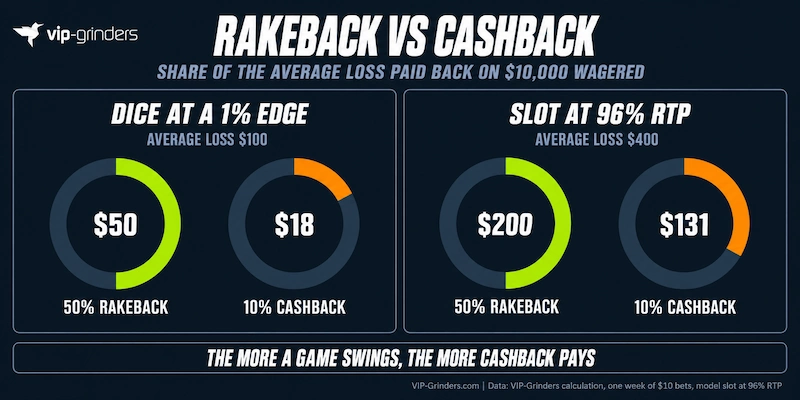
On the same $10,000 of dice, betting $100 at a time instead of $10 raised the average 10% cashback from $18 to $45. The rakeback stayed at $50, because the amount wagered did not change.
How We Ran the Test
Every row uses the same week of play and the same rules:
- The play: $10,000 wagered in one week, as 1,000 bets of $10 or 100 bets of $100
- The games: dice paying 2x at a 49.5% win chance, red at European roulette, and a model slot with a 96% RTP, a win on about 1 spin in 3 and a top prize of 1,000x
- The rewards: rakeback as a share of the house edge, and cashback as a share of the week's net loss, paid only after a losing week with no wagering on it
- The math: exact probability calculations for every row, checked by simulating 100,000 players per row
The model slot is not a real game, and real slots differ. The pattern holds for other games, though: the more a game swings, the more of your losses there are for cashback to pay back.
Why Cashback Pays More on Slots and Big Bets
Cashback only pays after a losing week, and a game that swings more produces bigger losing weeks. In our test, 10% cashback beat 5% rakeback in every row, and 50% rakeback beat 10% cashback in every row except the slot at $100 bets.
The two rewards also pay different players. At $10 bets, cashback paid out in 61% of dice weeks and about four in five roulette and slot weeks, while rakeback paid every player, including the ones who finished ahead. This is the cashback rate it takes to match 50% rakeback:
| Game, 1,000 Bets of $10 | Cashback Rate That Pays the Same as 50% Rakeback |
|---|---|
| Dice at 1% | 27.4% |
| European roulette | 44.4% |
| Slot at 96% | 15.2% |
On the slot, a cashback rate of about 15% pays as much as 50% rakeback. On roulette, it takes a cashback rate of about 44%.
Which Reward Fits How You Play
Neither reward changes the house edge, but one can suit your play better than the other:
- Many small bets on low edge games: your weekly results stay close to the average, so cashback has less to pay back and the rakeback rate counts for more
- Slots or big stakes: cashback grows with the swings, so check what a cashback offer pays on your usual bet size
- Both on offer: work out the rakeback with the calculator above, and check whether the cashback comes as cash or with wagering, which makes it worth less
How Casino VIP Levels Work
A casino VIP program moves you up levels as you play, and each level unlocks rewards such as a level up bonus or larger weekly and monthly bonuses. None of the casinos we checked publish a full table of rewards for every level, but most publish how you climb.
Most Programs Count Wagering, Not Deposits
The four level based programs we checked count what you wager, and some weight it by the game:
- Shuffle: "Casino betting generates 1 XP per $1 USD wagered", and sports bets at odds of 1.1 or more earn 3 XP per $1
- Thrill: 1.5 XP per $1 on games at 97% RTP and below, 1 XP from 97% to 99% and 0.5 XP above 99%, with 3 XP per $1 on sports at odds of 1.10 or more
- Gamdom: progress is weighted by RTP, so "$200 on Slots (97% RTP) advances you more than $200 on Dice (99.9% RTP)"
- Stake: "Once you've wagered a total of $10,000, you'll join the Bronze level", the first of its VIP levels
Thrill and Gamdom give more progress on games with a lower RTP, so the house edge you pay counts, not only the amount you wager. At those two, a level partly tracks the expected loss you have put through the casino.
BitStarz works differently: its VIP program is by invitation only, and its terms say “we expect our VIPs to deposit on average 5K EUR monthly in order to keep their status”.
What It Costs to Reach a VIP Level
We set the published thresholds against the house edge to see what reaching a mid level costs on average, and what the casino publishes in return:
| Level | How You Play | Wager Needed | Average Loss | Published Rewards on the Way |
|---|---|---|---|---|
| Thrill Gold (100,000 XP) | Slot at 96% RTP, 1.5 XP per $1 | $66,667 | $2,667 | $175 in level up bonuses |
| Thrill Gold (100,000 XP) | Game at 99% RTP, 1 XP per $1 | $100,000 | $1,000 | $175 in level up bonuses |
| Shuffle Gold 1 (100,000 XP) | Game at a 1% edge | $100,000 | $1,000 | About $276 in level up bonuses, plus about $50 rakeback |
| Shuffle Gold 1 (100,000 XP) | Slot at 96% RTP | $100,000 | $4,000 | About $276 in level up bonuses, plus about $200 rakeback |
On published rewards alone, reaching Thrill Gold pays back about 6.6% of the average loss on a 96% slot and 17.5% on a 99% game. Shuffle’s figures work out at about 32.6% on a 1% game and 11.9% on a slot, though Shuffle says its level up amounts depend on “the edge of the games you have wagered”.
Both casinos also pay weekly and monthly bonuses without publishing the amounts, so the full return is higher than these figures. The cheapest way up is still a low edge game: Thrill Gold costs $1,000 on average at 99% RTP, against $2,667 on a 96% slot.
Weekly, Monthly and Level Up Bonuses
The weekly and monthly bonuses that come with a VIP level have no published rate, but the casinos list what goes into them:
- Your wagering: Shuffle, Stake and Thrill all start from what you wagered in the period
- The house edge: Shuffle, Stake and Thrill count the edge of the games you played, so the same wager on slots can pay more than on dice
- Your results: Stake says "if you have an unlucky week, you might receive a bit extra", and Thrill that "you may receive a higher bonus as compensation"
That last point makes these bonuses part cashback, since a losing week can pay more. Higher levels also bring a VIP host, from Emerald I at Thrill and from a $2,500,000 lifetime wager at Rainbet.
For hosts, higher limits and faster withdrawals, our list of crypto casinos for high rollers compares what each one offers.
Is a Casino VIP Program Worth It?
A casino VIP program is worth it when it pays you back on play you had already planned. It stops being worth it once the next level starts to decide how much you play.
João Mourato, our Head of iGaming Product, explains why rakeback means something different at a casino than at a poker table:
“Poker rakeback is paid on the rake, and the rake is not a loss you are bound to take over time: a player who beats the table wins it back from the other players. Casino rakeback is paid on the house edge, which is a theoretical loss built into every bet. That is why I judge a VIP program by how much of that loss it gives back, not by the headline percentage.”
João Mourato, Head of iGaming Product at VIP-Grinders
When a VIP Program Pays Off
A VIP program adds value when most of these are true for you:
- You would play the same amount anyway: every reward is then money back on bets you had already planned
- You play low edge games: levels cost less to reach on average, and 50% rakeback on a 1% game cuts your average loss to 0.5% of what you wager
- Rewards are paid as cash: you can withdraw them without betting them again first
- The rate or formula is published: you can work out what you get before you play
When It Costs More Than It Pays
A VIP program works against you when any of these apply:
- You bet more to reach the next level: the extra play costs the full house edge, and in our examples the published rewards for reaching a level paid back 6.6% to 32.6% of its average cost
- Rewards carry wagering: each time you bet a reward through, the house edge takes another share of it
- The rate is not published: you only find out what a level pays after you have paid to reach it
- You count on a bigger bonus after a losing week: the casinos that mention it say only that an unlucky week may pay more, not how much
Rewards Paid in Casino Tokens
Some crypto casinos pay rewards in their own token, or pay more when you bet with it. Shuffle says “By wagering with SHFL on Shuffle.com, players will get increased VIP bonuses”, and BC.Game pays an instant $BC bonus after each settled bet on selected games, such as its originals.
Neither casino says how much extra you get. A token’s price moves every day, so a reward worth $100 when it is paid is worth $70 if the token falls 30% before you sell it.
Before you count a token reward, check three things:
- 1Its value today: count it at what you could swap it for now, since the dollar figure shown when it was paid may be out of date
- 2How you sell it: BC.Game holds $BC rewards in its BC Engine until you withdraw them, and Shuffle's own guide points to Uniswap for swapping SHFL, with "at least $20 worth of ETH" in your wallet for network fees
- 3Your balance while you play: if you bet in the token to get bigger bonuses, your whole balance rises and falls with its price, not only the bonus
A VIP level should follow your budget, not set it. Our page on how deposit and loss limits work explains what each limit caps and why it works best when you set it before you start playing.
Frequently Asked Questions
What is casino rakeback?
Casino rakeback is a reward that pays back a share of the house edge on every eligible bet you place, win or lose. It is based on how much you wager rather than on your results, so a winning session earns the same rakeback as a losing one of the same size. Shuffle’s help center gives 5% of the house edge and Stake’s 3.5%.
How is casino rakeback calculated?
Multiply the amount you wager by the house edge and by your rakeback rate. At 5% rakeback, 1,000 USDT wagered on a game with a 2% edge returns 1 USDT, which is the worked example in Shuffle’s help center. Casinos that use each game’s own edge pay more rakeback on slots than on dice, because the edge is bigger.
What does 50% rakeback mean at a casino?
At the crypto casinos that define it, 50% rakeback means half of the house edge, not half of what you wager. On $1,000 of dice at a 1% edge that pays $5, and on $1,000 of a slot at 96% RTP it pays $20. Check whether a headline rate such as “up to 70%” is the rate at your level or several rewards added together.
What is the difference between rakeback and cashback at a casino?
Rakeback pays a share of the house edge on everything you wager, win or lose. Cashback pays a share of your net losses over a set period, so it only pays after a losing day, week or month. In our test of $10,000 wagered in a week, 50% rakeback paid more than 10% cashback in every case except a slot played at $100 a spin.
Can rakeback make you profitable at a casino?
Only if it pays back more than 100% of the house edge. At 100% your average result is break even, and any lower rate cuts your average loss without removing it: at 50% rakeback on a 96% slot, you still lose 2% of what you wager on average. Some casinos remove the whole edge on their own games up to a limit, such as Gamdom on the first $5,000 you wager on its in house games.
Do all casino games earn the same rakeback?
No, not at casinos that use each game’s own house edge, such as Shuffle, Thrill and Stake’s casino. At the same rate, a slot at 96% RTP pays four times the rakeback of dice at a 1% edge, because its edge is four times bigger, and it also costs four times as much. Some bets are left out as well: Shuffle pays no rakeback on sports, and Stake excludes voided and cashed out sports bets.
How do casino VIP levels work?
You move up levels by wagering, and each level unlocks rewards such as a level up bonus and larger weekly and monthly bonuses. Shuffle gives 1 XP per $1 wagered on casino games, while Thrill and Gamdom give more progress on games with a lower RTP. Reaching Thrill Gold on a 96% slot means wagering about $66,667, which costs $2,667 on average against $175 in published level up bonuses.
Is casino rakeback paid in cash or bonus money?
It depends on the casino. Shuffle and Stake pay rakeback as cash, Duel says its rakeback has “no wager requirements”, and BC.Game’s deposit rakeback unlocks money from a locked bonus balance. Some casinos also pause it while a bonus is active: Gamdom says “Rakeback isn’t generated while the wagering requirement is active”.