

- How Martingale works, with a worked example of a losing streak
- Our simulation of Martingale against eight other ways to bet, from Fibonacci and D'Alembert to Labouchère
- Why no betting system beats the house edge, whatever the progression
- A Martingale calculator that shows how many losses your bankroll can survive
- How table limits, autobet and bonus terms change what a progression can do
- The gambler's fallacy, and why red is never due after a run of black
- Bankroll: 1,000 units, with a base bet of 1 unit
- Game: European roulette, betting on red (18 winning numbers out of 37, a 2.70% house edge)
- Length: 1,000 bets per player, or fewer if the bankroll ran out
- Short stack rule: a player who could not cover the next stake bet whatever was left
- Table limit: none, which is the best case for Martingale (limits come later in this guide)
- Losses in a row to bust from 1,000 units: 15 (Martingale: 10)
- Finished ahead: 74.6%, the highest of any system we tested
- Went bust: 21.4%
- Average result: down 101 units
- Finished ahead: 34.9%
- Went bust: 46.2%, the most of the five systems above
- Average result: down 412 units, also the worst of the five
- Typical highest stake in a session: 47 units, against 1 unit for flat betting
- Highest stake: 4 units, so no Paroli player went bust
- Chance of three wins in a row: 11.5% at European roulette
- Finished ahead: 22.6%
- Average result: down 46 units
- Grand Martingale: doubles the stake after a loss and adds 1 unit, so each finished sequence wins a little more
- Labouchère: write a line of numbers (we used 1, 2, 3, 4) and bet the first plus the last; cross both off after a win, add the lost stake to the end after a loss
- Oscar's Grind: aims for 1 unit of profit per series, adding 1 unit after a win, keeping the stake after a loss and never betting more than it needs to reach that 1 unit
- 1-3-2-6: bets 1, 3, 2 and 6 units on consecutive wins, then goes back to 1 unit after a loss or after the fourth bet
- The headline: the losses in a row that end your Martingale, set by whichever runs out first, your bankroll or the table limit
- The bar chart: one bar per bet in that losing sequence, so you can see how fast the stakes grow, with the bet that ends it in orange
- How often it turns up: the odds for one sequence, which look small, and for sessions of 100, 1,000 and 10,000 bets, which decide your result
- The cost: how many winning sequences one bust wipes out
- 1Before you bet, the casino shows a hash of its secret server seed
- 2You set your own client seed, and each bet adds 1 to a counter called the nonce
- 3Each roll is calculated from the server seed, the client seed and the nonce
- 4When you change seeds, the casino reveals the old server seed, so you can check it against the hash and recheck every roll
- After one to four repeats of the same even money outcome, players bet against the streak about as often as chance would predict
- After five in a row, a significant lean against the streak appeared
- After six or more in a row, 85% of even money bets went against the streak
- BitStarz can confiscate bonus winnings and deposits from a group of linked players using the same betting patterns
- BitStarz does not count minimal risk bets, such as red and black at the same time, toward wagering
- Shuffle can void bets where it sees suspicious, irregular or unusual betting patterns
- Shuffle bans the use of bots or automation tools to gain an unfair advantage, and can void bets placed by an automated system
- UK Gambling Commission: gambling products must not actively encourage customers to chase their losses or increase their stake (RTS 14A)
- UK autoplay ban: autoplay ended on online slots on October 31, 2021, and on all online casino games, live casino included, on January 17, 2025
- UK game speed: online casino games other than slots must allow at least 5 seconds from the start of one game to the start of the next (RTS 14G)
- Malta Gaming Authority: lists chasing losses among the things players should never be encouraged to do
- Diagnosis: the DSM, the manual used to diagnose gambling disorder, lists returning another day to get even after losing money, known as chasing losses, as one of its nine criteria
- Raising your base bet after a losing session to win it back faster
- Topping up your balance in the middle of a sequence so you can keep doubling
- Moving to a bigger table or a higher max bet to fit the next stake
- Playing longer than you planned because you are still below where you started
- Turning autobet back on straight after a stop on loss ends it
Martingale Betting System: Why It Wins Most Sessions and Still Loses Money
The Martingale betting system doubles your stake after every loss, so one win recovers everything you lost plus a profit equal to your first stake. It wins small amounts often, which is why it feels like it works. No betting system changes the house edge, though, and Martingale only changes when and how you lose.

We simulated 100,000 players per system on European roulette, each starting with 1,000 units and playing 1,000 bets. Martingale players finished ahead in 54% of sessions, yet the average result was a loss of 123 units, and about 1 in 3 went bust along the way.
VIP-Grinders has worked with poker players since 2013, and in poker, staking and bankroll math decide who lasts. The same math applies at the roulette table and on crypto dice, where autobet turns Martingale into a single click.
This guide covers:
What Is the Martingale Betting System?
The Martingale betting system, often called the Martingale strategy, is a staking plan for even money bets, such as red or black in roulette or a 2x roll on crypto dice. You start with one unit, double your stake after every loss and go back to one unit after a win.
Each new stake is bigger than all your losses in the sequence combined, so the first win always leaves you one unit ahead. Most sequences end with that small profit, which is the whole appeal.
How Martingale Works on Roulette: A Worked Example
This is a $1 Martingale on red at European roulette, where each spin loses 19 times in 37 because of the green zero. A win on any row ends the sequence $1 ahead, and the last column shows how often you lose that many spins in a row:
| Bet | Stake | Total Lost if It Loses | Chance of Losing This Many in a Row |
|---|---|---|---|
| 1 | $1 | $1 | 51.4% |
| 2 | $2 | $3 | 26.4% |
| 3 | $4 | $7 | 13.5% |
| 4 | $8 | $15 | 6.95% |
| 5 | $16 | $31 | 3.57% |
| 6 | $32 | $63 | 1.83% |
| 7 | $64 | $127 | 0.94% |
| 8 | $128 | $255 | 0.48% |
| 9 | $256 | $511 | 0.25% |
| 10 | $512 | $1,023 | 0.13% |
By the tenth bet you are staking $512 to win back $1, with $1,023 lost if it fails. Ten losses in a row is a 1 in 784 event for any one sequence, which sounds rare until you count how many sequences a session holds.
Where Martingale Came From
Martingale has been around for centuries. In his memoirs, Giacomo Casanova describes playing it at cards during the carnival in Venice:
“I took all the gold I found, and playing the martingale, and doubling my stakes continuously, I won every day during the remainder of the carnival. I was fortunate enough never to lose the sixth card, and, if I had lost it, I should have been without money to play, for I had two thousand sequins on that card.”
Giacomo Casanova, Memoirs, Volume 9: The False Nun (Arthur Machen translation)
His whole bankroll rode on never losing six times in a row. He won that carnival, but three chapters later the memoir’s chapter heading reads: “I Ruin Myself at Play, and at the Suggestion of M. M. I Sell all Her Diamonds, One After Another.” The next section shows what happens to players who keep going.
Does the Martingale System Work? We Simulated 100,000 Players
Martingale does what it promises most of the time: the majority of players who use it finish a session ahead. It fails where it matters, because the average result is still a loss, and a bigger one than flat betting produces.
How We Ran the Simulation
We wrote the simulation in Python and played each betting system 100,000 times. Each run is one player, with the same rules for every system:
We put Fibonacci, D’Alembert, Paroli and flat betting through the same test, then repeated all five on crypto dice at a 1% house edge. This section covers Martingale, and the other systems follow in the next one.
Why Martingale Wins Most Sessions and Still Loses
After 1,000 bets, 53.6% of Martingale players were ahead, and the typical winner was up 487 units. Of the other 46.4%, three in four lost the whole bankroll.
| Result After 1,000 Bets | Share of Players | Typical Result |
|---|---|---|
| Finished ahead | 53.6% | Up 487 units |
| Lost part of the bankroll | 11.6% | Down 273 units |
| Went bust | 34.7% | Down 1,000 units |
| All players | 100% | Average: down 123 units |
Wins are small because each completed sequence pays 1 unit, so even the best session in our test finished 549 units up. Losses are the whole bankroll, and for every 100 players, about 35 lost 1,000 units each while 54 won around 485 each.
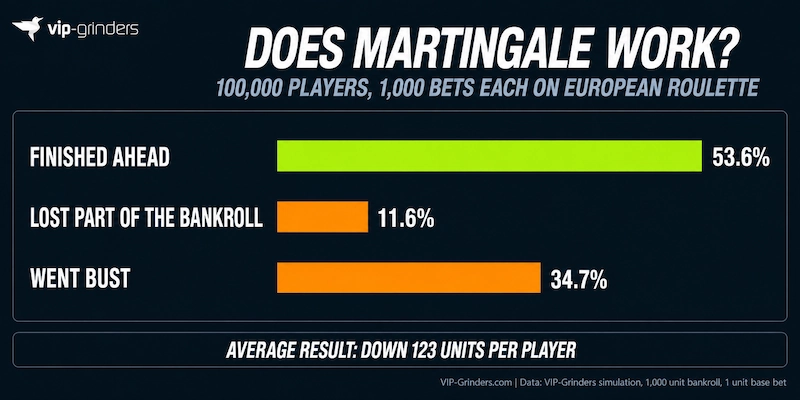
Nearly every player who went bust (99.6%) had been ahead at some point, typically by 165 units at their peak. Martingale wins for a long time, then gives everything back in one streak.
Betting 1 unit flat on every spin lost 27 units on average. Martingale lost about 4.5 times as much because it put about 4.5 times as much money on the table, which the house edge section below explains.
The Losing Streak That Ends It
From a 1,000 unit bankroll, 10 losses in a row cost 1,023 units, more than the player started with. A player less than 24 units ahead goes bust on the 10th loss, and one further ahead is left with only their profit, which the next bet puts at risk in full.
In any single sequence, a streak that long is rare. A 1,000 spin session holds hundreds of sequences, though, and that changes the odds:
| Losses in a Row | Chance in One Sequence | At Least Once in 1,000 Spins | At Least Once in 10,000 Spins |
|---|---|---|---|
| 8 | 1 in 207 | 90.8% | Over 99.9% |
| 10 | 1 in 784 | 46.2% | 99.8% |
| 11 | 1 in 1,527 | 27.2% | 95.9% |
| 12 | 1 in 2,974 | 15.0% | 80.6% |
| 15 | 1 in 21,965 | 2.2% | 19.9% |
In our simulation, 46.3% of Martingale players hit a run of 10 losses. 34.7% went bust, and nearly all the rest are the 11.6% in the table above who lost part of the bankroll: they survived the streak on one final all in bet.
Play 10,000 spins instead of 1,000 and a run of 10 losses becomes 99.8% likely. Probability theory calls this gambler’s ruin: with a limited bankroll against a house edge, the chance of going broke climbs toward certainty the longer you keep playing. Our Martingale calculator below shows the streak that ends your own bankroll.
Roulette Betting Systems Compared
The Martingale system is the best known progression, but it is not the only one. We ran the most common alternatives through the same simulation, with flat betting as the baseline:
| System | Finished Ahead | Typical Result | Average Result | Went Bust |
|---|---|---|---|---|
| Flat betting | 18.8% | Down 28 units | Down 27 units | 0% |
| Martingale | 53.6% | Up 459 units | Down 123 units | 34.7% |
| Fibonacci | 74.6% | Up 164 units | Down 101 units | 21.4% |
| D’Alembert | 34.9% | Down 537 units | Down 412 units | 46.2% |
| Paroli | 22.6% | Down 47 units | Down 46 units | 0% |
Typical result is the median player, with half doing better and half doing worse. Every system lost money on average, and every one finished ahead more often than flat betting. The three negative progressions, which raise the stake after a loss, paid for it with busts in 21% to 46% of sessions.
Fibonacci Betting System
Fibonacci stakes follow the sequence 1, 1, 2, 3, 5, 8, 13, 21, where each number is the sum of the two before it. You move one step along after a loss and two steps back after a win, and the sequence ends when you are back at the first 1.
The slower climb means a straight losing streak rarely finishes a Fibonacci player: only 6.7% of our busted players had lost 15 in a row. The rest went down in choppy runs, because one win moves you back two steps, so any stretch with more than two losses per win keeps the stake climbing.
D’Alembert System
D’Alembert adds 1 unit to the stake after a loss and takes 1 unit off after a win, never going below 1 unit. It rests on the idea that wins and losses even out over time, so a slow, steady climb should be safe.
Wins and losses do not even out in a way that helps you. The stake only falls after a win, so a run where losses slightly outnumber wins leaves you betting close to 50 units a spin, and the green zero makes those runs more common than the reverse.
Reverse Martingale and the Paroli System
Reverse Martingale flips the idea: you double after a win and drop back to 1 unit after a loss. With no stop point it hands back every winning streak, because the run can only end with a loss, and that loss takes everything the streak built.
Paroli is a positive progression that adds the stop point. In our version you bet 1, 2 and 4 units, bank 7 units if all three win, then start again at 1 unit:
Paroli’s small stakes kept every player clear of a bust, but they do nothing about the edge. It still lost 46 units on average, more than flat betting, because it wagered 1,694 units instead of 1,000.
Labouchère, Oscar’s Grind and Other Systems
We also tested four systems players often ask about, with the same bankroll and the same 1,000 bets. This is how each one changes the stake:
| System | Finished Ahead | Typical Result | Average Result | Went Bust |
|---|---|---|---|---|
| Grand Martingale | 44.3% | Down 1,000 units | Down 169 units | 53.4% |
| Labouchère | 32.2% | Down 1,000 units | Down 342 units | 67.3% |
| Oscar’s Grind | 67.4% | Up 116 units | Down 178 units | 24.9% |
| 1-3-2-6 | 23.3% | Down 55 units | Down 53 units | 0% |
More than half of Grand Martingale and Labouchère players went bust, so the typical player in both lost everything. Across all nine ways of betting we tested, the loss came to between 2.66% and 2.73% of everything wagered, and the next section explains why that number barely moves.
Why No Betting System Beats the House Edge
Every bet on red at European roulette loses 2.70% of its stake on average, because the green zero wins for the house. Our guide to the house edge in casino games shows where that number comes from.
That 2.70% applies to the first bet of a session and to the tenth bet of a losing streak alike, because the wheel has no memory. A betting system only decides how much goes on each spin, so the one thing it can change is how much you bet in total:
Average loss = house edge × total amount wagered
Your Loss Follows What You Wager
Our simulation shows the rule at work. Multiply each system’s average total wagered by 2.70% and you land within 2% of the average loss it produced:
| System | Average Total Wagered | 2.70% of Wagered | Actual Average Loss |
|---|---|---|---|
| Flat betting | 1,000 units | 27 units | 27 units |
| Paroli | 1,694 units | 46 units | 46 units |
| 1-3-2-6 | 1,970 units | 53 units | 53 units |
| Fibonacci | 3,794 units | 102 units | 101 units |
| Martingale | 4,490 units | 121 units | 123 units |
| Grand Martingale | 6,260 units | 169 units | 169 units |
| Oscar’s Grind | 6,632 units | 179 units | 178 units |
| Labouchère | 12,835 units | 347 units | 342 units |
| D’Alembert | 15,143 units | 409 units | 412 units |
The ranking by money wagered is also the ranking by money lost, from flat betting at the top to D’Alembert at the bottom. Per unit bet, every system lost the same 2.7% within sampling noise, so the one difference between them is how much each one puts on the table.
What the Math Proves
Probability theory proves the same thing for every system, not only the nine we tested. In a 2019 paper on teaching the math of gambling, Stewart Ethier of the University of Utah and Fred Hoppe of McMaster University sum up the key result in one line:
“no betting system applied to a sequence of fair or subfair wagers can result in a positive expectation.”
Stewart N. Ethier and Fred M. Hoppe, Teaching a University Course on the Mathematics of Gambling (2019)
A subfair wager is one where the house has the edge, which covers every bet on a roulette wheel. In probability theory, the word martingale describes a fair game, and the theory built on it shows that, with a limited bankroll, no rule for sizing your bets or choosing when to stop lifts your expected result above where you started.
Checking a Published Martingale Study
In a 2019 paper for the International Conference on Gambling and Risk Taking, Peter Pflaumer of the Technical University of Dortmund analyzed a Martingale that starts at 1 unit on European roulette and stops doubling at 512. Each sequence either wins 1 unit or loses all 10 bets and 1,023 units. We recalculated his main figures:
| Measure | Pflaumer (2019) | Our Check |
|---|---|---|
| Chance a sequence loses all 10 bets | 0.128% | 0.128% |
| Average result per sequence | Down 0.306 units | Down 0.306 units |
| Average result after 10,000 sequences | Down 3,056 units | Down 3,056 units |
| Chance of being ahead after 10,000 sequences | 18.28% | 18.28% |
| Sequences until the chance of being ahead falls to 1% | 78,026 | About 75,000 |
Every row matches except the last, where the paper uses a normal approximation and we counted the exact binomial odds. Either way, a sequence wins 99.87% of the time, and the 0.13% that lose cost more than all the wins put together.
Staking Changes the Swings, Not the Result
João Mourato, our Head of iGaming Product, used staking plans as a professional tennis bettor:
“When I bet professionally on tennis, my staking plan never decided whether I made money. The profit came from finding prices that were wrong, and the staking only decided how big the swings were. At a casino the price is fixed against you, so no way of sizing your bets can turn it around.”
João Mourato, Head of iGaming Product at VIP-Grinders
At a casino, a betting system can change how a session feels, with more small wins or fewer big swings. It cannot change the price of each bet, and the calculator in the next section shows what a Martingale needs to survive before you try one.
Martingale Calculator: How Many Losses Can You Survive?
Pick roulette, dice, limbo or Aviator, enter your base bet and bankroll, and add the table limit if there is one. The calculator shows the losing streak that ends your Martingale, how fast the stakes grow on the way and how often that streak turns up.
10 losses in a row wipe out your $1,000 bankroll
After 9 losses in a row you are $511 down with $489 left. Bet 10 should be $512, so one more loss leaves you with nothing.
Stakes in the sequence: $1, $2, $4, $8, $16, $32, $64, $128, $256, $489.
How often a run of 10 losses turns up
Each winning sequence pays $1. One run of 10 losses costs $1,000, the profit from 1,000 winning sequences. To survive one more loss, you would need a bankroll of more than $1,023.
Each bar is one bet in a losing sequence, sized by its stake. The calculator uses your starting bankroll, and the streak you can survive rises or falls as your balance changes during a session.
How to Read the Calculator Results
What the results show:
The streak your bankroll covers moves with your balance during a session. In our $1,000 bankroll simulation, nearly two in three busted players went down on a run of 11 losses rather than 10, because they were at least $24 ahead when the streak arrived.
How Much Bankroll Does Martingale Need?
Each extra loss you want to survive doubles the bankroll you need. We ran 1,000 bets of a $1 Martingale on European roulette at four bankroll sizes, with 100,000 players each:
| Bankroll | Losses in a Row to Bust | Finished Ahead | Went Bust | Average Result |
|---|---|---|---|---|
| $100 | 7 | 12.5% | 87.3% | Down $37 |
| $1,000 | 10 | 53.6% | 34.7% | Down $123 |
| $10,000 | 14 | 91.7% | 4.4% | Down $206 |
| $100,000 | 17 | 98.6% | 0.6% | Down $263 |
Ten times the bankroll buys only three or four more losses. That makes a bust rarer, and with $100,000 almost every player finished about $484 ahead. The average loss still grew with the bankroll, because the deeper doublings it allows put more money on the table, and the 0.6% who went bust lost $100,000 each.
Where Martingale Breaks: Table Limits and Your Bankroll
Every Martingale ends one of two ways: the next stake is more than you have, or more than the table accepts. From that point, one bet can no longer win back the run.
Poker players handle the first problem with bankroll rules: our poker bankroll management guide recommends 30 buy ins for cash games and moving down a level below 20. Martingale does the opposite and doubles the stake after every loss.
How Table Limits Cap the Doubling
Starting at a $1 minimum, the table maximum decides how many doublings you get before the next stake is refused:
| Table Maximum | Bets Before the Limit | Bankroll to Cover Them | Losing All of Them in One Sequence | At Least Once in 1,000 Spins |
|---|---|---|---|---|
| $100 | 7 | $127 | 1 in 106 | 99.1% |
| $500 | 9 | $511 | 1 in 403 | 70.3% |
| $1,000 | 10 | $1,023 | 1 in 784 | 46.2% |
| $10,000 | 14 | $16,383 | 1 in 11,279 | 4.2% |
| $200,000 | 18 | $262,143 | 1 in 162,206 | 0.29% |
A bigger bankroll buys nothing past those figures. Once the next stake is over the maximum, the doubling stops, however much is left in your account.
A $200,000 Table Limit in Practice
The widest limits we have seen are on Pragmatic Play’s VIP Auto Roulette at Shuffle, from $1 to $200,000 a spin. A $1 Martingale there gets 18 bets, the last one $131,072, before the next stake of $262,144 is refused.
We gave 100,000 players exactly $262,143, enough to cover all 18 bets, and ran them through 1,000 and 10,000 spins:
| Spins | Finished Ahead | Typical Result | Went Bust | Average Result |
|---|---|---|---|---|
| 1,000 | 99.5% | Up $484 | 0.2% | Down $268 |
| 10,000 | 97.0% | Up $4,860 | 2.2% | Down $3,009 |
Nearly every player won about $484 per 1,000 spins, with $262,143 at risk to do it. Over 10,000 spins the busts outweighed all those wins, and the average loss of $3,009 is 2.7% of the $109,523 each player bet.
Over 10,000 spins, 3.0% of players hit 18 losses in a row. Only 2.2% count as bust because the rest were a little ahead when the streak came, but they survived it with almost nothing left and finished a median $254,109 down.
Crypto Dice and Aviator: What Stops the Doubling
Crypto originals rarely stop a small Martingale with a table limit. In our testing at partner casinos, the max bet button on dice staked the whole balance, so your bankroll is the limit until you play big:
| Game | What Stops the Doubling | Bets From a $1 Base |
|---|---|---|
| Dice at the partner casinos we tested | Your balance | Set by your bankroll |
| Shuffle Dice | A max bet of 50,000 divided by the target multiplier, so 25,000 at 2x | 15, if the cap is in dollars |
| BC.Game Ultimate Dice | A max win of 0.75% of the game’s bankroll per round | Depends on that bankroll |
| Aviator | A max bet of usually $100 | 7 |
| VIP Auto Roulette at Shuffle | A $200,000 table maximum | 18 |
Without a table limit, a Martingale on dice runs until the balance cannot cover the next stake, which is the setup our simulation tested. The next section covers how autobet runs that sequence for you.
Martingale on Crypto Dice and Autobet
On paper, crypto dice suits the Martingale strategy better than any table game. A 2x roll is an even money bet, the house edge is often 1% instead of 2.70%, and autobet places every doubled stake for you.
None of that removes the losing streak. It changes how fast you meet it and how much the edge takes along the way.
How Autobet Runs a Martingale
All three dice games we checked let you build a Martingale into autobet in a few clicks:
| Casino | How to Set a Martingale | Stop Settings |
|---|---|---|
| Shuffle Dice | A Martingale preset in Advanced mode (with Delayed Martingale, Paroli and D’Alembert), or a custom rule to raise the bet by 100% on every loss | A set number of bets or stop conditions |
| BC.Game Ultimate Dice | On lose: increase by 100%. On win: reset to the initial amount | Stop on win and stop on loss |
| Duel Dice | On loss: increase by 100%. On win: reset | A number of bets (or no limit), stop on profit and stop on loss |
Shuffle’s own dice page puts it plainly: “no preset changes the underlying odds.” A stop on loss caps what one session can cost, but it does not change the average either.
Autobet also changes the pace. At about 1,500 bets an hour, the autobet pace we use in our house edge guide, a 10,000 bet session takes under 7 hours, and over 10,000 dice bets a run of 10 losses in a row is 99.5% likely.
Our Dice Simulation at a 1% Edge
We ran the same 100,000 players per system on dice at a 1% edge, where a 2x roll wins 49.5% of the time:
| System | Finished Ahead | Typical Result | Average Result | Went Bust |
|---|---|---|---|---|
| Flat betting | 36.5% | Down 10 units | Down 10 units | 0% |
| Martingale | 58.6% | Up 477 units | Down 44 units | 29.9% |
| Fibonacci | 79.8% | Up 177 units | Down 34 units | 16.6% |
| D’Alembert | 54.1% | Up 87 units | Down 146 units | 28.1% |
| Paroli | 38.7% | Down 17 units | Down 17 units | 0% |
Every system lost less than on roulette, and the loss again matched the edge, at 0.97% to 1.01% of everything wagered. Martingale still busted 29.9% of players, against 34.7% on roulette, because a 49.5% win chance makes long losing runs only a little rarer.
What a Lower House Edge Changes
Some crypto casinos go below 1%. Duel’s dice wins 49.95% of 2x rolls, a 0.1% edge, and its Zero Edge offer drops the edge to zero on the first $1,000 of each bet, for up to $50,000 of bets a day. We ran 1,000,000 players through the same Martingale at both:
| House Edge | Where | Finished Ahead | Went Bust | Average Result |
|---|---|---|---|---|
| 2.70% | European roulette | 53.6% | 34.7% | Down 123 units |
| 1% | Typical crypto dice | 58.6% | 29.9% | Down 44 units |
| 0.1% | Duel dice | 61.2% | 27.6% | Down 4 units |
| 0% | Duel Zero Edge | 61.4% | 27.3% | About even |
The edge decides the average result, and Martingale decides how it is spread. Even at zero edge, more than one player in four lost the whole bankroll, while the small wins of everyone else balanced those busts out.
Not every crypto dice game sits at 1% either. BC.Game’s Classic Dice pays 1.96x at a 50% win chance, a 2% edge, and our guide to dice and limbo odds by casino shows how to read the edge from the payout before you set up autobet.
Provably Fair: Why the Next Roll Does Not Know About the Last
Dice games like these are provably fair, which means you can check every roll yourself:
Because every roll is fixed by its own seeds and nonce before you bet, a losing streak cannot make the next roll more likely to win.
Our guide on how provably fair dice results are generated and checked shows how to verify a bet. Provably fair or not, the betting system math in this guide applies at every site in our list of the best crypto casinos.
The Gambler’s Fallacy: Why Red Is Never Due
Much of Martingale’s appeal comes from a belief many players hold without noticing: after a run of black, red must be due. This is the gambler’s fallacy, and it fails on any game where each result is independent of the last.
A roulette wheel has no memory. After ten blacks in a row, the next spin is still red 18 times in 37, exactly as it was before the streak began:
| Blacks in a Row | Chance of That Streak From Any Given Spin | Chance the Next Spin Is Red |
|---|---|---|
| 3 | 1 in 9 | 48.65% |
| 5 | 1 in 37 | 48.65% |
| 10 | 1 in 1,347 | 48.65% |
| 15 | 1 in 49,424 | 48.65% |
| 26 | 1 in 137 million | 48.65% |
A long streak is unlikely before it starts. Once it has happened, it tells you nothing about the next spin.
The Night Black Came Up 26 Times in a Row
The best known case is from Monte Carlo. In How to Take a Chance (1959), Darrell Huff reports that black came up 26 times in a row there on August 18, 1913, and that players began rushing to bet on red once it had come up about 15 times.
Each of those bets had the same 18 in 37 chance as any other spin that night, and a $1 Martingale started at the 16th black would have lost 11 bets in a row, $2,047 in total.
Real Roulette Players Bet Against Streaks
Economists Rachel Croson and James Sundali watched 18 hours of security video from one roulette table in Reno, covering 904 spins and more than 24,000 bets. On even money bets, the fallacy grew with the streak:
They found the reverse belief too, the hot hand. After a win on the numbers, players went on to cover 13.62 numbers on average, against 9.21 after a loss, though the authors note that playing with fresh winnings may explain part of it.
Why Martingale Leans on the Fallacy
Martingale does not need red to be due, but it feels safe for the same reason. Each doubled stake treats the end of the streak as close, when the next spin has the same 48.65% chance as the first bet of the sequence.
If a long losing run makes you suspect the game itself, our guide on how casino RNGs are tested and certified shows what a lab certificate proves and how many spins it takes before your own results mean anything.
Martingale and Casino Bonus Terms
Martingale on bonus money runs into two rules fast, the maximum bet and how much each bet counts toward wagering:
| Casino | Max Bet With a Bonus Active | Table Games Toward Wagering | Terms Last Updated |
|---|---|---|---|
| BitStarz | 5 USD, EUR, CAD, AUD, NZD or USDT | Typically 5%, live games included | June 25, 2025 |
| 7Bit | 60 μBTC, or 12 μBTC per spin on Welcome Package bonuses | 5% for all games except slots, 0% for live casino | January 1, 2025 |
The Max Bet Rule Breaks the Doubling Early
A $5 max bet leaves little room to double. From a $1 base you get three bets, $1, $2 and $4, before the next stake of $8 is over the limit:
| Base Bet | Bets Under a $5 Max | Chance a Sequence Hits the Max on European Roulette |
|---|---|---|
| $0.10 | 6 | 1 in 55 |
| $0.50 | 4 | 1 in 14 |
| $1 | 3 | 1 in 7 |
Neither casino’s max bet clause spells out a penalty, but both make the limit a condition of playing with bonus funds. A Martingale on bonus money has to stop at the max, and every loss up to that point stays a loss.
Why Roulette Is a Slow Way to Clear a Bonus
Table games typically count 5% toward wagering at both casinos, so $100 of roulette clears $5. With a 35x requirement like 7Bit’s standard one, a $100 bonus needs $3,500 of wagering, or $70,000 of roulette.
At a 2.70% edge, $70,000 of roulette is expected to cost $1,892, almost 19 times the bonus, so the bonus and your deposit will almost always run out first. No staking plan changes that: the cost is the edge times what you must wager, as our guide on how much a wagering requirement costs you shows with slots.
Betting Pattern and Automation Clauses
None of the terms we read name Martingale. They target patterns and automation instead:
For a Martingale on bonus money, the max bet rule is the one you will hit first, often within a few losses.
Betting Systems and Chasing Losses
Martingale has the same shape as chasing losses: after every loss, more money goes on the next bet to win it back. Regulators and clinicians treat that pattern as a warning sign of gambling harm.
What Regulators and Clinicians Say
The rules and the clinical definition point at the same behavior:
In its autoplay consultation, the UK Commission cited research finding that non slot casino games had the fastest loss rate of any product, at £1.12 a minute. Crypto casinos licensed outside the UK are not bound by these rules, and their dice games still offer autobet that can run a Martingale.
Signs a System Has Turned Into Chasing
A betting system can slide into chasing without feeling like it. These are the patterns to watch for:
If any of these sound familiar, our guide to responsible gambling tools and support covers deposit, loss and session limits, self exclusion and free helplines by country. A loss limit set before you start works better than a decision made in the middle of a losing run.
Frequently Asked Questions
Does the Martingale strategy work?
It wins most sessions but loses money on average. In our simulation of 100,000 players on European roulette, 53.6% finished ahead after 1,000 bets, yet the average result was a loss of 123 units and 34.7% went bust. No betting system changes the house edge.
What are the odds of losing 10 times in a row in roulette?
On European roulette, an even money bet loses 19 times in 37, so 10 losses in a row has a 0.128% chance, about 1 in 784, for any one sequence. Over a session it is far more likely: a run of 10 or more turns up at least once in 46.2% of 1,000 spin sessions and 99.8% of 10,000 spin sessions.
How much bankroll do you need for Martingale?
Each extra loss you want to survive doubles the bankroll you need. With a $1 base bet, $1,023 pays for 10 doubled bets, $16,383 for 14 and $262,143 for 18. In our simulation, ten times the bankroll bought only three or four more losses, and the average loss still grew.
What is the best roulette betting system?
None of them beats the house edge. In our simulation of nine ways to bet, every system lost between 2.66% and 2.73% of everything wagered on European roulette, so the ones that bet more lost more. Fibonacci finished ahead most often, in 74.6% of sessions, and still lost 101 units on average.
Is the Martingale system illegal?
No, Martingale is a way of sizing your own bets, and none of the terms we read at BitStarz, 7Bit or Shuffle name it. Casinos limit it in other ways: table maximums cap the doubling, bonus max bets stop it within a few losses, and the UK bans autoplay on online casino games.
Does Martingale work on crypto dice with autobet?
Autobet makes it easy to run, with a Martingale preset at Shuffle and on lose settings at BC.Game and Duel, but it does not change the result. On dice at a 1% edge, 58.6% of our Martingale players finished ahead after 1,000 bets, but 29.9% went bust and the average was a loss of 44 units. Even at Duel’s zero edge, 27.3% still went bust.
What is the gambler's fallacy in roulette?
It is the belief that after a run of one color, the other color is due. Each spin is independent, so after ten blacks the chance of red is still 18 in 37, or 48.65%. A study at a casino in Reno found that after six or more repeats of the same outcome, 85% of even money bets went against the streak.
What is the reverse Martingale strategy?
Reverse Martingale doubles after a win and drops back to the base bet after a loss. Without a stop point it gives back every winning streak, so Paroli adds one and banks the profit after three wins. In our simulation Paroli never went bust but still lost 46 units on average, more than flat betting.