

Online Casino Licenses Explained: What Curaçao, Anjouan and MGA Mean for Players
At a crypto casino, the license in the footer is often the only official promise behind the site, so it pays to know what that promise covers.
Two checks matter more than the regulator’s name: whether the license shows up on the regulator’s own register, and who handles your complaint if the casino will not pay. Curaçao, Anjouan and the MGA give very different answers to both.
Offshore licenses trade protection for freedom: fewer limits on stakes, bonuses and crypto, but a weaker route if something goes wrong. This guide covers:
- What a license should protect, and what offshore licenses leave out
- How to verify a casino license on the official register, step by step
- What each license gives you, from Curaçao and Anjouan to Kahnawake, Tobique and the MGA
- Why many players choose offshore casinos, and how to play at them safely
- What to do if a casino will not pay you, and who handles your complaint
- Whether playing at an offshore casino is legal where you live
Already looking at a casino? Go straight to how to verify a casino license.
What Is an Online Casino License?
An online casino license is legal permission from a gambling regulator to offer real money games. In return, the casino accepts the regulator’s rules and can lose the license if it breaks them.
The license belongs to a company, not to a brand. One company can run several casino sites under the same license, which is why the regulator’s records should list each approved domain, as Curaçao’s certificates and the MGA register do.
What a License Should Protect
A license is only as strong as its rules and the regulator’s will to enforce them. A good one gives you five protections:
- Your money kept apart. Player balances are held separately from the company's own funds, so they stay protected if the business fails.
- A complaint route. An independent body can rule on a dispute when the casino's own support does not solve it.
- Tested games. An approved lab checks each game's math and RTP before release.
- Identity and money checks. KYC and anti money laundering rules, which is why a casino may ask for documents before a withdrawal.
- Responsible gambling tools. Deposit limits and self exclusion that the casino must offer and respect.
How strictly games are tested also differs from one license to the next, and our guide to the game testing rules behind each license compares six regulators.
Crypto casinos often add a check no license gives you: provably fair games you can check yourself, bet by bet.
Offshore vs Local Licenses
A local license covers one country and follows its rules, such as the UK Gambling Commission for Great Britain. An offshore license comes from a small jurisdiction, such as Curaçao or Anjouan, and lets a casino serve players in many countries where it holds no local license:
| Local License | Offshore License | |
|---|---|---|
| Examples | UK Gambling Commission, GGL (Germany), Kansspelautoriteit (Netherlands) | Curaçao, Anjouan, Kahnawake, Tobique |
| Who it covers | Players in that one country | Players in many countries, except those the license or the casino excludes |
| Crypto payments | Not offered by UK licensed casinos | Allowed by Curaçao and Anjouan |
| Stakes and bonuses | Often capped, such as £5 per slot spin in the UK | Set by the casino |
| If something goes wrong | Stronger complaint routes and enforcement | Weaker, and it varies by regulator |
Crypto casinos usually hold offshore licenses because local licenses work country by country, each with its own rules, taxes and payment limits. One offshore license lets a single site serve players worldwide, which is the tradeoff this guide comes back to.
How to Verify a Casino License
Checking a license takes a few minutes and needs nothing more than the casino’s footer and the regulator’s website. Follow these six steps in order:
- 1Find the license details. Scroll to the footer and note the regulator, the license number and the company name.
- 2Click the seal. A real seal opens a certificate on the regulator's own website, such as cert.cga.cw for Curaçao. A picture that does not click, or a page on another domain, fails this step.
- 3Match the company. The company on the certificate should be the same one named in the casino's terms and conditions.
- 4Match the domain. The site you are on should appear on the certificate or register entry. Mirror sites and lookalike domains may not.
- 5Check the status. Search the regulator's own register for the license number and make sure it shows as active, not suspended, revoked or expired.
- 6Find the dispute service. Curaçao and MGA licensees must name an independent dispute service in their terms. If you cannot find one, you have no route beyond the casino's support.
These are the same checks behind how we test casinos before listing them. Each regulator’s register works a little differently, so the section on each license below shows where to look.
Red Flags of a Fake License
Copied seals are common, because a seal is only an image until you click it. Treat any of these as a warning sign:
- No license number. Only a regulator's name or logo, with nothing you can look up.
- A seal that goes nowhere. It does not click, or it opens a page outside the regulator's own domain.
- An orange Curaçao seal. Curaçao's regulator made it invalid from 15 October 2025, and licensed casino sites now show a green seal.
- An old Curaçao number ending in /JAZ. It comes from the sublicense system that Curaçao's 2024 reform replaced.
- Names that do not match. The company or domain on the certificate differs from the casino's terms or the site you are on.
- No dispute service in the terms. A licensed casino should tell you where to take a complaint.
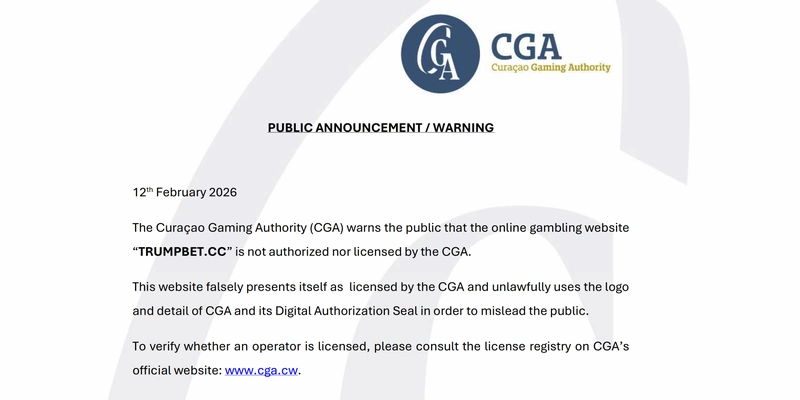
Regulators see the same pattern. In 2026, Curaçao’s regulator publicly named sites such as trumpbet.cc and EZZ.CASINO for showing its logo and seal without a license, and the MGA found fraudulent references to itself or its licensees on 42 of the 109 sites it reviewed in 2025.
This is the public warning Curaçao’s regulator issued about trumpbet.cc in February 2026:
If a license claim fails any one of the steps above, treat the site as unlicensed until the regulator’s own register says otherwise.
What Each License Gives You
The regulator’s name tells you how a license was issued and what you can check for yourself. These are the six you are most likely to see:
| Regulator | Legal Status | What You Can Check | Crypto |
|---|---|---|---|
| Curaçao (CGA) | State regulator under the gaming law in force since 24 December 2024 | Green seal linking to cert.cga.cw, plus a license registry on cga.cw | Allowed, with crypto rules issued in June 2026 |
| Anjouan | Licenses issued through private agents, with a standing the Comoros central bank disputes | Validator on anjouangaming.com | Allowed |
| Kahnawake | Mohawk regulator in Canada, with online rules since 1999 | Permit holders list on gamingcommission.ca | No published policy found |
| Tobique | First Nation regulator in New Brunswick, Canada | License holders and complaints pages on thetgc.ca | No published policy found |
| MGA (Malta) | EU state regulator under the Gaming Act 2018 | Licensee register on mga.org.mt | Only with MGA approval |
| UK Gambling Commission | State regulator under the Gambling Act 2005 | Public register on gamblingcommission.gov.uk | Not offered by licensed casinos |
Curaçao: From Sublicenses to a Real Regulator
For years, Curaçao licenses were sublicenses sold by four private master license holders, which is where numbers ending in /JAZ come from. The gaming law that took effect on 24 December 2024 replaced that system, and the Curaçao Gaming Authority (CGA) now licenses each operator directly.
By 17 December 2025, the CGA had issued 604 provisional licenses, 551 of them to operators that serve players directly, and rejected 139 applications. A Curaçao license now gives you:
- A certificate you can check. Each license has a page on cert.cga.cw showing the company, license number, approved domains and status. The CGA also keeps a license registry on cga.cw, which shows whether a license has expired or been revoked.
- A dispute service the casino pays for. Licensees must offer a dispute service certified by the CGA, free for players, and seven were certified on 31 August 2026. The CGA itself does not handle individual disputes.
- Crypto rules. Since June 2026, licensees may accept crypto only as payment for gambling, must reject funds from sanctioned wallets and mixers, and must keep player funds in separate wallets by June 2027.
The new system is still settling in. In September 2026 the CGA confirmed that someone using a false identity had access to its licensing portal from December 2025. In October 2026 it said the portal will not return and that the current digital seal will be affected, so if a seal does not open, check the registry instead.
To check a Curaçao license, click the green seal. It should open a certificate on cert.cga.cw that shows the same company as the casino’s terms and the domain you are on:
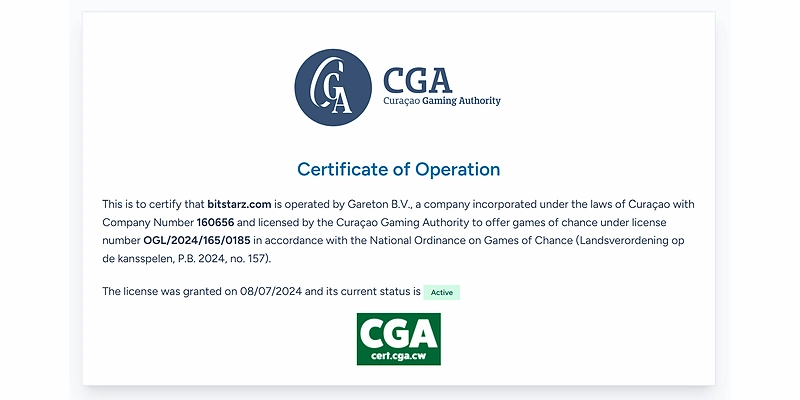
License numbers starting with OGL or CGA come from the CGA’s direct licensing, while a /JAZ number on a casino today points to the old system.
Anjouan: Flexible but Disputed
Anjouan is one of the islands of the Comoros, and its gambling licenses are sold through private agents. In July 2026, Anjouan Gaming said it had issued more than 1,650 gambling licenses, nearly 1,500 of them active, and many crypto casinos hold one because Anjouan allows crypto and sets few limits on the product.
The legal standing behind those licenses is disputed. The Comoros central bank called several Anjouan regulators “fictitious structures” in a 2023 statement, and an ABC News investigation in December 2025 reported that banking laws passed in 2013 and 2015 removed the Anjouan Offshore Finance Authority’s status as a recognized regulator.
Anjouan’s own complaint process, as updated in May 2026, works like this:
- 1Complain to the casino first, through the complaint form on its Anjouan seal, within 14 days for a game result or 30 days for an account issue.
- 2Wait for a reply. The casino must answer within 30 days.
- 3Escalate to a dispute service if it does not solve the problem: EGIS ADR, Axion ADR, iGaming ADR or CADRE B.V. The casino pays the cost.
The authority states that it does not handle, mediate or adjudicate player complaints, and players on forums such as Casino Guru and AskGamblers report complaints to it going unanswered for months. That is the tradeoff: an Anjouan casino can offer more freedom, but if a dispute goes wrong, there is little behind the license to fall back on.
To check an Anjouan license, click the casino’s seal or use the validator on anjouangaming.com, then match the license number, which starts with ALSI, and the domain:
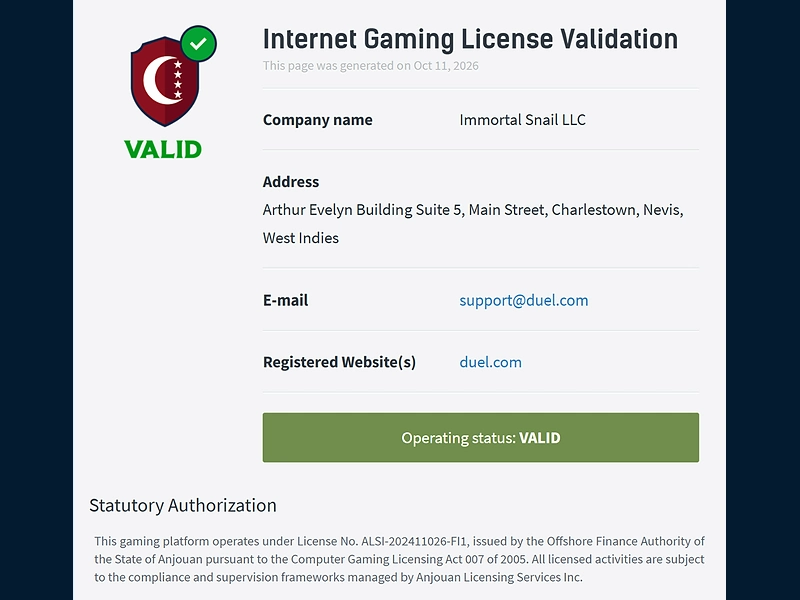
The validator confirms the license exists in Anjouan’s own records, but those records are not backed by a regulator the Comoros government recognizes.
Kahnawake and Tobique
Two First Nation regulators in Canada also license casinos that serve players abroad:
- Kahnawake Gaming Commission. Based in the Mohawk territory of Kahnawà:ke near Montreal, it has regulated online gaming since adopting its rules on 8 July 1999. Unlike Curaçao and Anjouan, it says it receives and reviews player complaints itself, and it publishes its permit holders on gamingcommission.ca.
- Tobique Gaming Commission. A newer First Nation regulator in New Brunswick, whose site invites applications from foreign online operators through a private company, DLAG Global. It lists license holders and a complaints page, but we found no statement from New Brunswick or the Canadian government recognizing its online licenses.
MGA and the UK Gambling Commission: The Strict Benchmarks
Few crypto casinos hold these licenses, but they show what strong player protection looks like:
- MGA (Malta). Licensees must use an independent dispute service and comply with its decision within 20 days, or face enforcement. In 2025 the MGA issued 30 fines totaling €162,520 and suspended or cancelled three licenses, and it allows crypto only with its prior approval under a January 2023 policy.
- UK Gambling Commission. Casinos must tell you how well your balance is protected if the company fails, using one of three ratings: not protected, medium or high. UK licensed casinos do not take crypto.
That protection comes with strict limits on what you can play and how, which the next section puts into numbers.
Freedom vs Protection: Why Players Choose Offshore Casinos
Strict regulators protect players by limiting the product itself: how much you can stake, deposit and win from a bonus. These are some of the rules in three of the strictest markets:
| Market | Rule |
|---|---|
| UK | Slot stakes capped at £5 per spin, or £2 for ages 18 to 24, since spring 2025 |
| UK | Bonus wagering capped at 10x, and no offers that mix products, since 19 January 2026 |
| UK | Financial checks once deposits minus withdrawals pass £150 in 30 days, since 28 February 2025 |
| Germany | Slot stakes capped at €1 per spin, with up to €5 for some players aged 21 and over since 1 July 2026 |
| Germany | Deposits capped at €1,000 a month by default, across all licensed sites combined |
| Netherlands | New players start with a deposit limit of €350 a month, or €150 up to age 24, since 1 October 2024 |
| Netherlands | Affordability check above €700 a month, or €300 up to age 24 |
Rules like the UK’s 10x wagering cap shrink bonuses, while stake and deposit caps limit how you play. Many players respond by leaving, and the regulators’ own figures show it:
- Netherlands. About 91% of players gamble only at licensed sites, but measured by money, licensed sites hold 53%, according to the Kansspelautoriteit's April 2026 report. The regulator says newly introduced player protection rules may be one reason that share has fallen.
- Sweden. Licensed sites held 81% of online casino play in 2025, according to Spelinspektionen.
- Germany. The GGL estimates that 77% of online gambling goes to licensed sites and 23% to unlicensed ones.
Every license sits somewhere between protection and freedom, and none sits at both ends:
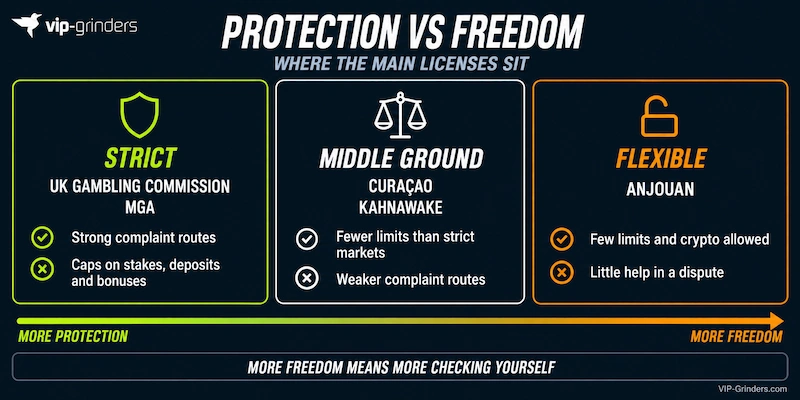
Neither end is wrong for everyone. The right license depends on how much protection you need and how much checking you are willing to do yourself.
Who an Offshore License Suits
An offshore license suits players who value freedom and are willing to check a casino themselves before they deposit. In exchange for fewer limits, you carry more of the risk if something goes wrong, so our recommendation is simple:
- 1Deposit only what you plan to play. Do not use a casino as a wallet.
- 2Withdraw when you finish. Crypto withdrawals are often near instant, so there is no reason to leave a large balance behind.
- 3Check before you deposit. Verify the license with the steps above, then make a small first withdrawal to test the cashier.
- 4Set your own limits. Strict markets impose limits to protect players at risk of harm, and offshore casinos leave that choice to you.
If you play where those rules do not apply, set your own deposit and loss limits before you start, since a limit chosen calmly works better than one chosen mid session. For casinos that have already passed a real withdrawal test, see the crypto casinos we have tested.
What to Do if a Casino Won’t Pay You
Before you complain, check whether the casino has refused your withdrawal or only paused it for an ID check. A paused payout clears once you pass, and our guide explains what to do if your withdrawal is held for KYC.
Every license sends you to the casino first. What happens next depends on the regulator, and each one plays a very different role:
| License | First Step | If It Is Not Solved | Does the Regulator Review Your Case? |
|---|---|---|---|
| Curaçao | The casino’s own complaint process | A CGA certified dispute service named in the terms, free for you | No |
| Anjouan | The complaint form on the casino’s seal, with a reply due within 30 days | EGIS ADR, Axion ADR, iGaming ADR or CADRE B.V., paid for by the casino | No |
| MGA | The casino’s own complaint process | The casino’s dispute service, whose decision the casino must follow within 20 days | Partly: its Player Support Unit takes complaints, and it can act against a casino that ignores a decision |
| Kahnawake | The casino’s own complaint process | The Kahnawake Gaming Commission | Yes |
The seven dispute services certified by the CGA on 31 August 2026 were Resolvo Curaçao, ADR Curaçao, Cadre, EGIS, ABC-ADR, iGamingADR and IBAS. Whichever you use, follow these steps in order:
- 1Collect evidence. Save screenshots of your balance, the withdrawal request, chat transcripts and the terms as they stood when you played.
- 2Complain to the casino in writing. Use its official complaint form or email rather than live chat alone, and keep the ticket number.
- 3Wait for the deadline. Anjouan gives casinos 30 days to reply, and other licenses set their own timelines in the terms.
- 4Escalate to the dispute service named in the terms, which is free for you at Curaçao and Anjouan casinos.
- 5Report the casino to its regulator if it ignores the outcome. Most regulators will not rule on your case, but they can act against the license.
Complaint sites such as Casino Guru and AskGamblers also mediate disputes, but they have no legal power over a casino. VIP-Grinders does not handle casino complaints, so use the routes above.
The best protection is not needing any of this. Withdraw as you go, and a dispute can only ever cover the balance you left behind.
Licensed Does Not Mean Legal Where You Live
A license gives the casino permission to operate under one regulator’s rules. It does not give you permission to play from your country, which depends on your own local law.
Offshore licenses and casino terms also list excluded countries, and playing from one breaks the terms, which can void your winnings. As for the law itself, many countries target only the operator, but some also penalize players:
| Country | Who the Law Targets | What It Means for You |
|---|---|---|
| UK | The operator: offering gambling to British players without a UK license is an offense under the Gambling Act 2005 | You lose UK protections, but the offense is the operator’s |
| US | Mostly the operator: federal law targets gambling businesses, and only a handful of states, such as New Jersey, Pennsylvania and Michigan, license online casinos | Some states also cover players, such as Washington, where sending or receiving gambling information online is a class C felony |
| Canada | The provinces run or license gambling, and Ontario has its own regulated market | Outside Ontario, offshore casinos operate in a legal gray area, and we found no reported prosecutions of players |
| Australia | The provider: the Interactive Gambling Act 2001 targets operators | Players are not penalized, but the regulator, ACMA, blocks illegal offshore sites |
| Germany | Players too: taking part in unlicensed gambling is a criminal offense | Players can face a fine or up to six months in prison, so only GGL licensed sites are legal to use |
| Belgium | Players too: the Gaming Act of 1999 prohibits taking part in unlicensed games | Players can be fined |
This is a summary, not legal advice. Laws change, so check the rules in your own country before you play.
Frequently Asked Questions
Is a Curaçao license safe?
It is a real state license, but it protects you less than an MGA or UK license. Since the 2024 reform, Curaçao licensees must offer a certified dispute service that is free for players, although the regulator does not handle individual disputes itself. Before you deposit, check that the seal opens a certificate on cert.cga.cw, or find the license number in the CGA’s license registry.
Is an Anjouan license legit?
It is valid within Anjouan’s own licensing system, but its legal standing is disputed, and the Comoros central bank called several Anjouan regulators fictitious structures in 2023. Anjouan requires licensees to use a dispute service, but its authority does not handle player complaints itself. Treat it as a license that offers freedom with little protection, and withdraw your winnings as you go.
Which casino license is best for players?
For protection, the UK Gambling Commission and the MGA, which require dispute services and enforce their decisions. For crypto, bigger bonuses and fewer limits, Curaçao and Anjouan casinos offer more freedom but less protection if something goes wrong.
How do I check if an online casino is licensed?
Find the license number and company in the footer, then click the seal and make sure it opens a certificate or register entry on the regulator’s own website. The company and domain on that page should match the casino’s terms and the site you are on, and the status should show as active.
Is the orange Curaçao seal still valid?
No. Curaçao’s regulator made the orange seal invalid from 15 October 2025 and replaced it with a green seal linking to cert.cga.cw. In October 2026 it said it will replace that seal system too, so if a seal does not open, check the license registry on cga.cw.
Can a licensed casino refuse to pay me?
A casino can withhold winnings if you broke its terms, such as its bonus rules or playing from an excluded country. If you think the refusal is wrong, complain to the casino in writing, then take it to the dispute service named in its terms.
What if a crypto casino has no license?
Then no regulator checks its games or rules, and no dispute service has to take your complaint. We recommend not depositing at an unlicensed casino, however good the bonus looks.
Is it illegal to play at an offshore casino?
In many countries the law targets the operator, not the player, as in the UK, Australia and under US federal law. Players themselves can be penalized in some places, such as Germany, Belgium and Washington state, so check your local law, since this is not legal advice.