

Where Are Prediction Markets Banned? Polymarket and Kalshi Restrictions by Country
Two things decide whether you can use a prediction market: whether a regulator where you live has acted, and whether the platform has shut your country out by itself. Most lists on this subject treat those as the same thing. They are not.
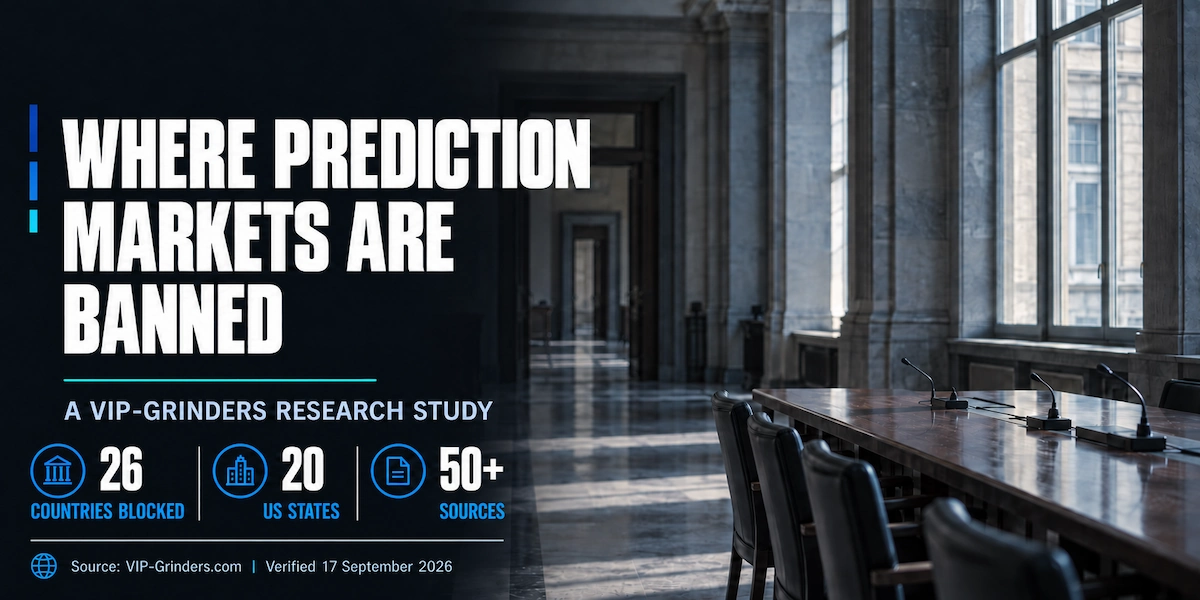
The difference shows up the moment you open the site. In France or Denmark nothing loads. In Germany it loads but you cannot open a new position, only close what you already hold. In Malta everything works except the sports tab.
It also decides which countries belong here at all. Japan, Kenya, South Africa and Zimbabwe turn up on most lists as bans. No regulator in any of them has done anything. Those are commercial decisions the platforms made themselves.
Then there is the United States, which is its own mess. Both platforms hold a federal licence. Two appeal courts have ruled on whether that licence beats state gambling law and reached opposite answers, two more are sitting on it, and one state gave up and legalised it.
Every entry below carries the date of the decision and a link to the regulator, court or register behind it. Where there is no document, the entry says so.
26 countries and 20 US states with a published decision | 6 more reported without one | North Carolina has legalised instead | Last verified: 17 September 2026 | Reviewed quarterly
Which Countries Have Banned Polymarket and Kalshi?
If you are asking whether Polymarket is legal where you live, this is the table to check first. Dates are the date of the decision, not the day access stopped. Those are often a week apart, and in France the app kept working after the website went dark.
The last column names which platform each action actually covered. That is where most coverage falls apart, and the reason why is further down.
| Country | Authority | Action | Date | Platforms named | Source |
|---|---|---|---|---|---|
| Switzerland | Gespa, ESBK | Blocklist, Federal Gazette | 26 Nov 2024 | Polymarket only | Blocklist |
| Singapore | GRA | ISP block, penalties for users too | Dec 2024 | Polymarket. Kalshi unclear | Regulator statement |
| Poland | Ministry of Finance | Prohibited domains register | 8 Jan 2025 | Polymarket only | Official register |
| Belgium | Gaming Commission | Blacklist, first in the EU | 30 Jan 2025 | Polymarket only | Official blacklist |
| Canada (Ontario) | OSC, Capital Markets Tribunal | Settlement, two year ban to Apr 2027 | 17 Apr 2025 | Polymarket. Kalshi licensed separately | Settlement |
| Australia | ACMA | IGA breach finding, ISP block | 13 Aug 2025 | Polymarket only | Regulator finding |
| Germany | GGL | Warning only, no order. Polymarket went close-only | 5 Sep 2025 | Polymarket warned. Kalshi self-restricts | Regulator warning |
| Colombia | Coljuegos | ISP block, investigation opened | 1 Oct 2025 | Polymarket only | Regulator order |
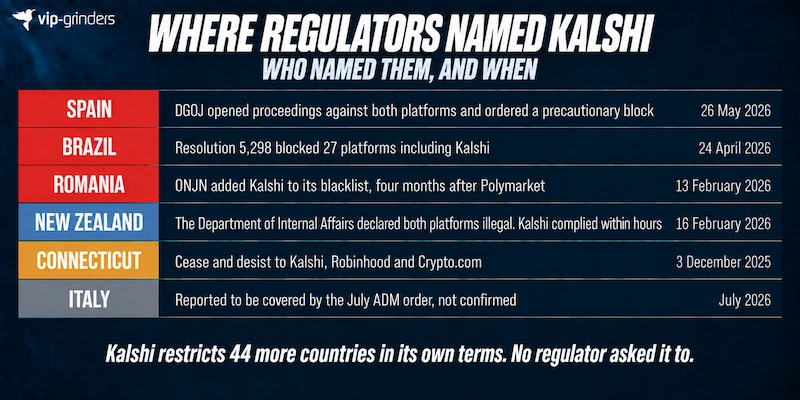
| Italy | ADM | Blocked, then revoked, then blocked again | 22 Oct 2025 | Polymarket. Kalshi reported Jul 2026 | Inhibited sites list |
| Romania | ONJN | Blacklist, court upheld it in April | 29 Oct 2025 | Both. Kalshi added 13 Feb 2026 | Regulator releases |
| Ukraine | NKEK, on PlayCity advice | Resolution 695, blocked register | 10 Dec 2025 | Polymarket only | PlayCity |
| Portugal | SRIJ | 48 hour notice, ISPs blocked 20 to 21 Jan | Jan 2026 | Polymarket only | SRIJ enforcement |
| Hungary | SZTFH | Temporary block, ref 321/5/2026 | 19 Jan 2026 | Polymarket only. Kalshi still worked | Blocked sites register |
| Netherlands | KSA | Order under penalty, deadline 17 Feb | 20 Jan 2026 | Polymarket only | Order |
| New Zealand | Department of Internal Affairs | Declared illegal gambling. Kalshi complied, Polymarket did not | 16 Feb 2026 | Both | Letter, not published |
| Argentina | Buenos Aires court, ENACOM | Nationwide block, app stores told to pull it | 16 Mar 2026 | Polymarket only | Court order |
| Brazil | CMN, Anatel | Resolution 5,298, 27 platforms blocked | 24 Apr 2026 | Both | Resolution 5,298 |
| India | MeitY, under PROGA | Whole category banned by statute | 1 May 2026 | Category ban. No order named Kalshi | Government release |
| Spain | DGOJ | Proceedings opened, precautionary block | 26 May 2026 | Both | Proceedings |
| Slovakia | Úrad pre reguláciu hazardných hier | Prohibited offers register | 22 Jun 2026 | Polymarket only | Official register |
| Denmark | Frederiksberg Court, Spillemyndigheden | Court order against an ISP, 98 sites, under appeal | 8 Jul 2026 | Polymarket only | Regulator release |
| Czech Republic | Ministry of Finance | Unauthorised internet games list | 13 Jul 2026 | Polymarket only | Official list |
| France | ANJ | ISP block, website only | 16 Jul 2026 | Polymarket. Kalshi geoblocked itself | Order |
| Turkey | National Lottery Administration | Access block, decision 2026/10 | 16 Jul 2026 | Polymarket. Kalshi unclear | Decision, not published |
| Ireland | GRAI | High Court action threatened, both withdrew before any order | 21 Jul 2026 | Both withdrew | GRAI news |
| United Kingdom | FCA, Gambling Commission | Retail binary options ban from 2019, never aimed at these platforms | Apr 2019 | Both restricted | PS19/11 |
Four groups sit outside that table. The evidence behind them is either weaker or a different sort of thing entirely.
- Reported, nothing published: Bulgaria, Greece, Cyprus, Taiwan, Thailand and Indonesia. Each turns up in another regulator's summary or in press reporting, and none has a national decision we can point at.
- Our own testing: Malta, where no regulator has published anything and only the sports section returns a block page.
- Legalised instead: North Carolina taxed the product rather than banning it, and Canada lets licensed dealers offer a narrow slice through Wealthsimple.
- Platform's own choice: British Columbia, Alberta and Quebec are close-only on Polymarket with no provincial decision behind them, which is why they are not counted above.
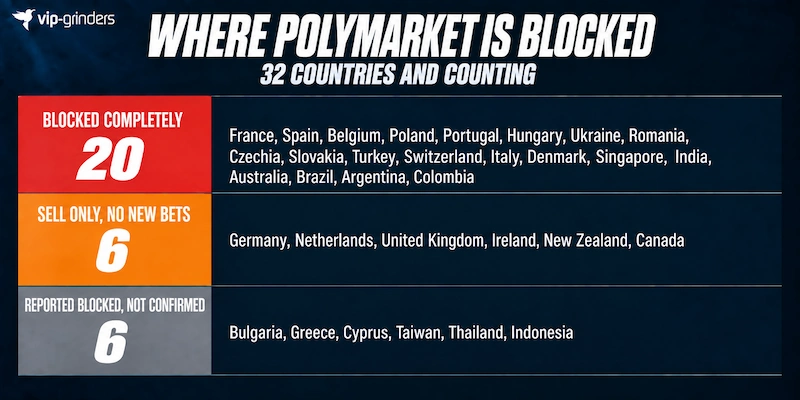
The United States needs its own section further down. Twenty states have moved against the platforms, with cease and desist letters, state court suits and in Arizona a criminal prosecution. Two federal appeal courts have ruled in opposite directions, and the Supreme Court has been asked to settle it.
Kalshi is a US company with a federal licence, which is why the American fight looks nothing like the European one. In Europe the question is whether this counts as gambling. In the United States it is whether a federal licence stops a state from calling it that.
Why Is Polymarket Blocked in My Country?
Almost every decision in that table rests on the same finding: putting money on an uncertain outcome is gambling, whatever the platform calls it. What changes from country to country is which arm of the state reached that conclusion and what it had available to enforce it.
Six routes have been used so far. Which one applies to you decides what you actually see when you open the site, and what happens to money you already have in there.
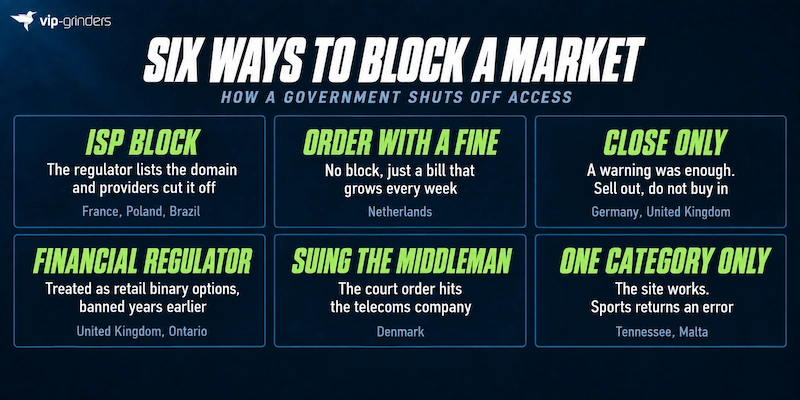
- ISP block: the regulator puts the domain on a register, blacklist or prohibited list, and domestic internet providers are then obliged to cut it off. The site simply fails to load. France, Spain, Belgium, Poland, Portugal, Hungary, Ukraine, Romania, Czechia, Slovakia, Turkey, Switzerland, Italy, Denmark, Singapore, India, Australia, Brazil, Argentina and Colombia.
- Order with a fine attached: no block, just a bill that grows every week until the platform pulls out by itself. The Dutch regulator set it at EUR 420,000 a week.
- Close-only: nobody ordered anything. A warning or an old law was enough that the platform decided to let residents sell out of what they hold but not buy anything new. Germany and the UK.
- The financial regulator route: the contracts get treated as short-term binary options, which several securities regulators banned for retail investors years before any of these platforms existed. That is what keeps them out of the UK and Ontario.
- Suing the middleman: Denmark did not go after Polymarket at all. It took a telecoms company to court, won, and an industry code of conduct then bound every other Danish provider to the same outcome.
- One category only: the site works, your account works, most markets trade, and one tab returns an error. It is almost always sports. Tennessee and Connecticut ordered it, though Tennessee's order is currently suspended by a court. Malta has it with no order at all.
The first three belong to gambling regulators and the fourth to financial ones, which is why a country can end up restricting one platform and not the other. The two operate under different laws and answer to different agencies.
The Mistake Almost Every List Makes
There is one more thing that looks identical from your sofa and is not on that list, because it is not a ban at all. Kalshi and Polymarket both publish lists of countries they refuse to serve, and those lists are longer than the list of countries that have actually done anything.
Japan is the clearest case. Polymarket blocks the Japanese front end. No Japanese regulator has issued a statement, opened a case or published a decision, and the platform is openly lobbying for approval there. It appears as a ban on most published lists anyway.
Kenya, South Africa and Zimbabwe are the same story. Kenya’s new gambling regulator is still writing its rules. South Africa’s bookmakers association has asked for prediction markets to be regulated, which is a trade body asking, not a regulator acting.
The practical version: if the site loads and your account opens, no regulator has blocked you. If the site loads and your account will not open, the platform has excluded you. If nothing loads at all, that is your government.
Sorting the two apart is most of what this page does. After the US section below, there is a full comparison of what Kalshi excludes against what regulators have actually banned, and the two lists do not line up the way anyone assumes.
Why the Fee Structure Keeps Coming Up
Regulators keep landing on the same argument, and it explains why “but we are an exchange” has failed nearly everywhere it has been tried.
A sportsbook builds its margin into the odds. A prediction market charges an explicit fee on top of a price that adds up to roughly 100 cents, which is the same thing a poker room does when it takes rake instead of a house edge. The platforms argue this makes them infrastructure rather than a bookmaker.
Regulators have consistently answered that it changes the business model without changing the bet. The Dutch regulator went furthest, saying this form of betting would not be licensable even for a Dutch operator that applied properly.
The same question arrived from the opposite direction when Roobet became the first crypto casino to list event contracts. A casino adding event contracts and an exchange adding sports contracts look identical to a gambling regulator, which is rather the point.
None of that argument has worked in Europe. In the United States it has worked in some courts and failed in others, and for a reason that has nothing to do with gambling law.
Is Kalshi Legal in My State?
Federally, yes. Both platforms hold a CFTC licence, and the federal government has actively defended them. It has sued nine states to stop them enforcing gambling law against the exchanges: Arizona, Connecticut, Illinois, Minnesota, New Mexico, New York, Rhode Island, Wisconsin and Kentucky.
At state level it depends entirely on where you are, and the answer has been changing every few weeks. Twenty states have moved against the platforms, with mixed results. One has legalised them outright.
The Circuit Split
Two federal appeal courts have now ruled on the same question and reached opposite answers. That is what puts this in front of the Supreme Court.
On 6 April 2026 the Third Circuit ruled 2-1 that New Jersey cannot enforce its gambling laws against Kalshi’s sports contracts, holding they are swaps under exclusive CFTC jurisdiction. On 28 August the Ninth Circuit ruled 3-0 the other way in the Nevada case, finding the contracts unlikely to qualify as swaps at all.
Nevada has since started enforcing. Kalshi asked the Ninth Circuit to rehear the case with a full panel on 9 September, which is still pending.
| Court | Case | Status | Date |
|---|---|---|---|
| Third Circuit | New Jersey | Ruled for Kalshi, 2-1 | 6 Apr 2026 |
| Fourth Circuit | Maryland | Argued, 38 states filed for Maryland | 7 May 2026 |
| Sixth Circuit | Ohio and Tennessee, consolidated | Argued, no ruling | 30 Jul 2026 |
| Ninth Circuit | Nevada | Ruled for Nevada, 3-0 | 28 Aug 2026 |
| Tenth Circuit | Utah | Refused Kalshi an emergency injunction | 8 Sep 2026 |
| Supreme Court | No. 26-299 | Docketed, response due 8 Oct | 8 Sep 2026 |
The Sixth Circuit case is the odd one. It consolidated Ohio and Tennessee because the district courts in those two states reached opposite conclusions three weeks apart, inside the same circuit.
State by State
Sorted by how far the state has got, not alphabetically. A cease and desist letter and a criminal prosecution are not the same thing.
| State | What the state did | Date | Where it stands |
|---|---|---|---|
| Arizona | 20 criminal charges, first anywhere | 17 Mar 2026 | Halted by federal injunction, 5 May |
| Nevada | Injunctions, then Ninth Circuit win | 28 Aug 2026 | Enforcing |
| Utah | Kalshi sued pre-emptively and lost | 8 Sep 2026 | State free to enforce |
| New York | AG and Governor sued, seeking $36bn+ | 31 Jul 2026 | Removal to federal court contested |
| Kentucky | Three AG lawsuits, plus a 14.25% tax | 17 Jun 2026 | CFTC sued the state back |
| New Mexico | AG suit, plus a felony statute | 4 Jun 2026 | CFTC and Polymarket both sued the state |
| Rhode Island | AG suit | 21 May 2026 | Kalshi countersued the same day |
| Wisconsin | State suits against three platforms | 23 Apr 2026 | Ho-Chunk Nation case also live |
| Minnesota | First outright statutory ban | May 2026 | Paused by a federal judge, 27 Jul |
| Massachusetts | Superior Court injunction | Jan 2026 | Under appeal |
| Michigan | Coinbase sued the state and lost | 6 Aug 2026 | AG remains a defendant |
| Ohio | Cease and desist, $5m fine upheld | Apr 2025 | Sixth Circuit, awaiting ruling |
| Maryland | Cease and desist, Kalshi lost below | 7 Apr 2025 | Fourth Circuit, awaiting ruling |
| Tennessee | Cease and desist on sports contracts | 9 Jan 2026 | Kalshi won an injunction, contracts live |
| Connecticut | Cease and desist, then a lawsuit | 3 Dec 2025 | Kalshi lost its own injunction bid |
| Montana | Two cease and desist letters | 6 Apr 2026 | Kalshi sued in federal court |
| Iowa | Threatened enforcement | 11 Mar 2026 | Kalshi sued pre-emptively and lost |
| New Jersey | Cannot enforce, pending Supreme Court | 6 Apr 2026 | Petitioned for cert |
Tennessee is the one to watch for anyone reading an older list. Every roundup still says sports contracts were pulled there in January. They were ordered pulled, Kalshi sued the same day, and a federal judge granted an injunction on 19 February. The contracts have been available ever since.
Washington and Illinois belong on that list without enough detail to give them rows. Washington has a court order restricting Kalshi. Illinois is one of the nine states the CFTC has sued over its enforcement. Neither has produced a published decision we can date precisely, so both are counted in the total and left out of the table.
North Carolina Went the Other Way
On 7 July 2026 North Carolina became the first state to legalise prediction markets rather than fight them. The law recognises the CFTC’s exclusive federal authority and applies a 6% tax on net trading fee revenue from state residents, with no licence required.
The same bill raised the state’s sports betting tax from 18% to 23%, which tells you how the trade was framed internally.
The Tribes Have a Separate Case
Three California tribes sued Kalshi and Robinhood in July 2025 under the Indian Gaming Regulatory Act, arguing that sports event contracts undercut exclusive gaming rights they negotiated with the state.
A federal judge denied their injunction, holding that the Act does not reach third-party platforms. The Ninth Circuit heard the appeal on 10 July 2026 and has not ruled. In Wisconsin the Ho-Chunk Nation brought a similar claim and survived a motion to dismiss on 11 May, which is the first ruling anywhere to favour a tribe on this question.
Volume and fee figures for both platforms are tracked separately in our monthly prediction markets report.
Why Can I Open Polymarket but Not the Sports Section?
This is the restriction almost nobody writes about, because it does not show up in any regulator statement. The site loads. Your account works. Most markets trade normally. You click sports and get an error page.
It happens for two completely different reasons, and you cannot tell which from the outside.
What We Found in Malta
We tested this from Malta on 17 September 2026. Polymarket loaded, markets displayed, the account functioned, and opening the sports section returned a block page.
No Maltese regulator has published a decision on prediction markets. Malta is the one EU jurisdiction actively working toward a licensing framework for them, and its economy minister said in March that the government was exploring the sector.
So the block is coming from the platform, not the state. Polymarket’s own geoblock documentation confirms it, listing Malta as sports only while everything else stays open.
The logic is easy enough to follow. Malta licenses and taxes sports betting heavily and has no prediction market rules at all. Closing the sports tab removes the obvious legal exposure and leaves the rest of the product running.
In the US It Comes With Paperwork
Tennessee and Connecticut ordered exactly the same outcome, in writing. Tennessee’s Sports Wagering Council sent cease and desist letters on 9 January 2026 to Kalshi, Polymarket and Crypto.com’s Nadex, demanding they pull sports contracts, void open positions and refund deposits by the end of the month.
The letters carried penalties of up to $25,000 per offence and the threat of criminal referral. Kalshi sued the same day and won an injunction, so the contracts are still there.
Canada reached the same place voluntarily. Kalshi launched through Wealthsimple under rules that permit economic, environmental and financial contracts and exclude sports and elections entirely.
| Where | Who decided | What closes | Date |
|---|---|---|---|
| Tennessee | Sports Wagering Council | Sports contracts, refunds ordered | 9 Jan 2026 |
| Connecticut | Gaming Division | Sports contracts | 3 Dec 2025 |
| Canada | Kalshi, under CIRO rules | Sports and elections | 18 Jun 2026 |
| Malta | Polymarket, no order published | Sports only | Observed 17 Sep 2026 |
Why It Is Always Sports
Every jurisdiction on this page already licenses, regulates and taxes sports betting. The regulator exists, the rules exist, the tax base exists, and there is a domestic industry paying for all three.
Prediction markets arrive offering the same bet with none of those obligations. That makes sports the first thing a regulator reaches for and the last thing a platform is willing to defend.
The other categories tell the same story from the other side.
- Sports: closed first, everywhere. A licensed industry, a regulator and a tax base are already in place and all three object.
- Elections: banned outright in much of Europe on public order grounds, still being fought over in the US courts.
- Economic and financial: usually allowed, because they fit existing derivatives rules. Brazil banned everything else and kept these. Canada did the same.
- Weather: allowed, and now under scrutiny after a Paris prosecutor opened an enquiry in May 2026 into whether sensors behind some contracts had been tampered with.
If you are reading a price quoted from a prediction market, it is worth knowing it may be unreachable from where you are sitting, and the restriction may apply to one tab rather than the whole site.
Is Kalshi Available in My Country?
Everything above records what a state did. Both platforms also publish their own lists of countries they refuse to serve, and those lists are longer than the list of countries that have banned anything.
For a reader checking one country, both have to say yes. The regulator has to have left the platform alone, and the platform’s terms have to allow you in.
Kalshi’s List Contradicts Itself
This is worth setting out carefully, because Kalshi’s own published documents do not agree with each other.
Kalshi’s country availability page currently says the platform is available in 143 countries and restricted in 52. That list includes Hungary, New Zealand, Switzerland and the United Arab Emirates.
Kalshi’s Member Agreement is the document that actually governs your account. Its last fully published restricted list, in an Exchange Notice dated 4 November 2025, named 48 jurisdictions. An amendment dated 17 June 2026 added India.
India does not appear on the availability page. Neither does Ireland nor Portugal, both of which the European Securities and Markets Authority attributed to Kalshi’s restricted list in a report published on 10 September 2026.
We are not guessing at which is right. Both are quoted above with their dates, and the gap between them is itself the finding. ESMA made the same observation from the regulator side, asking why the platforms restrict some EU member states and not others.
The List Follows the Regulators
The more useful pattern is what the additions have in common. Kalshi has been adding countries roughly as regulators act in them.
Hungary blocked Polymarket in January 2026. Portugal blocked in January. New Zealand declared both platforms illegal in February. Ireland’s regulator threatened High Court action in July. All four have since appeared on Kalshi’s restricted list or been attributed to it.
That makes the list a trailing indicator of enforcement rather than an independent commercial judgement. It is worth watching for that reason. A country appearing there without a public decision may mean one is coming.
Where the Two Lists Disagree
Sorting the state decisions against the platform decisions produces four groups, and the middle two are where almost all the confusion comes from.
- Blocked by both: France, Belgium, Poland, Singapore, Taiwan, Thailand, Australia, Canada, Ukraine, the UK and New Zealand. Hungary belongs here in effect, though its regulator only named Polymarket and Kalshi added the country itself afterwards. Italy probably belongs here too, but the July 2026 order naming Kalshi is reported rather than confirmed from the list itself. A regulator acted and Kalshi also excludes the country in its own terms.
- Blocked by the state, allowed by Kalshi: Spain, Brazil, Turkey, Romania, Czechia, Slovakia, Denmark, Argentina and Colombia. In Denmark the block came through a court order against an internet provider rather than against either platform. The terms do not list these countries, but a regulator has acted and in several cases named Kalshi directly.
- Blocked by Kalshi, allowed by the state: Monaco, Kenya, Bolivia, Namibia, Algeria, Angola, Cameroon, Laos, Mozambique, Côte d'Ivoire and mainland China. No prediction market decision on record in any of them. Bulgaria sits here too, with a court decision reported but not published.
- Neither, but restricted anyway: Germany and the Netherlands, where Polymarket went close-only or geoblocked after regulator pressure and Kalshi's terms stay silent.
Roughly 25 of the 48 named in the November agreement are US sanctions territory, which Kalshi has to enforce as a US regulated exchange regardless of local gambling law. Cuba, Iran, North Korea, Russia, Syria, Venezuela, Belarus, Myanmar and others.
That leaves about a dozen where nobody has objected to anything and Kalshi excludes the country anyway.
Polymarket Publishes Three Tiers
Polymarket’s documentation is clearer, and it separates restrictions in a way the tables above cannot.
- Fully blocked: front end and API, and positions cannot be closed. Iran, Syria, Cuba, North Korea and the occupied regions of Ukraine. These are sanctions, not gambling decisions.
- Close-only, front end and API: you can sell out but not buy in. Australia, Belgium, Brazil, France, Germany, Italy, Poland, Singapore, Slovakia, Taiwan, Thailand, the UK, the US, New Zealand and the Canadian provinces of Ontario, British Columbia, Alberta and Quebec.
- Close-only, front end only: the website restricts you and the API does not. Ireland, Japan, the Netherlands, and Malta for sports alone.
The countries missing from that list are the interesting part. Czechia, Hungary, Spain, Turkey, India, Argentina and Ukraine outside the occupied regions do not appear anywhere in Polymarket’s geoblock at all.
Every one of them has ordered a block. So the restriction in those countries is coming entirely from the state, at the internet provider level, with the platform making no change to its own product.
That is the cleanest evidence on this page for the distinction the whole thing rests on. Where a country appears on the platform’s list, the platform pulled out. Where it does not and the site still fails to load, your government did it.
Both Lists Change Without Notice
Kalshi reserves the right to amend its restricted jurisdictions at any time and has done so more than once since October 2025. Polymarket updates its geoblock documentation the same way.
A country’s absence today is not a permanent position, which is why this page is reviewed quarterly and carries the date it was last checked.
Is Polymarket Banned in the UK?
Not by name, and no British regulator has ever issued a decision about prediction markets specifically. What keeps both platforms out is a rule written in 2019 for an entirely different product.
The Financial Conduct Authority banned the sale of binary options to retail consumers in April 2019, under policy statement PS19/11. Prediction markets as they exist now did not exist then.
The 2019 Ban and Why It Still Applies
The FCA published a Perimeter Report in March 2026 confirming that every financial prediction market product it had examined was, in its assessment, a binary option. All of them therefore remain caught by the 2019 rule.
Announcing the original ban, Christopher Woolard, then the FCA’s executive director of strategy and competition, described binary options as gambling products dressed up as financial instruments.
The Times reported on 4 September 2026 that the FCA has since held talks with platforms about easing the restriction. No consultation has been published, and the Perimeter Report still calls the ban appropriate.
Two Regulators, Two Halves of the Product
The complication is that the FCA only covers part of what these platforms sell. Contracts on financial and certain weather outcomes sit inside its perimeter. Sport, politics and entertainment are gambling, which makes them the Gambling Commission’s problem.
| Contract type | Regulator | Status | What would have to change |
|---|---|---|---|
| Financial, some weather | FCA | Retail ban since April 2019 | An FCA rule change, after consultation |
| Sport, politics, entertainment | Gambling Commission | Licence required, neither holds one | The operator applies for a UK licence |
| Polymarket, UK users | Platform | Close-only | Either of the above |
| Kalshi, UK users | Platform | Restricted in the user agreement | Either of the above |
The Gambling Commission has been consistent that a platform cannot escape gambling rules by renaming its product. That position has since been quoted approvingly by regulators elsewhere in Europe.
Lifting the Ban Would Not Change Much
This is the part the coverage of those FCA talks tends to miss. The financial contracts the FCA controls are a small fraction of what actually trades.
Sport and elections carry most of the volume, and those sit with the Gambling Commission. An FCA rule change would open the smallest slice of the market and leave the rest exactly where it is.
A Gambling Commission licence application would also cut straight across both platforms’ central argument in US courts, which is that they run exchanges rather than sportsbooks. Applying for a UK betting licence would be a difficult thing to explain to a federal judge.
The direction of travel is not one way either. The UK crackdown on unlicensed gambling operators shows how hard the government polices offshore operators, and prediction markets are squarely in that category as things stand.
Which European Countries Have Blocked Polymarket?
Europe holds the largest cluster of enforcement anywhere and the widest spread of methods. Eighteen countries have acted, using registers, blacklists, penalties, court orders and one financial regulator rule written in 2019 for something else.
The country sections below are ordered roughly by how far each went, with the pattern underneath them set out once the registers are covered.
France
France ran the longest campaign of any European regulator. The ANJ opened its file in November 2024 and issued a formal notice, after which Polymarket geoblocked French transactions itself, a measure the regulator later said was widely circumvented.
In February 2026 the ANJ stated publicly that prediction markets are illegal gambling in France. On 16 July its president ordered French internet providers to block the site.
The grounds matter here. The ANJ held that the homepage itself, displaying live odds, was advertising an unauthorised gambling offer. That is a criminal offence in France carrying a fine of up to 100,000 euros, and it applies to publishing the odds as much as to taking the bet.
The regulator cited Similarweb figures of 578,751 French visits in June alone.
- November 2024: the ANJ opens its file and issues a formal notice. Polymarket geoblocks French transactions itself.
- February 2026: the ANJ says publicly that prediction markets are illegal gambling in France.
- 4 May 2026: the Paris prosecutor's cybercrime section opens an enquiry into weather markets where sensors may have been tampered with.
- 16 July 2026: the ANJ president orders providers to cut access to the website.
- 17 July 2026: French press confirms the website is unreachable while the Polymarket app still works.
- August 2026: Polymarket files suit against the ANJ.
That app gap matters well beyond France. An order at internet provider level is a DNS and URL measure, so it reaches the browser and not necessarily the native app.
It is why “blocked” in the tables on this page means ordered blocked, rather than technically unreachable.
Spain
Spain moved against both platforms at once, which most countries did not. On 26 May 2026 the DGOJ opened proceedings against Polymarket and Kalshi and ordered both websites blocked as a precautionary measure while it investigates.
Notifications to the operators’ foreign addresses had failed, so the proceedings were served through the state gazette. The regulator estimated three to four months to a decision, which puts it around now.
No final ruling has been published as of 17 September 2026.
Denmark
Denmark is the most interesting case in Europe, because the regulator changed its own position in public.
In February 2026 Spillemyndigheden said it had no grounds to act. Its director, Anders Dorph, explained that a site merely being reachable from Denmark did not prove it was targeting Danish users, and that the authority would move if targeting could be shown.
By July it had persuaded a court that the threshold was met. On 8 July the Frederiksberg Court ruled that Polymarket was offering gambling to Danish users without authorisation, and the platform went onto a list of 98 blocked sites.
The mechanism is the unusual part. The case was brought against a telecoms company rather than against Polymarket, and an industry code of conduct then bound every other Danish provider to the same outcome. Polymarket has appealed.
Portugal
Portugal acted within days of its presidential first round. The SRIJ gave Polymarket 48 hours to stop, and when it did not, ordered providers to block.
MEO blocked from 20 January 2026 and Vodafone and NOS confirmed the same by 21 January. Note the dates, because most coverage of this gets them wrong.
Portugal’s grounds were broader than anywhere else. Portuguese law prohibits betting on political events outright, domestic or foreign, so no licence would have helped and no negotiation was available.
The SRIJ also told Rádio Renascença something worth reading twice. It regulates and inspects licensed operators only, and its power over an unlicensed one extends to telling it to stop. It could give no assurance that Portuguese users would get back what they had staked.
Hungary
The SZTFH ordered a temporary block on 19 January 2026, covering polymarket.com and all its subdomains from Hungarian IP addresses, while it investigates Adventure One QSS Inc. for organising prohibited gambling. The reference is 321/5/2026.
The block is expressly temporary, running only until a final decision, and the authority acknowledged openly that it does not stop VPN access. No final decision has been published.
The timing was not neutral. Polymarket was running a market on Hungary’s April parliamentary election, with Péter Magyar favoured over Viktor Orbán at around 54% to 45%, and one user reportedly holding more than 225,000 dollars in a single position.
Kalshi was never named and remained reachable from Hungary. It has since appeared on Kalshi’s own restricted list instead.
Ukraine
Ukraine is the only case in Europe driven by conflict rather than an election.
Resolution No. 695, issued by the electronic communications regulator NKEK on 10 December 2025 on the state gambling agency’s advice, added polymarket.com to the national register of blocked sites alongside roughly 200 other gambling domains. Providers enforced from mid-January.
Local reporting put more than 270 million dollars of war-linked positions on the platform, including markets on which cities would fall. A senior official later said there is no legal route back for the product during wartime, because changing the gambling definitions would require parliament.
Romania
The ONJN blacklisted Polymarket at its meeting on 29 October 2025, after what it called an explosive rise in activity during the May 2025 elections. It put presidential market volume above 600 million dollars.
Polymarket challenged the listing. On 1 April 2026 a Romanian court refused to suspend the decision while the case continues, and the regulator’s president welcomed the ruling publicly.
Romania then did something no other European regulator has done. On 13 February 2026 it added Kalshi to the same blacklist, by decision number 76. That makes Romania one of the few places where both platforms were named by the state rather than one being named and the other withdrawing.
Slovakia, Czechia, Poland and Belgium
These four used the same instrument, a national register that obliges providers to block anything listed on it.
- Poland, 8 January 2025: the Ministry of Finance adds polymarket.com to its register of prohibited gambling domains, which triggers provider and payment blocking. Kalshi is not in the register.
- Belgium, 30 January 2025: the Gaming Commission blacklists the platform after a November 2024 formal notice and further warnings went unanswered. This was the first blacklisting anywhere in the EU.
- Slovakia, 22 June 2026: the gambling regulator adds polymarket.com to its prohibited offers register, which close to a thousand sites already sit on.
- Czechia, 13 July 2026: the Ministry of Finance adds it to the list of unauthorised internet games, arguing that the same rules apply to everyone offering betting for money.
Kalshi appears in none of those four registers. In each case it had already excluded the country in its own terms, so there was nothing for the regulator to list.
That is the pattern the Kalshi section above describes, and Europe is where it shows up most clearly.
Turkey and Italy
Turkey’s National Lottery Administration blocked access under a decision dated 16 July 2026, numbered 2026/10, citing illegal betting.
Italy is the only country in Europe to have blocked, unblocked and blocked again. The ADM listed Polymarket on 22 October 2025 under a directorial decree. A court refused to suspend that decision on 4 November. The ADM then revoked the block on 15 December 2025, before reinstating it in July 2026 with providers required to comply by the 27th.
We have not found a published explanation for the December revocation. Italian press reported that the July order covered Kalshi as well, which we have not been able to confirm against the list itself.
Switzerland
Switzerland acted earlier than almost anyone and gets almost no coverage for it. Polymarket went onto the Swiss blocking list by general ruling published in the Federal Gazette, dated 26 November 2024.
Swiss blocking lists are public and maintained by Gespa and the federal gaming board, with additions announced formally. Kalshi does not appear on them, though it does now list Switzerland in its own restricted jurisdictions.
A further Gespa update in August 2026 added several Polymarket lookalike domains registered in Switzerland, which suggests the block had been working well enough to make imitation worthwhile.
Bulgaria
Bulgaria belongs here rather than in the tables, because we cannot produce the document. A February 2026 decision by a Sofia court, published by the national revenue agency, is reported to have ordered access to polymarket.com restricted.
We have not been able to retrieve that decision or pin the exact date within February. What is confirmed is that a licensed Bulgarian operator launched its own prediction product later in the year, which is the only case in Europe of a domestic company moving into the space after the foreign platform was pushed out.
Germany, Netherlands and Ireland: Restricted Without a Block
Not every European restriction cuts the site off. In several countries it loads perfectly, your account works, and the only thing you cannot do is open a new position.
That outcome comes about in two ways: a regulator attached a fine large enough that the platform withdrew, or it issued a warning and the platform read the room.
Netherlands
The Dutch regulator used money rather than a block, and it is the most precisely documented case in Europe.
The Kansspelautoriteit issued an order under penalty against Adventure One QSS Inc. on 20 January 2026, giving it until 17 February to stop offering gambling to Dutch users or pay 420,000 euros a week, up to a maximum of 840,000.
Polymarket blocked Dutch users on 18 February, one day after the deadline and on the same day the regulator ran its check. The first 420,000 became payable.
The KSA issued a collection decision on 19 May and rejected Polymarket’s objection in full on 23 June. Whether the platform has since appealed to the administrative court is not something we have been able to confirm.
One line in the Dutch decision goes further than any other regulator has. The KSA stated that this form of betting would not be permitted even for a licensed Dutch operator, which closes the licensing route rather than simply noting that nobody has applied.
Germany
Germany has issued no order at all. The GGL named Polymarket in a public warning on 5 September 2025 and restated its position on 13 August 2026: bets on elections, court rulings or entertainment outcomes cannot be licensed under the Interstate Treaty on Gambling.
That was enough. Polymarket lists Germany as close-only and Kalshi restricts German residents in its own terms, with no enforcement action against either.
The GGL has also warned that participants themselves may face criminal risk, which is unusual. Most European regulators aim exclusively at the operator.
Ireland
Ireland is the newest case and the fastest. The Gambling Regulatory Authority of Ireland threatened High Court action in July 2026, and both platforms geoblocked Irish users on or around the 21st.
No order was ever published, because none was needed. Ireland’s Gambling Regulation Act 2024 brought in a licensing requirement from 1 July 2026, and neither platform held a licence.
Reporting at the time pointed to a Dublin by-election, with somewhere around four million euros wagered on a single constituency race, though GRAI has not said publicly what prompted it. Its chief executive has described the platforms as black market gambling.
Greece and Cyprus
Both appear on this page in the reported tier, and it is worth being precise about why.
Neither the Hellenic Gaming Commission nor the Cyprus National Betting Authority has published a decision naming either platform that we have been able to find. Both countries appear instead in summaries compiled by other regulators, specifically the French ANJ and the Czech institute for gambling regulation.
That is not nothing. A regulator listing another country as having restricted a platform is meaningful. It is also not a decision we can date, link to or quote, so we do not treat it as one.
Is Polymarket Legal in India, Australia, Singapore and New Zealand?
Asia-Pacific produced the earliest block anywhere and the widest range of consequences. Singapore was restricting access before most European regulators had opened a file, and it is the only country on this page where the user faces a stated penalty rather than the operator.
Singapore
Singapore moved first. The Gambling Regulatory Authority blocked access in December 2024, well ahead of the European wave, and users hit a block page from January 2025.
The block page is the part worth reading. It warns of a fine of up to 10,000 Singapore dollars or six months in prison for gambling with an unlicensed provider, under the Gambling Control Act 2022.
Nearly every other country on this page aims exclusively at the operator. Singapore tells the user they are committing an offence.
India
India did not block a platform. It banned the category.
The Promotion and Regulation of Online Gaming Act passed in August 2025, its rules were notified in April 2026, and the whole framework came into force on 1 May 2026. Prediction markets fall inside its definition of prohibited online money games, so no licence exists to apply for.
MeitY issued an advisory on 25 April 2026 warning VPN providers and naming Polymarket directly, which is unusual. Most regulators acknowledge VPN circumvention and do nothing about it.
A blocking order against Polymarket was reported in May 2026 under the IT Act, though no order has been published. A Kalshi order was reported as imminent at the same time and never materialised. Kalshi told reporters it had received no takedown order, and India was instead added to Kalshi’s own restricted list in June.
Australia
Australia is the clearest case anywhere of marketing triggering enforcement.
The ACMA opened its investigation in May 2025 after an Australian outlet found Polymarket paying Instagram and TikTok influencers to promote election markets during the federal campaign, with posts tagged as paid partnerships. One user was reported to have staked more than 60,000 US dollars on the Liberal leader.
A formal warning followed on 2 July 2025. On 13 August the ACMA found the platform in breach of the Interactive Gambling Act 2001 and directed providers to block it, alongside three conventional casino sites.
The regulator told the national broadcaster in May 2026 that it had not investigated any other operator. Kalshi is not on the ACMA register and restricts Australia in its own terms.
New Zealand
New Zealand shows what happens when a regulator has no enforcement mechanism.
On 16 February 2026 the Department of Internal Affairs wrote to both platforms confirming their products meet the definition of gambling under the Gambling Act 2003 and the Racing Industry Act 2020, and that neither was authorised. Only TAB NZ may offer sports and racing betting in the country.
Kalshi complied within hours and added New Zealand to its blocked list. Polymarket did nothing.
Six months later it had still done nothing, and New Zealanders could reach the platform without a VPN. The reason is structural: New Zealand has no internet provider blocking regime for gambling sites. Australia, facing identical non-compliance, ordered network level blocking. New Zealand can write a letter and nothing else.
Taiwan, Thailand and Indonesia
All three are reported to have blocked Polymarket and none has a decision we can point to.
Taiwan was described as the first jurisdiction anywhere to block the platform, in 2024, reportedly alongside arrests for election betting. Thailand followed in January 2025 and Indonesia in May 2026.
Taiwan and Thailand both appear on Kalshi’s restricted list, which is consistent with something having happened. It is not evidence of what.
The Americas: Brazil, Argentina, Colombia and Canada
Latin America moved faster than Europe once it moved at all, and Brazil produced the single largest enforcement action anywhere on this page.
Brazil
Brazil did not blacklist a website. It changed financial law.
On 24 April 2026 the National Monetary Council issued Resolution 5,298, prohibiting derivatives whose underlying is a sporting, political, electoral, social, cultural or entertainment event. Anatel blocked roughly 27 platforms the same day, including both Polymarket and Kalshi.
The resolution kept a carve out for derivatives on economic and financial benchmarks through central bank authorised firms, which is the same line Canada drew by a different route.
Two things make it notable. It shut down the Brazilian exchange’s own plans for election contracts ahead of the October 2026 presidential vote. And Kalshi had announced Brazil as its first overseas market only weeks earlier.
The licensed betting industry had been lobbying for it since February.
Argentina
Argentina used the criminal code. On 16 March 2026 a Buenos Aires court ordered a nationwide block, enforced through the telecoms regulator, following a complaint by the Buenos Aires city lottery and a casino industry body.
The order went further than most. Apple and Google were told to remove the app, which addresses the gap that left France’s block reaching only the browser.
Kalshi was not named.
Colombia
Colombia was early. Coljuegos ordered providers to block Polymarket on 1 October 2025 and opened an investigation, on the straightforward basis that the platform held no Colombian permit.
That puts Colombia ahead of every European regulator except Switzerland, Poland and Belgium, and it has attracted almost no coverage.
Canada
Canada is the only country running restriction and authorisation at the same time.
Polymarket restricted Ontario in May 2023 at the securities regulator’s request. In April 2025 the Capital Markets Tribunal approved a settlement in which its operators admitted breaching Ontario’s ban on short term binary options. The settlement bars both companies from Ontario markets for two years, to April 2027, and requires geoblocking of Ontario addresses for anything other than redemptions.
Polymarket’s own documentation now lists British Columbia, Alberta and Quebec as close-only alongside Ontario. No provincial decision sits behind those three, so they are the platform’s choice rather than a regulator’s.
Meanwhile Kalshi launched in Canada in June 2026 through Wealthsimple, under investment industry rules permitting economic, environmental and financial contracts with a minimum settlement period. Sports and elections are excluded.
So the same country blocks one platform in one province and licenses a narrow version of the other nationally. That is the shape a workable framework might take, and Brazil’s carve out points the same way.
Why Elections Trigger Prediction Market Bans
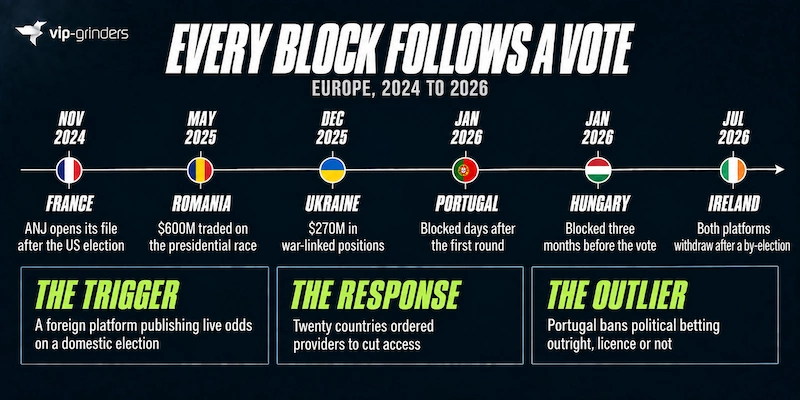
Look at the dates in the tables above and something becomes obvious. Almost every European block traces back to an election, not to a routine compliance review.
The timing varies more than the trigger does. Portugal moved within days of a first round, Romania took five months after its presidential race, and Hungary moved three months before a vote while a market on it was already trading.
| Country | Event | Reported volume | What followed |
|---|---|---|---|
| France | US presidential, Nov 2024 | $85M won by one French trader | ANJ opened its file |
| Romania | Presidential, May 2025 | $600M+, per ONJN | Blacklisted Oct 2025 |
| Ukraine | Russia’s invasion | $270M+ war-linked | Blocked Dec 2025 |
| Portugal | Presidential, Jan 2026 | €103M+ on the first round | Blocked within days |
| Hungary | Parliamentary, Apr 2026 | $225,000 single position | Blocked Jan 2026 |
| Ireland | Dublin by-election, 2026 | €4M on one constituency, reported | Both platforms withdrew Jul 2026 |
The objection is rarely about the money. It is that a foreign platform is publishing live odds on a domestic election, and those odds get quoted in the press as though they were polling.
Portugal went furthest on this. Its law prohibits betting on political events outright, domestic or foreign, which means no licence would have helped and no negotiation was available.
The Volumes Are Smaller Than They Look
Worth a caveat, because these figures get repeated without one. Prediction market volume counts both sides of every matched trade and every time a position is traded in and out.
A contract bought and sold four times generates eight times its value in reported volume. So a headline of 600 million dollars on a Romanian election is a trading figure, not the amount staked on the outcome.
Regulators have generally quoted the headline number, which is understandable, and it does make the activity look larger than the money actually committed.
Europe Now Enforces as a Bloc
Until the middle of 2026 every European action was national and uncoordinated. Regulators acted on their own timetables, using whatever instrument their own law provided.
That changed on 17 June 2026, when nine gambling regulators signed a joint declaration against unlicensed prediction markets. It was published to coincide with the opening of the World Cup, which was not an accident.
| Signatory | Regulator | Position before signing |
|---|---|---|
| Belgium | Gaming Commission | Blacklisted, Jan 2025 |
| Poland | Ministry of Finance | Register listing, Jan 2025 |
| Germany | GGL | Warning, Sep 2025 |
| Italy | ADM | Blocked Oct 2025, revoked Dec 2025 |
| Netherlands | KSA | Order under penalty, Jan 2026 |
| Portugal | SRIJ | Blocked, Jan 2026 |
| Spain | DGOJ | Proceedings and block, May 2026 |
| France | ANJ | Under investigation, blocked Jul 2026 |
| Switzerland | Gespa | Blocklist, Nov 2024 |
Every signatory had already acted, so the declaration did not change anyone’s position. What it did was commit the nine to shared enforcement and set out the toolkit: warnings, sanctions, service blocking, fines, advertising restrictions and account freezes.
It also urged sports federations, leagues and clubs to check an operator’s legal status before signing a partnership, which is aimed squarely at sponsorship money.
The Objection Is About Product Design
The reasoning in the declaration is not really about whether event contracts are gambling. It is about how the product is built.
- Always open: the platforms run around the clock with no downtime, unlike licensed operators bound by session rules.
- No limits: no mandatory deposit caps, no time restrictions, no cooling off periods.
- Weak age checks: identity and age verification the regulators describe as minimal, tied to documented popularity among young adults.
- Viral distribution: social media native marketing which, combined with the above, the declaration says creates a significant addictive cycle.
Read that list against a licensed European operator and the gap is obvious. Everything the platforms treat as a feature is something a licence would require them to remove.
ESMA Opened a Second Front
The financial regulators arrived separately, and later.
ESMA issued a public statement on 3 July 2026 addressing prediction markets under MiFID, holding that event contracts which qualify as financial instruments are derivatives and fall within the existing EU ban on selling binary options to retail investors.
It went further on 10 September 2026, in its risk monitor report. That document states that marketing and selling event contracts in the EU generally requires authorisation which the largest platforms do not hold, flags VPN circumvention as an enforcement problem, and asks a question this page has been asking throughout: why the platforms restrict some EU member states and not others.
The scope limit matters. ESMA reaches contracts on financial and economic outcomes. Sport, elections and entertainment stay with national gambling law, and that is where nearly all the volume sits.
What Happens to Your Money When a Country Is Blocked?
This is the question regulators say least about, and it is probably the one you care most about if you have a balance sitting on one of these platforms.
The short version: an order lands on the operator, not on your account. What happens to your money depends entirely on which mechanism was used.
| Mechanism | Open positions | Withdrawals | Example |
|---|---|---|---|
| ISP block | Untouched, but the site is unreachable | No route through the blocked domain | France, Portugal, Slovakia |
| Close-only | Can be sold or held to resolution | Normally still processed | Germany, Australia, the UK |
| Platform geoblock after pressure | Visible, cannot be traded | Varies by platform | Netherlands after February 2026 |
| Ordered refund | Voided by the regulator | Mandated by a deadline | Tennessee, ordered for 31 January 2026 |
| Sanctions block | Frozen, cannot be closed | None | Iran, Syria, Cuba, North Korea |
Only one regulator anywhere on this page has ordered money returned, and it did not stick.
Portugal Said the Quiet Part Out Loud
When Rádio Renascença asked the SRIJ what would happen to Portuguese users’ balances, the answer was unusually direct.
The regulator explained that it regulates and inspects licensed operators. Its power over an unlicensed one extends to telling it to stop. It could give no assurance that Portuguese users would get back what they had staked.
That is the honest position across most of Europe, whether or not the regulator says it aloud. The block protects future users. It does nothing for the ones already holding positions.
Tennessee Is the Exception
The US state actions went the other way. Tennessee’s cease and desist letters ordered the platforms to void open contracts and refund every deposit by 31 January 2026, which is the only instance anywhere of a regulator ordering money returned.
It did not happen. Kalshi sued the same day and a federal judge granted an injunction in February, so the refund order never took effect and the contracts stayed open.
That is worth holding onto if you are trying to predict how any of this ends. Even the one regulator that ordered your money back was stopped before it could deliver.
The Middle Ground Is Where Most People Land
Most European actions sit between those two poles. The platform geoblocks, the site stops loading or the account goes read only, and what happens to your balance depends on the platform’s own wind down rather than on anything the regulator wrote.
Polymarket settles on a public blockchain, which means positions technically persist whether or not you can reach the interface. That is different from a conventional operator, where the balance exists only in the company’s database.
It also means the practical answer varies by how you access the platform. Polymarket restricts some countries at the website only and leaves the API open, which is why the three tier breakdown above matters more than it looks.
Blocks Are Rarely Lifted
Three of the restrictions on this page could in principle reverse. Hungary’s block is formally temporary and runs only until a final decision. Spain’s is precautionary pending the outcome of proceedings. Ontario’s expires in April 2027.
One already has. Italy revoked its block in December 2025, then reinstated it seven months later, which is the only round trip anywhere.
Every other action has either held or hardened.
Which Other Platforms Have Been Restricted?
Kalshi and Polymarket carry the coverage, but regulators have been naming a wider field for most of a year. If you are checking one platform, the actions rarely stop at one.
| Platform | Named by | When | Scope |
|---|---|---|---|
| Crypto.com and Nadex | Connecticut, Tennessee, Ohio, Maryland | Dec 2025 onward | Sports event contracts |
| Robinhood | Connecticut, Nevada, Wisconsin, California tribes | Dec 2025 onward | Sports event contracts |
| Coinbase | Nevada, Michigan, Wisconsin | 2026 | Sports event contracts |
| Webull | Kentucky | Jun 2026 | Named in the state’s lawsuits |
| 27 platforms, unnamed here | Brazil, CMN and Anatel | 24 Apr 2026 | Blocked as a group |
| Gowagr | Lagos State, Nigeria | Mar 2026 | Listed as an unlicensed operator |
Brazil is the outlier on scale. The Anatel block covered around 27 platforms in a single action, not two, which tells you the regulator was treating this as a category rather than a pair of companies.
The same is true at state level in the US. Kentucky named five entities in its lawsuits, Wisconsin filed against three, and each of the cease and desist letters went to three operators at once.
Nigeria is a different case again and worth noting for what it is not. Lagos State listed a local platform, Gowagr, on its register of unlicensed operators. No Nigerian regulator has acted against Polymarket or Kalshi, which is why Nigeria does not appear in the tables on this page.
Roobet Came at It From the Other Direction
In 2026 Roobet became the first crypto casino to list event contracts, which is the same product arriving from the opposite end.
No regulator has named Roobet in connection with prediction markets. It is on this page because a casino adding event contracts and an exchange adding sports contracts look identical from a regulator’s desk, and the direction of travel now runs both ways.
Prediction Markets vs Licensed Sportsbooks: Why Regulators Object
Strip away the legal argument and one fact explains most of the enforcement on this page. Prediction markets compete directly with licensed sportsbooks, and licensed sportsbooks have regulators, tax bills and lobbyists.
| Signal | What it shows |
|---|---|
| Sports closes first, everywhere | Tennessee, Connecticut, Malta and Kalshi’s own Canadian launch all draw the line in the same place |
| The declaration was timed to the World Cup | Nine regulators published on the opening day, June 2026 |
| The licensed industry lobbied for it | Brazilian sportsbook bodies petitioned from February, the block landed in April |
| Sponsorship warnings | Regulators told federations and clubs to check operators’ legal status before signing |
| A trade body asked, and was not a regulator | South Africa’s bookmakers association called for regulation in July 2026, with no regulator response |
None of that makes the regulators wrong. It does explain the timing, and it explains why sports is the vertical that closes while economic contracts almost always survive.
The Obligations Gap
A licensed European sportsbook operates under conditions that cost money. Deposit limits, session reminders, self exclusion registers, identity verification, advertising restrictions, and a licence fee on top.
A prediction market offering the same bet on the same match carries none of those. That is the complaint in one sentence, and it is why the nine regulator declaration focused on product design rather than on legal classification.
Why This Sits on a Poker Site
VIP-Grinders has tracked rake, edge and player economics since 2013, and the argument playing out here is one poker players have had for twenty years.
A prediction market charges an explicit fee on a price that sums to roughly 100 cents, in the same way a poker room takes rake rather than building in a house edge. A sportsbook builds its margin into the odds and never shows you the number.
Which is cheaper depends entirely on how often you trade. Held to resolution, an explicit fee usually beats an overround. Traded in and out repeatedly, the fee applies every time and the advantage narrows or disappears.
Where the Next Decision Lands
Three decisions are due that would change the tables on this page. We are deliberately not listing eight, because a page reviewed quarterly cannot credibly track eight pending items.
| Decision | Body | Expected | What changes |
|---|---|---|---|
| Spain’s disciplinary ruling | DGOJ | Around October 2026 | The precautionary block becomes final, is lifted, or turns into a fine |
| Supreme Court, No. 26-299 | US Supreme Court | This term | A grant puts a national answer on track for mid 2027. A denial leaves the map split by circuit |
| Sixth Circuit ruling | Ohio and Tennessee, consolidated | Pending since July | Decides whether states can order a single vertical closed |
Two longer term items sit behind all of them.
Malta is working toward a dedicated licensing framework, which would be the first of its kind in the EU and would test whether such a licence travels across the single market. Gibraltar is looking at the same question.
And the nine regulator declaration means any one of those countries acting is now a signal about the other eight, which makes Europe less useful to watch country by country than it was a year ago.
How We Track This
Every entry on this page is either linked to a document or labelled as something weaker. This section sets out where the line is.
What Counts as a Decision
An action by a regulator, court, ministry or telecoms authority against a named platform, published by that body. Register entries, blacklists, court orders, cease and desist letters, ministerial decisions and formal warnings all qualify.
Where we tested the platform ourselves, we say so and give the date.
The Four Tiers
- Confirmed: a published document from the body that acted, with a date we can cite. These are the entries in the main table.
- Reported: credible reporting or another regulator's summary, with no document we can retrieve. Bulgaria, Greece, Cyprus, Taiwan, Thailand and Indonesia sit here.
- Platform self-restriction: the platform excludes the country and no regulator has acted. Japan, Kenya, South Africa, Zimbabwe, Monaco and others. These are not bans and we do not count them as such.
- Our own testing: we opened the platform from the country and recorded what happened, with the date. Malta only.
What Absence Means
A country not appearing on this page means we found no published decision. It does not mean the product is legal there, and it does not mean it is available.
Roughly 150 jurisdictions have not been checked to primary source level. The ones we have checked and found clear are listed below, and so are the ones we have not reached.
Checked and Found Clear
Norway, Japan, South Africa, Kenya, Peru, Mexico, Chile and Ecuador, plus around 29 US states where no enforcement action was located.
In several of those, the platform restricts the country anyway. That is the self-restriction tier, not a ban.
Not Yet Checked
Sweden, Finland and the Baltic states. Austria, Slovenia, Croatia, Serbia and the rest of the Balkans. Russia, Belarus, Moldova, the Caucasus and Central Asia. The Gulf and wider MENA region. East and Southeast Asia beyond Singapore, Thailand and Taiwan. Most of Africa and most of Latin America.
Several of those countries publish blocking registers that would settle the question in an afternoon. We work through them a region at a time and update as we go.
What This Page Cannot Tell You
- Whether a block actually works: orders at internet provider level reach the browser and often not the native app, as France showed in July. Blocked here means ordered blocked.
- The platforms' current lists with certainty: Kalshi's own published documents disagree with each other, and both platforms amend without notice.
- What happens to your balance: that depends on the platform's wind down, which is rarely published in advance.
- Anything decided since the date at the top: this page is reviewed quarterly, and this subject moves faster than that between reviews.
Sources
We prefer the regulator’s own website, official register, government gazette, court filing or the platform’s published terms. Where only trade press or mainstream reporting exists, the entry says reported and stays out of the counts.
Affiliate sites, SEO roundups and crypto aggregators are not used, which is why several countries that appear as bans elsewhere do not appear here.
Editorial Independence
VIP-Grinders has no commercial relationship with any prediction market platform covered on this page. No platform pays for inclusion, position or how it is described. This page carries no affiliate links.
Update Schedule
Reviewed quarterly, and sooner when a listed decision lands. The date at the top is the date the page was last verified, not the date it was published.
This page is part of the VIP-Grinders research programme alongside our monthly prediction markets report. Our testing and verification standards are set out in how we test.
If you are a journalist or researcher using anything from this page, contact João Mourato for sourcing detail.
Update Log
Newest first. Each line is one action by a regulator, court or government, dated to the action itself rather than to when we wrote about it.
- 17 September 2026: page published. Our own testing from Malta finds the sports section blocked while the rest of the site works.
- 10 September 2026: ESMA publishes its risk monitor report, stating that selling event contracts in the EU generally requires authorisation the platforms do not hold.
- 9 September 2026: Kalshi petitions the Ninth Circuit for a rehearing by a full panel.
- 8 September 2026: the Tenth Circuit refuses Kalshi an emergency injunction against Utah. New Jersey's Supreme Court petition is docketed as No. 26-299.
- 4 September 2026: The Times reports FCA talks on easing the UK retail ban. No FCA statement issued.
- 28 August 2026: the Ninth Circuit rules 3-0 for Nevada, creating a split with the Third Circuit.
- 13 August 2026: Germany's GGL restates that election and entertainment bets cannot be licensed.
- 31 July 2026: New York's attorney general and governor sue Kalshi, seeking at least $36 billion.
- 30 July 2026: the Sixth Circuit hears the consolidated Ohio and Tennessee appeals.
- 27 July 2026: a federal judge pauses Minnesota's statutory ban days before it takes effect.
- 21 July 2026: both platforms geoblock Ireland after GRAI threatens High Court action.
- 16 July 2026: France's ANJ orders providers to block Polymarket. Turkey blocks under decision 2026/10.
- 13 July 2026: the Czech Ministry of Finance adds Polymarket to its unauthorised internet games list.
- 10 July 2026: the Ninth Circuit hears the California tribes' appeal. Italy's ADM reinstates its block.
- 8 July 2026: the Frederiksberg Court rules against Polymarket in Denmark, which goes onto a list of 98 blocked sites.
- 7 July 2026: North Carolina legalises prediction markets and taxes them at 6%.
- 3 July 2026: ESMA addresses event contracts under MiFID.
- 23 June 2026: the Dutch KSA rejects Polymarket's objection to the penalty in full.
- 22 June 2026: Slovakia adds Polymarket to its prohibited offers register.
- 18 June 2026: Kalshi launches in Canada through Wealthsimple, without sports or elections.
- 17 June 2026: nine European regulators sign a joint declaration, timed to the World Cup. Kalshi amends its member agreement to add India.
- 26 May 2026: Spain's DGOJ opens proceedings against both platforms and orders a precautionary block.
- 1 May 2026: India's online gaming act comes into force, banning the category by statute.
- 24 April 2026: Brazil blocks around 27 platforms under CMN Resolution 5,298.
- 6 April 2026: the Third Circuit rules 2-1 for Kalshi against New Jersey.
- 17 March 2026: Arizona files 20 criminal charges against Kalshi, the first anywhere.
- 16 March 2026: a Buenos Aires court orders a nationwide block in Argentina.
- 19 February 2026: a federal judge grants Kalshi an injunction in Tennessee, suspending the January order.
- 16 February 2026: New Zealand's Department of Internal Affairs declares both platforms illegal gambling.
- 13 February 2026: Romania adds Kalshi to its blacklist, the only European regulator to name both platforms separately.
- 20 January 2026: the Dutch KSA issues its order under penalty, with a 17 February deadline.
- 19 January 2026: Hungary's SZTFH orders a temporary block. Portuguese providers block over the following two days.
- 9 January 2026: Tennessee orders Kalshi, Polymarket and Nadex to pull sports contracts and refund deposits.
- 15 December 2025: Italy's ADM revokes its block, the only reversal anywhere.
- 10 December 2025: Ukraine's Resolution 695 adds Polymarket to the blocked register.
- 3 December 2025: Connecticut issues cease and desist letters to Kalshi, Robinhood and Crypto.com.
- 4 November 2025: Kalshi's exchange notice names 48 restricted jurisdictions.
- 29 October 2025: Romania's ONJN blacklists Polymarket.
- 22 October 2025: Italy's ADM blocks Polymarket for the first time.
Earlier actions, from Switzerland’s November 2024 blocklist entry through Singapore, Poland, Belgium, Ontario, Australia and Germany, are dated in the tables above.
Prediction Market Bans: Frequently Asked Questions
Is Polymarket legal in my country?
Twenty six countries have a published decision against it and six more are reported without one. The table near the top of this page lists all of them with dates. If your country is not there, we found no published decision, which is not the same as confirming the product is legal.
Which countries block Polymarket completely?
Twenty have ordered providers to cut access: France, Spain, Belgium, Poland, Portugal, Hungary, Ukraine, Romania, Czechia, Slovakia, Turkey, Switzerland, Italy, Denmark, Singapore, India, Australia, Brazil, Argentina and Colombia.
Is Polymarket banned in the UK?
Not by name. The FCA’s 2019 retail ban on binary options covers the financial contracts, and the Gambling Commission requires a licence for sports and political ones, which neither platform holds. Polymarket runs close-only for UK users and Kalshi restricts the UK in its own terms.
Is Polymarket legal in Germany?
No German regulator has issued an order. The GGL warned publicly in September 2025 that these contracts cannot be licensed, and Polymarket went close-only in response. You can sell out of positions you already hold but not open new ones.
Is Polymarket banned in India?
The category is banned by statute. India’s online gaming act came into force on 1 May 2026 and classifies prediction markets as prohibited online money games. A blocking order against Polymarket was reported in May, though no order has been published. No order naming Kalshi exists.
Is Polymarket legal in Australia?
No. ACMA found in August 2025 that Polymarket had breached the Interactive Gambling Act and ordered providers to block it. The investigation began after the platform paid Australian influencers to promote election markets. Kalshi is not on ACMA’s register and restricts Australia in its own terms.
Is Kalshi available in Canada?
Yes, through Wealthsimple, but not for everything. Kalshi launched in June 2026 under rules that permit economic, environmental and financial contracts and exclude sports and elections. Polymarket is separately restricted in Ontario until April 2027 and runs close-only in three other provinces.
Why can I open Polymarket but not the sports section?
Because some restrictions close one category rather than the whole site. Tennessee and Connecticut ordered exactly that, Kalshi launched in Canada that way by choice, and our own testing found the same pattern in Malta with no order behind it.
Is Kalshi banned in the same countries as Polymarket?
Rarely by name. Spain, Brazil, Romania and Connecticut named both. Almost everywhere else the regulator named Polymarket alone, because Kalshi had already excluded the country in its own terms and there was nothing to list.
What happens to my balance if my country gets blocked?
It depends on the mechanism. Close-only lets you sell out or hold to resolution. An internet provider block makes the site unreachable without touching the positions. Only Tennessee ever ordered refunds, and a court suspended that order before it took effect. Portugal’s regulator said plainly it could give no assurance users would get their stakes back.
Can you be fined for using Polymarket?
In Singapore, yes. The block page cites a fine of up to 10,000 Singapore dollars or six months in prison for gambling with an unlicensed provider. Germany’s GGL has warned of criminal risk for participants. Most other countries penalise the operator rather than the user.
Is Polymarket legal in the United States?
Federally yes, through a CFTC licence. At state level it varies, with twenty states having taken some form of action and North Carolina having legalised and taxed the product instead. The Supreme Court has been asked to settle who decides.
Has any country lifted a ban?
Italy did, then reversed itself. It revoked its block in December 2025 and reinstated it seven months later. Hungary’s block is formally temporary, Spain’s is precautionary, and Ontario’s expires in April 2027, so three more could in principle reverse. Every other action has held or hardened.