

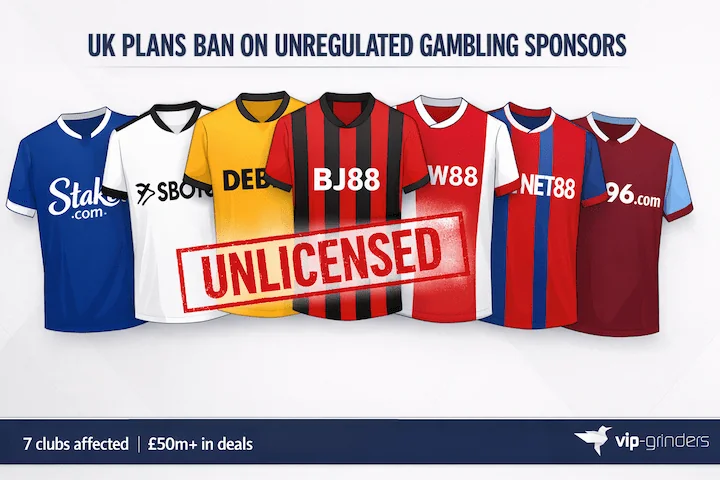
The UK government wants to ban unlicensed gambling operators from sponsoring Premier League clubs. Culture Secretary Lisa Nandy announced the consultation on 23 February 2026, targeting seven clubs whose shirt sponsors collectively represent over £50 million in annual deals with platforms that hold no UK Gambling Commission licence.
On the surface, the move makes sense. Brands like 96.com, BJ88, and NET88 have no functioning UK websites, no player protection frameworks, and no regulatory oversight. Fans watching Burnley or Bournemouth on a Saturday afternoon are being exposed to operators that exist entirely outside the system designed to keep them safe.
But here is the problem nobody in Westminster seems willing to address.
This sponsorship ban arrives just weeks before remote gaming duty jumps from 21% to 40% on 1 April 2026. Combined with £2/£5 online slot stake limits and mandatory financial checks, the UK's licensed gambling product is about to become significantly less competitive compared to the unregulated alternatives it is trying to suppress.
Every European country that has combined aggressive taxation with strict product restrictions (the Netherlands, Germany, Sweden) has watched its black market expand, not shrink.
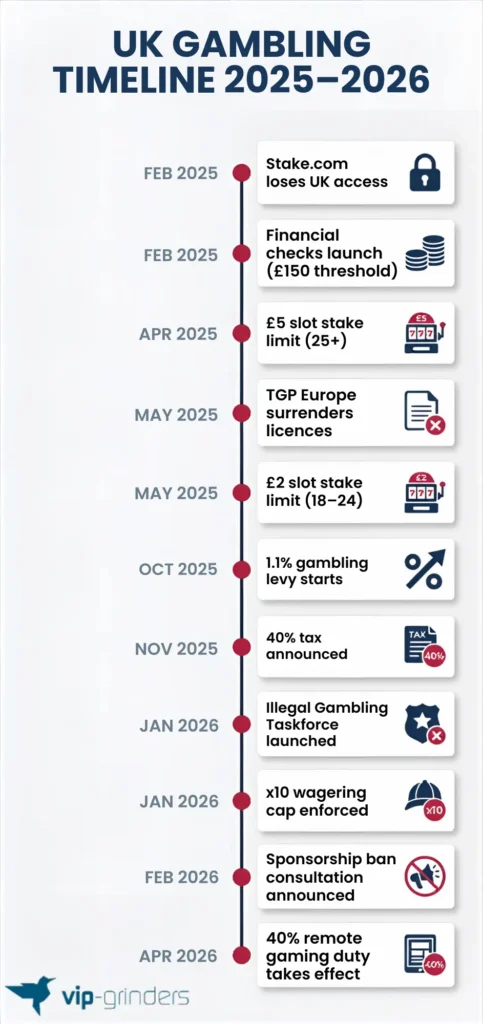
What the UK Government Announced on 23 February 2026
The Department for Culture, Media and Sport confirmed plans to launch a Spring 2026 public consultation on banning gambling companies without a UKGC licence from entering into any sponsorship arrangements with British sports clubs. This is not yet law. It is a planned consultation that will determine the scope and enforcement mechanism.
The proposal covers all forms of sponsorship, not just front-of-shirt deals. That means shirt sleeves, training kits, stadium branding, and LED perimeter boards would all fall within scope.
Culture Secretary Lisa Nandy said fans deserve to know the sites they use are properly regulated. Gambling Minister Baroness Twycross was more direct, describing unregulated gambling as something that exploits vulnerable people and confirming the consultation would work alongside the Illegal Gambling Taskforce, launched in January 2026, which brings together Google, Mastercard, Visa, TikTok, law enforcement, and gambling bodies to target unlicensed operators across payments, social media, and advertising.
What the Taskforce Is Targeting
- Stopping unlicensed operators from advertising on social media
- Blocking payments to and from unlicensed gambling sites
- Improving cross-agency enforcement and intelligence sharing
The government also committed £26 million in additional funding to the Gambling Commission over three years (£5 million in 2026/27, £10 million each in 2027/28 and 2028/29) specifically to fight the black market. New legislation will be required to enforce the sponsorship ban. Several open questions remain:
- Will existing contracts get a transitional period, or must clubs terminate immediately?
- Does the ban extend beyond football to rugby, cricket, darts, and other sports?
- How will white-label structures be treated where the brand is unlicensed but the platform provider holds a licence?
Legal analysts at Bird & Bird noted this signals a shift in regulatory thinking, moving away from asking whether UK consumers can access a site and toward a simpler test: is the sponsor GB-licensed or not.
Which Premier League Clubs Are Affected?
In the 2025/26 season, 11 of 20 Premier League clubs (55%) carry gambling front-of-shirt sponsors. Of these, seven have deals with operators that hold no UKGC licence. The majority trace back to a single entity: TGP Europe, a now-defunct white-label provider that enabled offshore brands to operate in Britain under its umbrella licence.
Here is the full breakdown:
| Club | Sponsor | Est. Annual Value | Licence Status |
|---|---|---|---|
| Everton | Stake.com | £10m | No. UK site shut down March 2025 after UKGC investigation. |
| Fulham | SBOTOP | £10m | No. TGP Europe white label. Licence surrendered May 2025. |
| Wolves | DEBET | £10m | No. TGP Europe white label. No functioning UK website. |
| Bournemouth | BJ88 | £6-8m | No. TGP Europe white label, surrendered May 2025. |
| Sunderland | W88 | £5-7m | No. Licensed via DM Limited/Midnight Gaming, surrendered 2024. |
| Crystal Palace | NET88 | £5m | No. Risq white label (separate from TGP). No UK website. |
| Burnley | 96.com | £3.5m | No. TGP Europe white label, surrendered May 2025. |
Total estimated value of unlicensed front-of-shirt deals: £51.5 to £53.5 million annually. That represents roughly 54-56% of the £95 million in total gambling shirt sponsorship spending across the Premier League for 2025/26. For comparison, clubs with licensed sponsors include Aston Villa (Betano, £20m), West Ham (BoyleSports, £12m), and Nottingham Forest (Bally's, £8m).
The BJ88 deal is particularly notable: a Vietnamese mirror page was found displaying the UKGC logo despite the brand never holding a direct licence.
The unlicensed presence extends beyond shirts. Crystal Palace also carries Kaiyun Sports as a sleeve sponsor, a brand the UKGC confirmed has never held a direct licence. Investigative outlet Josimar has linked Kaiyun to the Chinese criminal organisation Yabo. Additional undisclosed partnerships with unlicensed Asian-facing operators are visible on LED perimeter boards at multiple grounds, including Aston Villa, Chelsea, and others.
How TGP Europe Made All of This Possible
Most of these deals exist because of TGP Europe, an Isle of Man-based company that ran 29+ gambling websites in the UK under a single UKGC licence. This white-label model allowed offshore brands to accept British customers without ever applying for their own licence.
The timeline of TGP's collapse tells the story:
- 12023: TGP fined £316,250 for failing to consider money laundering risks in its B2B relationships
- 2February 2025: Stake.com (Everton's sponsor) loses UK access after a promotional stunt involving an adult content creator outside Nottingham Trent University
- 315 May 2025: TGP surrenders all four UKGC licences rather than comply with a £3.3 million penalty for anti-money laundering failures
The UKGC found that TGP had failed to carry out effective due diligence on third-party ownership, failed to check the source of funds, and breached enhanced due diligence requirements. The Commission warned clubs directly that officers could face prosecution, fines, or imprisonment for promoting unlicensed gambling businesses that transact with UK consumers. Five clubs (Bournemouth, Fulham, Newcastle, Wolves, and Burnley) received direct warnings.
Despite all of this, every single club kept its unlicensed sponsor on the shirt. Everton confirmed it had no plans to remove Stake from the front of their shirts for the remainder of the season.
The 40% Tax That Changes Everything
The sponsorship ban grabbed the headlines. But the policy that will reshape UK gambling more than anything else arrived months earlier in the November 2025 Autumn Budget. Chancellor Rachel Reeves announced a near doubling of online gaming tax that BGC CEO Grainne Hurst called a devastating hammer blow to the industry.
What Changed
| Tax | Old Rate | New Rate | Effective Date |
|---|---|---|---|
| Remote Gaming Duty (online casino/slots) | 21% | 40% | 1 April 2026 |
| Remote Betting Duty (online sports betting) | 15% | 25% | 1 April 2027 |
| Statutory Gambling Levy | None | 1.1% of GGY | October 2025 |
| Bingo Duty | 10% | Abolished | April 2026 |
The Treasury projected an additional £810 million in 2026/27, rising to £1.16 billion per year by 2030/31. The tax went live on 1 April 2026, and the fallout was immediate: see our full breakdown of what UK players actually lose under the 40% tax. But H2 Gambling Capital warned the actual yield would be roughly half of those forecasts, estimating gross gambling yield could drop £1.1 billion (14%) as operators cut marketing, exit unprofitable segments, and players migrate offshore.
How Much It Costs Each Major Operator
- Flutter (Paddy Power, Betfair, Sky Bet): $320 million EBITDA hit in 2026, $540 million in 2027
- Entain (Ladbrokes, Coral): £100 million in 2026, £150 million from 2027
- Evoke (William Hill, 888): £125–135 million annualised
- Betfred: warned 7,500 jobs at risk and up to 1,300 betting shops could close
The practical consequence for players is straightforward. Entain's global performance marketing director Daniel Toledo confirmed operators will have no choice but to implement smaller welcome bonuses, less frequent free bets, and worse odds. For anyone using licensed UK bookmakers, the value proposition is about to decline significantly.
How UK Tax Compares to the Rest of Europe
| Country | Online Gaming Tax Rate |
|---|---|
| Malta | 1–5% (capped at €466K/licence/year) |
| Sweden | 18–22% |
| Italy | 24–25% |
| Denmark | 28% |
| Netherlands | 34.2% (37.8% planned) |
| UK (new rate) | 40% |
| France | 40–55% |
The European average across 16 monitored EU states is approximately 19%. The UK's new 40% rate is more than double that average and places it alongside France as the most heavily taxed online gambling market in Europe.
Evoke CEO Per Widerström called the proposals ill-thought-through, counter-productive, and highly damaging. Before the tax hike, the UK had a channelisation rate of 95–99%, the highest in Europe, built over decades of moderate taxation and a pragmatic regulatory model. The industry's core argument is simple: no country that has pushed its online gaming tax above 30% has maintained channelisation above 80%.
How UK Player Restrictions Are Reshaping the Product
The tax hike is only one side of the equation. Throughout 2025 and into 2026, the UKGC has rolled out a wave of product restrictions that fundamentally change how online gambling works for UK players. Each rule in isolation sounds reasonable. Stacked together, they create a licensed experience that is measurably worse than what players can find outside the UKGC system.
Online Slot Stake Limits
From 9 April 2025, players aged 25 and over are capped at £5 per spin. From 21 May 2025, players aged 18 to 24 are capped at just £2 per spin.
Early UKGC data shows mixed results: slots GGY actually increased 10% year on year to £788 million in Q3 2025/26, with total spins up 7%. But sessions lasting longer than one hour dropped 16%, average session length fell to 16 minutes, and total active accounts declined 2% to 12.7 million.
Financial Vulnerability Checks
Since 28 February 2025, operators must run a soft credit check when a player's net deposits exceed £150 in any rolling 30 day period. These checks look for bankruptcy orders, IVAs, debt relief orders, CCJs, and recent defaults. The UKGC reports 95 to 97% of checks complete frictionlessly, but roughly 3% of accounts get flagged, and high spending customers were found to be 2 to 4 times more likely to have a debt management programme.
The Full List of Product Changes
- Autoplay banned on all online slots
- Minimum 2.5 second spin duration enforced
- Bonus buy features prohibited
- Losses disguised as wins banned
- Maximum wagering requirements capped at x10 from 19 January 2026 (previously operators could set x20, x50, or higher)
- Mixed product bonuses banned (e.g. "bet £10 on football, get 50 free spins" is now prohibited)
- Granular marketing opt-ins required from May 2025
- Mandatory deposit limit prompts during registration from June 2026
The cumulative effect is significant. A UK player visiting any regulated online casino in 2026 faces spin limits, slower gameplay, no autoplay, mandatory financial screening, smaller bonuses with stricter wagering caps, and fewer promotional offers as operators cut costs to absorb the 40% tax rate.
Meanwhile, offshore crypto casinos operating under Curacao or other international licences offer a fundamentally different product: higher stakes, faster onboarding, larger bonuses, and cryptocurrency payments. Whether a player sees that as a better deal or a riskier one depends on the platform, but the product gap between what the UK allows and what exists outside it has never been wider.
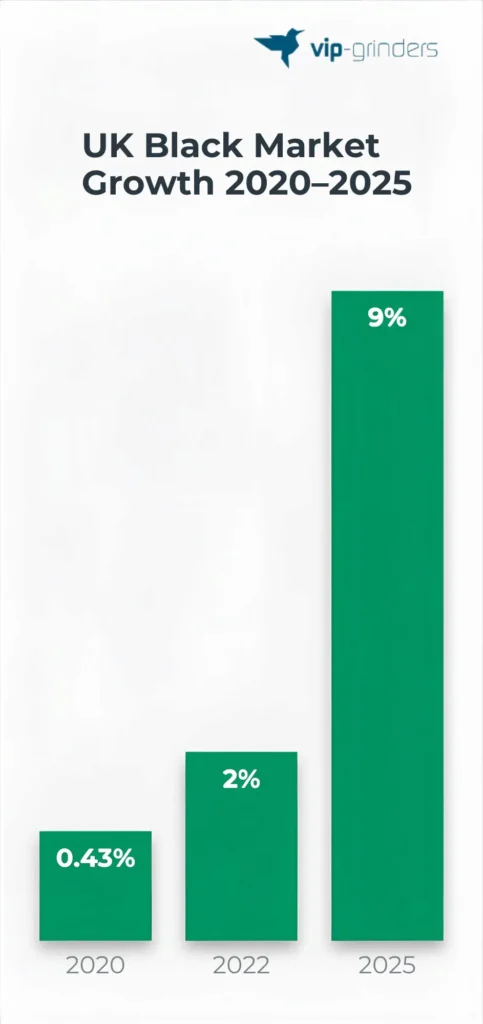
The Black Market Is Already Growing Without Help
Everything described above (the tax hike, the product restrictions, the reduced bonuses) has not even taken full effect yet. And the share of UK players using platforms outside the UKGC system is already surging.
According to Yield Sec/GCI data, unlicensed operators control approximately 9% of Britain's online gambling market as of the first half of 2025. That is up from 2% in 2022 and just 0.43% in 2020. A roughly 20 fold increase in five years.
The Scale of the Problem
A Frontier Economics report commissioned by the BGC (September 2024) put hard numbers on what this means:
- £2.7 billion staked annually with online black market operators
- £1.6 billion in underground in-person gambling
- £4.3 billion total in illegal wagers annually
- An estimated 1.5 million Britons actively engage with black market gambling
At the BGC's 2026 AGM, EY's Chris Sanger estimated the illegal market had grown from 0.5% to 10 to 12% of the legal market, measured against online GGY of £7.8 billion.
Who Is Using the Black Market?
The demographics tell a clear story. 65% of black market spending comes from players aged 18 to 34. One in five (20%) of 18 to 24 year olds who gamble have used an unlicensed site. And 54% of users did not even know they were on an unlicensed platform.
| Motivation for Using Black Market Sites | % of Users |
|---|---|
| Better bonuses and free bets | 35% |
| Easier account setup | 32% |
| More flexible payments (including crypto) | 30% |
| Better odds | 30% |
Every single motivation in that table (better bonuses, easier signup, crypto payments, better odds) maps directly to a feature the UK government is either taxing away or restricting through regulation.
What the UKGC Is Doing About It
The Commission has dramatically ramped up enforcement. Between October 2024 and September 2025:
- 806 cease and desist letters sent to unlicensed operators
- 314 websites geo-blocked
- 102,000+ URLs referred to Google (64,000 removed), a tenfold increase from 2023/24
- An estimated 700 unlicensed operators active in the UK, promoted by 1,600+ affiliates
- 89% of illegal sports streaming in Britain during 2024/25 carried unlicensed gambling ads
The UKGC's own research found 2.5% of British adults (roughly 1.3 million people) had used an unlicensed operator in the past 12 months, with 40% mistakenly believing the operator held a UKGC licence. Yet the Commission maintains it is not yet able to make a robust estimate of the black market's true size and found no indication of sustained growth in illegal gambling where reliable data exists.
The licensed industry sees it very differently. BGC CEO Grainne Hurst responded directly: the government has given the Gambling Commission £26 million to tackle the black market, but the real point is to stop sending people into the black market in the first place. The regulated sector needs to remain attractive, healthy, and sustainable.
Entain CEO Stella David put it more bluntly in an open letter to Premier League CEO Richard Masters on 25 February 2026. She described the upcoming Bournemouth vs Sunderland fixture as a “black market derby”, with both teams wearing sponsors that hold no UK licence, and demanded an immediate ban on LED board advertising for unlicensed operators.
The Crypto Gambling Boom in Numbers
The UK government frames this as a fight against “illegal gambling.” But much of the growth happening outside the UKGC system is not underground at all. It is happening on established platforms, licensed in jurisdictions like Curacao and Anjouan, processing billions in wagers through transparent blockchain transactions.
The government's failure to distinguish between shell companies like BJ88 and legitimate crypto casinos holding international licences is part of what makes this regulatory approach so blunt.
The global crypto gambling market has grown at extraordinary speed. Players wagered more than $81 billion at crypto casinos in 2025, a fivefold increase from approximately $16 billion in 2022. Q1 2025 alone saw $26 billion in crypto wagers, nearly double the same quarter in 2024.
Key Market Data
| Metric | Figure | Source |
|---|---|---|
| Total crypto wagers (2025) | $81 billion+ | SiGMA World |
| Growth since 2022 | ~5x | SiGMA World / SOFTSWISS |
| Crypto share of all online bets | ~17% (SOFTSWISS), ~30% (SiGMA estimate) | SOFTSWISS / SiGMA World |
| Ethereum L2 casino volume growth | 320% YoY (Q4 2025) | On-chain data |
| Stake.com GGR (2024) | $4.5 to $4.7 billion | Easygo Group filings |
| Stake.com registered accounts | 21 million+ | Easygo Group |
It is important to note that the $81 billion figure represents total wager volume, not revenue. At a typical 2 to 5% house edge, actual gross gaming revenue would sit around $1.6 to $4 billion.
But the trajectory is what matters. Three years ago this market barely existed in mainstream conversations. Today it processes more volume than several regulated European markets combined.
Stake.com: The Platform on Everton's Shirt
Stake.com is worth examining specifically because it sits at the centre of both the sponsorship debate and the crypto growth story. Parent company Easygo Group Holdings reported A$970 million (~$645M USD) in revenue and A$257 million in net profit for the year ending June 2025, processing $1.1 to $1.3 billion in monthly deposits.
This is not a shell company with no website. It is one of the largest gambling operators on earth, larger by revenue than several UKGC-licensed competitors. Yet because it does not hold a UK licence, the government treats it the same as 96.com, a brand with no functioning platform at all.
Why No UK-Licensed Operator Accepts Crypto
This is the core regulatory gap. No major UKGC-licensed operator currently accepts cryptocurrency as a payment method. UKGC Executive Director Tim Miller confirmed at the BGC AGM on 26 February 2026 that crypto is one of the two biggest searches leading British gamblers to sites outside the UKGC system.
The UKGC has tasked its Industry Forum with exploring a “sensible pathway” for crypto payments, and H2 Gambling Capital's Simon Legg expects some movement in 2026.
The market is also not exclusively casino. Crypto poker rooms have seen significant growth as players seek tables without the verification friction and deposit limits imposed by UK regulation. Platforms running on blockchain infrastructure can offer provably fair dealing through SHA-256 hashing, a level of transparency that traditional licensed operators do not match.
What Happened in the Netherlands, Germany, and Sweden
The UK is not the first country to combine high taxes with strict product restrictions. Three European markets have already run this experiment. In every case, the black market grew.
The Netherlands: How Channelisation Collapsed
The Netherlands introduced mandatory deposit limits in October 2024: €300 per month for players aged 18 to 24, €700 for those 25 and older. At the same time, gambling tax rose from 29.5% to 34.2%, with 37.8% planned for 2026.
The results were swift. Licensed operators' GGR dropped 14% in the first half of 2025. Revenue based channelisation collapsed to approximately 49 to 50%, meaning the black market now exceeds the legal market in money terms for the first time. Offshore operators grabbed an estimated €617 million in that period alone.
The planned tax increase was projected to raise an additional €200 million. The actual result was a €30 million revenue shortfall. The tax trajectory (29.5% to 34.2% to 37.8%) mirrors the UK's path (21% to 40%), and the outcome speaks for itself.
Germany: 60 to 80% of Slots Activity Is Unlicensed
Germany's Interstate Gambling Treaty, launched in July 2021, imposed a €1 online slot stake limit and a turnover tax starting at 5.3% (raised to 7% in 2024). The results have been catastrophic for channelisation.
| Metric | Germany |
|---|---|
| Online slot channelisation | 20 to 40% (60 to 80% unlicensed) |
| Overall online gambling channelisation (2024) | 40% (H2 Gambling Capital) |
| Projected channelisation (2025) | 36% (declining) |
| Online casino tax revenue change (2024) | Down 16% |
A Hessian Tax Court ruling in October 2024 assessed the black market share for virtual slots as likely to be over 80%. DSWV President Mathias Dahms confirmed that Germany has an increasing black market problem and that regulator estimates are far too low.
Germany's €1 stake limit is directly relevant to the UK debate. The UK's new £2 limit for 18 to 24 year olds is higher, but combined with the 40% tax, the net effect on the licensed product's competitiveness may be comparable.
Sweden: Tenfold Increase in Unlicensed Traffic
Sweden re-regulated in 2019 with an 18% GGR tax (later raised to 22%) and a complete ban on welcome bonuses. Channelisation has settled at 74 to 86% depending on source and segment, well below the government's 90% target. Online casino channelisation specifically may be as low as 57 to 62%.
- Visitor traffic to unlicensed domains has increased tenfold since 2019
- PwC found 38% of self-excluded Swedish players reported still gambling online with unlicensed operators
- Italy's 2018 complete ban on gambling advertising is estimated to cost €1 billion per year in lost GGR to unlicensed operators
The Pattern Is Clear
| Country | Tax Rate | Key Restriction | Channelisation |
|---|---|---|---|
| Netherlands | 34.2% | Deposit limits (€300/€700) | ~50% (revenue based) |
| Germany | 5.3–7% turnover | €1 slot stake limit | ~40% overall, ~20% slots |
| Sweden | 22% | Bonus ban | 74–86% overall, ~60% casino |
| UK (pre-hike) | 21% | Moderate | 95–99% |
| UK (post-hike) | 40% | £2/£5 stake limits + checks | TBD |
Before the tax hike, the UK had the highest channelisation rate in Europe. That was built on moderate taxation and a pragmatic regulatory model. The government is now dismantling both pillars simultaneously, and the international evidence suggests the result will be the same: more players, not fewer, finding their way to platforms outside the system.
Our Take: A Regulatory Collision Course
VIP-Grinders has covered poker and gambling regulation since 2013. We have watched markets open, close, over-regulate, and course-correct across dozens of jurisdictions. What the UK is doing right now follows a pattern we have seen before, and the ending is predictable.
The sponsorship ban itself is not the problem. Banning shell companies like 96.com and BJ88 from Premier League shirts is defensible. These are brands with no functioning platforms, no player protections, and no accountability. Nobody in the industry, licensed or otherwise, is arguing they should be on the front of a football shirt.
The problem is everything surrounding the ban.
The government is raising online gaming tax to 40%, the second highest in Europe. It is capping slot stakes at £2 for young adults. It is mandating financial checks at £150 in deposits. It is restricting bonuses, banning product features, and requiring marketing opt-ins that reduce every operator's ability to acquire and retain customers. And it is doing all of this at the same time.
Three Things That Need to Happen
- 1The government needs to distinguish between shell companies and legitimate offshore-licensed platforms. Treating Stake.com the same as 96.com is not regulation. It is a failure to understand the market.
- 2The UKGC needs to create a pathway for crypto payments within the licensed framework. Tim Miller acknowledged crypto is one of the two biggest drivers of UK players leaving the system. Blocking it instead of regulating it is a choice that benefits offshore operators.
- 3The Treasury needs to watch the Netherlands closely. The Dutch tax trajectory mirrors the UK's almost exactly, and the result was a revenue shortfall, not a windfall. If the UK follows the same path, H2 Gambling Capital's warning that actual yield will be half of Treasury forecasts looks conservative, not pessimistic.
The UK built the most effective channelisation model in Europe over two decades. It did that by making the licensed market attractive enough that players had no reason to go elsewhere. The policy direction since 2025 reverses that logic entirely: make the licensed product worse, tax it more heavily, and then spend £26 million trying to stop players from finding alternatives.
Every country that has tried this has seen the same result. The UK has better enforcement tools than most, but enforcement alone has never been enough to overcome a product and pricing gap. If the licensed experience is demonstrably worse and more expensive than what exists outside the system, players will leave. Not because they are criminals, but because they are rational consumers making a straightforward comparison.
The question is not whether the black market will grow. Based on every available data point, it will. The question is whether the government will recognise the pattern before the UK's channelisation rate starts looking like the Netherlands rather than the success story it used to be.
