

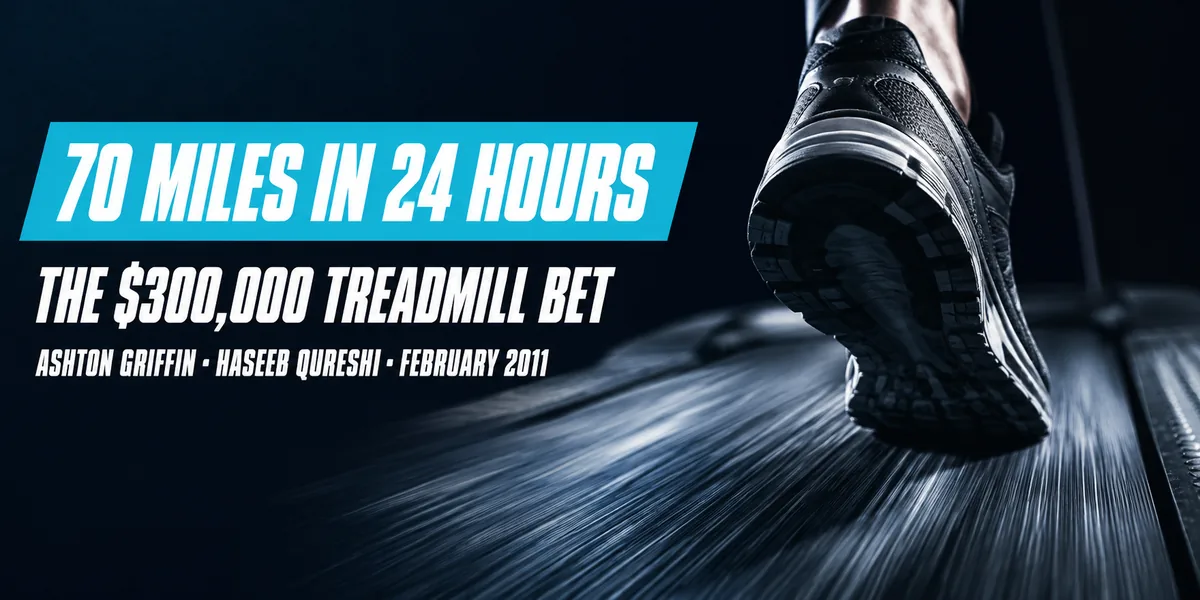
In February 2011, Ashton Griffin ran 70 miles on a treadmill inside 24 hours to win $300,000 from the man he lived with. He had slept about four hours and spent the previous night drinking. Almost nobody who watched it thought he would finish.
It has been retold constantly since, most recently on a podcast with six figures of views. Those retellings get the money wrong, the timing wrong and the athlete wrong.
Haseeb Qureshi, the man who lost, wrote it all down within days. That account is why we know what happened.
How the Prop Bet Came Together in Nine Minutes
Griffin had been out the night before at an Orlando Magic game, then a concert, then a bar. He got home at around 3am and slept perhaps four hours. By late morning he was at his computer on Skype, trying to find someone to bet against him.
His target was Justin Smith, and Smith would not bite. Each time he hesitated, Griffin sweetened the price: even money, then 2-1, then 3-1, then 3.5-1. Smith said he was going to sleep and hung up.
The offer was simple to state.
- Distance: 70 miles, a little under three marathons, all of it indoors on a treadmill.
- Clock: 24 hours, starting the moment he stepped on.
- No walking: anything below a set running speed did not count toward the total.
- Breaks: unlimited. Griffin could stop as often as he liked, but the clock never did.
Griffin turned to his housemate. Haseeb Qureshi had watched him lose money on impulsive wagers for years and had never once taken part. This time he booked it at 3-1, putting up $70,000 against Griffin's $210,000.
Everything that follows comes from Qureshi's own account of the bet, written days afterwards.
Griffin finished his doughnuts, went upstairs to change into shorts, and started running at 12:30pm.
What Griffin Had Actually Run Before
The popular version of this story treats Griffin as a man with no running background at all, which is what makes the result sound impossible. It is also wrong, and it changes how the bet should be read.
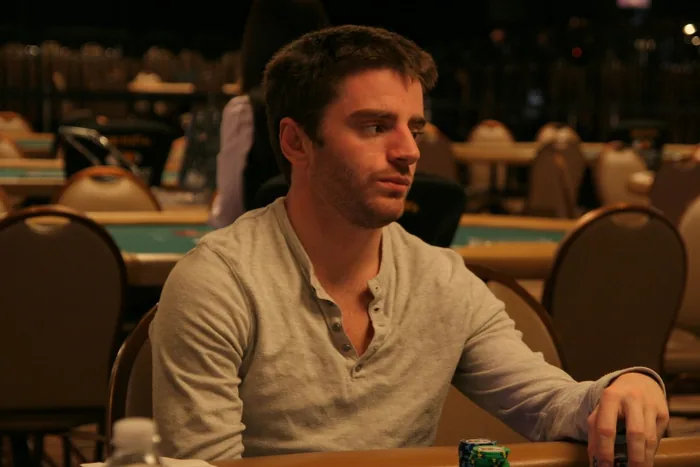
He had run cross-country at high school and wrestled at collegiate level. He had covered 13 miles just a couple of days earlier. He was extremely fit.
That gap is what Qureshi was betting on. Not fitness, and not willpower. He was betting that a body with no endurance base would break somewhere between 22 miles and 70.
Griffin ran it in spaced blocks of roughly ten miles rather than grinding it out in one go, which cut his injury risk considerably. It was a more calculated run than the story usually allows for.
Why $210,000 Became $900,000
At around 2pm, a few hours into the run, Griffin texted from the gym. He was looking for more action. He wanted to get his own exposure up to $900,000, and he was going to sell the rest of it to whoever would take it.
Qureshi's read was that his friend was giving money away and that somebody was going to catch it. He texted back offering to buy the remainder himself. His own stake went from $70,000 to $285,000.
| Position | Griffin risks | Qureshi risks | Qureshi wins if Griffin fails |
|---|---|---|---|
| Opening bet, 3-1 | $210,000 | $70,000 | $210,000 |
| After the top-up | $900,000 | $285,000 | $855,000 |
| Total booked against Griffin | $900,000 | $300,000 | Split with others |
A swing of that size against $855,000 on a single afternoon is why it became known as the million dollar bet. Roughly $15,000 of the $300,000 sat with other people. Accounts differ on exactly who held it.
Qureshi later wrote that the biggest wager he had made on anything before that day was under $1,000.
The Night the Parents Arrived
Griffin could not sleep. He came back to the house three times through the evening to try, and each time he was out of the door again within minutes.
By 11pm he had 30 miles down, with midnight as the halfway mark on the clock.
| Time | Where the bet stood |
|---|---|
| 12:30pm Friday | Clock starts, Griffin heads to the gym |
| 4:00pm | First attempt to sleep, back out within ten minutes |
| 6:00pm | Second attempt, out again just as fast |
| 9:30pm | Third attempt, the longest rest of the night |
| 11:00pm | 30 miles down, behind the pace he needed |
| 11:30pm | Parents arrive from Fort Lauderdale |
| 12:30am | Back on the treadmill after a bowl of spaghetti |
Qureshi was not watching alone. Doug Polk was in the house that week and had taken a small piece of the action himself, years before the career that made Polk's name.
Then Griffin's parents arrived, having driven three hours from Fort Lauderdale after he called his mother and asked for help. She had assumed the people betting against her son were strangers. Qureshi told her in the kitchen that it was him.
She could not stop him either. Griffin came downstairs shortly after midnight in a hoodie and ate a bowl of spaghetti at his desk.
He played a dubstep track he wanted everyone to hear and drummed on the desk while he ate. Then he changed back into shorts and went out of the door.
The Buyout Griffin Offered at 60 Miles
By 7am, Griffin had used 78% of his clock and covered 77% of the distance. It was close enough that either result looked live. Qureshi had by then stopped being able to watch him run at all.
At around 9am, with 60 miles done and three hours left, Griffin sent an offer. Qureshi could buy his way out for $200,000 rather than risk his whole position.
Griffin came through the front door shortly before noon, inside the final hour. His stepfather had to help him up the stairs and he could barely lift his legs. He could still walk, which is how Qureshi knew he had lost.
Griffin got into a bath of Epsom salts and asked for pancakes.
What the Retellings Get Wrong
Griffin's run has become a set-piece anecdote, and the details have drifted a long way from the record. The latest telling came from Doug Polk, who was in the house for all of it.
Polk is candid throughout that he is recalling rather than reading, and hedges most of the figures himself. These are the details worth correcting.
| The popular version | What the record shows |
|---|---|
| Finished with four or five hours spare | Inside the final hour. Reports at the time ranged from 30 to 60 minutes |
| No running background | High-school cross-country, collegiate wrestling, 13 miles days earlier |
| Quit at 10 to 15 miles, found collapsed | 30 miles by 11pm, and he never stopped for longer than a few minutes |
| Stake climbed through 500k to a million | Booked at $70,000 against $210,000, then topped up once to $900,000 |
| Qureshi bet $750,000 | $285,000 of a $300,000 total booked against Griffin |
| Qureshi could not cover the loss | Unsupported. He wrote at the time that it would hurt but he would be fine |
| Griffin dropped off the map afterwards | Still playing. His most recent recorded cash came in July 2026 |
The $750,000 figure comes from this post by Jason Mo, made more than a decade after the bet.
Haseeb once bet $750k against someone being able to run 70 miles on a treadmill in 24 hours. Didn’t have $750k to lose but thought it was a lock. Ended up losing and had to borrow money from a friend who he paid back in “life coaching”
True story pic.twitter.com/qJce5s7Cs4
— jmo (@cuntycakes123) October 24, 2025
Mo was not in the house that weekend. His figure conflicts with the only first-hand written account anyone involved has produced, in which Qureshi puts his own stake at $285,000 and describes the loss as painful but survivable.
Prop bets on this scale have become rarer since. Our roundup of the biggest recent prop bets covers what replaced them.
Griffin's Own Verdict
The moral question sat over the story from the moment Griffin's mother walked in. Griffin answered it publicly soon afterwards, speaking to ESPN in the days after the run, and he was unambiguous.
“I wanted the action and he thought it was a good bet for him. I was going to make the bet regardless of whether he was the one I'd make it with.” – Ashton Griffin
Qureshi was less forgiving of himself. He had spent the night imagining his friend's knees giving way, and he wrote afterwards that the experience made him question what the game was doing to the people in it.
He had also heard Griffin say, at the concert the night before the bet, that he had not been happy in a long time. That context sits underneath the whole story and rarely survives the retelling.
Where Both Men Ended Up
Fifteen years on, the two sides of the bet have gone in opposite directions. One stayed in poker and one used it as the exit.
- Ashton Griffin: still playing. His recorded live earnings stand at $1,325,267 across 70 cashes, with a best result of $560,000.
- Haseeb Qureshi: left poker within a few years, wrote a book about the game, and now works as a managing partner at a crypto investment firm.
- Doug Polk: took only a small piece of the action and went on to build one of the biggest followings in poker.
- The friendship: both men have said publicly that neither blamed the other, though Qureshi moved out of the house within days.
The treadmill was never Griffin's biggest payday. He won $560,000 at a $25,000 high roller shootout in Las Vegas in 2010, a year before the bet, and that still stands as his best live result.
Those earnings are Hendon Mob's recorded figures, checked on 10 September 2026. He plays rarely now, so they move slowly.
Qureshi has never come back to the game.
For more from the era that produced them both, browse our latest poker news coverage.
