

The 57th World Series of Poker starts on May 26 at Horseshoe and Paris Las Vegas. Four days out, the biggest story in poker has nothing to do with cards. It's about what players are allowed to wear.
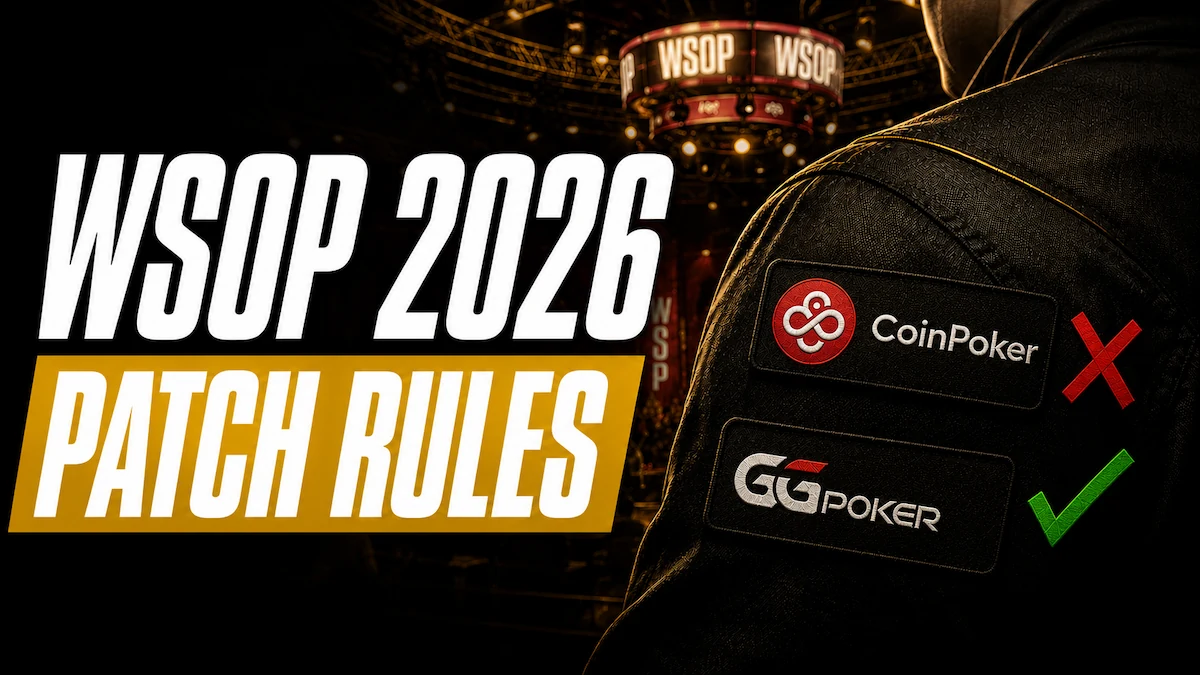
The WSOP rewrote Rule 52 for 2026. Every sponsored player must now submit patch approval requests in writing at least 24 hours in advance. Show up with an unapproved logo and you face disqualification, forfeiture of your buy-in, and loss of any winnings.
Patrick Leonard, a CoinPoker ambassador, was the first player to publicly reveal his patch request was denied. His post on X reached millions of views and initially left his WSOP participation in doubt.
On May 21, Leonard shared an update: WSOP approved a different sponsor, bitB, for his use at the series. His CoinPoker patch remains denied, but Leonard confirmed he will play.
Patrick Leonard on X (May 21, 2026): “Thanks @WSOP for not making it personal and blocking other patches. Appreciate it and see you next week!”
The story exposed a question nobody has answered in one place: which brands are approved, which are banned, and what do you actually need to do?
This guide breaks down the WSOP 2026 patch rules and the rule changes specific to sponsorship: what changed from 2025, the approved and denied brand list, the submission process straight from the rulebook, and what this costs mid-stakes grinders financially. For the full schedule, see our WSOP 2026 hub.
What Changed: Rule 52 in 2025 vs 2026
In 2025, Rule 52 was minimal. Players had to sign a participant release form before entering an event, and that was it. No pre-approval for patches, no restrictions on what you could wear, and up to three players from the same sponsor could sit at a feature table.
The 2026 version is a full rewrite, triggered directly by the 2025 Millionaire Maker scandal. ClubWPT Gold ran a promotion offering a $1 million bonus tied to bracelet wins for designated players wearing their patch. The heads-up between Jesse Yaginuma and James Carroll ended with chip dumping accusations, no bracelet awarded, and both players banned for life from Caesars properties.
2025 vs 2026 Rule 52: Side by Side
| Detail | 2025 Rule 52 | 2026 Rule 52 |
|---|---|---|
| Pre-approval required? | No | Yes, written approval mandatory |
| How to submit | N/A | Email sponsorship@wsop.com |
| Deadline | N/A | At least 24 hours before display |
| Scope | Participant release form only | Logos, patches, and promotional language of any kind |
| Where it applies | N/A | Feature tables (multiple outlets reported the May 19 final rulebook extends this to all tournament play) |
| Same-sponsor table limit | 3 players per feature table | 2 players per feature table (high-card draw if 3+ arrive) |
| Penalty for non-compliance | None specified | Disqualification + forfeiture of buy-in and winnings |
| Can patches be added mid-session? | Not addressed | No. No patches, logos, or promo language can be added after the session starts |
What Content Is Restricted
The WSOP also listed specific categories of content that will not be approved under any circumstances, regardless of the brand.
- Unregulated gambling: promotion of illegal or unregulated gambling sites in the United States, including offshore crypto casinos.
- Controversial material: obscene language, vulgarity, or pornographic content.
- Harmful products: non-prescription drugs, tobacco, firearms, or ammunition.
- False claims: misleading information, unauthorized lotteries, or libelous material.
- Intellectual property: unauthorized use of copyrighted logos, images, or text.
- Prejudicial to WSOP: anything the WSOP deems harmful to its brand, host properties, or television partners.
That last category is the broadest. It gives the WSOP unilateral discretion to reject any logo for commercial reasons, even if the brand is fully legal and regulated. This is the clause that enables selective enforcement.
Which Brands Are Approved and Which Are Denied
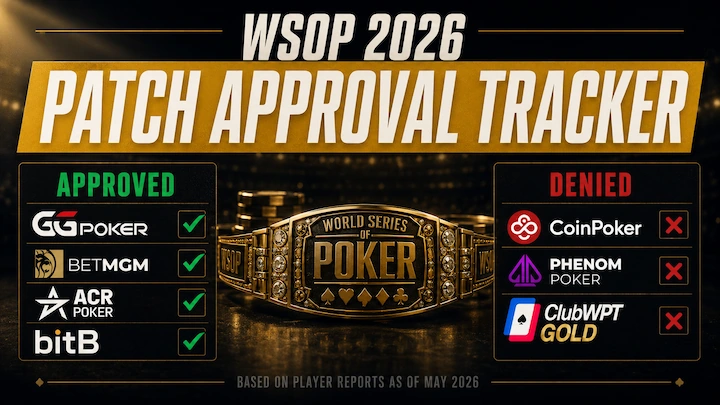
Despite the attention the WSOP patch ban has received, no official list of approved or denied brands has been published. What exists is a running list shared by Shaun Deeb on X, corroborated by multiple poker outlets.
Below is our WSOP 2026 approved and denied patches list, based on public player reports and media coverage. Every entry includes its source so you can verify it yourself.
Last updated: May 22, 2026. New: bitB approved for Patrick Leonard (May 21). Leonard confirmed he will play the series. This table will be updated as new approvals or denials become public.
WSOP 2026 Patch Approval Tracker
| Brand | Status | Source |
|---|---|---|
| GGPoker | Approved | Official WSOP partner |
| BetMGM | Approved | Reported by Joey Ingram on X, corroborated by Poker.org |
| ACR (Americas Cardroom) | Approved | Reported by Shaun Deeb's running list per Poker.org and SoMuchPoker |
| PokerStars | Expected approved | SoMuchPoker reported “expected to get the green light” |
| BetRivers | Expected approved | SoMuchPoker reported “expected to get the green light” |
| bitB | Approved | Patrick Leonard shared WSOP approval email on X (May 21, 2026) |
| CoinPoker | Denied | Patrick Leonard confirmed directly on X (May 15, 2026) |
| Phenom Poker | Denied | Reported by Shaun Deeb's running list per Poker.org and Spadepoker |
| ClubWPT Gold | Denied | Reported by Shaun Deeb's running list per Poker.org |
What Stands Out
The denied brands fall into two categories. CoinPoker and Phenom Poker are offshore poker sites that are unregulated in the US. ClubWPT Gold is a WPT product and a direct WSOP competitor, denied in the wake of the Millionaire Maker scandal.
On the approved side, BetMGM, PokerStars, and BetRivers all hold US state licenses. That tracks with the “unregulated gambling” restriction in Rule 52.
The exception is ACR. Americas Cardroom is not regulated in the US and operates offshore, yet it has reportedly been approved. That inconsistency has drawn public criticism from Shaun Deeb and from Joe Ingram who has form here. We break down why the logic doesn't add up later in this article.
How to Submit a Patch Approval Request
Here is what the official rulebook requires, step by step.
- 1Email sponsorship@wsop.com with your request. This is the official address listed in the 2026 WSOP Tournament Rules PDF.
- 2Include three details: the name of your sponsor, the specific logo you plan to display, and its exact placement on your clothing.
- 3Submit at least 24 hours before you plan to display the patch. This is the minimum. Earlier is better.
- 4Wait for written approval. Verbal confirmation is not enough. The rulebook specifies that consent must be in writing.
- 5Do not add any patch after the session starts. The rule is explicit: no logos, patches, or promotional language can be added once play begins for that day.
What If Your Table Gets Randomly Selected for Streaming?
This is the question PokerStars Team Pro Maria Konnikova raised on X.
Feature tables at the WSOP are not always announced in advance. Your Day 1 table could be pulled for a live stream with little warning.
If your sponsor entity sends multiple players to the WSOP, PokerScout reported that larger organizations can submit a single bulk approval covering all players who wear their logo. This could save time if your sponsor coordinates it in advance.
What Happens If Three or More Players Share a Sponsor at a Feature Table
The 2026 rules cap same-sponsor representation at two players per feature table. If three or more players wearing the same brand end up at a streamed table, they must agree among themselves who removes their patch.
If they can't agree, a WSOP official conducts a high-card draw. The losing player either covers the logo or changes their clothing before play begins.
The Inconsistency Problem: ACR vs CoinPoker
On paper, ACR and CoinPoker have a lot in common. Both operate offshore. Neither is regulated in the United States. Both serve an international player base and accept crypto deposits.
One was reportedly approved. The other was denied.
The Facts
- CoinPoker lists the United States as a restricted territory in its own terms and conditions.
- ACR does not restrict US players. It has actively marketed to American grinders for over a decade.
- PokerNewsDaily reported that patch approvals must be cleared by both the WSOP and GGPoker. CoinPoker is a direct competitor to GGPoker in the crypto poker space.
- CoinPoker has been aggressively signing ambassadors in recent months. Poker journalist Barry Carter noted that CoinPoker appears to be targeted partly because they are 'the new kid on the block who have been endorsing a vast number of poker players.'
The Crypto Apparel Angle
There is another layer to this. GipsyTeam's rule-by-rule comparison noted that the 2025 prohibition on cryptocurrency-branded apparel was removed from the 2026 rulebook. That means patches for crypto exchanges like Kraken or Coinbase would no longer be automatically blocked.
But crypto poker sites are still being denied under the “unregulated gambling” restriction. The distinction matters: crypto as a payment method is fine, but crypto as a poker platform is not, at least not according to how the WSOP appears to be applying Rule 52 this year.
What This Tells Us
The WSOP has not explained its approval criteria publicly. No official statement has been issued as of May 22, 2026. Based on the pattern of approvals and denials, three factors appear to drive the decisions:
- US regulatory status: brands with US state licenses (BetMGM, PokerStars, BetRivers) get approved. Brands that restrict US players in their own terms (CoinPoker) get denied.
- Direct competition with WSOP/GGPoker: ClubWPT Gold (WPT product) and CoinPoker (GGPoker competitor) were both denied. ACR, which occupies a different market segment, was reportedly approved.
- Recent controversy: ClubWPT Gold's Millionaire Maker promotion directly triggered these rule changes. That brand was always going to be denied.
None of this is confirmed by the WSOP. These are patterns drawn from the available evidence. The ACR approval remains the data point that doesn't fit cleanly into any framework, and it's the one most likely to generate further debate once the series begins.
What This Costs Mid-Stakes Grinders
Most of the coverage around this story has focused on Patrick Leonard and other high-profile names. But the players hit hardest by the WSOP patch ban are mid-stakes grinders, streamers, and content creators who rely on sponsorship money to fund their summer.
A typical patch deal for a non-celebrity grinder can cover anywhere from $5,000 to $20,000 of a WSOP summer. That money goes directly toward buy-ins, travel, and housing in Las Vegas. Many professionals offset their costs by selling sponsor patch space on their clothing.
If your sponsor gets denied under Rule 52, you face two options:
- Play without the patch: most sponsorship contracts require visible logo placement. If you can't wear the patch, you likely void the deal and lose the funding.
- Skip events: some sponsored players may reduce their schedule or sit out entirely, losing tournament equity on top of the sponsorship income.
Mid-stakes pros, streamers, and content creators are the group most affected by the new rules. For players operating on thin margins, this is not a branding debate. It is a direct hit to their summer bankroll.
Leonard himself made this point on X when his CoinPoker patch was denied. He has since secured approval for a different sponsor (bitB) and confirmed he will play, but his original concern stands: the restrictions discourage sites from investing in players.
Several poker pros are already skipping the 2026 WSOP for various reasons, and sponsorship uncertainty adds another factor to that list.
Rule 40(e): The Third-Party Prop Bet Ban
The patch rules are only half of the 2026 crackdown. Rule 40(e) now explicitly bans players from accepting any payment or prize from a third-party entity based on the outcome of a WSOP event. The penalty is forfeiture of all WSOP prize money, recoverable with interest if already paid out.
This rule exists because of ClubWPT Gold. Their $1 million bracelet bonus created a direct financial incentive that the WSOP concluded compromised tournament integrity.
What Is and Isn't Banned
- Banned: a company offering you a cash bonus for winning a WSOP event (e.g., 'win a bracelet wearing our patch and we'll pay you $1M').
- Banned: any third-party promotion that ties a payout to your WSOP results.
- Not banned: normal player-to-player prop bets, last-longers, and side action between friends.
- Not banned: backing deals, staking arrangements, and standard swaps.
The distinction matters for grinders. Selling pieces of your action, running last-longers with your group, and swapping percentages with friends are all standard parts of a WSOP summer. Rule 40(e) does not appear to target any of those arrangements based on the current rulebook language, per PokerFlops' analysis of the rule.
What Happens Next
The 2026 WSOP begins on May 26. The rules are set, but enforcement will tell the real story. This article will be updated throughout the series as new brands are approved or denied, and as on-floor decisions clarify how strictly the WSOP 2026 patch rules are enforced in practice.
For the full storylines heading into this summer, see our WSOP 2026 preview.
