

The Mental Game of Poker 2026: Tilt, Focus and Emotional Control
You can play perfect poker for an hour and lose a week of profit in the next ten minutes. That ten minute leak does not show up in any tracker, and no solver in the world can fix it. It is called tilt, and it is the single biggest reason winning players have losing months.
Most poker advice tells you tilt is about emotions. That is half the picture. Tilt is also math, and the numbers are worse than most players think.
This guide is for grinders who want practical answers, not generic advice. The math of variance and the rules of bankroll management sit in their own dedicated guides on this site, linked where they fit. Here is what this guide covers:
- The seven types of tilt with specific triggers, table behaviors, and fixes for each one
- What tilt actually costs you in dollars and hours at every stake from NL25 to NL200
- A complete prevention routine you can run before, during, and after every session
- How to measure your mental game so you know whether you are actually improving month over month
What the Mental Game Actually Is (and Why Tilt Is a Skill Gap)
Every poker player has two versions of themselves at the table. The A-game version makes clean reads, folds the right marginal hands, and trusts the math. The C-game version calls down with third pair, reloads on tilt, and spews chips trying to win back a pot that was lost ten minutes ago.
The mental game is not about being calm or confident or positive. It is about closing the gap between those two versions of you, because that gap is where most of your yearly profit lives or dies.
The Gap Between Your A-Game and C-Game
Every player sits somewhere on a curve. Your best days are your A-game, your worst days are your C-game, and most sessions land somewhere in the middle.
Mental game coaching research puts a hard number on this: shifting just twenty percent of your sessions from C-game to A-game can nearly double your win rate. That is a bigger edge than almost any strategic improvement you can buy.
Here is the uncomfortable part. Your real win rate is not how well you play when everything is going right. It is the average of every session you play, including the ones where you were tired, tilted, distracted, or chasing a losing day.
Why Your Brain Hijacks Itself on Bad Beats
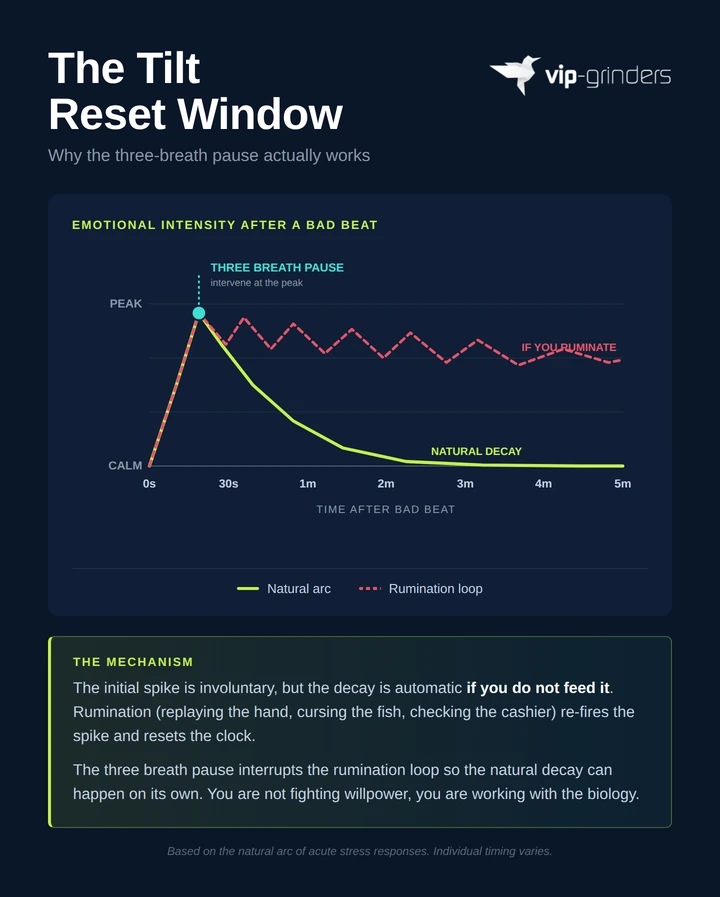
Tilt feels like a choice, but the first few seconds of it are not. When you lose a big pot to a bad beat, the emotional part of your brain reacts before the thinking part can catch up. Scientists call this an amygdala hijack.
Your emotional brain is faster than your thinking brain. It reads a bad beat as an attack and puts your body into stress mode before your thinking brain can step in. That is why “just play through it” almost never works.
The good news is this is trainable. Every time you pause and let your thinking brain come back, you train yourself to pull out of tilt faster next time. Working on your mental game is a real change in how your brain handles pressure, not a personality upgrade.
Tilt Is a Skill Gap, Not a Character Flaw
Most players treat tilt as a moral failing. They feel ashamed when they tilt, hide it from friends, and beat themselves up for not being tougher. That framing is wrong and it makes the problem worse.
Tilt is a skill gap the same way a leaky c-bet strategy is a skill gap. It can be spotted, studied, and fixed with the right approach. Treating it as a personal failure turns every tilt episode into a crisis instead of a leak you can patch.
The grinders who fix their mental game fastest are the ones who stop asking “what is wrong with me” and start asking “what is the leak and how do I patch it.” That shift is the entire point of this guide.
The Seven Types of Tilt Every Grinder Faces
Most players talk about tilt like it is one thing. It is not. There are at least seven different kinds of tilt, each with its own trigger and its own fix, and knowing which one you have is the first step to stopping it.
The list below comes from mental game coach Jared Tendler, whose work has been the industry standard for more than a decade. Read through each one and be honest about which ones you recognize in your own game. Most grinders have two or three tilt types they hit most often, not all seven.
| Tilt Type | What Triggers It | How It Shows Up at the Table | The Fix |
|---|---|---|---|
| Running Bad Tilt | A long losing streak where nothing seems to work. | Despair, changing your strategy mid session, feeling like the site is rigged. | Accept that riding out bad runs is part of the job. You cannot dodge bad variance. |
| Injustice Tilt | Bad beats and suck outs, especially on big pots. | Outrage, chat box complaints, feeling personally targeted by the deck. | Remind yourself that bad beats are the reason fish keep playing. No variance, no profit. |
| Hate Losing Tilt | Any loss, even a small one from a correct fold. | Frustration out of proportion to the size of the loss, tying your mood to session P&L. | Separate how well you played from whether you won. Grade the decision, not the result. |
| Mistake Tilt | Making a known error you have been trying to fix. | Self-berating, spiraling into more mistakes, tilt about being on tilt. | Compare today’s worst decisions to your worst decisions six months ago, not to your best ones. |
| Entitlement Tilt | Feeling you deserve to win because you are better than the table. | Lazy play, overconfident stack offs, rage when a weaker player sucks out. | Recognize that weaker players winning sometimes is exactly why the game stays profitable for you. |
| Revenge Tilt | One specific opponent who cracked you or who talks trash. | Targeting that player with bad bluffs, ignoring the rest of the table. | Remember you are playing the whole table. Chasing one opponent wrecks your strategy against everyone else. |
| Desperation Tilt | Being stuck a lot and wanting to get even. | Wild bluffs, reckless all ins, moving up stakes to win it back faster. | Pre-set a stop loss before you sit down. One session is too small a sample to “get even” in anyway. |
Two More Worth Naming
Two types not on Tendler’s original list show up often enough in online play to be worth naming. Winner’s tilt is overconfidence after a hot streak, where you start punting with weaker hands because you feel untouchable. Boredom tilt is the opposite: the slow drift into autopilot and loose calls because nothing interesting has happened in thirty minutes.
Both follow the same rule as the seven above. Recognize the trigger, name the tilt, and apply the fix before the next hand is dealt.
Why Naming the Tilt Matters
There is a real reason naming the tilt helps. Brain research shows that giving a feeling a specific name calms you down faster than trying to push the feeling away. “I am tilted” is too vague to fight, but “this is injustice tilt from the cooler on table three” is specific enough to actually do something with.
Over time, just the habit of naming your tilt type in the moment will shorten how long each episode lasts. You cannot fix a leak you cannot see.
When tilt shows up as external behavior, like berating a dealer after a bad beat or typing insults in the chat box, it also becomes an etiquette violation that damages your reputation and drives recreational players away from the table.
What Tilt Actually Costs You (The Math No One Else Shows You)
Most articles tell you tilt is expensive. None of them tell you how expensive. The number matters because once you see it, you stop thinking of tilt as a bad feeling and start thinking of it as the biggest hole in your monthly profit.
Here is the math, in plain dollars, for a typical tilt episode at low and mid stakes.
A Normal Tilt Episode at NL50
You sit down at NL50, which is the $0.25/$0.50 cash game with a $50 buy in. You lose a big pot on a cooler in the first thirty minutes. Instead of walking away, you reload, then reload again, and by the time you finally close the tables you are down five buy ins, which is $250 gone.
Five buy ins lost to tilt is not a worst case scenario. It is a perfectly normal tilt episode that most grinders have lived through more than once. The question nobody answers is how much work it takes to win that money back.
How Long It Takes to Earn That Back
A solid winning player at NL50 earns roughly three big blinds per hundred hands. Three big blinds at NL50 is $1.50. In plain terms: for every hundred hands you play, you earn about a dollar fifty in profit.
To win back $250 at that rate, you need to play around 16,700 hands of clean, focused, non-tilted poker. If you four table online at about five hundred hands per hour, that is roughly 33 hours at the tables. A full grinding week, erased by one bad thirty minute stretch.
The table below shows how this math plays out across different stakes. The dollar amounts change. The hours needed to recover do not, because both your tilt cost and your win rate grow as the stakes grow.
| Stake | 5 Buy-In Tilt Cost | Hands to Recover | Hours at 4 Tables |
|---|---|---|---|
| NL25 | $125 | ~16,700 | ~33 hours |
| NL50 | $250 | ~16,700 | ~33 hours |
| NL100 | $500 | ~16,700 | ~33 hours |
| NL200 | $1,000 | ~16,700 | ~33 hours |
The number that should stop you is the hours column. One tilt episode, at any stake, costs you a full grinding week of normal play. That is the real exchange rate: thirty minutes of tilt for thirty plus hours of clean work to get back to even.
And this assumes the recovery stretch itself is tilt free. If you tilt again during those 33 hours, which most grinders do, the hole gets deeper before it gets filled.
The Monthly Compound
Most grinders do not tilt once a month. They tilt two to four times in a typical month, with one bigger blowup every six to eight weeks. Run the numbers across a year and uncontrolled tilt often costs more than the profit a winning player makes that whole year.
This is why mental game is not a wellness topic. It is the biggest leak in most winning players’ games, and it is the one almost nobody works on. Tilt costs 0.5 to 9 bb/100 depending on severity, ranking it among the most expensive poker mistakes you can make. Every other edge you can buy, from better preflop ranges to solver study, is smaller than what you gain by closing the tilt hole.
One more thing before we move on: rakeback changes this math. A good rakeback deal cushions every one of those losing sessions, which gets its own section later in this guide.
Tilt Triggers Are Different in Every Format
Most mental game advice is written as if every poker player is a cash game grinder. That is a problem, because the tilt triggers in cash games are almost nothing like the ones in tournaments, and both are different again from Spin and Gos or fast fold pools.
Each format has its own built in traps. Knowing your format’s traps cuts your tilt episodes faster than any generic advice ever will.
Cash Game Tilt: The Reload Button
Cash game tilt almost always comes from one feature of the format: you can reload. A tournament ends when your stack is gone, but a cash game never does. That one fact causes more tilt losses than any bad beat.
The triggers are specific. You lose a stack and reload on autopilot, then sit there grinding back to even while your decision quality drops by the minute. You refuse to close the tables because the session P&L is red and walking away would make the loss feel real.
The counter is to track your results in big blinds, not dollars, and to hide the cashier from view during the session. If you never see “down $250” on a screen, your emotional brain has nothing concrete to chase. Pair this with a pre-set stack loss limit and most cash game tilt disappears before it starts.
MTT Tilt: Bubble Pressure and Re-Entry Traps
Tournament tilt peaks in two places. The first is the money bubble, where folding and busting start to feel the same even though one sends you home empty and the other locks up real money. The second is the moment you bust, when the re-entry button starts calling your name.
Bubble tilt comes from how tournaments pay out, not from bad strategy. Players who have been grinding for five hours start folding hands they know are profitable shoves because busting feels worse than folding. The fix is to remind yourself before every bubble that correct decisions cost you money in the short term and pay you back many times over across a career. Our poker bubble strategy guide covers the exact math behind these decisions so you can trust the shove instead of fearing the bust.
Re-entry tilt is the bigger wallet killer. You bust the $22 and immediately register the $55 to win it back faster, then bust that and jump to the $109. Cap your re-entries before the day starts, write the number down, and treat it as unbreakable once you sit down.
Spin and Go Tilt: Designed Variance
Spin and Gos are built on variance the way roller coasters are built on falls. The format means most of your profit comes from a small number of big multiplier hits, and most sessions feel like nothing is working. A losing run of fifty buy ins is normal, not a disaster.
The problem is that the format gives you no time to process the swings. You are into the next game three seconds after the last one ends, which means every cooler and every cold run piles on top of the last one before you can breathe. Playing on autopilot because of the speed is the real enemy.
The counter is short breaks you force yourself to take. Every twenty games, pause for sixty seconds: stand up, drink water, take three breaths, then sit back down. It feels like nothing when you do it, but it changes your session results across a month of volume.
Fast Fold Tilt: The Autopilot Trap
Fast fold pools like Zoom and Rush and Cash have their own mental game problem, and it is the opposite of the others. There are no bad beats that stick in your head because you never see the same opponent twice, and there are no table dynamics to keep you locked in. The tilt here is not about emotions, it is about focus.
The format invites pure autopilot. You fold, fold, fold, pick up a hand, click buttons, fold again, and two hours later you have played a thousand hands you will never remember. Your decisions get worse without any obvious signal that something is wrong.
The fix is to play fast fold in blocks, not marathons. Four hundred to five hundred hands, then stop and review at least three tagged hands before the next block. The review is not optional, it is the only thing that proves to your brain you are still paying attention.
Your Complete Tilt Prevention Routine (Before, During and After)
The best way to beat tilt is to not get to it in the first place. Most players try to fight tilt in the middle of a session, which is the hardest possible moment to win that fight. Your thinking brain is already offline by then.
What works instead is a routine that runs before, during and after every session. None of the steps take long, and none of them are hard. The only thing that matters is that you do them every time, not just on the days you feel like it.
Before You Sit Down: The Five Minute Warm Up
A good pre-session routine takes five minutes and does three things: it wakes up your thinking brain, it picks a target for the session, and it kills distractions before they become problems. Skip it and you start the session cold, which is exactly when mistakes show up.
Run these five steps in order every time:
The last step is the one most players skip, and it is the most important. Sitting down to grind when you are already at a 2 out of 5 on mood is how tilt episodes start before the first hand is dealt. Your stop loss rules and bankroll choices are the structural backbone here, and they live in their own dedicated bankroll management guide.
During the Session: The Three Circuit Breakers
No pre-session routine is perfect. Tilt will still show up sometimes, and when it does, you need three specific tools to cut it short before it costs you a stack.
The first is the three breath pause. Any time you feel your chest tighten or your jaw clench, pause for three slow breaths before your next action. This is not meditation, it is just long enough to let your thinking brain catch up to your emotional brain.
The second is the tilt meter. After every big pot, check in with yourself and rate it 1 to 5: 1 or 2 means you are fine, 3 means take a sixty second break, 4 means walk away from the screen for five minutes. At 5 you close the tables and end the session, no negotiation.
The third is tag and park. When a hand upsets you, tag it for review later and move on. Do not try to figure out what went wrong while you are still in the session, because that is how one bad hand turns into ten bad hands.
After the Session: The Five Minute Cool Down
What you do in the first five minutes after a session determines whether you carry the session into tomorrow or leave it at the table. Most players skip this step and wonder why yesterday’s losses show up in today’s decisions.
Run these three steps every time, win or lose:
The point of the cool down is to put a clean line between the session and the rest of your life. A session that never ends in your head is a session that tilts you before the next one even starts.
Why The Routine Works Even When It Feels Pointless
The first few times you run this routine it will feel like a waste of five minutes. Do it anyway. What you are really building is a habit your brain can fall back on when things get hard, and habits only work if they are already in place before you need them.
Players who run this routine consistently for a month report fewer tilt episodes, shorter tilt episodes when they happen, and better focus across the board. That is the whole point: not to be perfect, just to be steadier than you were last month.
The Physical Foundations Most Grinders Ignore
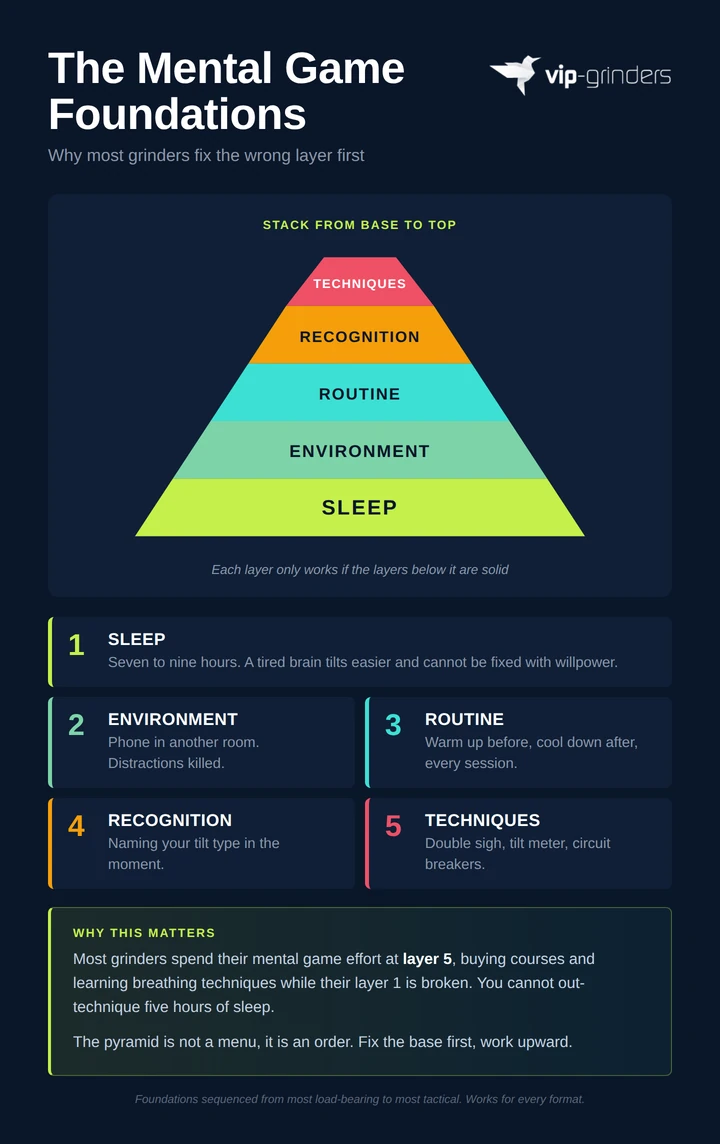
Most mental game content treats tilt like a thinking problem. It is not, at least not only. Half of the fight happens in your body, and if the body side is broken, no amount of willpower will fix the mind side.
The four things below are boring on purpose. They are also the highest return per hour of effort you can get anywhere in poker, and most grinders ignore them because they do not feel like “real” work.
Sleep: The One Nobody Takes Seriously Enough
A poker brain that is short on sleep is a poker brain that tilts easier, spots fewer reads, and forgets what it learned last week. This is not a motivational point, it is how the brain actually works. One or two hours of missed sleep a night hits the exact parts of the brain you need for poker the hardest.
Seven to nine hours is the target for most adults. Anything less and you are playing with a handicap that no amount of study can fix. Late night grinding to force volume is the fastest way to turn a winning week into a losing one, because the hours you play after midnight often give back everything you won earlier.
If there is one change in this whole guide worth making first, it is this one. Fix your sleep for two weeks and you will notice the difference in your game before anything else on this list kicks in.
Your Phone Is Costing You More Than You Think
You do not need to be on your phone for it to drain your focus. Research out of Stanford shows that just having your phone on the desk, face down and silent, makes your brain work worse. It is not the notifications, it is the object itself that splits your attention.
The fix is stupidly simple and stupidly effective. Put your phone in another room before you start. Not face down on the desk, not in a drawer next to you, another room entirely.
This one change alone is the difference between a focused session and a session full of mini autopilot lapses you never even notice. Treat your phone like you treat your cashier: if you cannot see it, it cannot hurt you.
Food, Water and Movement
Nobody plays their best game hungry, dehydrated or stiff. The body foundations are simple: eat a balanced meal about an hour before you play, keep water visible at the desk, and get up to move between sessions. That is it.
Heavy meals right before a session make you slow, and too much caffeine makes your hands shake and your decisions rushed. Sitting for four hours straight with no water is how you end up foggy at hour three without knowing why. None of this is mysterious, it is just the kind of thing grinders skip because it feels too basic to matter.
The Two Minute Breathing Fix
If you only remember one physical tool from this guide, remember this one. It comes from Stanford research that tested different breathing methods for stress and focus, and one method beat everything else including meditation.
It is called the double sigh. You take a deep breath in through the nose, then on top of that first breath you add a quick second sniff to fill your lungs all the way up. Then you let it all out slowly through the mouth in one long exhale.
Do that three times in a row when you feel a tilt wave starting, and you will feel your heart rate drop almost immediately. It works in about thirty seconds, it works in any chair, and nobody at your table will even notice you are doing it.
Multi-Tabling Is a Mental Game Problem, Not Just a Volume One
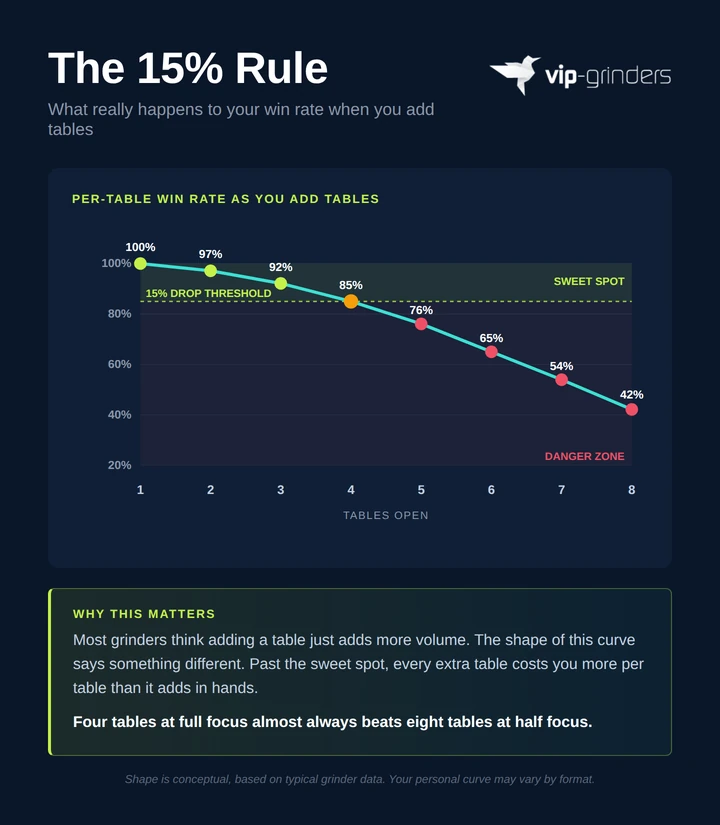
Most grinders think of multi-tabling as a math question: how many tables can I add before my win rate drops too much. That is only half the question. The other half is how many tables you can add before tilt starts spreading across all of them.
Nobody talks about this part, but it is the biggest hidden reason multi-tabler grinders have bad sessions without knowing why.
Tilt Spreads Across Tables
Here is what actually happens when you tilt while four tabling. You lose a big pot on Table 3, and for the next ten hands your focus is still on that hand, which means you are running on autopilot on Tables 1, 2 and 4. One bad beat just infected three other tables you were not even losing at.
This is why single table grinders often feel “more focused” than multi-tablers even when their win rate is lower. They are not actually more focused, they just have fewer places for tilt to leak into. When a multi-tabler tilts, the damage multiplies by the number of tables open.
The more tables you play, the faster a single tilt moment turns into a session wide problem. Volume does not just increase your profit, it increases your exposure to your own bad moments.
The 15 Percent Rule
Here is a simple way to know if you are playing too many tables. Track your per table win rate at your current table count for twenty thousand hands. Then drop one table and play another twenty thousand hands.
If your per table win rate jumps by more than fifteen percent after dropping a table, you were playing too many. The extra table was not adding volume, it was eating your edge. Most grinders find their real sweet spot is two or three tables lower than they thought. Our multi-tabling guide covers how to find that number by format, room, and HUD access.
The truth most players do not want to hear is that adding tables always feels fine until it stops feeling fine, and by then you have already been leaking for months.
Drop Tables Instead of Quitting
Here is a circuit breaker nobody teaches. When you feel a tilt wave starting, you do not have to quit. You can just close one or two tables and keep playing on the rest.
Dropping tables gives your thinking brain more room to work on each decision, which often stops the tilt spiral before it gets worse. It also keeps you in the game instead of forcing the all or nothing choice of “fight through it or end the session.”
This is the move to reach for before you hit the stop loss. Two fewer tables for the next thirty minutes will save you more money than white knuckling through eight tables on tilt ever will.
How to Actually Measure Your Mental Game
Every other article on this topic tells you to “track your tilt” without telling you how. That leaves most grinders doing nothing, because they do not know what to write down, where to write it, or what to look for when they do.
You do not need special software or a fancy system. You need a notebook and three minutes after every session.
Three Things to Write Down After Every Session
After you close the tables and do your five minute cool down from earlier in this guide, add these three lines to a notebook or a notes app. Same three things every time, no more, no less:
- 1Energy and focus, 1 to 5. How sharp did you feel during the session? Not how you ran, how you felt.
- 2Did you tilt? Yes or no. If yes, which type from the seven earlier in this guide, and what triggered it.
- 3Did you stick to your stop loss? Yes or no. If no, how many buy ins over the limit.
That is it. Three lines. You can do it on your phone in under sixty seconds once you get the habit down.
What to Look For After a Month
One session tells you nothing. A month of sessions tells you everything. After thirty days of writing down those three lines, you will start seeing patterns you could not see before.
You will notice that tilt shows up more on specific days, or at specific times, or after specific kinds of sessions. You will notice that your energy and focus scores track your mood at work, or your sleep, or your weekend plans. You will notice that the stop loss rule you keep breaking is the same one you keep promising yourself you will respect.
These patterns are the data that turns vague “I need to tilt less” into specific “I need to stop playing on Sunday nights after family dinner.” That is the whole point of tracking, and it is the part generic mental game advice never gets to because it skips the part where you write anything down.
The Rakeback Mental Game Edge
Here is the part of the mental game nobody else writes about. Your rakeback deal does not just pay you more money, it also changes how losing sessions feel. And how losing sessions feel is the single biggest factor in whether you tilt after them.
This is the edge VIP-Grinders players have that most other grinders do not. It is worth understanding even if you never play through our deals.
Why Rakeback Softens Losing Sessions
A grinder on a thirty percent rakeback deal is not really down what the scoreboard says they are down. Every losing session quietly pays back a chunk of the losses in the background, so the emotional sting of a bad day is smaller than the raw number on the cashier.
This matters more than most people think. A session that feels like “down two buy ins” at a site with no rakeback is the same session that feels like “down one and a half” at a site with a strong deal. The math is almost identical, but your brain does not feel them the same way, and your brain is the thing that decides whether you tilt into the next session.
Over a month, that smaller emotional sting adds up to fewer tilt episodes, shorter recovery time after the ones you do have, and steadier decisions on the days nothing is working. The deal you play on is quietly part of your mental game whether you realize it or not.
The VIP Volume Tilt Trap
There is a dark side to rakeback most grinders never think about. If you are chasing VIP levels or a monthly volume target, you are under pressure to play even on the days you should not.
That pressure pushes you to grind through sessions where your energy is at a 2 out of 5, where you should be studying instead, or where you should have quit an hour ago. The rakeback you were chasing gets paid back twice over in tilt losses, and the VIP level you were trying to protect becomes the reason you blew up in the first place.
The fix is to treat your VIP volume target the same way you treat your stop loss. Plan it across the month, not the day. Our session management guide covers how to schedule volume around promo deadlines without burning yourself out. Miss a session and make it up when you are fresh, because losing a stack on tilt always costs more than the VIP points you were chasing.
Choosing a Deal With Your Mental Game in Mind
Not every rakeback structure is built the same, and the right deal for you depends partly on how you handle variance. Flat weekly cashback feels steady and predictable, which helps if you tilt when things feel chaotic. Progressive VIP ladders pay more at the top but can push you into the volume trap if you are not careful with scheduling.
The cleanest approach is to pick a deal that pays you fairly without forcing you to grind on days you should be resting. Our exclusive rakeback deals are negotiated with this in mind, and every deal is sorted so you can see the structure before you commit to it.
Whatever deal you end up on, remember the principle. Rakeback is not just extra money, it is a quiet part of how you feel about your sessions. And how you feel about your sessions is most of the mental game.
Common Mental Game Mistakes That Cost You Money
The mistakes below are the ones that cost grinders the most money, and almost all of them come from mixing up what tilt is with how to fight it. Each one maps to a concept from earlier in this guide, and each one has a fix you can apply on your next session.
Read these the way you read the seven tilt types earlier. Be honest about which ones you have done in the last month, because those are the ones to fix first.
Every one of these mistakes comes from treating tilt as something to push through instead of something to manage. The tools in this guide work, but only if you are willing to admit you have a leak in the first place. The grinders who stay stuck are the ones who cannot name the mistake.
FAQs
What are the different types of tilt?
The most widely used model lists seven types: Running Bad Tilt, Injustice Tilt, Hate Losing Tilt, Mistake Tilt, Entitlement Tilt, Revenge Tilt and Desperation Tilt. Two more worth knowing for online play are Winner’s Tilt (overconfidence after a hot streak) and Boredom Tilt (autopilot from understimulation). Each one has its own trigger and its own fix, covered in detail earlier in this guide.
Can you completely eliminate tilt?
No, and anyone who tells you otherwise is selling something. Every player tilts sometimes, including the best in the world. The realistic goal is to recognize tilt faster, recover from it quicker, and stop it from spreading across a whole session.
How do I know if I am on tilt?
The physical signs are clenched jaw, tight chest, shallow breathing, and a hot face. The behavioral signs are calling hands you would normally fold, targeting one opponent with revenge bluffs, and caring more about getting even than playing well. If you catch any of these, pause for three slow breaths before your next decision.
How many buy ins should my stop loss be?
A common starting point for cash games is a three buy in table stop loss and a five buy in session stop loss. The important part is not the exact number, it is setting it before you sit down and sticking to it once you are playing. Your bankroll size and risk tolerance should shape the specific numbers you choose.
Should I quit when I am winning?
Not automatically. The right question is whether your decision quality is still at your A-game level, not whether you are up or down. If the table is good and your focus is sharp, keep playing, but if you are tired, tilted or distracted, quit regardless of the scoreboard.
Is mental game more important than poker strategy?
They are inseparable, but for most winning players mental game improvements return more money per hour of work. Shifting twenty percent of your sessions from your C-game to your A-game can nearly double your win rate, which is a bigger edge than almost any strategic change you can make. Strategy gets you to a winning baseline, mental game keeps you from throwing that baseline away.
What is the best book on poker mental game?
The Mental Game of Poker by Jared Tendler is the industry standard and the source of the seven tilt types covered in this guide. For a more modern take, Elliot Roe’s A-Game Poker (2024) works at the subconscious level and is the other commonly recommended title. Both are worth reading if you want to go deeper than a single article can go.
Does rakeback help with tilt?
Yes, in two ways. A solid rakeback deal softens the emotional sting of losing sessions because part of the loss is quietly paid back in the background, which means your brain does not get hit as hard. The only catch is that chasing VIP volume targets can push you to grind on days you should not play, so plan your volume across the month, not the day.