

Tom Goldstein was sentenced to 72 months in federal prison on Friday, July 24, 2026, for hiding millions in high stakes poker winnings from the IRS and making false statements to mortgage lenders.
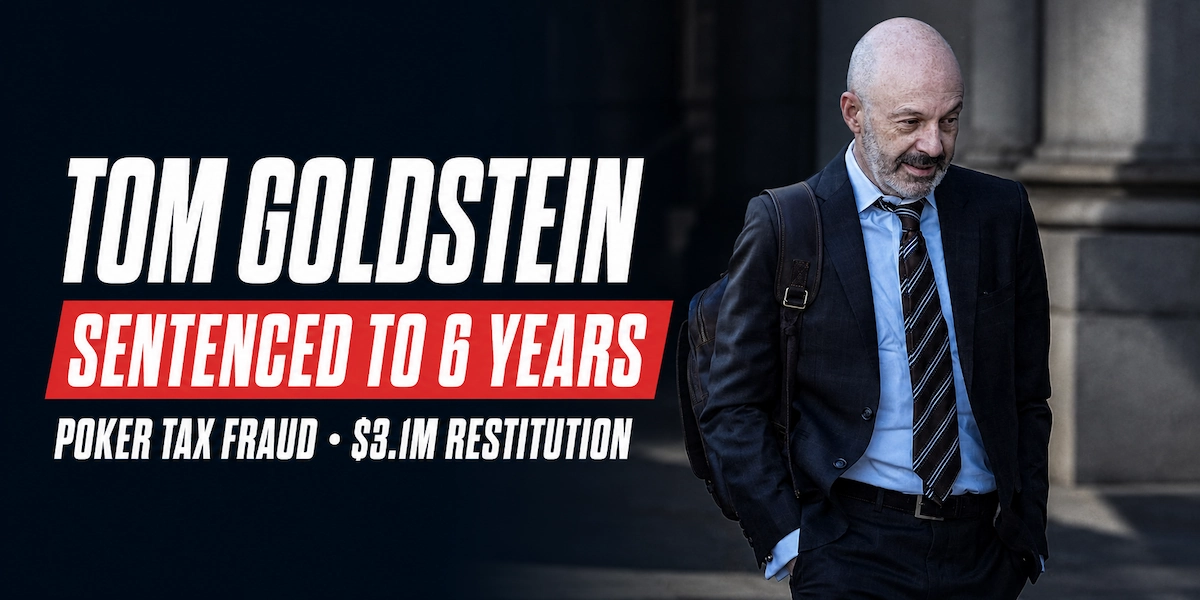
US District Judge Lydia Kay Griggsby added $3,103,427 in restitution and five years of supervised release, then revoked his bond as a flight risk. The SCOTUSblog co-founder, who argued 44 cases before the United States Supreme Court, removed his shoelaces and was handcuffed in the courtroom in Greenbelt, Maryland. There would be no bail pending appeal.
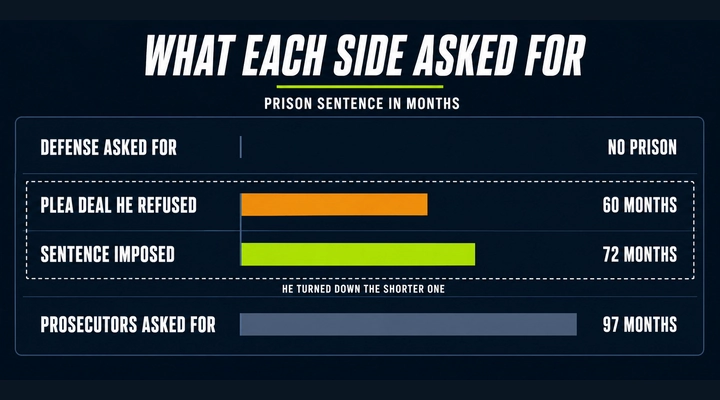
He was convicted in February on 12 of 16 counts after a six week trial and roughly two days of jury deliberation. Prosecutors asked for just over eight years. His lawyers asked for no prison time at all.
This article covers exactly what Griggsby imposed, the counts that stuck and the four that did not, and the heads up matches against Andy Beal and Alec Gores that produced the money at the center of the case.
How Many Years Tom Goldstein Got, and What Else the Court Imposed
Prosecutors wanted just over eight years. The defense argued for no custody at all, pointing to what they called a severe and longstanding gambling addiction and asking for supervision or home confinement instead.
Griggsby landed between them, and closer to the government.
| Item | What the Court Imposed |
|---|---|
| Prison term | 72 months (six years) |
| Restitution | $3,103,427 |
| Supervised release | Five years after release |
| Forfeiture | Ordered, amount left indeterminate |
| Bond | Revoked, remanded immediately |
| Bail pending appeal | Denied |
The remand was the sharpest turn of the day. Griggsby had resisted repeated government requests to jail Goldstein before trial, keeping him on release even after the February conviction. She said the posture of the case was different now.
His parents sat in the gallery and watched it happen. He joins a short list of other poker pros sentenced to jail, a line that runs back to Benny Binion in the 1950s.
What Goldstein Told the Court
He spoke before sentencing, and his voice broke partway through.
“There is no question that I have deeply disappointed people, that I have not held myself to standards that I should be held to as someone who is a lawyer and prominent attorney, that I have caused people real pain, that I have betrayed the trust of people who really loved me.”
Tom Goldstein, addressing the court before sentencing
Griggsby acknowledged the letters of support, which arrived from figures including NPR's Nina Totenberg, retired NBC News correspondent Pete Williams, and legal scholar Laurence Tribe. She credited SCOTUSblog directly, calling it groundbreaking and saying it had reshaped how the legal community talks about the law.
Then she described the conduct itself.
“Serious and concerning, not only in terms of the nature of it but its breadth.”
Judge Lydia Kay Griggsby, at sentencing
The 12 Counts That Sent Him to Prison
The jury returned its verdict on February 25, 2026 after roughly two days of deliberation. Goldstein was convicted on 12 charges and cleared on four, with every acquittal falling inside a single group.
| Charge | Charged | Convicted |
|---|---|---|
| Tax evasion | 1 | 1 |
| Willful failure to timely pay taxes | 4 | 4 |
| Aiding and assisting preparation of false returns | 8 | 4 |
| False statements on loan applications | 3 | 3 |
| Total | 16 | 12 |
Worth being precise about what is not on that list. There is no wire fraud count, and no gambling offense of any kind.
Playing poker for millions of dollars in private games is legal. Failing to declare the winnings, and hiding the resulting debts from a lender, is what put him in custody.
What the Mortgage Counts Were About
The three loan application convictions came from a single purchase. Goldstein was buying a $2.6 million home in Washington DC, and his statements to one lender enabled him to obtain a $1.98 million loan.
What he left out was the problem. He omitted more than $14 million in poker related debts, held across two promissory notes, along with the taxes he owed at the time.
The house itself survived. Forfeiture was put to the jury separately and they found it was not sufficiently tied to the crime, so it stayed out of the government's hands. Goldstein had disclaimed any personal interest in it, saying he fought the forfeiture only to protect the stake held by Amy Howe, his estranged wife and SCOTUSblog co-founder.
Six Weeks in Greenbelt
Jury selection began on January 12, 2026 and opening statements followed three days later. The trial ran six weeks in Greenbelt, Maryland, and produced testimony from a billionaire, several poker professionals and a Hollywood actor before the case went to the jury.
Goldstein had pleaded not guilty to all 16 counts and testified in his own defense, telling jurors his record keeping was a mess but that he never intended to defraud anyone.
The Motion That Failed in June
Before sentencing, Goldstein asked for an acquittal or a new trial. Griggsby denied it from the bench on June 16 and issued a written opinion six days later.
“This was not a close case.”
Judge Lydia Kay Griggsby, written opinion, June 22, 2026
She noted in the same opinion that the jury had never signaled any difficulty reaching a verdict across its two days of work. That finding matters for what comes later, because a defendant seeking release pending appeal has to show the appeal raises a substantial question.
The $51.4 Million He Took Off Andy Beal
For most of the case the biggest opponent had no name. Court filings referred to an unnamed player, and a New York Times Magazine profile called him only “the Southerner.” A joint stipulation of fact signed by Goldstein and prosecutors on January 28, 2026 finally identified him as Andrew Beal.
Poker already knew the name. The Texas banker is the Beal of The Professor, the Banker, and the Suicide King, the amateur who sat down against Phil Ivey, Doyle Brunson, Jennifer Harman and Howard Lederer at the Bellagio two decades ago.
| Goldstein vs Beal | Figure |
|---|---|
| Period | May 2022 to May 2024 |
| Won from Beal | $65.3 million |
| Lost to Beal | $13.8 million |
| Net result | $51.4 million |
It did not start cleanly. Goldstein took $15 million out of the first match around May 24, 2022, gave $5 million back the following month, then sat out July entirely.
From late 2022 the ledger ran one way. The bigger individual results tell the story:
- November 2022: $8.3 million.
- February 2023: $7.5 million.
- May 2024: $9.3 million as the run wound down.
How the Two of Them Ended Up at a Table
They met at a game in Costa Rica. Goldstein told the Times he engineered the introduction and brought four girlfriends along to hold Beal's attention, and that none of it was accidental.
The matches became frequent enough that Goldstein rented an apartment in Beal's city. In 2023 he retired from law, and he was open about why.
Playing Beal was “a way I can make a quarter-billion dollars for the rest of my life.”
Tom Goldstein, to the New York Times Magazine
The $51.4 million was gross rather than take home. Goldstein was backed throughout, and one staking deal alone saw him pay $500,000 to Michael McGuinness in October 2022 for a piece of the Beal action.
He Already Knew the IRS Was Looking
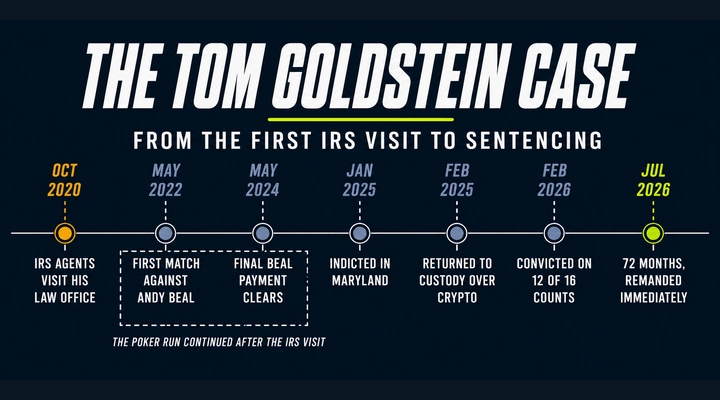
The timeline is the part that hurt him. IRS agents visited his Washington DC law office in October 2020, roughly eighteen months before the first Beal match.
The entire run, all $65.3 million of it, happened after that visit. He was formally charged in January 2025, months after the last payment cleared.
The 2016 Run and the $14 Million He Gave Back
Beal was the second act. The run that first put Goldstein in the ultra high stakes world came six years earlier, and it is the one his own coaches testified about.
In 2016 he played heads up against private equity billionaire Alec Gores and two gamblers court documents named only as “Tango” and “Chairman.” He was coached through it by Andrew Robl and Keith Gipson, both of whom later took the stand.
- Alec Gores: $9 million in November 2016, then $17.4 million in December, for a combined $26.4 million.
- Tango and Chairman: $13.3 million and $9.9 million from two gamblers identified in court only by nickname.
- Group total: roughly $50 million in profit across the year, shared with backers and coaches.
The $26.4 million off Gores arrived inside two months, and it stood as his biggest haul from any single opponent until the Beal matches began six years later.
That is the half of his record that gets quoted. The other half is why he insisted throughout the trial that he was not a winning poker player.
The $14 Million He Handed to Bob Safai
In 2017, Goldstein played California real estate mogul Bob Safai and lost $14 million over the course of their matches. Safai testified at the trial and described Goldstein's style as aggressive and, at times, erratic.
One Labor Day weekend session in 2017 accounted for about $6 million of it across two days. Safai told jurors he had trouble collecting, and Goldstein was still carrying roughly that same $6 million into mid 2018, when he signed a promissory note for it.
That note matters beyond the poker. It became one of the two promissory notes he later left off the mortgage application, part of the debt load that produced three of his twelve convictions.
His Own Lifetime Number
Goldstein testified that across everything, he is down about $10 million at poker. He told the New York Times the true figure sits somewhere between $10 million and $15 million in the red.
The heads up matches were the winning part. The ring games were where it went, and he lost enough there to swallow the eight figure profits from Gores and Beal.
That claim was central to his defense and the jury did not find it exculpatory. Losing money overall does not cancel a taxable win, and the government spent the trial demonstrating that the wins had been real, documented and undeclared.
The trial also put the wider circle on the record. Dan Bilzerian was described as a close friend and the counterparty on a $385,000 Las Vegas prop bet, and Goldstein finished down again at a July 2024 birthday game thrown by Kevin Hart in Mykonos.
The Witnesses Who Sank Him
The government never had to prove Goldstein played poker. He admitted that freely. What it had to prove was that specific wins were real, documented and left off his returns, and the witness list did most of that work.
Tobey Maguire and the $7.8 Million Debt
In December 2019, Tobey Maguire beat Andy Beal for more than $15.6 million in a Dallas match. Beal paid part of it and then balked, leaving $7.8 million outstanding.
Maguire hired Goldstein in 2020 to chase it. An August 2020 email raised the possibility of a lawsuit, and by June 2021 Beal had paid the $7.8 million, earning Goldstein a $500,000 legal fee.
Then came the detail that mattered to the jury. At Goldstein's direction, Maguire wired that fee not to Goldstein but straight to Bob Safai, covering part of Goldstein's own poker debt.
Maguire testified for the prosecution and was never accused of wrongdoing. His appearance also put a familiar circle on the record, the same Hollywood private game world documented in Houston Curtis's account of the Molly Bloom games.
The Coaches Who Testified
Andrew Robl was the first defense witness. He told jurors he had known Goldstein through poker since around 2010 and, from 2016, coached and staked him while holding roughly 10 to 15 percent of his action.
Parts of that helped the defense. Robl said plainly that Goldstein was not a winning player in ring games, which supported the lifetime loser argument.
Other parts did not. Robl also said Goldstein still owed him $1.5 million, some of it from the Mykonos game. Keith Gipson testified too, a man Goldstein had once represented in a gambling seizure case that reached the Supreme Court.
The Secret Ledger
On Day 13 the prosecution put a private accounting of Goldstein's poker results in front of the jury. It named opponents and creditors who had stayed out of the public account entirely.
- Dan "Jungleman" Cates: $750,000, paid out after a loss in Manila.
- Stewart Resnick: a $10 million line of credit extended for poker.
- Chamath Palihapitiya: $176,000.
- Tony Gregg, Rick Salomon and Alfred Decarolis also appeared, alongside Gores, Beal and Safai.
The ledger undercut the defense in a way testimony could not. Goldstein had told the world he kept terrible records. Here was a document showing he had tracked the money carefully enough, just not anywhere the IRS could see it.
The Accountant Who Came Apart on Cross
The defense's best moment came from Walter Deyhle of GRF CPAs and Advisors, Goldstein's outside tax preparer. On direct examination he told the government's story, saying Goldstein had never given him adequate information about the gambling income.
On cross he conceded he had made errors on the returns himself, and that he had given IRS investigators incorrect information without meaning to.
It was a real hit, and it was not enough. The jury convicted on 12 counts regardless, and the accountant's errors never became the reasonable doubt the defense needed.
Where Tom Goldstein Is Now, and What Happens Next
Goldstein has been in custody since the morning of July 24. He is now serving the sentence at FCI Petersburg Low, part of the federal prison complex in Hopewell, Virginia.
The Bureau of Prisons lists his projected release date as August 29, 2031. Like every federal projection, it already factors in credit for good conduct and can still change.
| As of September 28, 2026 | Where It Stands |
|---|---|
| Custody | FCI Petersburg Low, Virginia |
| Projected release | August 29, 2031 |
| Release pending appeal | Denied by Griggsby and the Fourth Circuit |
| Appeal | Pending at the Fourth Circuit, expedited review denied |
| Restitution | $3,103,427 outstanding |
| Law license | Disciplinary case pending in D.C., no final ruling |
| SCOTUSblog | Sold to The Dispatch in April 2025 |
The Appeal
His lawyers filed for release pending appeal on July 22, two days before sentencing, saying he intended to take the case to the Fourth Circuit on an expedited basis. They asked, in the alternative, to push back his surrender date.
Griggsby's remand answered both at once, and the Fourth Circuit took the same view on September 23, 2026. In an unsigned order, it refused to release him while the appeal runs, declined to expedite the case and rejected a request for longer briefs.
He is not short of firepower. Jonathan Kravis ran the trial defense, and Elizabeth Prelogar, the former US Solicitor General, was brought in ahead of sentencing with the appeal in mind.
Not His First Time in Custody
This is the second time the case has put him behind a locked door. In February 2025, weeks after the indictment, prosecutors had him taken back into custody over crypto transfers they said breached his release conditions.
He got out then, with restrictions on crypto use and device monitoring that he spent much of 2025 fighting. Griggsby kept him on release through the trial and through five months of waiting for sentencing.
What changed at sentencing was the conviction hardening into a judgment. A defendant with a sentence to serve has a reason to run that a defendant awaiting one does not.
What He Lost Along the Way
SCOTUSblog, the site he co-founded with Amy Howe and the thing Griggsby praised from the bench, is no longer his. It was sold to The Dispatch in April 2025, with Howe continuing to lead its Supreme Court coverage.
His law license is the open question. A disciplinary case against him is now listed as pending in Washington, D.C., with no final ruling made public.
What the Goldstein Case Means for High Stakes Players
Nothing about this case makes private poker illegal. Goldstein was not charged with running a game, playing in one or taking tens of millions off a billionaire across two years of heads up matches.
He was charged with what happened after the money moved. That distinction is the whole case, and it is the part worth understanding if your own results live outside any casino's reporting system.
The Records He Said He Did Not Keep
Goldstein's defense rested on disorganization. He told jurors his record keeping was a mess, that his accountant let him down, and that nothing was deliberate.
The private ledger did more damage to that story than any witness. It showed opponents, amounts and dates, tracked with reasonable care, and it existed while the returns did not reflect any of it.
Prosecutors did not need him to confess. They rebuilt his results from bank records, wire transfers and stipulations both sides had already signed.
The Lifetime Loser Argument
He testified he is down roughly $10 million across his career. The heads up wins were real, the ring game losses were bigger, and by his own accounting the net is negative.
The jury convicted anyway, because a career deficit and an undeclared winning year are separate questions. Tax years close. A profit inside one does not disappear because a later year went badly.
- No paperwork does not mean no obligation. A private game issues no forms, and the win is still reportable.
- Netting is not automatic. Being down over a lifetime does not erase a winning year.
- Backing splits the money, not the responsibility. Gross winnings and take home are different numbers, and the paperwork has to reflect which is which.
- Poker debts are debts. They belong on a loan application like any other liability.
The backing point deserves its own line, because it is the one most grinders will recognize. Goldstein won around $88 million heads up and most of it went straight to backers. Winning money you immediately owe to investors is normal, and it still has to be documented properly rather than assumed away.
The Mortgage Counts Are the Underrated Lesson
Three of the twelve convictions had nothing to do with a tax return. They came from a loan application, where he left off more than $14 million in poker debts while borrowing $1.98 million.
Those were also the counts carrying the heaviest sentencing exposure. A player who treats poker debt as a private arrangement between friends can find it treated as a material omission the moment a bank is involved. Our ranked account of who paid their poker debts and who didn't shows how rarely these arrangements produce a paper trail until something forces one.
Rules differ by country and by situation, so this is background rather than advice. Our guide to poker tax for US players covers the general rules, and anyone with real volume should be talking to an accountant who understands gambling income.
FAQs
How many years did Tom Goldstein get?
Tom Goldstein was sentenced to 72 months, or six years, in federal prison on July 24, 2026. Judge Lydia Kay Griggsby also ordered $3,103,427 in restitution and five years of supervised release, then revoked his bond and had him taken into custody immediately. Prosecutors had asked for just over eight years, while the defense argued for no prison time at all.
What was Tom Goldstein convicted of?
He was convicted on 12 of 16 counts in February 2026: one count of tax evasion, four counts of willful failure to timely pay taxes, four of eight counts of aiding and assisting the preparation of false tax returns, and three counts of making false statements on loan applications. He was acquitted on the remaining four. There was no wire fraud charge and no gambling offense anywhere in the case.
How much did Tom Goldstein win playing poker?
Court records show he won $65.3 million from Texas billionaire Andy Beal between May 2022 and May 2024, losing $13.8 million back for a net of $51.4 million. In 2016 he won $26.4 million from Alec Gores across November and December alone. Goldstein told jurors he won around $88 million in heads up matches across his career, though most of it went to backers.
Is Tom Goldstein in prison now?
Yes. He has been in custody since his sentencing on July 24, 2026, when Judge Griggsby revoked his bond and had him remanded as a flight risk. He is serving the sentence at FCI Petersburg Low in Virginia, and the Bureau of Prisons lists his projected release date as August 29, 2031.
Can Tom Goldstein appeal his conviction?
Yes, and the appeal is now pending at the US Court of Appeals for the Fourth Circuit. On September 23, 2026 the court refused to release him while it decides the case, and it also declined to expedite the appeal. Elizabeth Prelogar, the former US Solicitor General, was retained ahead of sentencing with the appeal in mind.
Who is Andy Beal and how much did Tom Goldstein win from him?
Andrew Beal is a Texas banker and billionaire known in poker for his heads up matches against Phil Ivey, Doyle Brunson, Jennifer Harman and Howard Lederer. Goldstein netted $51.4 million from him between May 2022 and May 2024. Beal was the unnamed opponent referred to only as ‘the Southerner' until a joint stipulation of fact in January 2026 identified him.
Do poker players have to pay tax on their winnings?
In the United States, gambling winnings are taxable income whether or not an operator issues paperwork, so a private game creates the same obligation as a tournament cash. The Goldstein case turned on exactly that point, since prosecutors reconstructed his results from bank records and signed court stipulations rather than any reporting form. Rules vary by country and by situation, so anyone with real volume should consult an accountant who understands gambling income.
Did Tobey Maguire testify at Tom Goldstein's trial?
Yes. Maguire testified for the prosecution about hiring Goldstein in 2020 to recover a $7.8 million poker debt owed to him by Andy Beal. Beal paid in June 2021 and Goldstein earned a $500,000 legal fee, which at Goldstein's direction was wired straight to Bob Safai to cover Goldstein's own poker debt. Maguire was not accused of any wrongdoing.
