

Women and Gambling Statistics 2026
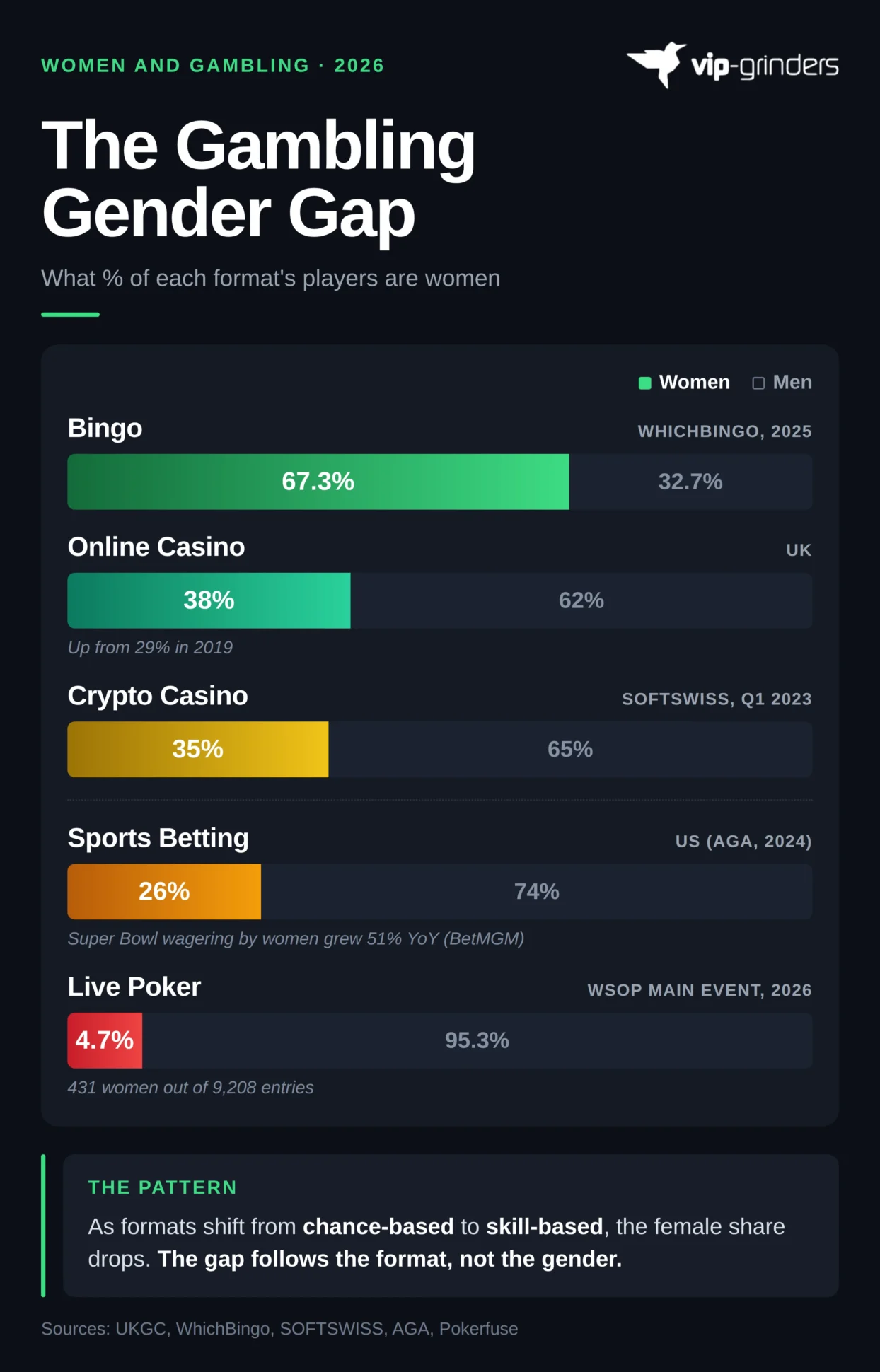
Women now represent roughly one in three online casino players, one in four US sports bettors, and just under 5% of major live poker tournament fields. The gap between those numbers tells a story that most gambling industry reports skip over entirely.
This page collects the most current data on female gambling participation, behavior, and outcomes across online casinos, poker, sports betting, and crypto gambling. Statistics are sourced from primary research wherever available: the UK Gambling Commission, SOFTSWISS platform data, the American Gaming Association, Hendon Mob tournament records, GamCare helpline reports, and peer-reviewed academic studies.
Last updated: September 2026. This is an evergreen resource, refreshed annually with new data.
Key Statistics (2026)
The following headline figures summarize the current state of women and gambling across formats, regions, and data sources. Each stat is expanded with full context and sourcing in the sections below.
- 35% of crypto casino players are women: SOFTSWISS data from over 700 partner brands (Q1 2023) found that women make up 35% of identified crypto casino players, with 70% of that audience aged 31 to 50.
- 44% of British women gambled in the past 4 weeks: The UK Gambling Commission’s GSGB Annual Report 2025 (n=20,476) recorded 44% female participation versus 51% for men. Excluding lottery, the gap widens: 12% of women gambled online versus 20% of men.
- 26% of US sports bettors are women: American Gaming Association estimates for 2024 put female sports betting participation at 26%, with other surveys (Ipsos, Statista YouGov) ranging from 28% to 31%. BetMGM reported female Super Bowl wagering grew 51% from 2023 to 2024.
- Only 4.68% of WSOP Main Event players are women: In 2026, a record 431 women entered the 9,208-player WSOP Main Event field, up from 369 in 2025. That share has stayed in the 3% to 5% band for over a decade.
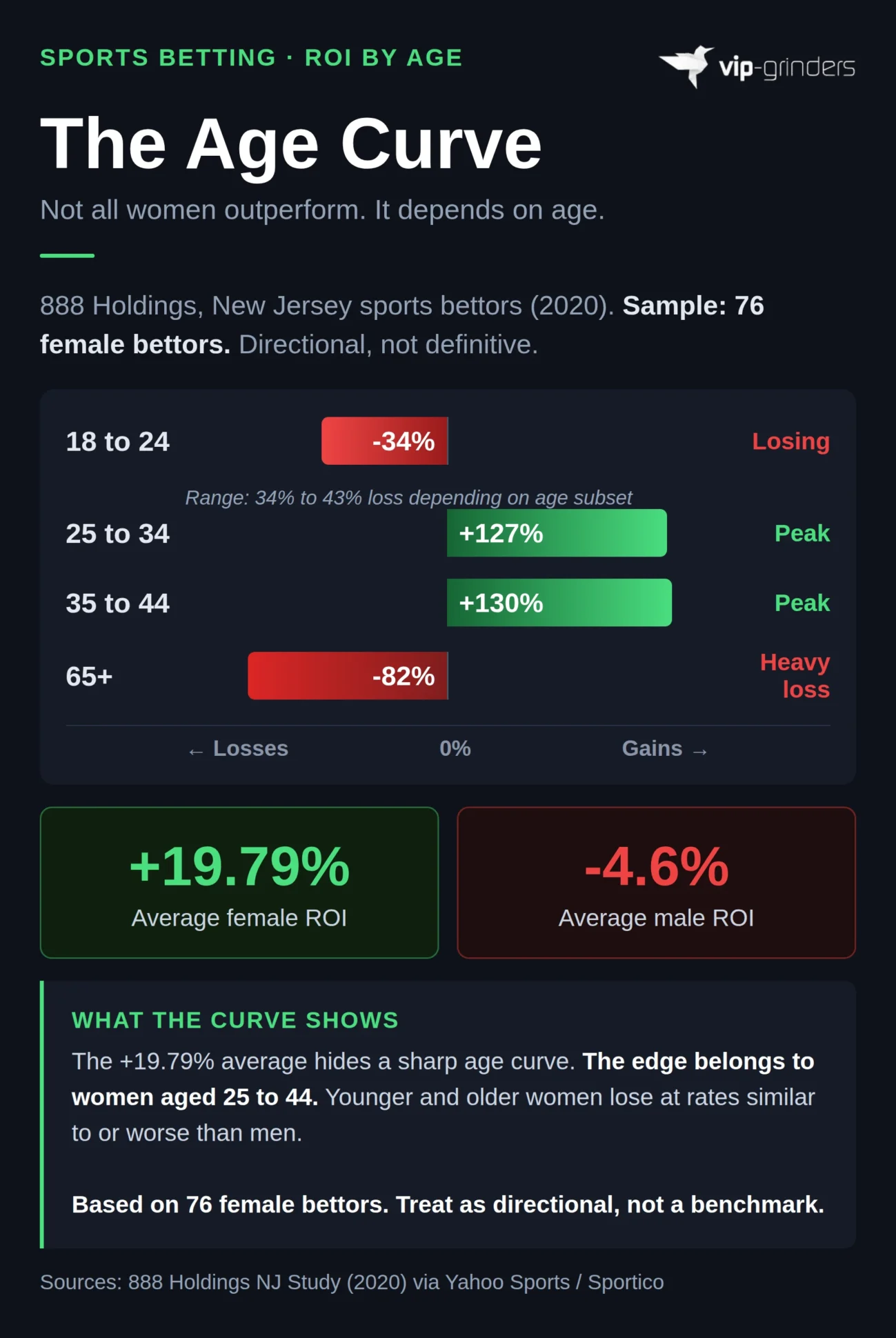
- Female bettors posted 19.79% ROI versus men’s negative 4.6%: An 888 Holdings analysis of New Jersey sports bettors (2020) found women outperformed men by a wide margin. Caveat: the sample included only 76 female bettors.
- Women progress to problem gambling faster: A tracked-behaviour study of 184,113 Norwegian EGM players (Syvertsen et al., 2023) found women hit their first loss-limit breach in a median of 46 months versus 55 months for men. This pattern is known as the “telescoping effect.”
- 67.3% of bingo players are women: Bingo remains the most female-dominated gambling format. UK women are nearly twice as likely as men to play bingo, 5.7% versus 3.2% in the past four weeks (GSGB 2025).
- Kristen Foxen holds $19.2M in live tournament earnings: The Canadian pro surpassed Vanessa Selbst as the highest-earning female poker player in history (Hendon Mob, August 2026). She holds six WSOP bracelets and five GPI Female Player of the Year titles.
- 30% of UK gambling helpline contacts are women: GamCare handled 130,589 contacts across its Helpline and online services in 2024/25. Roughly 30% identify as female, and GamCare reports a notable increase in female contacts across its services.
- 39% of female problem gamblers avoid treatment due to stigma: GambleAware research found that 39% of women who said they would not seek treatment cited embarrassment as the reason. 19% of female problem gamblers were also harmed by someone else’s gambling.
These are the headline numbers. The sections below break down the data behind each one: who is gambling, where, in what formats, and what the research says about gender-specific patterns in both recreational and problem gambling.
Women in Online Gambling
Female participation in online gambling has grown steadily over the past five years, driven by mobile access, live dealer game shows, and the shift from physical venues to digital platforms. The data below draws primarily from the UK Gambling Commission’s GSGB Annual Report 2025 and SOFTSWISS platform reporting.
How Many Women Gamble Online
The most reliable national dataset comes from the UK Gambling Commission’s Gambling Survey for Great Britain (GSGB), a push-to-web survey conducted by NatCen and the University of Glasgow with roughly 20,000 respondents per year.
| Metric | Women | Men | Source |
|---|---|---|---|
| Gambled in past 4 weeks (any format) | 44% | 51% | GSGB Annual Report 2025 (n=20,476) |
| Gambled in past 4 weeks (excl. lottery draw only) | 24% | 30% | GSGB Annual Report 2025 |
| Gambled online in past 4 weeks | 34% | 42% | GSGB Annual Report 2025 (n=20,378) |
| Gambled online (excl. lottery draw only) | 12% | 20% | GSGB Annual Report 2025 |
| Bet on sports or racing online or via app | 3.8% | 13.3% | GSGB Annual Report 2025 |
| Peak age group (excl. lottery draw only) | 35 to 44 (29%) | 25 to 34 and 35 to 44 (38%) | GSGB Annual Report 2025 |
The headline participation gap (44% vs 51%) narrows when lottery is included, because lottery draw games are the most popular gambling activity for women. 78% of women who gambled in the past four weeks played lottery draws (GSGB 2023, via the UKGC International Women’s Day 2025 release). Once you strip out lottery, the gender gap nearly doubles.
Online gambling among women grew by 8 percentage points between 2017 and 2021, according to earlier UKGC tracking. The GSGB 2025 data suggests that growth has continued, particularly among women over 35.
A separate analysis by NatCen and the University of Liverpool found a counterintuitive pattern: women who hold online gambling accounts (for slots, casino, bingo, and instant win products) tend to play more often, for longer sessions, and spend more per session than men with equivalent accounts. The gender gap in participation rate masks a different reality at the individual player level.
Game Preferences by Gender
Women and men gravitate toward different gambling formats. The UKGC’s International Women’s Day 2025 data release, based on the first annual GSGB (2023, n=9,742), broke down female gambling activity in detail.
- Lottery draws: 78% of women who gambled in the past 4 weeks played lottery draw games. This is the most popular format by a wide margin.
- Scratchcards: 32% of female gamblers bought scratchcards in the past 4 weeks.
- Online instant win games: 14% of female gamblers played online instant win games.
- Bingo: Women are nearly twice as likely as men to play bingo, 5.7% versus 3.2% in the past four weeks (GSGB 2025). Women make up 67.3% of all bingo players (WhichBingo 2025 survey, n=1,200+).
- Slots and live game shows: Women over-index on slots and live dealer game shows (Crazy Time, Monopoly Live). These formats drove much of the growth in female online casino participation from 29% to 38% of UK online casino players between 2019 and 2024.
- Men dominate in: sports betting (15.0% vs 4.8%), poker, blackjack, and craps. These formats remain heavily male-skewed across all age groups.
The pattern is consistent across multiple data sources: women favor chance-based, low-interaction formats (lottery, scratchcards, bingo, slots) while men favor skill-based or competitive formats (poker, sports betting, table games). This split shows up in the UKGC data, SOFTSWISS platform reports, and the academic literature on gambling format preference. Our casino statistics 2026 page breaks down how these formats perform by revenue, with slots alone generating $37.12 billion across US commercial casinos in 2025.
Mobile vs Desktop Usage
Mobile is the dominant channel for female gamblers. 77.4% of online bingo players use mobile devices (WhichBingo 2025 survey), consistent with SOFTSWISS regional data showing 68% to 72% mobile usage across European, Latin American, and Asian markets.
The UKGC’s 2022 research blog noted that online gambling among women increased by 8 percentage points between 2017 and 2021, a period that coincided with widespread smartphone adoption and the launch of mobile-optimized casino apps. Women with busy schedules cite convenience and the ability to play in short sessions as primary reasons for choosing mobile over desktop.
No published dataset currently isolates mobile vs desktop gambling participation by gender with exact percentages. SOFTSWISS reports mobile GGR share by region but does not cross-reference with gender. This remains a data gap across the industry.
Women in Poker
Poker is the gambling format with the widest gender gap. Women make up roughly a third of online casino players and a quarter of sports bettors, but they account for just 3% to 5% of live poker tournament fields in any given year. That ratio has barely moved in over a decade.
The data below covers live tournament demographics, earnings records, online participation estimates, and the structural barriers that keep the gap in place. VIP-Grinders has tracked poker industry trends since 2013 and maintains a dedicated directory of women who changed poker.
Tournament Participation
The largest annual sample for measuring female poker participation is the WSOP Main Event. Pokerfuse’s demographic analysis of the 2026 field provides the most granular recent data, and unlike 2025 it carries no undisclosed-gender entries.
| Metric | Figure | Source |
|---|---|---|
| 2026 WSOP Main Event total entries | 9,208 | Pokerfuse, July 2026 |
| 2026 female entries | 431 (record) | Pokerfuse, July 2026 |
| 2026 female share of field | 4.68% | Pokerfuse, July 2026 |
| 2025 female entries and share | 369 of 9,735 (3.79%) | Pokerfuse, July 2025 |
| 2024 WSOP Main Event female entries | 358 | Pokerfuse |
| Historical female share (past decade) | 3% to 5% | Pokerfuse, multiple years |
| 2026 WSOP Ladies Championship entries | 1,475 (record) | Hendon Mob / PokerNews |
| 2026 Ladies Championship prize pool | $1.3M | Hendon Mob |
The 2025 WSOP produced two historic moments for women in poker. Leo Margets (Spain) finished 7th in the Main Event for $1,500,000, becoming only the second woman ever to reach the Main Event final table after Barbara Enright in 1995. That gap of 30 years speaks for itself.
Shiina Okamoto (Japan) won the Ladies Championship for the second consecutive year, taking home $184,094 from what was then a record 1,368-player field. Her bid for a third straight title ended in 2026, when Skye Chen won a record 1,475-entry field on her tournament debut. The Ladies event uses a $1,000 buy-in for women. Men can enter but must pay $10,000, a structure designed to protect the women-only field that drew controversy in 2025 when a male player won an online satellite into the event.
The online vs live gap is significant. Industry estimates suggest women may comprise 10% to 20% of online poker players (depending on whether the measure includes casual play or only cash game and tournament grinders), compared to the consistent 3% to 5% in live fields.
The 888poker survey of 2,000 UK women found that 32% feel less inclined to play poker because they are women (9% strongly agree). Barriers cited in academic and industry research include perceived bias, smaller competitive networks, and hostile table dynamics.
Top Female Poker Earners
The Hendon Mob Women’s All Time Money List ranks 20,687 female players by verified live tournament earnings. The top five as of August 2026:
| # | Player | Country | Live Earnings | WSOP Bracelets |
|---|---|---|---|---|
| 1 | Kristen Foxen | Canada | $19,238,670 | 6 |
| 2 | Vanessa Selbst | USA | $11,946,107 | 3 |
| 3 | Kathy Liebert | USA | $7,353,698 | 1 |
| 4 | Liv Boeree | England | $6,699,290 | 1 |
| 5 | Sosia Jiang | New Zealand | $6,131,533 | 0 |
Kristen Foxen surpassed Vanessa Selbst as the highest-earning female poker player in history. Her live total alone stands at $19.2M, and she added a sixth WSOP bracelet at the 2026 $25,000 High Roller for $1,773,083. She also holds five GPI Female Player of the Year titles, more than any other player in the award’s history.
Vanessa Selbst retired from professional poker in 2018 with $11.9M in live earnings and three WSOP bracelets. She remains the second highest-earning woman and one of the most decorated tournament players of either gender.
Foxen’s $7.3M lead over Selbst puts her 61% ahead of second place, a wider proportional gap than on the overall all-time list, where Bryn Kenney leads Stephen Chidwick by 14.8%. Both lists appear in full in our Poker Statistics 2026 research.
Below Selbst, the #3 to #5 players sit between $6.1M and $7.4M. The concentration at the top reflects both the small number of women competing at high stakes and the variance in tournament outcomes over long careers.
Barriers to Entry
The question is not whether women can compete at the highest levels. Foxen, Selbst, Margets, and others have answered that. The question is why participation stays locked at 3% to 5% of live fields despite poker’s growth overall.
- Perceived gender bias: 32% of women in an 888poker survey (n=2,000 UK women) said they feel less inclined to play poker because of their gender. 9% strongly agreed.
- Live table environment: Industry surveys and player accounts consistently identify hostile table dynamics, condescending behavior from male players, and online toxicity as barriers to female participation.
- Network effects: Poker skill development relies heavily on study groups, coaching networks, and staking relationships. Women have historically been underrepresented in these networks, limiting access to the infrastructure that produces winning players.
- Online vs live gap: The higher female share in online poker (estimated 10% to 20%) versus live (3% to 5%) suggests that the physical environment, not the game itself, is the primary deterrent.
The WSOP’s Ladies Championship structure is one attempt to address the gap. Women-only tournaments, coaching programs (such as the Poker Power initiative), and increased media visibility of female pros like Foxen and Margets are all working to shift the ratio. But the data shows the floor has held at 3% to 5% for over a decade, and structural change is slow.
Women at Crypto Casinos
Crypto casinos represent one of the fastest-growing segments of online gambling. The question of how many women play at these platforms has a single reliable data point, and the answer may be higher than most people expect.
Female Player Share in Crypto Gambling
The only published platform-level gender breakdown for crypto casinos comes from SOFTSWISS, which aggregates data from over 700 partner brands. Their Q1 2023 State of Crypto report found:
- 35% female / 65% male: Among players who disclosed their gender at SOFTSWISS-powered crypto casinos.
- 70% aged 31 to 50: The crypto casino audience skews older than many assume. This is not a Gen Z phenomenon.
- 64% mobile GGR: Nearly two thirds of gross gaming revenue at crypto casinos came from mobile devices, versus 32% from desktop.
That 35% female share is notably higher than the 18% female share SOFTSWISS reported for its European regional casino data over the same period. The difference may reflect how gender disclosure works on these platforms: the regional data had roughly 35% of players listed as “undisclosed,” while the crypto-specific report appears to measure only those who identified their gender.
This matters because gender disclosure is not mandatory at registration on most online casinos. Published female shares are best understood as “share of those who disclosed,” not of all players. The real figure could be higher or lower depending on which gender is more likely to skip that field.
What Draws Women to Crypto Casinos
No published study directly measures why women choose crypto casinos over fiat alternatives. The evidence is indirect, drawn from academic work on online gambling behavior and platform design.
- Privacy and reduced stigma: Academic research (López-González et al., 2020; McCarthy et al., 2022) argues that the elimination of physical-venue stigma online disproportionately attracts women. Crypto casinos extend this further by removing bank statement visibility and reducing identity exposure.
- Faster onboarding: Many crypto casinos allow players to start with just a wallet connection or email, skipping the document upload and bank verification steps that traditional casinos require. For players who value discretion, this is a meaningful difference.
- Stablecoin adoption: USDT and USDC now account for over 65% of all crypto casino deposit volume (Tanzanite.xyz, trailing 12 months). Stablecoins eliminate the price volatility that made Bitcoin gambling unpredictable, which may appeal to players who prefer to manage a fixed bankroll.
These are plausible drivers, not confirmed causes. No researcher has directly surveyed women at crypto casinos about their choice of platform. This is one of the largest evidence gaps in the field, and filling it would require operator-level survey data that platforms have not published.
The crypto casino market itself is large. Tracked onchain deposit volume across 41 major operators reached $47.6 billion over the trailing 12 months through August 2026 (Tanzanite.xyz). If the 35% female share from SOFTSWISS holds roughly constant, that implies significant female participation in crypto gambling, but that projection should be treated as directional, not precise.
Women in Sports Betting
Sports betting is the gambling format where female participation is growing fastest. The combination of US state-by-state legalization (post-PASPA 2018), mobile betting apps, and the rise of women’s professional sports has driven a measurable shift in who bets and how.
Participation Rates
Multiple surveys converge on a similar range for the female share of US sports bettors, though the exact figure depends on methodology.
| Source | Female Share | Year | Notes |
|---|---|---|---|
| American Gaming Association | ~26% | 2024 | Super Bowl LVIII bettor estimate |
| Ipsos / Statista YouGov | 28% to 31% | 2024 | Survey-based, broader sample |
| NCPG NGAGE 3.0 | Not broken by gender | April 2024 | 2.5M US adults with gambling disorder |
| Statista Consumer Insights (Brazil) | ~47% | 2024 to 2025 | Highest female share of any major market |
The US figure of 26% to 31% represents a significant increase from pre-legalization levels. BetMGM reported that female Super Bowl wagering grew 51% from Super Bowl LVII in 2023 to Super Bowl LVIII in 2024, one of the sharpest single-year jumps in any gambling demographic. This is operator data rather than an AGA estimate, and it is widely misattributed to the AGA in secondary coverage.
In Florida, which legalized online sports betting in 2023, the number of female sports bettors increased 9-fold compared to the pre-legalization period (FCCG 888-ADMIT-IT helpline data, 2024). Men still accounted for 97% of total Florida bettors by volume, but the growth rate among women was dramatic.
Brazil stands out globally. Statista Consumer Insights data for 2024 to 2025 puts the female share of Brazilian sports bettors at roughly 47%, the highest of any major regulated market. Brazil launched its formal sports betting regulatory framework in January 2025.
Do Women Outperform Men?
The most cited finding on this topic comes from an 888 Holdings analysis of New Jersey sports bettors, published in 2020. The headline result: female bettors achieved a 19.79% ROI while male bettors posted a negative 4.6% return over the analysis period.
The age breakdown added detail. Women aged 25 to 34 returned +127% ROI. Women aged 35 to 44 returned +129.6%. At both ends, the pattern reversed: women aged 18 to 24 lost 34% to 43%, and women over 65 lost 82.2%.
Beyond ROI, the behavioral data paints a consistent picture across multiple sources:
- Smaller average losses: Women lose approximately $3,500 per year versus men’s $5,000 (HPL Digital Sport / SCCG Management, 2025).
- Longer betting duration: Women bet for an average of 21 months over their lifetime versus 14 months for men, but men have roughly twice as many sessions.
- High live betting engagement: 64% of female bettors place live in-game bets, suggesting active engagement with events rather than pre-match only wagering.
- Sport preferences: Women over-index on basketball, tennis, soccer, and high-profile events (Kentucky Derby, NCAA tournaments). Men skew more heavily toward NFL and daily MLB/NBA action.
Women’s Sport Betting Is Accelerating
One of the clearest trends in the data is the growth of betting on women’s professional sports, driven primarily by the WNBA and women’s soccer.
- WNBA betting up 270%: Flutter/research synthesis data (cited in the Washington Post) showed WNBA betting volume increased 270% in 2022 versus 2021.
- BetMGM saw 175% rise: WNBA betting action at BetMGM grew 175% in 2024. Caesars reported 500%+ growth during a WNBA season opener.
- Women’s soccer at ~20% CAGR: Betting on women’s soccer has grown at approximately 20% annually since 2020, driven by the FIFA Women’s World Cup and expanded domestic league coverage.
The growth in women’s sport betting creates a feedback loop. More betting interest drives more broadcast coverage, which drives more fan engagement, which drives more betting. The Washington Post noted that sports betting has been one of the most effective financial catalysts for women’s professional leagues, generating revenue and visibility that traditional sponsorship models struggled to deliver.
Women and Risk-Taking: What the Data Shows
The gambling statistics above show what women do. This section explores why. The following research on women and strategic risk-taking was first published by VIP-Grinders in May 2025 and has been cited by Forbes, Digital Journal, IT-Daily, Estado de Minas, and other publications.
A study found that female sports bettors achieved an impressive average return on investment (ROI) of almost 20%, while their male counterparts experienced an average loss of 5%.
For generations, women have been deemed biologically more risk-averse than men. But is that really the case?
To debunk the myth, experts at VIP-Grinders teamed up with Niloufar Esmaeilpour, registered clinical counsellor and founder of Lotus Therapy, to explore how women aren’t less risk-averse. They’re more risk-aware and, in fact, strategic risk-takers.
Key findings
- Traditionally defined risks often overlook the complex, high-stakes decisions women make: starting a business while raising a family, undergoing cosmetic surgery, or leaving a stable career for entrepreneurship.
- No significant gender differences were found in risk-taking at work, according to a 2022 study.
- Research shows that female executives are often more likely than their male peers to invest in long-term, high-stakes projects.
- From Oprah Winfrey to Serena Williams, the experts highlighted 8 trailblazing women whose bold, strategic risks have reshaped industries.
Breaking the myth: Women are strategic risk-takers, NOT risk-averse
The data challenges a long-held assumption. Across multiple studies, the evidence points in the same direction: women take risks differently, not less often.
Traditional studies define risk too narrowly
The theory that women are more risk-averse than men has been cemented by decades of economic and psychological studies that define risk through a narrow, male-centric lens, focusing on behaviours like extreme sports or competitive physical challenges.
What’s often overlooked is that women do take risks, just different kinds. These are often calculated, strategic, and come with broader, long-term implications.
Women’s high-stakes choices are overlooked
Decisions like undergoing cosmetic surgery or launching a business while raising a family involve significant, multifaceted risks: physical, emotional, financial and social. Yet, these kinds of high-stakes decisions are rarely acknowledged in traditional risk research.
New research shows no gender gap in risk-taking at work
A 2022 study published in Psychology of Women Quarterly found no significant gender differences in workplace risk-taking.
A separate Journal of Business Research study revealed that female executives are often more willing than their male counterparts to invest in long-term, high-stakes projects like R&D and capital expenditures. These aren’t guaranteed wins: they carry substantial financial risk and delayed returns, but are critical for long-term growth.
The takeaway is clear: Women aren’t risk-averse, they’re risk-smart.
Women approach risk with a long-term strategy
While this decision may not seem flashy or reckless, it is incredibly bold, especially considering the pressures from investors and shareholders.
Women often consider the downstream effect of their decisions: how they affect team dynamics, organisational culture, or even the ethical consequences. This nuanced, multifaceted approach to risk is not a sign of timidity, but of strategic depth.
Structural pressures shape how women take risks
Women are often under the microscope and held to different standards, especially in leadership roles. A 2019 Harvard Business Review article noted that female leaders are more likely to be penalised for failure.
What may appear as caution is often a smart, calibrated response to these uneven expectations, balancing risk with the need to protect morale, manage culture, and meet societal demands.
Telma Casaca, Marketing Director at VIP-Grinders, commented:
“For too long, the myth has been perpetuated that women are risk-averse. However, new research and real-world examples show that women are, in fact, risk-smart and approach challenges with deep strategic foresight. Risk-averse is far from accurate.
When women take risks, they aren’t reckless. They carefully weigh all the variables. It’s about playing the long game and creating a sustainable future, not just for themselves, but for the organisations and communities they impact. Whether in business, sports, or social justice, the lessons from these trailblazing women are a testament to the power of strategic risk-taking.”
8 famous female risk-takers
From boardrooms to boxing rings, these women didn’t just take chances. They redefined what bold risk-taking looks like.
- 1Oprah Winfrey, Media Mogul and Entrepreneur: Born into poverty, Oprah took a career-defining risk by founding her own production company, Harpo Productions, in the 1980s. She built an empire in a white, male-dominated media world and became the first Black female billionaire.
- 2Whitney Wolfe Herd, Founder of Bumble: Left Tinder after a high-profile lawsuit and launched a female-first dating app, flipping industry norms. In 2021, she took Bumble public, becoming the youngest self-made female billionaire at age 31.
- 3Sheryl Sandberg, COO of Facebook (Meta): Leaving Google for a then-fledgling Facebook in 2008 was a massive leap. Her leadership helped scale the company globally. Her book, Lean In, sparked both praise and backlash, but undeniably ignited a global conversation about women in leadership and workplace equity.
- 4Denise Coates, CEO of Bet365: In 2000, Coates mortgaged her family’s betting shops to launch a little-known online gambling site. She revolutionised the gambling industry, and today, Bet365 is one of the world’s largest online betting platforms.
- 5Ronda Rousey, UFC Champion and Trailblazer: When women’s MMA didn’t exist in the UFC, Rousey demanded a seat at the table. She became the first female fighter signed by UFC, proving women could headline major events.
- 6Melanie Perkins, Co-founder and CEO of Canva: After dropping out of university, she pitched her visual design platform over 100 times before landing funding. Today, Canva is used by over 100 million people globally, and Perkins is one of the youngest self-made billionaires in tech.
- 7Serena Williams, Tennis Legend and Entrepreneur: Arguably the most recognised female athlete of all time, Williams has taken bold risks both on and off the court, from speaking out on race and gender, to investing in early-stage startups, to launching a fashion line. Her return to elite tennis after childbirth challenged outdated narratives about motherhood in sport.
- 8Malala Yousafzai, Activist and Nobel Laureate: Malala defied Taliban threats to speak out for girls’ education in Pakistan, a decision that nearly cost her life. After surviving an assassination attempt, she became the youngest Nobel Peace Prize winner.
Women and Problem Gambling
The data on female gambling participation tells a growth story. The data on female problem gambling tells a different one. Women are less likely than men to develop gambling problems overall, but when they do, the progression is often faster and the barriers to getting help are higher.
The Telescoping Effect
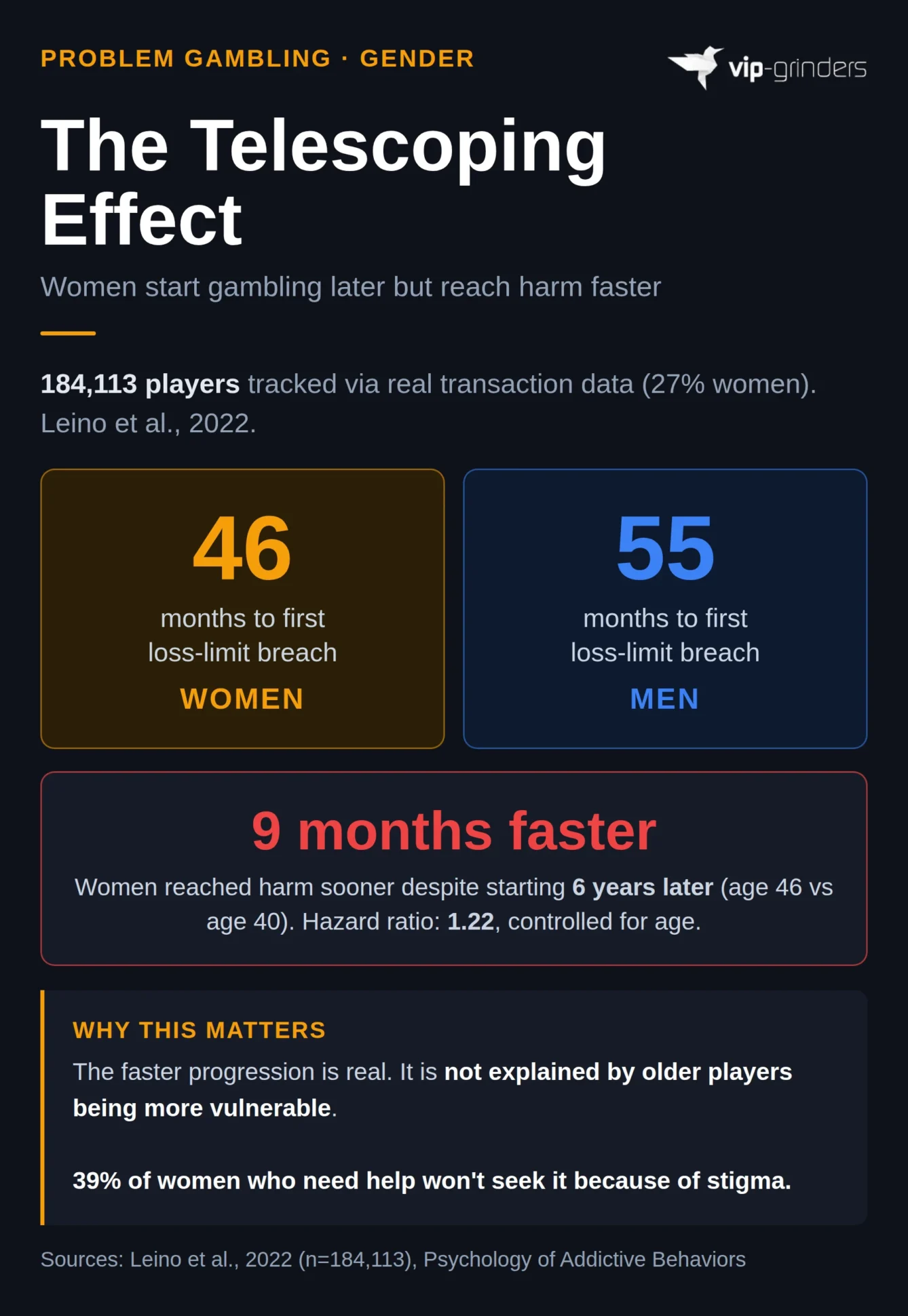
One of the most studied gender differences in problem gambling is the “telescoping effect”: the observation that women tend to start gambling later in life but progress from recreational to disordered gambling faster than men.
The strongest modern evidence comes from a tracked-behaviour study by Syvertsen et al., published in Psychology of Addictive Behaviors (2023, volume 37, issue 3, pages 499 to 508). The study followed 184,113 Norwegian electronic gaming machine (EGM) players (27% women) using actual transaction data rather than self-reported surveys.
| Metric | Women | Men | Source |
|---|---|---|---|
| Median time to first loss-limit breach | 46 months | 55 months | Syvertsen et al., 2023 (n=184,113) |
| Hazard ratio for hitting loss-limit faster | 1.22 (95% CI 1.20 to 1.25) | Reference | Syvertsen et al., 2023 |
| Average age at gambling onset | 46 years | 40 years | Syvertsen et al., 2023 |
The pattern is clear: women started gambling later (age 46 vs 40) but reached their first loss-limit breach 9 months sooner than men. The hazard ratio of 1.22 held after controlling for age, meaning the faster progression is not simply explained by older players being more vulnerable.
Earlier clinical studies support the same direction. Tavares et al. (2003) found women progressed faster from social to intense to disordered gambling, particularly in electronic bingo and video lottery terminals. Grant et al. (2012) found shorter time from gambling onset to clinical diagnosis in a sample of 71 patients seeking treatment.
Problem Gambling Rates by Gender
The UK Gambling Commission’s GSGB 2025 annual data (n=20,476, fieldwork January 2025 to January 2026) provides the most recent population-level estimates of problem gambling by gender, using the Problem Gambling Severity Index (PGSI).
- Women are about half as likely as men to score PGSI 8+: The threshold for problem gambling. Among those who gambled in the past 12 months, 2.7% of women scored 8 or more versus 5.3% of men.
- Moderate risk (PGSI 3 to 7): 3.8% of female gamblers versus 8.0% of male gamblers, again roughly half.
- Severe consequences: 1.8% of female gamblers experienced at least one severe consequence in the past 12 months, versus 3.5% of male gamblers. For women this breaks down as relationship breakdown (0.9%), violence or abuse (0.8%), losing something of significant financial value (0.7%) and committing a crime (0.7%).
The lower overall rate masks an important nuance. Research by Håkansson (2020, Frontiers in Psychiatry) found that among online gamblers specifically, gender differences in problem gambling rates narrow or disappear entirely. Women’s chance-based online play (slots, instant win games) was strongly associated with problem gambling and internalizing symptoms like depression and anxiety.
This connects directly to the participation data earlier in this page. Women are increasingly gambling online, on mobile, in short sessions, on chance-based games. These are exactly the formats where the gender gap in problem gambling is smallest.
Help-Seeking and Stigma
Women face distinct barriers when seeking help for gambling problems. The data from GamCare (the UK’s National Gambling Helpline) and GambleAware research paints a consistent picture.
| Metric | Figure | Source |
|---|---|---|
| Total Helpline and online contacts (2024/25) | 130,589 | GamCare Annual Review 2025 |
| Female share of contacts | ~30% | GamCare, earlier reporting |
| Women who avoid treatment due to embarrassment | 39% | GambleAware / YouGov, 2020 |
| Female problem gamblers also harmed by others’ gambling | 19% | GambleAware / YouGov, 2020 |
| Treatment sessions delivered (2024/25) | 8,164 | GamCare Annual Review 2025 |
| Average wait, referral to first contact | 1.3 days | GamCare Annual Review 2025 |
| Referrals to further support (2024/25) | 7,140 (15.9% of target contacts) | GamCare Annual Review 2025 |
The 39% stigma figure is the most important number in this table. Nearly four in ten women with gambling problems who said they would not seek treatment cited embarrassment as the reason. This suggests the true prevalence of female problem gambling is higher than helpline data indicates.
GamCare’s Women’s Programme, run in partnership with Refuge, trained 2,155 professionals on gambling-related harm among women in 2024/25, down from 3,813 the previous year. The programme specifically addresses the intersection of gambling harm and domestic abuse, a connection supported by Australian research (Hing et al., 2022) documenting cycles between gambling and intimate partner violence.
33% of women in GamCare treatment data cite escapism as their primary motivation for gambling. GambleAware research (conducted with IFF Research and the University of Bristol) found that loneliness and depression are stronger predictors of problem gambling in women than in men, while men are more likely to cite competition and adrenaline.
Resources
If you or someone you know is experiencing gambling-related harm, the following services provide free, confidential support.
| Service | Region | Contact |
|---|---|---|
| GamCare (National Gambling Helpline) | UK | 0808 8020 133 (24/7) or gamcare.org.uk |
| GambleAware | UK | begambleaware.org |
| National Council on Problem Gambling | USA | 1-800-522-4700 or ncpgambling.org |
| Gambling Help Online | Australia | 1800 858 858 or gamblinghelponline.org.au |
| Stödlinjen | Sweden | 020-819 100 or stodlinjen.se |
Women in the Gambling Industry
The data above covers women as players. This section covers women as employees. The gambling industry’s workforce gender split tells its own story: three quarters of women in the industry sit in entry level roles, and almost none reach the top.
Workforce Gender Gap
The most detailed industry-wide workforce data comes from the All-In Diversity Project (AiDP), which publishes the All-Index benchmarking report. The most recent edition covers 2022/23 and draws from 32 organizations across 21 jurisdictions, covering 80,936 employees. The previous edition, covering 2020/21, drew from 40 organizations and approximately 140,000 employees across 16 jurisdictions.
| Measure | Female | Male | Source |
|---|---|---|---|
| Overall workforce | 39.04% | 60.48% | AiDP All-Index 2022/23 |
| Executive board | 29% (58 of 200) | 71% (142 of 200) | AiDP All-Index 2022/23 |
| Non-executive board | 29% (35 of 120) | 71% (85 of 120) | AiDP All-Index 2022/23 |
Non-binary employees accounted for 0.02% and “other” for 0.46%. This was the first year the female share dipped below 40%.
The All-Index does not report a female share for each seniority tier. It reports how women are distributed across tiers, which shows the pipeline problem more directly.
| Level | Share of all women in the industry | Share of total workforce |
|---|---|---|
| Entry level or new starter, up to Team Leader or Supervisor | 75.29% | 28.84% |
| Team Leader or Supervisor | 10.35% | 3.96% |
| Manager | 6.23% | 2.39% |
| Head of Department | 2.35% | 0.90% |
| Director, VP, Partner or C-level | 1.12% | 0.43% |
| CEO or MD | 0.04% | 0.02% |
| Other (freelance, contract, consultant) | 4.63% | 1.77% |
Three quarters of all women in the gambling industry sit at entry level or below. Just 0.04% hold a CEO or MD role. AiDP attributes the drop largely to the rise of sports betting and to the Great Resignation, and warns that the shortfall of women with senior experience puts EU-licensed operators at risk of missing the Women on Boards deadline.
Female non-executive board representation fell from 32% in the previous edition to 29%. For context, AiDP cites a US average of 36%, down from 39% in 2022, and a UK FTSE 250 average of 39%. The earlier 2020/21 edition had recorded the overall workforce at 56% male to 43% female, already the widest gap at that point.
Leadership and Pay
The American Gaming Association’s Gaming Industry Workforce Diversity Report (April 2023, covering 26 organisations: 18 commercial and tribal operators and 8 manufacturers) provides a US-specific view, based on Equal Employment Opportunity Commission filings.
- 47.5% female workforce: Broadly in line with the US national workforce (48.0% female). 61.3% of all US gaming employees are minorities, versus 41.7% of the US workforce overall.
- Executive and senior level is 70.0% male and 30.0% female: Consistent with the AiDP global data. Women hold 40.6% of first and mid level management roles, and 70.6% of administrative support roles.
- Pay gap data is scarce: 42% of organizations in the AiDP All-Index collect gender pay data, and 46% of those found a gap. None now collect ethnicity pay gap data, down from one the previous year. This is a major data-quality gap for the industry.
- Global Gaming Women: The industry network has over 7,500 active members, with 24% at senior-manager level or higher.
One regulatory driver may accelerate change. The EU Women on Boards Directive, approved in 2022, must be in place by July 2026. It requires either 40% of non-executive director posts or 33% of all director posts to go to the under-represented sex, with dissuasive penalties for non-compliance. It applies to listed and public companies and to enterprises with more than 250 employees, turnover above 50 million euros, or a balance sheet above 43 million euros.
The top-scoring organization in the AiDP 2020/21 All-Index was Sky Betting and Gaming (85 out of 100), followed by Kindred Group (79 out of 100). These scores reflect not just gender ratios but also policies on parental leave, flexible working, pay transparency, and inclusion initiatives.
Regional Data Snapshot
The data throughout this page draws from multiple countries. This section consolidates the key regional figures into a single reference, highlighting where each market differs and what makes each dataset useful.
| Country | Female Gambling Rate | Key Gender Metric | Primary Source |
|---|---|---|---|
| United Kingdom | 44% past 4 weeks | 12% online (excl. lottery) vs 20% men | GSGB Annual Report 2025 (n=20,476) |
| United States | 26% to 31% of sports bettors | Female Super Bowl wagering up 51% YoY (BetMGM) | AGA / Ipsos / Statista YouGov / BetMGM, 2024 |
| Australia | 65% of adults gambled past year | 5.8% of female regulars high-risk vs 9.3% men | AGRC Pilot, 2024 (n=3,881) |
| Sweden | 67% of women vs 75% of men | 42% of unregistered gamblers are women | Spelinspektionen, 2024 |
| Brazil | ~47% of sports bettors are women | Highest female share of any major market | Statista Consumer Insights, 2024 to 2025 |
United Kingdom
The UK has the most detailed public dataset on gendered gambling behavior. The Gambling Survey for Great Britain (GSGB) runs quarterly waves with roughly 5,000 respondents each and an annual aggregate above 20,000. It is the benchmark source used throughout this page.
The UK also produces the strongest problem gambling data by gender (PGSI scores by sex), the most detailed helpline data (GamCare), and the most active responsible gambling research programme (GambleAware). No other country publishes gender-disaggregated gambling data at this level of granularity.
United States
US data is strongest on sports betting, where the AGA tracks participation around major events. The post-PASPA expansion has created natural experiments: Florida’s 9-fold increase in female sports bettors after legalization is the clearest example of how regulatory change drives female participation.
The US lacks a single national gambling survey equivalent to the UK’s GSGB. The NCPG’s NGAGE 3.0 (April 2024) is the closest, but it does not break most metrics by gender. State-level data varies widely in quality and availability. Our US Gambling Survey 2026 (n=2,000) provides a gender breakdown across wins, losses, frequency, funding sources, and concealment behavior, filling several of those gaps.
The survey found that women reported an average biggest ever gambling win of $6,325 against an average biggest ever loss of $2,325. Men reported $12,359 and $7,422 respectively. Women also gambled less often, averaging 5.1 sessions per month versus 6.6 sessions for men.
Both averages exclude respondents who reported never having a significant win or loss. Fieldwork ran May 5 to 7, 2026 among 2,000 US adults who gamble.
Australia
The AGRC National Gambling Prevalence Study Pilot (2024, n=3,881) is Australia’s freshest dataset. It found that 65% of Australian adults gambled in the past year, up 8 percentage points from 2019. Weekly gambling rates show a clear gender split: 48% of men versus 28% of women.
One data point unique to Australia: 19% of partners of weekly-or-more gamblers reported experiencing intimate partner violence (AGRC, 2024). This is the only national-level dataset that directly links gambling frequency to domestic violence outcomes.
Sweden
Sweden’s Spelinspektionen 2024 survey found that 67% of women gambled in 2024 versus 75% of men (71% overall). The most distinctive finding: 42% of unregistered (account-less) gamblers were women versus 24% of men, suggesting women interact more casually with gambling, favoring lottery tickets and retail scratchcards over registered online accounts.
Sweden also operates Spelpaus.se, the national self-exclusion register. As of Q4 2025, roughly 134,500 individuals were self-excluded. Gender breakdowns of Spelpaus registrations have not been published.
Brazil
Brazil is the global outlier. Statista Consumer Insights data for 2024 to 2025 puts the female share of Brazilian sports bettors at roughly 47%, nearly double the US figure and the highest of any major regulated market.
Brazil launched its formal sports betting framework under Normative Ordinance No. 615/2024 in January 2025. The regulation explicitly bans cryptocurrency as a payment method for licensed gambling operators. All deposits and withdrawals must flow through institutions authorized by the Central Bank of Brazil.
Expert Commentary
The data across this page reveals a consistent pattern: women gamble differently, not less. The participation gap is narrowing in most formats, the behavioral data suggests more selective and strategic wagering, and the barriers that remain are structural, not about ability or interest.
Telma Casaca, Marketing Director at VIP-Grinders, connects the findings:
“The numbers tell a clear story. Women now make up a third of online casino players and a quarter of sports bettors, yet they’re still under 5% of live poker fields. That’s not a skill gap. That’s an environment gap.
What stands out most to me after 13 years tracking this industry at VIP-Grinders is how the 888 Holdings ROI data and the risk-taking research point in the same direction. Women bet less often, but when they do, they’re more selective. They weigh variables, manage bankrolls tighter, and avoid emotional chasing. The data calls that ‘risk-smart.’ I’d call it disciplined.
The problem gambling data is the part that needs more attention. Women progress to disordered gambling faster, and 39% of those who need help won’t seek it because of stigma. That’s nearly four in ten women suffering in silence. If the industry is serious about responsible gambling, it needs to design support systems that account for how women actually experience harm, not just scale what works for men.”
Methodology & Sources
This page combines primary data from government regulators, platform operators, academic researchers, and industry bodies. No single source covers all aspects of women and gambling. The table below lists every primary source referenced in this report, what it measures, and where to verify the underlying data.
Primary Sources
| Source | What It Measures | Sample / Scope |
|---|---|---|
| UK Gambling Commission (GSGB Annual Report 2025, published 16 July 2026) | Gambling participation, PGSI scores, activity types by gender | n=20,476; four waves, fieldwork Jan 2025 to Jan 2026 |
| SOFTSWISS State of Crypto (Q1 2023) | Gender split of crypto casino players, age, device | 700+ partner brands |
| SOFTSWISS Casino Platform (2022 to 2023) | Regional gender breakdown, mobile GGR share | 700+ partner brands |
| American Gaming Association | US sports betting participation, Super Bowl wagering by gender | Survey-based, annual estimates |
| Hendon Mob Poker Database | Women’s all-time live tournament earnings | 20,687 ranked female players |
| Pokerfuse (2026) | WSOP Main Event demographics by gender | Annual field analysis |
| 888 Holdings NJ Study (2020) | Sports betting ROI by gender and age | 76 female sports bettors (New Jersey) |
| GamCare Annual Review 2025 (year to 31 March 2025) | Helpline contacts by gender, treatment sessions, wait times | 130,589 contacts |
| GambleAware / YouGov (2020) | Female problem gambling stigma, affected others | Two online surveys, YouGov UK panel of 1M+ adults |
| Syvertsen et al. (2023, Psychology of Addictive Behaviors 37(3), 499 to 508) | Telescoping effect in EGM players | n=184,113 (Norsk Tipping, Norway) |
| Marks and Clark (2017, Frontiers in Psychology) | Telescoping review across clinical and population samples | Systematic review |
| Grant et al. (2012, J Psychiatric Research) | Gender differences in time to problem gambling diagnosis | n=71 treatment-seeking patients |
| Tavares et al. (2003, J Gambling Studies) | Female progression from social to problem gambling | Clinical sample |
| Håkansson (2020, Frontiers in Psychiatry) | Gender differences in online problem gambling | Online gambling population |
| 888poker Women and Poker Survey | Women’s attitudes toward poker, perceived gender bias | n=2,000 UK women |
| WhichBingo UK Players Survey (2025) | Bingo player demographics, device usage, gender split | Survey of UK bingo players |
| AGRC National Gambling Prevalence Pilot (2024) | Australian gambling participation, harm by gender | n=3,881 |
| Spelinspektionen Survey (2024) | Swedish gambling participation by gender | National population survey |
| All-In Diversity Project All-Index (2020/21 and 2022/23) | Gambling industry workforce gender split by level | 32 organizations, 21 jurisdictions, 80,936 employees (2022/23) |
| AGA Gaming Industry Workforce Diversity Report (April 2023) | US gaming workforce demographics | 26 operators |
| Tanzanite.xyz | Onchain crypto casino deposit volume | 41 centralized crypto casinos, 10 chains |
Data Quality Notes
- Gender disclosure gaps: Gender disclosure is not mandatory at registration on most online casinos. SOFTSWISS and similar platform datasets typically have 30% to 50% “undeclared” entries excluded from the male/female split. Published female shares represent “share of those who disclosed,” not of all players.
- Methodology shifts: UK PGSI estimates changed when the GSGB replaced the NHS Adult Psychiatric Morbidity Survey methodology. The AGA changed its Super Bowl methodology in 2025. Direct year-on-year comparisons across methodology changes should be treated with caution.
- Small sample warnings: The 888 Holdings NJ study (76 female sports bettors) is the most widely cited figure in this report and across media coverage of women and gambling. It should be treated as directional, not definitive.
- Crypto casino data is dated: The SOFTSWISS 35% female crypto casino figure is from Q1 2023. No platform has published updated gender data for crypto casinos as of mid-2026.
- Telescoping is contested: The telescoping effect is robustly supported in treatment-seeking and tracked-behaviour samples but shows mixed results in general-population retrospective surveys. Both sides are presented in this report.
- Helpline data understates female prevalence: GamCare’s 30% female helpline share likely under-represents real female problem gambling prevalence because of higher stigma and slower help-seeking among women.
Update Schedule
This page is part of the VIP-Grinders research programme and is updated annually. Key refresh triggers:
- February: AGA Super Bowl wagering data (female sports betting participation).
- July: WSOP Main Event field demographics (Pokerfuse) and the UK Gambling Commission GSGB annual report.
- Ongoing: If SOFTSWISS resumes publishing player gender breakdowns, the crypto casino section will be updated immediately.
If you are a journalist, researcher, or analyst using data from this page, contact Telma Casaca at VIP-Grinders for verification, additional context, or access to the underlying data references.