

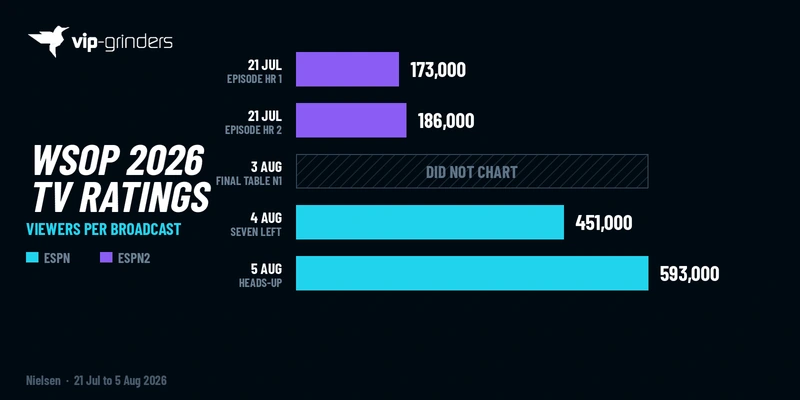
The heads-up match that crowned Lucas Jumalon the 2026 world champion drew 593,000 viewers on ESPN on 5 August. The night before, with seven players left, the broadcast pulled 451,000. The WSOP ESPN ratings for opening night do not exist, because that broadcast never charted.

The figures come from Nielsen. They were surfaced by Lance Bradley, who covered the series for ESPN.com, in his Saturday newsletter The Overlay.
One detail has gone unremarked since. The night that failed to register was the only one of the three on ESPN2 rather than the main ESPN channel. The other two ran on ESPN, including the finish that drew the biggest audience.
What the WSOP ESPN Ratings Actually Show
Nielsen publishes viewership for the top 100 cable programmes each night. Anything below that line goes unreported, which is why 3 August has no number attached to it rather than a small one. It was not zero, it simply sat under the floor.
| Date | Broadcast | Channel | Viewers |
|---|---|---|---|
| 21 July | Edited episode, first hour | ESPN2 | 173,000 |
| 21 July | Edited episode, second hour | ESPN2 | 186,000 |
| 3 August | Final table, night one | ESPN2 | Below reporting floor |
| 4 August | Final table, seven left | ESPN | 451,000 |
| 5 August | Heads-up finale | ESPN | 593,000 |
Set against the era most people are comparing it to, the finale is a fraction of the size. Joe Cada's 2009 title drew over two million viewers, and Peter Eastgate's win a year earlier reached 1.9 million households.
Those audiences arrived long before the multi-year ESPN broadcast agreement that brought the Main Event back this summer, and into a far larger cable universe.
Why Night One Never Charted
The three nights did not run on the same network. Opening night went out on ESPN2, and nights two and three moved to ESPN.
The obvious explanation would be reach, and it does not hold. Nielsen carriage estimates have tracked the two networks side by side for more than two decades, and by 2024 both sat at roughly 71.3 million homes.
So the channel changed but the potential audience barely did. That rules out the easy answer and leaves the slot, the promotion around it, or a genuine shortfall in interest on the opening night.
Every outlet reporting the figures has treated the missing number as a verdict on poker's pulling power. None has checked whether the channel switch explains it. It does not, and our guide to which nights aired on which channel sets out how the schedule was split.
The 2008 Delay Came With Four Months of Television
The 20-day pause between the final nine being set and the final table resuming was not an accident of scheduling. It descends from the November Nine, the format that ran from 2008 to 2016.
Under it, the Main Event stopped at nine players and resumed months later, so the tournament could air on television before anyone knew the outcome. In 2008 the runway ran to months.
Play halted on 14 July and the finalists did not sit back down until 9 November, a gap of close to four months. ESPN filled it with weekly two-hour episodes from 22 July and dedicated Main Event coverage across ten Tuesdays from 2 September.
A one-hour finalist special followed on 4 November, before the finale aired on 11 November. Sixteen weeks of television built the audience. The delay was the frame around it, not the product.
2026 kept the pause and discarded almost all of the runway.
| Element | 2008 | 2026 |
|---|---|---|
| Gap before final table | Close to four months | 20 days |
| Build-up episodes | Weekly from 22 July | Two nights, 21 and 28 July |
| Main Event coverage | Ten Tuesdays from 2 September | One two-hour block |
| Finale format | One-day tape delay | Live |
| Finalist special | Yes, 4 November | No |
One wrinkle cuts against the easy reading. The 2026 finale was live, so nobody watching on 5 August knew the result. It had not happened yet.
What was public for 20 days was the identity of the nine players. That spoils a recap of the earlier days and does nothing at all to a live final table.
The evidence lines up with that split. The two edited episodes, whose outcome viewers already knew, drew the smallest audiences of the run.
The unspoiled live finale drew more than three times either of them. The delay did not fail the finale, it failed to feed it, and how the delayed final table played out shows three nights building an audience from a standing start.
The Audience Did Not Leave, It Moved
The 2026 Main Event drew 9,208 entries, the fourth-largest field in its history. Whatever the television numbers say, participation is not the problem.
The ceiling is structural. Pew Research Center surveyed 9,397 US adults in April 2025 and found that cable subscription now splits sharply by age.
- 65 and over: 64% subscribe to cable or satellite
- 50 to 64: 44% subscribe
- 30 to 49: 23% subscribe
- 18 to 29: 16% subscribe
- All US adults: 36% subscribe, against 83% who watch streaming
Read that against the purpose of the exercise. A broadcast built to recruit the next generation of players is running on a platform fewer than one in five of them has at home.
The WSOP already knows where those viewers are. Free daily streams from the Las Vegas series ran on its own YouTube channel throughout the summer, outside the cable bundle entirely.
The televised final table sits on one side of that split and the rest of the series sits on the other. Only one of the two requires a subscription.
The exposure still carries a price, which is the calculation behind what a televised patch is now worth to a sponsored player. A final table on ESPN still delivers mainstream exposure that online coverage does not. It is no longer the only place the game is watched.
What Happens to the WSOP on Television in 2027
Bradley makes the fair counterpoint himself. The 2026 figures comfortably exceed what the Main Event drew during its years on CBS Sports Network.
Measured against the recent past rather than the poker boom, poker's television ratings gained ground this summer.
The open question is what the WSOP builds around the delay next year, having tested it without the weekly television that made it work. ESPN's own wrap of the three nights in Las Vegas treated the format as a success on its own terms.
A decision on the 2027 broadcast will say more about where poker's audience is expected to be than any single viewing figure.
The game has moved online for the autumn, with 33 bracelets on offer in WSOP Online running through to the end of September.
For everything else moving in the game, our news section carries more poker news and industry analysis.
