

Fold Equity Explained: When Your Bluffs Have Real Value 2026
Every bet you make in poker has two ways to profit. You can win at showdown with the best hand, or your opponent can fold. Fold equity is the value that comes from that second path: the portion of a bet’s expected value that exists purely because your opponent might give up.

Fold equity is not a feel concept. It has a formula, it plugs directly into the EV equation for every semi-bluff, and it changes based on bet size, opponent type, and board texture.
Here is what this guide covers:
- The fold equity formula and a quick dollar example you can use at the table
- The full EV equation for semi-bluffs with a worked turn example
- Break-even fold frequency tables by bet size, for both pure bluffs and draws
- Where fold equity peaks and when it drops to zero or goes negative
- Five fold equity mistakes that cost low and mid-stakes grinders the most money
What Is Fold Equity in Poker?
Fold equity is the share of a bet’s expected value that comes from your opponent folding. It is not a synonym for bluffing. It is a specific, calculable number that exists every time you bet or raise, whether you hold the nuts or complete air.
When you bet $75 into a $150 pot and your opponent folds 40% of the time, that 40% fold rate produces $60 in expected value before you even look at what happens when they call. That $60 is your fold equity in dollars.
The concept matters because most hands in poker are not strong enough to win at showdown consistently. Fold equity is what makes betting with those hands profitable.
How to Calculate Fold Equity
The Dollar Formula
This formula tells you how much money the fold scenario is worth in expectation:
Fold Equity ($) = Probability villain folds × Pot size
The pot is $200. You estimate your opponent folds 35% of the time. Your fold equity is 0.35 × $200 = $70.
That means $70 of your bet’s expected value comes purely from the chance that villain gives up, regardless of what you hold. This is the version you will see on most strategy sites because it only needs two inputs: pot size and fold estimate.
The Full EV Equation for Semi-Bluffs
The formula above isolates the fold scenario. The complete expected value equation captures both outcomes (villain folds and villain calls) in a single calculation:
EV = (F × P) + (1 − F) × [E × (P + B) − (1 − E) × B]
Four inputs drive the entire calculation:
- F = probability villain folds
- P = pot size before your bet
- B = your bet size
- E = your equity when called (probability you win at showdown)
The left half (F × P) is the fold equity component: how much you earn when villain gives up. The right half is the showdown component: how much you win or lose when villain calls. A profitable semi-bluff does not need both halves to be positive: it just needs the total above zero.
Worked Example: Flush Draw on the Turn
You hold 9♥ 8♥ on a board of K♥ 5♥ 3♣ 2♦. The pot is $200. You bet $150 (75% pot), estimate villain folds 40% of the time, and have roughly 20% equity when called.
- 1Fold portion: 0.40 × $200 = +$80
- 2Call portion: 0.60 × [0.20 × ($200 + $150) − 0.80 × $150] = 0.60 × [$70 − $120] = −$30
- 3Total EV: +$80 + (−$30) = +$50
The semi-bluff is profitable even though you lose money when called. The fold equity component (+$80) more than compensates for the negative showdown component (−$30). Without fold equity (F = 0), the same bet loses $50 every time.
This is the exact formula our Semi-Bluff EV Calculator uses under the hood. Plug in your four numbers and get an instant answer for any spot.
Break-Even Fold Frequency
Every bet has a threshold: the minimum fold rate that makes it profitable. The formula:
Break-even fold % = Bet ÷ (Bet + Pot)
Our bluffing guide covers this formula in depth with spot-by-spot applications. The table below is a quick reference for in-session use.
Pure Bluff Break-Even Table
| Bet Size (% of pot) | Villain Must Fold At Least |
|---|---|
| 25% | 20.0% |
| 33% | 25.0% |
| 50% | 33.3% |
| 66% | 40.0% |
| 75% | 42.9% |
| 100% | 50.0% |
| 150% | 60.0% |
| 200% | 66.7% |
These numbers assume a pure bluff with zero equity when called. When you have showdown equity (a draw, a live overcard), the required fold rate drops.
How Equity When Called Lowers the Threshold
| Bet Size (% of pot) | Pure Bluff (0% equity) | Weak Draw (10% equity) | Strong Draw (20% equity) |
|---|---|---|---|
| 50% | 33.3% | ~23% | ~9% |
| 75% | 42.9% | ~33% | ~20% |
| 100% | 50.0% | ~41% | ~29% |
| 150% | 60.0% | ~52% | ~41% |
A 75% pot semi-bluff with a flush draw (roughly 20% equity on the turn) only needs villain to fold around 20% of the time, compared to 43% for a pure bluff at the same size. Any hand with outs dramatically reduces how often your bluff needs to work.
For the full system on choosing bet sizes street by street, see our bet sizing guide.
Where Fold Equity Is Highest and Lowest
Fold equity is not a fixed number. The same hand on the same board can have 60% fold equity in one setup and 10% in another. Four structural factors control it.
- Heads-up vs multiway: every additional opponent roughly halves your fold equity. In a heads-up pot you need one fold, but in a three-way pot a 50% individual fold rate drops to 25% combined.
- Capped ranges: fold equity spikes when your opponent's range is missing its strongest hands. A player who checked the flop and turn on K-9-4-2 does not hold sets, two pair, or AK, so even a moderate bet generates significant folds.
- Tournament pressure: near the bubble and at final tables, fold equity increases because the cost of calling extends beyond chips. Our poker bubble strategy guide covers how to exploit this by stack size.
When Fold Equity Drops to Zero
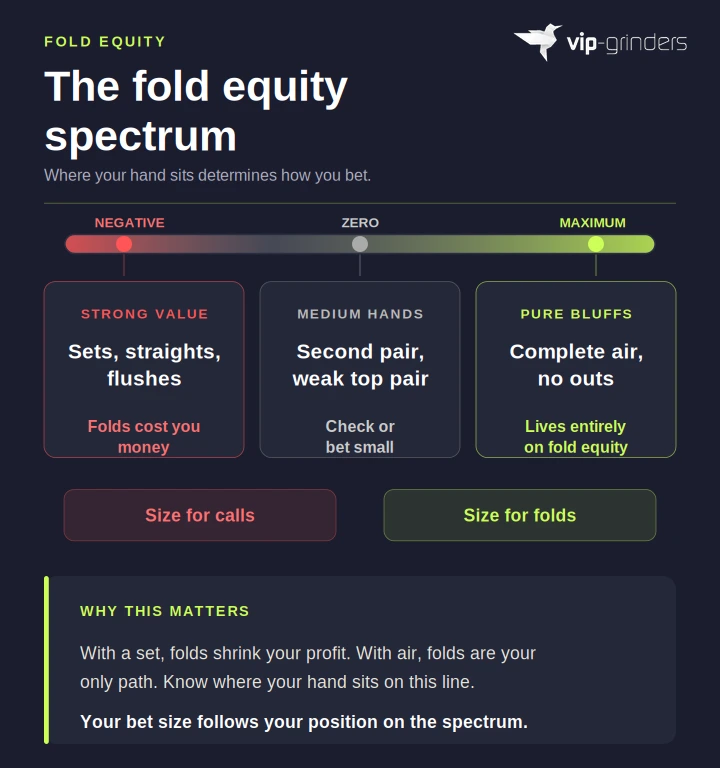
Three situations destroy fold equity entirely: calling stations who never fold, pot-committed opponents getting a price too good to pass, and multiway pots where at least one player is committed regardless. When fold equity is zero, your only profitable bets are value bets where you expect to win at showdown.
When Fold Equity Goes Negative
Fold equity turns negative when you hold a hand so strong that a fold costs you money compared to a call. If you have a set and villain folds a gutshot with 8% equity, you win the pot immediately but miss out on the larger profit from getting called by a hand you crush 92% of the time. Every fold in that scenario costs you roughly $110.
Five Common Fold Equity Mistakes
Most fold equity errors come from overestimating how often your opponent will fold.
- 1Overestimating fold frequency against recreational players. Casual players call because they want to see what happens. Their fold rate is often 20% to 30% lower than a regular in the same spot.
- 2Sizing bluffs too small. A quarter-pot bet gives your opponent a cheap price to call and generates almost no fold equity. If you are going to bluff, size large enough to create a real decision.
- 3Bluffing into three or more opponents. Each extra player roughly halves your fold equity. In a four-way pot where each folds 50% individually, the chance all three fold is only 12.5%.
- 4Ignoring your own table image. If you have been caught bluffing twice in the last ten hands, your fold equity has dropped significantly against observant opponents. Recent showdown history changes how often villain folds, and most players forget to adjust.
- 5Bluffing opponents who are already priced in. A player with 15bb left facing a 10bb bet into a 30bb pot is getting 4:1 and only needs 20% equity to call. Your fold equity against them is effectively zero.
A bluff you do not make costs you nothing. A bluff against the wrong opponent costs you your bet.
Frequently Asked Questions
What is fold equity in simple terms?
Fold equity is the value your bet gains from the chance that your opponent folds. If you bet $50 into a $100 pot and your opponent folds 30% of the time, that 30% fold rate produces $30 in expected value before you even consider what happens when they call.
How do you calculate fold equity?
Two formulas exist. The dollar version is: Fold Equity ($) = Probability villain folds × Pot size. This tells you how much money the fold scenario is worth. The equity version is: Fold Equity (%) = Probability villain folds × Villain’s equity. This tells you how much your overall equity improves when villain gives up.
Is fold equity the same as bluffing?
No. Bluffing is a decision you make at the table. Fold equity is a mathematical component of that decision. Every bluff relies on fold equity to be profitable, but fold equity also exists in value bets (when villain folds draws that had equity against you) and in semi-bluffs (where fold equity combines with showdown equity).
Does fold equity apply preflop?
Yes. Preflop raises and 3-bets generate fold equity by forcing opponents to fold hands they would otherwise play. A 3-bet from the cutoff against a button open might fold out 60% to 70% of the opener’s range, making the 3-bet profitable even with a weak hand. Preflop fold equity is especially important in tournament play where stealing blinds and antes adds up over hundreds of hands.
How do you increase fold equity?
Four factors increase fold equity: betting larger (bigger bets require more equity to call), isolating a single opponent (multiway pots kill fold equity), targeting capped or weak ranges (opponents who have shown weakness by checking multiple streets), and using high-pressure actions like 3-bets, check-raises, and overbets.
What is a good fold equity percentage?
There is no universal number because the threshold depends on your bet size and equity when called. A pure bluff with a 75% pot bet needs villain to fold at least 43% of the time. A semi-bluff with 20% equity at the same size only needs about 20% folds. The right question is whether you have enough fold equity for this specific bet to be profitable.
Can fold equity be negative?
Yes. When you hold a very strong hand and your opponent folds a hand you were going to beat, the fold costs you money compared to a call. If you have a set and villain folds a gutshot with 8% equity, you win the pot but miss out on the larger profit from getting called by a hand you crush 92% of the time.
What is the difference between fold equity and equity denial?
Both involve making your opponent fold, but they apply from opposite positions. Fold equity matters when you are behind or flipping and need folds to make your bet profitable. Equity denial matters when you are ahead and want to prevent draws from realizing their equity. The two can conflict: if your hand crushes villain’s range, forcing a fold actually has negative fold equity because the call was worth more.