

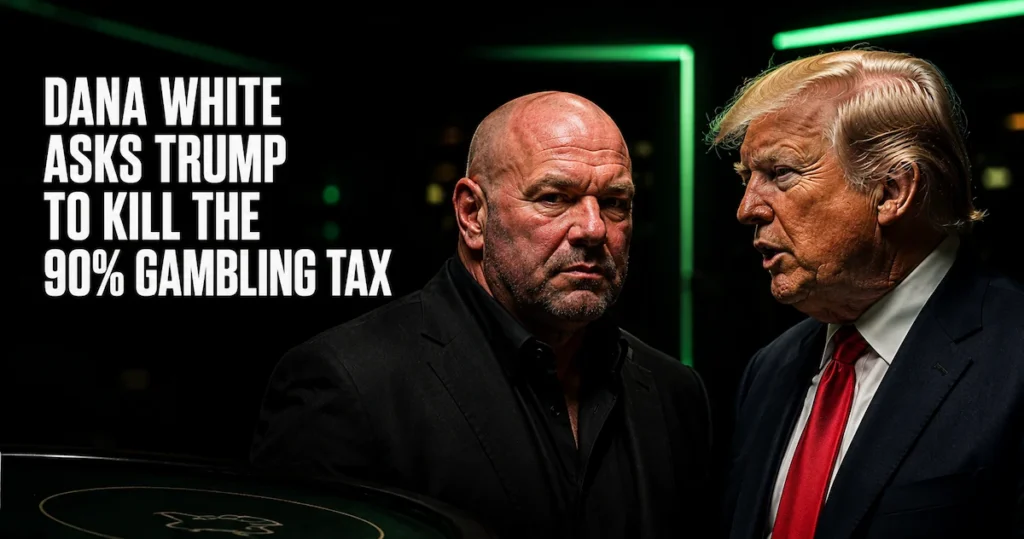
UFC President Dana White sent a letter to President Donald Trump on May 11, 2026, asking him to restore the full 100% gambling loss deduction. The letter was first reported by gambling journalist Dustin Gouker and confirmed by ESPN.
The story has moved fast since the letter went public. Here's where things stand:
- The One Big Beautiful Bill Act (OBBBA) caps gambling loss deductions at 90%, creating taxable phantom income for players who break even or lose money.
- White wants it gone. Four separate repeal bills are already in Congress with bipartisan support.
- Prediction market odds of repeal before 2027 roughly doubled on Kalshi within hours of the letter going public.
Poker legend Billy Baxter says the profession “can't survive” under the current rules. Erik Seidel, a 10x WSOP bracelet winner, has publicly scaled back his volume. Trump himself? He hasn't picked a side yet.
Below: what White actually wrote, who is backing the push in Congress, and a realistic timeline for whether this gets fixed before US players file 2026 taxes in April 2027.
What Dana White Told Trump
The letter, dated May 11, 2026 and written on official UFC letterhead, went directly to the White House. White opened by praising the OBBBA as a whole before turning to the one provision he wants removed: the 90% cap on gambling loss deductions.
His core argument came down to one line:
“The current law makes it irrational to bet in the United States.”
New: UFC President Dana White has sent a letter to President Donald Trump asking him to help reverse the 90 percent limit on gambling loss deductions for US taxpayers that became law last year.
The issue has been a concern for both bettors and the gambling industry itself. pic.twitter.com/WH9ukZi3mH
— Dustin Gouker (@DustinGouker) May 13, 2026
White told Trump that under the new rules, a gambler can owe taxes even after a losing year. That alone, he argued, is enough to push bettors away from legal, regulated platforms and toward offshore or underground alternatives.
He then connected the issue to three areas Trump cares about:
- No Tax on Tips: White argued that gamblers who win big tend to tip big. If fewer people gamble because of the tax hit, casino workers and dealers take home less. That directly undercuts Trump’s signature tipping policy.
- Legal sports betting: The UFC has built its business around fan engagement through legal sportsbooks. White wrote that discouraging legal betting hurts the entire ecosystem of state regulators, licensed operators, and sports partnerships.
- Common-sense regulation: White closed by framing the fix as a pro-business move, telling Trump that restoring the full deduction would send a strong signal that the US supports fair and transparent gambling regulation.
White also noted this wasn't the first time he'd raised the issue with Trump. The two have discussed it before, which suggests the conversation has been ongoing behind the scenes.
Trump's Response So Far
When asked about the gambling tax provision back in December 2025, Trump kept his options open.
“I don't know. I'm gonna have to think about that.”
As of publication, the White House has not responded to the letter publicly. That's the missing piece. Bipartisan support exists, the bills are written, and the highest-profile voice in Trump's circle is now on record, but the President hasn't given one.
Why the 90% Cap Hits Poker Players Hardest
The rule is simple. Before January 1, 2026, gamblers could deduct 100% of their losses against their winnings. Now the cap is 90%.
The remaining 10% becomes taxable income that doesn't actually exist in your bankroll. That's what the industry calls phantom income.
Here's what that looks like for three different player profiles:
| Player Profile | Total Winnings | Total Losses | Real Profit | Taxable Under Old Rule | Taxable Under 90% Cap |
|---|---|---|---|---|---|
| Breakeven recreational | $50,000 | $50,000 | $0 | $0 | $5,000 |
| Small winning grinder | $150,000 | $140,000 | $10,000 | $10,000 | $24,000 |
| Mid-stakes MTT pro | $3,000,000 | $2,800,000 | $200,000 | $200,000 | $480,000 |
The breakeven player made zero dollars and owes tax on $5,000. The mid-stakes pro earned $200,000 but gets taxed as if he made $480,000. That's the problem in two numbers.
Why Poker Gets Hit Worse Than Sports Betting
A casual NFL bettor might win $5,000 and lose $5,000 in a year. The 10% disallowed deduction on that is $500 in phantom income. Annoying, but manageable.
Poker is different. Tournament pros cycle enormous amounts of money through buy-ins. A player who cashes $3 million across a year might spend $2.8 million on entries, travel, coaching, and software.
The real profit is $200,000. But under the 90% cap, only $2,520,000 of those losses can be deducted.
That leaves $480,000 in taxable income on a $200,000 reality. Phil Galfond was among the first to run this math publicly after the OBBBA passed.
What Poker Pros Are Saying
Billy Baxter is 85 years old and the player whose landmark federal tax case established poker as a legitimate profession in the US. His take on the new rule is blunt:
“You can't pay tax on money you don't make.”
Baxter told Poker.org that professional poker simply cannot function under these rules. He added that if nothing changes, players will either quit, leave the country, or end up in legal trouble.
Erik Seidel, a Poker Hall of Famer with 10 WSOP bracelets and nearly $49 million in career earnings, has already started adjusting. He told PokerNews late last year that the tax change is pushing him toward semi-retirement, reducing the number of tournaments he enters and rethinking which events are worth the financial risk.
These aren't marginal players complaining about a minor rule change. These are two of the most accomplished names in poker history saying the math no longer works.
Four Bills, Two Parties, One Letter That Moved the Odds
Dana White's letter to Trump didn't land in a vacuum. The political groundwork to repeal the 90% cap has been building since the OBBBA was signed on July 4, 2025.
One detail most coverage has missed: the 90% cap was never a deliberate policy decision targeting gamblers. It was a budget offset, added to satisfy Senate reconciliation rules so the overall tax package could pass with only Republican votes. That matters because it means nobody in Congress is actually defending the provision on its merits.
Here's every active effort to remove it:
- 1FAIR BET Act (Rep. Dina Titus, D-NV): The first bill introduced after the OBBBA passed. It would restore the full 100% deduction. Titus publicly thanked White for raising the issue, writing on X that she has ‘led the fight in Congress.’
- 2Cortez Masto + Cruz bipartisan bill (Sen. Catherine Cortez Masto, D-NV and Sen. Ted Cruz, R-TX): The only Senate bill with co-sponsors from both parties. Cortez Masto responded to White’s letter within hours, posting: ‘I agree with Dana White, the President needs to join us and fix this now.’
- 3FULL HOUSE Act (Rep. Steven Horsford, D-NV): Another House bill targeting the same provision. Horsford promoted it again publicly the day White’s letter dropped.
- 4WAGER Act (Rep. Andy Barr, R-KY): The Republican counterpart in the House. Its existence confirms this is not a party-line issue.
The American Gaming Association (AGA) also backed White's intervention with an official statement, calling the restoration of the full deduction a top priority and thanking White for raising awareness of the issue.
I have a bipartisan bill to reverse the nonsense tax on gambling losses for exactly this reason: it's hurting players, our gaming and tourism industry, and the workers who count on them for their livelihoods.
I agree with Dana White, the President needs to join us and fix this… https://t.co/RrO11x7cMF
— Senator Cortez Masto (@SenCortezMasto) May 13, 2026
The Real Problem: Getting to a Vote
Four bills, bipartisan support, industry backing, and now a direct appeal from Trump's inner circle. On paper, this should be straightforward. In practice, none of these bills have reached a floor vote.
The FAIR BET Act has been sitting in committee since mid-2025. The Cortez Masto/Cruz bill has bipartisan co-sponsors but no scheduled hearing.
The bottleneck isn't support. It's Congressional bandwidth: gambling tax relief is competing for attention with dozens of other OBBBA corrections, and none of them have a clear path to the floor yet.
That's exactly why White's letter matters. It's not introducing a new idea. It's trying to move an existing one to the front of the line.
Did the Letter Actually Change Anything?
Within hours of the letter going public, two things moved: prediction markets and politicians.
The Kalshi Numbers
On Kalshi, the largest US prediction market platform, odds of the 90% cap being repealed shifted noticeably:
- Odds of repeal before September 1, 2026 jumped from near 0% to around 14%.
- Odds of repeal before 2027 jumped from roughly 19% to over 30%.
Those moves sound significant, but context matters. Total trading volume on these contracts was only around $27,000. That's a handful of bettors, not a market consensus, and the shift reflects increased attention, not a confident forecast.
The Political Response
Every lawmaker and industry group already on record supporting repeal amplified the letter within hours. All four bills got a fresh round of media coverage. That speed matters.
Before the letter, the repeal effort was a bipartisan push with zero momentum. After it, the same push had a celebrity endorsement, national coverage from ESPN and CNBC, and a direct line to the White House.
The letter didn't change the law. It changed the visibility of the fight to change it.
Realistic Timeline: When Could This Get Repealed?
There is no scheduled vote, no confirmed hearing, and no commitment from the White House. That's the honest starting point. But there are three windows where movement is most likely.
- 1House Ways and Means Committee hearings (Summer 2026): Reports suggest the committee is discussing hearings on OBBBA corrections, including the gambling deduction cap. Nothing is on the calendar yet, but this is the most realistic near-term path.
- 2November 2026 midterms: Four of the five lawmakers leading the repeal push represent Nevada. Casino workers, sportsbook operators, and poker players are a voting bloc there. Campaign season creates pressure to show results before November.
- 3April 2027 tax filing deadline: This is the hard wall. If the cap is not repealed before US players file their 2026 returns, every poker pro and serious recreational gambler pays phantom income taxes for real. The issue stops being theoretical and hits bank accounts.
The most likely scenario: nothing moves before Q3 2026. If the Ways and Means hearings happen over summer and midterm pressure builds, a fix could be attached to a broader tax correction bill in late 2026 or early 2027. That would be just in time for tax filing season.
The worst case: the bills keep sitting in committee, Trump stays silent, and the 90% cap survives into 2027 and beyond. If that happens, the effects White, Baxter, and Seidel are warning about will become visible in the data: fewer US tournament entries, more volume shifting offshore, and a generation of grinders reconsidering whether the US is the right place to play.
What Comes Next
White's letter is the highest-profile push yet to fix a rule that was never meant to target poker. Whether it moves Trump depends on whether this stays in the news or fades after the 2026 WSOP kicks off on May 26.
We will update this article as the story develops.
