

Seven-Card Stud: Rules, Starting Hands & Strategy 2026
In Seven-Card Stud, four of each player’s seven cards are dealt face-up on the table. You can see what your opponents are building, and they can see yours. Every smart decision in this game comes from reading those visible cards and acting on what they tell you.
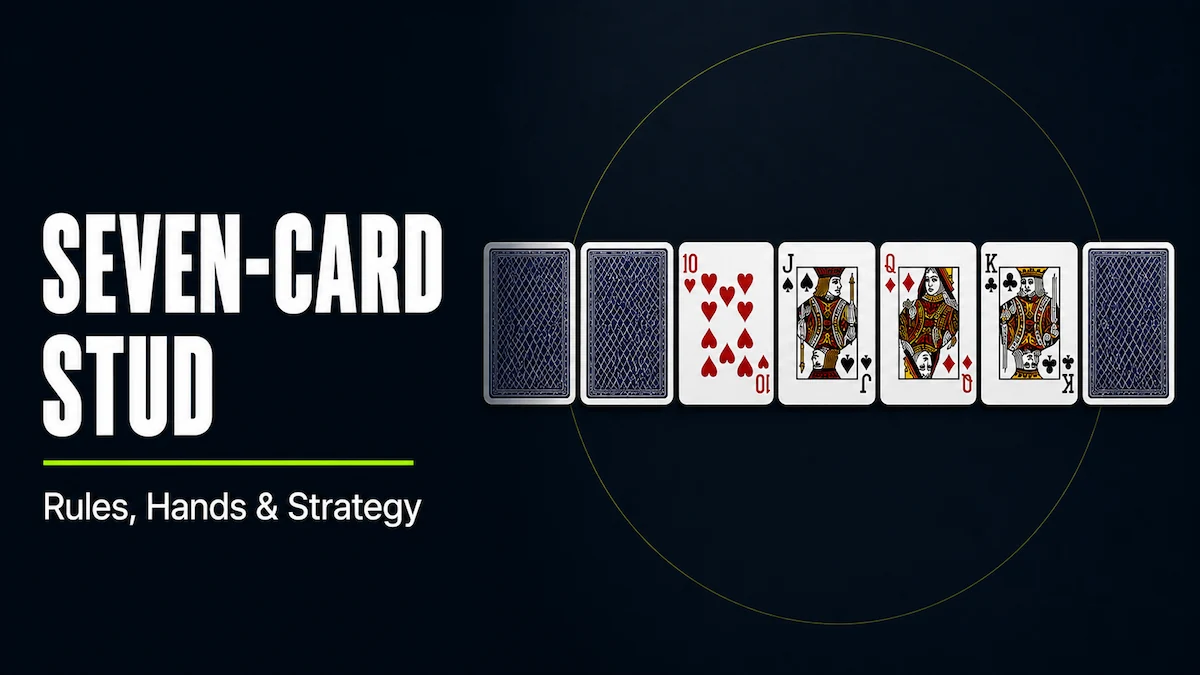
This guide covers the game from scratch:
- How a hand plays out from antes to showdown
- Which starting hands to play and which to fold
- Strategy for each street, from third through seventh
Every term is defined the first time it appears, including antes, the bring-in, and each of the five betting streets.
How a Hand Works
Seven-Card Stud uses a standard 52-card deck with no community cards. Here is what sets it apart from other poker formats:
| Seven-Card Stud | |
|---|---|
| Cards dealt to you | 7 (3 face-down, 4 face-up) |
| Community cards | None |
| Betting structure | Fixed-limit |
| Table size | 2 to 8 players |
| Hand rankings | Standard (same as Hold’em) |
Before any cards are dealt, every player posts a small forced bet called an ante. The hand then plays out across five betting streets.
The dealer gives each player two cards face-down and one card face-up. The face-up card is called your door card. The player showing the lowest door card must post a second forced bet called the bring-in.
In a $10/$20 game, the ante is usually $1 and the bring-in is $5. The bring-in player can also choose to complete to the full small bet of $10 instead of posting just $5. If two players show the same lowest door card, the tie is broken by suit.
The Five Betting Streets
Fixed-limit means every bet and raise is a set amount. On third and fourth street, all bets are the small bet ($10 in a $10/$20 game). From fifth street onward, all bets double to the big bet ($20).
| Street | Cards Dealt | Total Cards | Bet Size | Notes |
|---|---|---|---|---|
| Third | 2 down + 1 up | 3 | Small bet | Lowest door card posts the bring-in |
| Fourth | 1 face-up | 4 | Small bet | If any board shows a pair, big bet allowed |
| Fifth | 1 face-up | 5 | Big bet | Bets double from this street |
| Sixth | 1 face-up | 6 | Big bet | |
| Seventh | 1 face-down | 7 | Big bet | Final card is hidden |
The standard bankroll for fixed-limit Stud is 300 big bets at your stake.
From fourth street onward, the player with the strongest visible board acts first. This means your position changes every street based on what cards are showing, unlike Hold’em where the button stays fixed.
Showdown
After the final betting round on seventh street, remaining players reveal their cards. Each player makes the best five-card hand from their seven cards using standard poker hand rankings, identical to Texas Hold’em. The last player to bet or raise shows first.
Starting Hands
Your third-street decision is the most important one in Seven-Card Stud. If you enter with a weak hand, every street after that compounds the mistake. If you fold bad hands early, you save bets that add up over hundreds of sessions.
The chart below ranks starting hands from strongest to weakest. “Hole cards” are your two hidden cards. “Door card” is your one face-up card.
| Category | Hole Cards | Door Card | Action |
|---|---|---|---|
| Rolled-up trips | 5♠ 5♥ | 5♦ | Always raise. Odds of being dealt this: 424 to 1. |
| Big pair (hidden) | K♠ K♥ | 7♦ | Raise. Stronger when your door card looks scary (like an Ace). |
| Medium pair + high kicker | 9♠ 9♥ | A♦ | Raise or complete, but only if your pair is live. |
| Three to a flush | J♥ 7♥ | 3♥ | Play if two or fewer of your suit are visible on the table. |
| Three to a straight | 7♠ 8♦ | 9♣ | Play if your cards are connected and live. |
| Three high cards | Q♦ J♣ | K♠ | Playable in late position if all three cards are live. |
| Small pair | 4♠ 4♥ | J♦ | Fold unless both remaining fours are live and antes are large. |
| Everything else | Fold. |
Rolled-up trips means all three of your starting cards are the same rank (for example, 5♠ 5♥ 5♦). It is the strongest possible start and happens roughly once in every 425 hands.
A big pair hidden in the hole (like two Kings face-down with a low door card) is strong because your opponents cannot see it. A big pair showing face-up is weaker because every player at the table knows what you have.
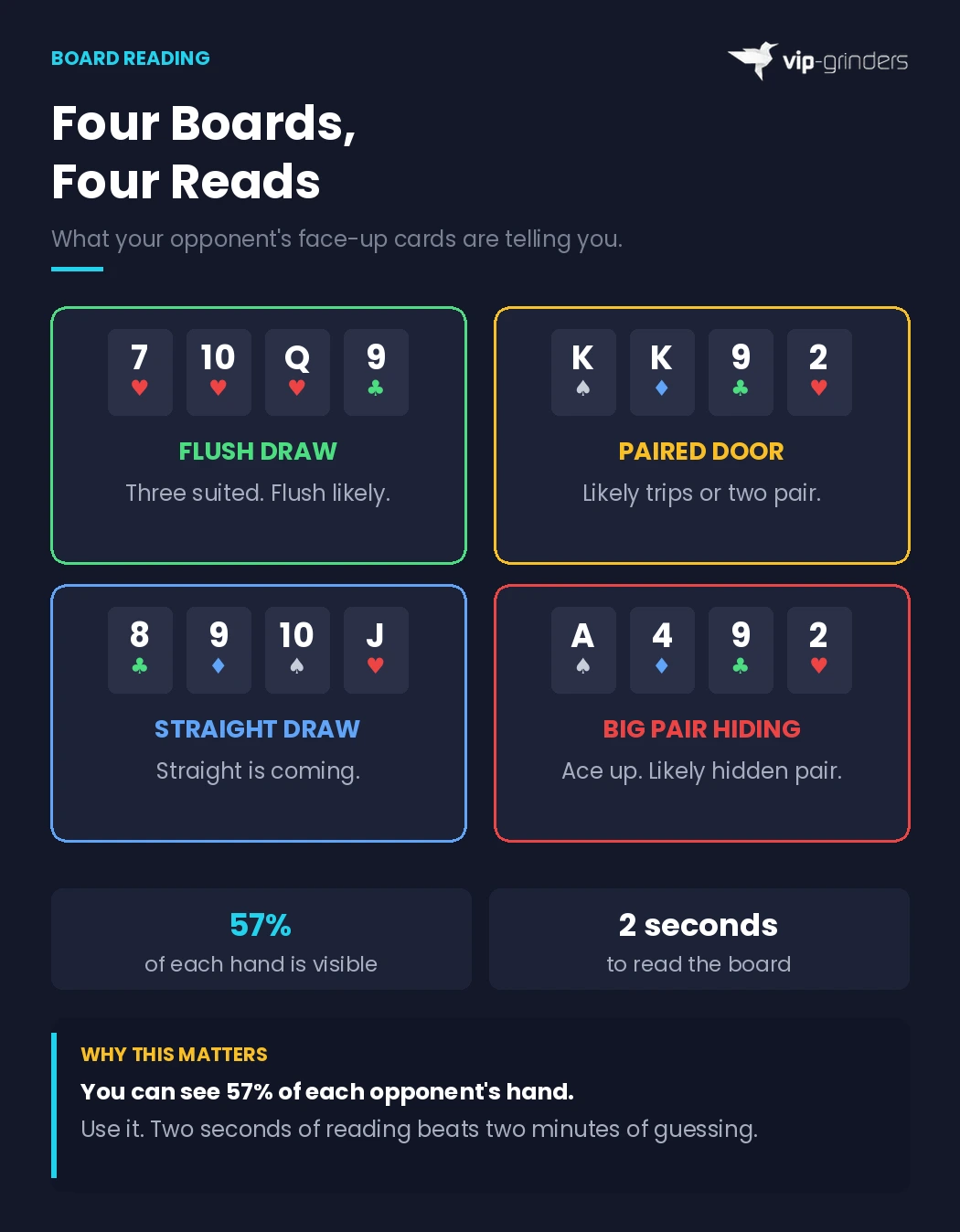
Live vs Dead Cards
This is the single most important concept in Seven-Card Stud. Because you can see every opponent’s face-up cards, you know which cards are still available and which ones are gone.
A hand is live when the cards you need to improve are not visible on the table. A hand is dead when the cards you need are already showing in other players’ boards.
Here is a practical example. You hold 9♠ 9♦ in the hole with K♣ as your door card. You look around the table at every opponent’s face-up cards:
- No Nines or Kings visible: your hand is fully live. Play it.
- One Nine visible: only one Nine left in the deck. Your chances of making trips dropped significantly. Proceed with caution.
- Two Nines visible: zero Nines left. Your pair can never improve to trips. Fold.
Before calling or raising on third street, always scan the table for cards that match your hand. This takes two seconds and saves you from chasing hands that can no longer get there. The more of your key cards that are live, the more profitable your hand becomes.
Understanding pot odds helps you calculate whether calling is correct when your hand is partially live. Implied odds matter less in fixed-limit Stud than in No-Limit because bets are capped, so focus on the direct pot price.
Strategy by Street
Once you know which hands to play, the next question is how to play them as new cards are dealt. Each street changes the information available to you and the price of staying in the hand.
Third Street
This is where the hand is won or lost. Three rules cover most situations:
- 1Only enter with hands from the starting hand chart above. If your three cards don’t fit one of those categories, fold.
- 2Check your live cards before every call. Scan the table for cards that match yours. A hand that looks playable on paper becomes a fold when your key cards are dead.
- 3Respect high door card raises. When a player showing an Ace or King raises, they usually have a strong pair to back it up. Don’t call with a medium or weak hand hoping to get lucky.
If you are the last to act and everyone has folded or just completed, a raise with a strong looking door card (like A♠ or K♠) can take the antes. This works best when the remaining players show low or disconnected boards.
Fourth Street
Bets are still small on this street, which makes it cheap to see one more card. Use that to your advantage.
If your fourth card improved your hand (a second suited card for your flush draw, or a card that connects with your straight draw), keep going. If you caught a blank and your opponent’s board just got stronger, fold now. Saving one small bet here adds up over time.
One special rule applies on fourth street: if any player’s board shows a pair, every player at the table has the option to bet the big bet instead of the small bet. Watch for this, because it changes the price of staying in the hand.
Fifth Street
This is the most important street after third. Bets double here, which means every call from this point forward costs twice what it did on third and fourth street.
The principle is simple: if your hand is not strong enough to call a double-sized bet, get out before fifth street. Do not pay small bet prices on third and fourth street only to fold when the pot gets expensive. That pattern is one of the most common ways stud players lose money.
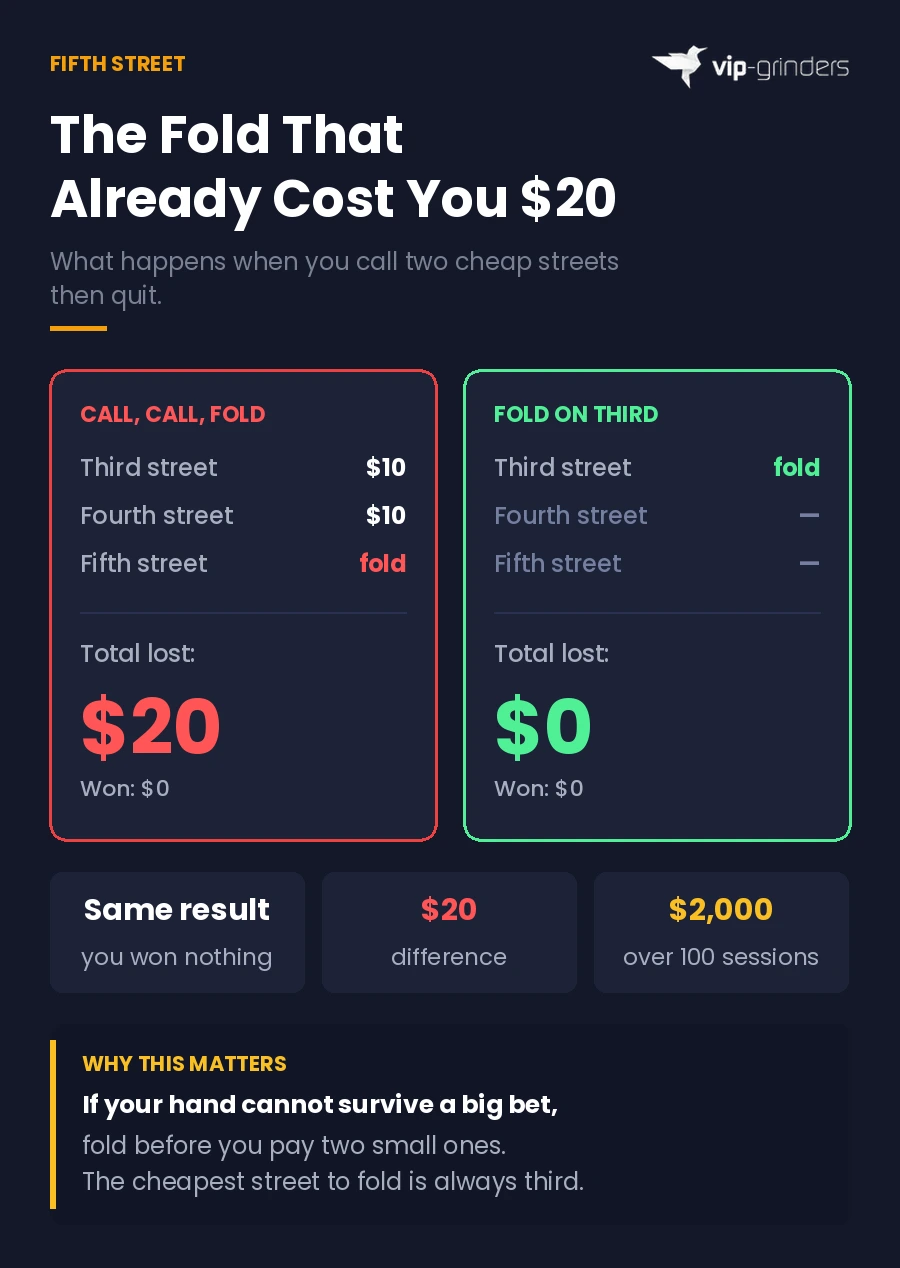
By fifth street, you can see three of each opponent’s face-up cards. That is enough information to estimate whether they are on a draw, holding a pair, or building something stronger. Use what you see to decide whether your hand is still worth playing.
Sixth and Seventh Street
On sixth street, you can see four of each opponent’s seven cards. This is where board reading matters most.
Look for patterns. Three cards of the same suit showing means a possible flush. A paired door card could mean trips or a full house. If an opponent’s board looks threatening and they are betting into you, believe them unless you hold a strong hand yourself.
Seventh street is dealt face-down, so you get no new information about your opponents. Your decision here is based on everything you observed across the previous four face-up streets plus the size of the pot. If the pot is large relative to one final big bet, calling is often correct even with a marginal hand.
Bluffing on seventh street works when your visible board tells a strong story. If your face-up cards show four to a flush or a scary pair, a bet can push opponents off better hands. But bluff sparingly in fixed-limit stud, because the pot usually offers your opponents good odds to call.
Frequently Asked Questions
What is the best starting hand in Seven-Card Stud?
Rolled-up Aces (A♠ A♥ A♦) is the strongest possible starting hand. Any rolled-up trips (three of a kind dealt on third street) is extremely strong, with odds of 424 to 1 against being dealt one. After trips, the next best starts are big hidden pairs like K♠ K♥ with a low or scary door card, followed by high three-card flush draws and high three-card straight draws where all key cards are live.
Are hand rankings the same as Texas Hold'em?
Yes. Seven-Card Stud uses the same rankings from Royal Flush down to High Card. There are no modified rankings like in Short Deck. The only difference is that stud players make their best five-card hand from seven individual cards rather than from two hole cards plus five community cards.
Can I still play Seven-Card Stud online?
Stud is available online but with limited traffic compared to Hold’em or Omaha. PokerStars (.com) runs stud tournaments in mixed game series. Americas Cardroom (ACR) offers both cash tables and tournaments. BetMGM spreads limited stud cash games for players in New Jersey. Outside of these, most stud action happens in live cardrooms during WSOP events or in mixed game rotations.
What bankroll do I need for Seven-Card Stud?
The classic guideline for fixed-limit poker is 300 big bets. At a $1/$2 table that means $600. At $5/$10 that means $3,000. At $10/$20 that means $6,000. Fixed-limit variance is lower per hand than no-limit, but sessions can still swing over short samples.
What is the difference between Stud and Razz?
Both games deal seven cards per player with the same street structure, antes, and bring-in. The difference is the goal. In Seven-Card Stud, the best (highest) five-card hand wins. In Razz, the worst (lowest) five-card hand wins, with Aces playing low and straights and flushes not counting against you.
Is Seven-Card Stud played in HORSE?
Yes. HORSE is a mixed game that rotates through five poker formats: Hold’em, Omaha Hi-Lo, Razz, Stud, and Stud Hi-Lo Eight-or-Better. Stud is the “S” in HORSE. Most WSOP mixed game events and many live cardroom rotations include stud as one of the formats. If you plan to play HORSE, learning stud alongside Omaha Hi-Lo and Razz will prepare you for three of the five rounds.