

Razz Poker: Rules, Hand Rankings & Strategy for Lowball Stud 2026
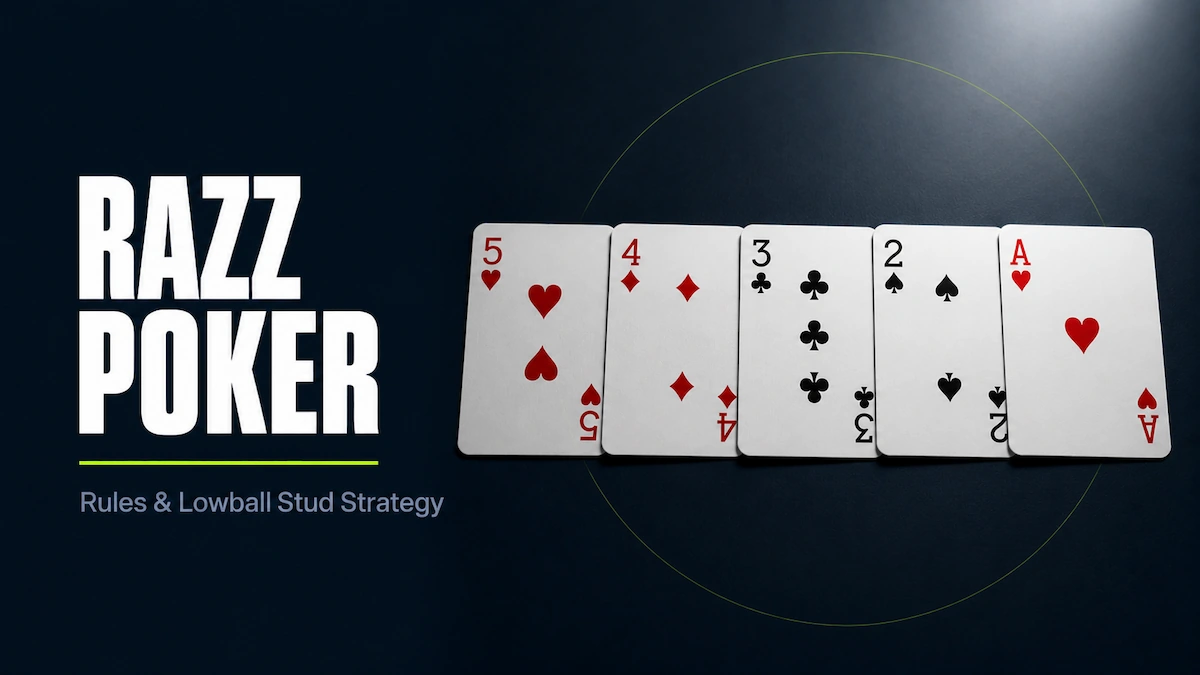
Razz is Seven-Card Stud played for low. The best possible hand is 5-4-3-2-A (called the “wheel”), straights and flushes do not count against you, and aces are always low. There are no community cards: every player receives seven cards of their own across five betting rounds, and the lowest five-card hand at showdown wins the pot.
If you already know Seven-Card Stud, Razz follows the same dealing and betting rules with one change: the lowest hand wins. If you’ve never played any form of Stud, that’s fine. This guide explains everything from scratch.
- The A-to-5 hand rankings with worked examples
- Antes, bring-in, and how the five betting rounds work
- A starting hand chart and street-by-street strategy from 3rd through 7th
- The five most common Razz mistakes and how to avoid them
Razz is part of the Stud family, where every player receives their own cards rather than sharing a community board. For the high-hand version of the game, see our Seven-Card Stud guide.
Razz Hand Rankings: The A-to-5 Ranking
In standard high-hand poker rankings, the Royal Flush sits at the top. In Razz, the ranking flips: the lowest five-card hand wins. The system is called A-to-5 lowball because Ace counts as 1 (the lowest possible card) and the best hand you can make is 5♠ 4♥ 3♦ 2♣ A♠.
Straights and flushes are completely ignored. That 5♠ 4♥ 3♦ 2♣ A♠ is technically a straight, but in Razz it does not matter: it is simply a “5-low” and the best hand in the game.
Pairs always hurt your hand. Any unpaired hand beats any paired hand, regardless of the cards involved. There is also no qualifier: unlike Omaha Hi-Lo where the low pot requires five cards 8-or-lower, the lowest hand at the Razz table always wins, even if it’s a pair of Kings.
| Rank | Hand | Notes |
|---|---|---|
| 1 | 5♠ 4♥ 3♦ 2♣ A♠ | The “wheel.” Best possible Razz hand. |
| 2 | 6♦ 4♠ 3♥ 2♣ A♠ | Best possible 6-low. |
| 3 | 7♥ 4♦ 3♠ 2♣ A♠ | Best possible 7-low. |
| 4 | 7♣ 6♠ 5♥ 4♦ 3♠ | Worst 7-low. Still beats any 8-low. |
| 5 | 8♠ 4♥ 3♦ 2♣ A♠ | Best possible 8-low. |
| 6 | 8♦ 7♥ 6♠ 5♣ 4♦ | Worst unpaired 8-low. |
| 7 | 9♥ 5♦ 4♠ 3♣ 2♥ | Rarely wins at showdown in a full game. |
| 8 | K♣ Q♠ J♥ 10♦ 9♠ | Worst possible unpaired hand. |
| 9 | A♣ A♥ 7♦ 4♣ 2♠ | Pair of Aces. Loses to every unpaired hand. |
How to Read a Razz Hand
When two players both have unpaired hands, compare the highest card first. If those match, compare the second highest, then the third, and so on until one hand has a lower card. That hand wins.
Example 1: 7♠ 5♥ 4♦ 3♣ A♠ beats 7♦ 6♠ 3♥ 2♣ A♦. Top cards match (both 7). Second card decides: 5 is lower than 6.
Example 2: 8♥ 6♦ 5♠ 4♣ A♠ beats 8♠ 6♥ 5♦ 4♦ 2♠. First four cards are identical. The Ace (= 1) beats the 2 at the fifth position.
If every card matches, the hands are equal and the pot is split. Suits never break ties in Razz.
How a Razz Hand Plays Out
A Razz hand uses fixed-limit betting, meaning all bets and raises are set amounts based on the stakes. Each player receives a total of seven cards across five betting rounds (called “streets”): three dealt face-down and four dealt face-up.
| Street | Cards Dealt | Bet Size | Who Acts First |
|---|---|---|---|
| 3rd Street | 2 down + 1 up | Small bet | Highest door card (bring-in) |
| 4th Street | +1 up (2 showing) | Small bet | Lowest exposed hand |
| 5th Street | +1 up (3 showing) | Big bet (doubles) | Lowest exposed hand |
| 6th Street | +1 up (4 showing) | Big bet | Lowest exposed hand |
| 7th Street | +1 down (4 still showing) | Big bet | Lowest exposed hand |
From 4th street onward, the player showing the lowest exposed cards acts first. This means your acting order changes from street to street based on what cards are dealt. For the button-based position system used in Hold’em and Omaha, see our guide to position in poker.
Antes, Bring-In, and the Suit Tiebreaker
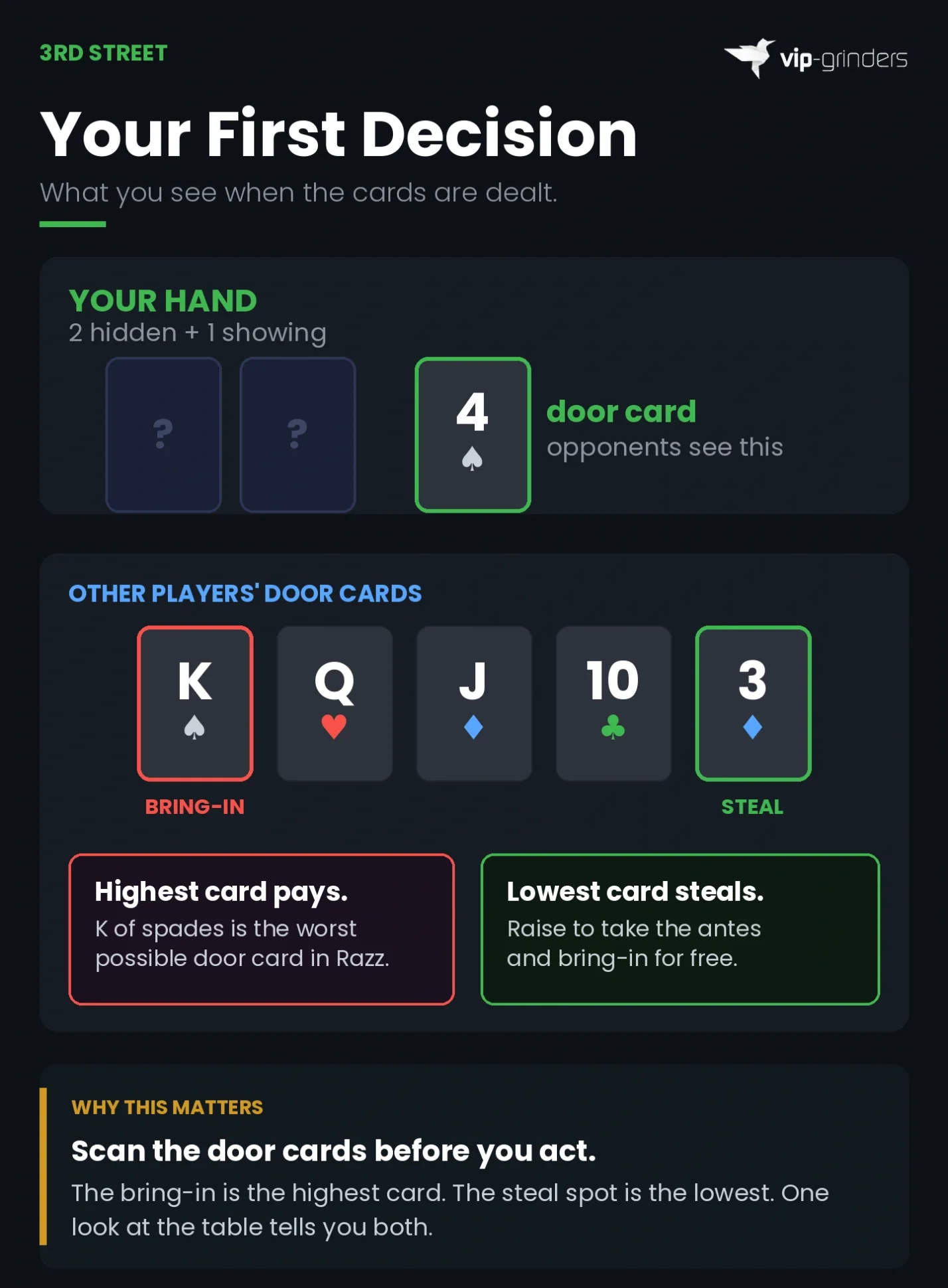
Before any cards are dealt, every player posts an ante (a small forced bet, typically 10% to 20% of the small bet). After the antes are in and each player receives their three starting cards (two down, one up), the player showing the highest exposed card must post the bring-in.
The bring-in is a forced bet larger than the ante but smaller than a full bet. The bring-in player can post just the forced amount or “complete” to the full small bet. Action then continues clockwise.
If two players show the same high card, suits break the tie: K♠ > K♥ > K♦ > K♣ (spades highest, clubs lowest). The player with the higher suit pays. That makes K♠ the worst possible door card in Razz: it guarantees you pay the bring-in every time.
Here is how the betting plays out in a typical $10/$20 Razz game:
| Bet Type | Amount ($10/$20 game) |
|---|---|
| Ante | $2 |
| Bring-in | $5 |
| Small bet (3rd and 4th street) | $10 |
| Big bet (5th, 6th, and 7th street) | $20 |
| Cap per street | 4 bets |
Razz uses the same bankroll management rules as other fixed-limit games: 300 big bets at your stake.
Starting Hands and Street-by-Street Strategy
Razz rewards patience. Most hands you’re dealt should be folded on 3rd street, and the players who win over time are the ones who enter pots with strong starting cards and pay attention to what’s showing on the board.
Starting Hand Tiers
A Razz starting hand is three cards: two dealt face-down and one face-up (your “door card”). Suits do not affect hand strength. The table below groups starting hands by the highest card in the three.
| Tier | Starting Hands | Action |
|---|---|---|
| Premium | Three unpaired cards 5 or below (A-2-3, A-2-4, A-3-4, 2-3-4, and similar) | Raise or complete |
| Strong | Three unpaired cards, highest is 6 or 7 (A-2-6, A-3-7, 3-4-6, and similar) | Complete. Raise if stealing. |
| Playable | Three unpaired cards, highest is 8 (A-2-8, 3-4-8, and similar) | Complete if door card is low and your cards are live (not showing in other players’ hands) |
| Fold | Any pair, any 9 or higher, any face card | Fold |
Your door card matters as much as your hidden cards. A hand with hidden A♠ 2♥ and a K♦ showing is a fold: opponents see the King and read you as weak. A hand with hidden 8♥ 7♦ and a 3♦ showing is playable because the table reads your low door card as strong.
Early Streets: Third and Fourth
On 3rd street, play hands from the top three tiers of the chart and fold everything else. If you hold a premium or strong hand and your door card is the lowest showing, raise to steal the bring-in and antes.
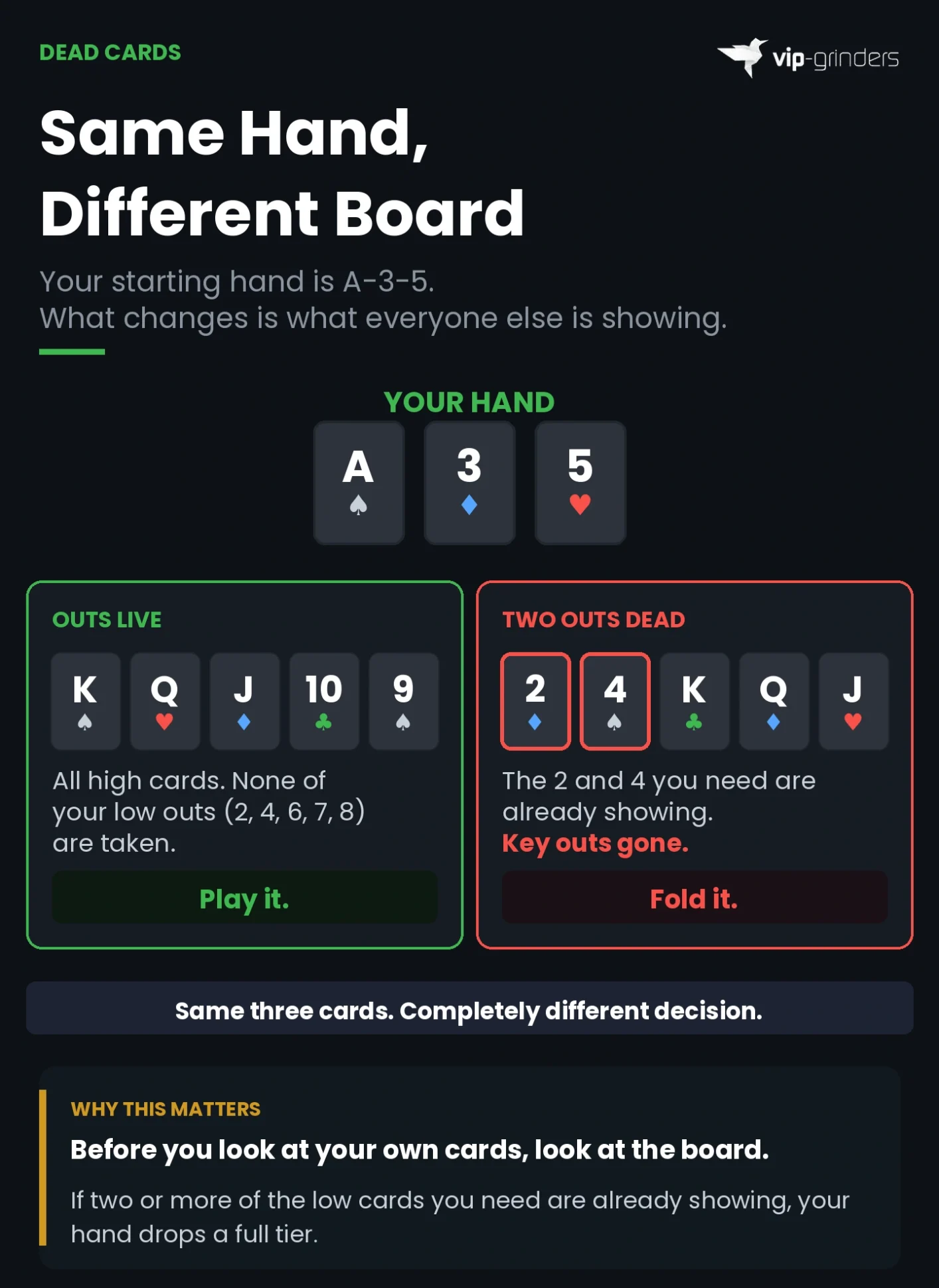
Before you act, scan every door card on the table. If two or more of the low cards you need are already showing in other players’ hands, your hand is weaker than the chart suggests. For example, if you hold A-3-5 but two other players are showing a 2♦ and a 4♠, your chances of catching those cards on later streets drop significantly.
On 4th street, the bet is still the small bet, so mistakes are cheap. If you catch another low card, bet or raise. If you brick (catch a high card or a pair), check and fold to a bet from a player who caught good.
Late Streets: Fifth Through Seventh
5th street is where bets double and the real money goes in: this is the commitment point. If you have four unpaired cards to a 7-low or better, you are committed to seeing the hand through. If you have paired or caught two high cards, fold now and save the big bets.
On 6th street, each player has four face-up cards and hand strength is mostly visible. Bet your made hands (completed lows), check-call with draws that still have one card to come, and fold draws that need to catch perfect on 7th street.
7th street is dealt face-down, so opponents cannot see your final card. Bet for value with strong completed hands. Bluffing on 7th street is rarely profitable because fixed-limit bet sizes give opponents cheap calls: a player getting 8 to 1 or better will not fold often enough to make a bluff work.
Five Common Razz Mistakes
These five mistakes cost Razz players the most money, on top of the common poker mistakes that apply to every format. Most come from applying Hold’em thinking to a game with very different rules.
- 1Playing starting hands above an 8-low. At a full table, any hand with a 9 or higher as your top card is a long-term loser. Fold it on 3rd street and wait for a real hand.
- 2Ignoring dead cards on 3rd street. If the low cards you need are already showing in other up cards on the table, your drawing odds drop fast. This is the single most important skill in Razz and the one beginners skip most often.
- 3Calling through 5th street with a paired or bricked hand. Once bets double, every call with a weak hand costs twice as much. If your hand has not developed by 5th street, fold and save the big bets.
- 4Not stealing the bring-in. When folded to you with the lowest door card showing, raise. The bring-in and antes are free money that adds up over a session.
- 5Playing Razz like Hold'em. Limping, slow-playing strong hands, and trying to trap does not work in fixed-limit Razz. Bet and raise with strong hands, check and fold with weak ones.
Frequently Asked Questions
What is the best hand in Razz?
The best hand in Razz is 5-4-3-2-A, called the “wheel.” It is the lowest possible five-card hand you can make. Straights do not count against you in Razz, so the straight component is irrelevant.
Do straights and flushes count against you in Razz?
No. Razz uses the A-to-5 lowball ranking system where straights and flushes are completely ignored when evaluating hands. This is different from 2-7 lowball games where straights and flushes DO count against you.
Who pays the bring-in in Razz?
The player showing the highest exposed card on 3rd street pays the bring-in. If two players tie for the highest card, the higher suit pays (spades > hearts > diamonds > clubs). This is the opposite of Seven-Card Stud, where the lowest card brings in.
Is there an 8-or-better qualifier in Razz?
No. The lowest hand at the table always wins the full pot, even if it is a pair or a very high hand like King-low. The 8-or-better qualifier exists in Stud Hi-Lo and Omaha Hi-Lo but does not apply to Razz.
Can I play Razz online?
PokerStars is the only major online room spreading Razz cash games and tournaments in 2026. GGPoker, ACR, and WSOP.com do not offer the game. For live poker, the WSOP features dedicated Razz bracelet events every summer in Las Vegas.