

Pot-Limit Hold’em: Rules & Key Differences from NL 2026
In Pot-Limit Hold’em (PLH), every rule is identical to No-Limit except one: the maximum you can bet or raise on any action is the current size of the pot. You still choose your own sizing, but the ceiling is the pot instead of your stack. That single rule changes how much pressure you can apply, how fast pots grow, and which hands perform best.
This guide covers exactly how it works.
- How the pot-limit raise works, with two calculation methods
- The 3x shortcut that experienced players use at live tables
- Four key differences from No-Limit that change how you play
- A complete hand example showing how pot growth works from preflop to river
For the No-Limit rules this guide builds on, see our Texas Hold’em rules and strategy guide.
These are the four differences that matter most when you sit down at a Pot-Limit table.
| Concept | No-Limit | Pot-Limit |
|---|---|---|
| Max bet | Any amount up to your entire stack | The current size of the pot |
| Fold equity | High: large bets and all-in shoves force folds | Lower: the pot cap limits how much pressure a bet carries |
| Implied odds | High: you can win a full stack on a single street | Lower: payoffs build across multiple streets |
| Pot growth | Can end in one all-in shove | Geometric: roughly doubles or triples each street |
How the Pot-Limit Raise Works
The pot-limit raise is the one mechanic that separates PLH from No-Limit. There are two ways to calculate it: a step-by-step method and a shortcut. Both give the same answer every time.
The Two-Step Mental Model
First call the bet, then raise the size of the new pot.
Here is how it works at a $1/$2 table. The small blind posts $1 and the big blind posts $2, making the pot $3. You are first to act and want the maximum raise.
- 1Call the $2 big blind
- 2The pot after your call is $3 + $2 = $5
- 3Raise by $5
- 4Your total bet: $2 + $5 = $7
That $7 is the maximum. You can still bet anything between $2 (the minimum raise, equal to the big blind) and $7. The pot-limit cap only sets the ceiling.
The 3x Shortcut
Multiply the previous bet by 3, then add the pot before that bet.
Same $1/$2 example:
- 1Previous bet: $2 (the big blind)
- 2$2 × 3 = $6
- 3Pot before the big blind: $1 (the small blind)
- 4$6 + $1 = $7. Same answer.
This works on every street. On the flop, the pot is $15 after a raise and a call preflop. Your opponent bets $15 and you want to pot-raise:
- 1$15 × 3 = $45
- 2Pot before their bet: $15
- 3$45 + $15 = $60. Your maximum raise is $60 total.
Saying “Pot” at a Live Table
At a live table, saying the word “pot” out loud commits you to a pot-sized bet. If you want to ask how much a pot-sized bet would be without committing, say “how much is the pot” instead. Online, this is handled automatically: the software includes a pot-sized bet button.
What Changes from No-Limit
The pot-limit cap does not just limit your bet size. It changes how entire hands play out. These are the four adjustments that matter most if you are coming from No-Limit.
Fold Equity Is Lower
In No-Limit, you can shove your entire stack to pressure an opponent into folding. In PLH, the most you can bet is the pot, so your opponent always gets a reasonable price to call. Bluffs need real backup: a draw, a blocker, or a credible story built across multiple streets.
Position Is Even More Valuable
Without a giant bet to end the hand early, more hands reach the turn and river. The player who acts last controls how fast the pot grows on every one of those streets. That makes late position an even bigger edge than it already is in No-Limit.
Pots Grow Geometrically
A pot-sized bet on every street roughly triples the pot each round. A $15 flop pot becomes $45 after a bet and call, then $135 on the turn, then $405 on the river. The cap slows the first street but does not prevent all-in pots by the river.
One-Pair Hands Go to Showdown More Often
Without a stack-sized shove to push opponents off their hands, top pair holds up more frequently and opponents call lighter. That means you should bluff less and value bet thinner than you would in No-Limit.
How a PLH Hand Plays Out
This hand shows the pot-limit cap in action from the first card to the last bet. Every number follows from the raise formula covered above.
Preflop
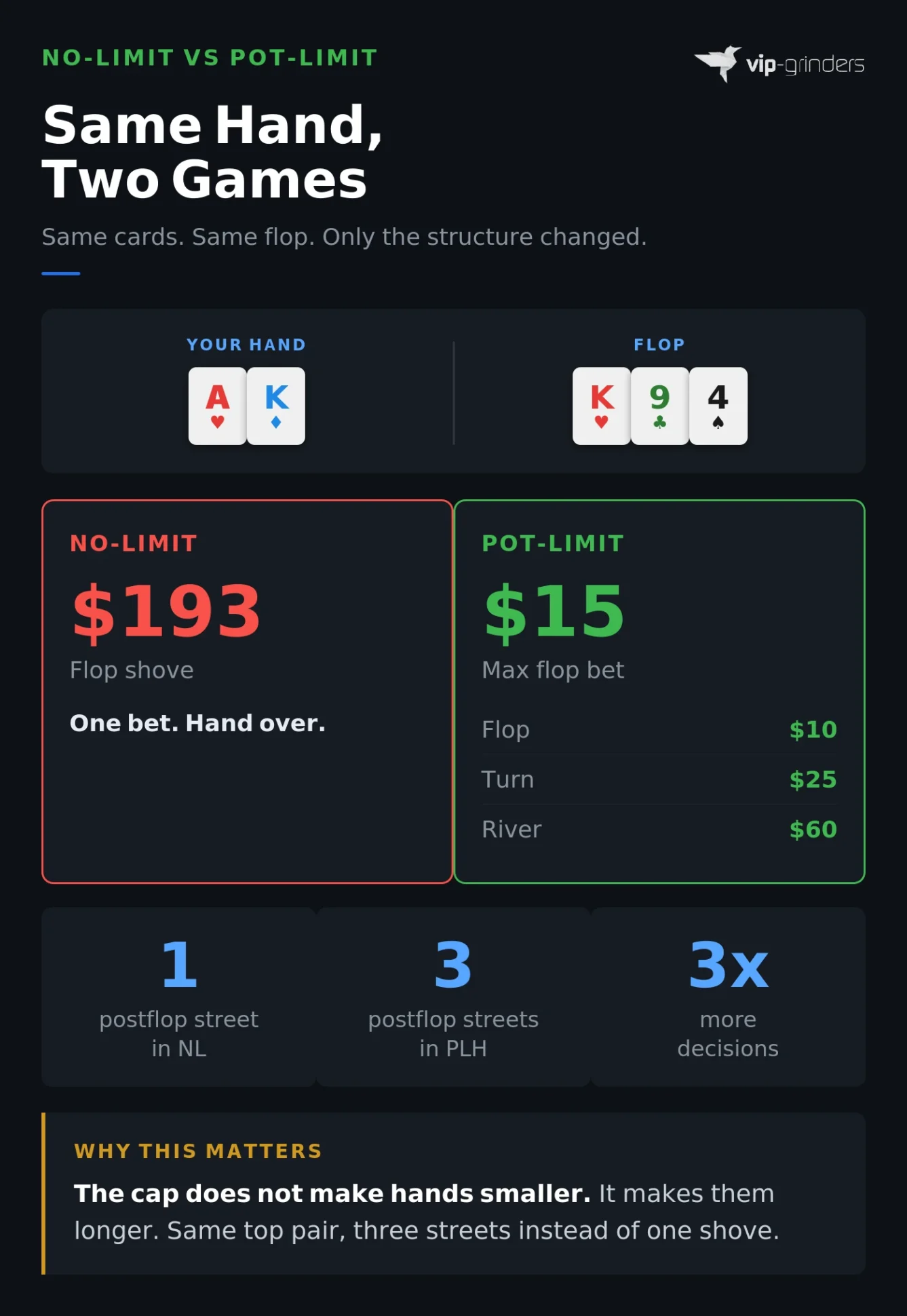
$1/$2 PLH, six players, $200 effective stacks. You hold A♥ K♦ on the button. Everyone folds to you. The pot is $3 (the two blinds). You pot-raise to $7. The big blind calls. The small blind folds.
Pot going to the flop: $15 ($7 + $7 + $1 from the folded small blind).
Flop: K♥ 9♣ 4♠
You flopped top pair, top kicker on a dry board. The big blind checks. The pot is $15, so your maximum bet is $15. You bet $10 (two thirds of the pot). The big blind calls.
Pot going to the turn: $35 ($15 + $10 + $10).
Turn: K♥ 9♣ 4♠ 6♦
The big blind checks again. The pot is $35. Your maximum bet is now $35. You bet $25. The big blind calls.
Pot going to the river: $85 ($35 + $25 + $25).
River: K♥ 9♣ 4♠ 6♦ 2♥
The big blind checks. The pot is $85. Your maximum bet is $85. You have $158 behind ($200 starting stack minus $7 preflop minus $10 flop minus $25 turn = $158). You bet $60 for value.
The big blind folds. You win $85 without showdown.
What This Hand Shows
The pot started at $3 and reached $85 by the river without a single pot-sized bet after the preflop raise. In No-Limit, you could have shoved $193 on the flop and ended the hand immediately. In PLH, the pot built gradually across three streets, giving both players decisions on every round. That slower escalation is the core difference you will feel at the table.
Frequently Asked Questions
Can you go all-in in Pot-Limit Hold'em?
Yes. If your remaining stack is equal to or less than the current pot size, you can push all-in. The pot-limit cap only prevents you from betting MORE than the pot. You can always bet less, including your entire stack when it falls below the maximum.
How is PLH different from Pot-Limit Omaha?
Same betting structure, different game. PLH deals two hole cards and you can use any combination of your hole cards and the board to make your best five-card hand. Pot-Limit Omaha deals four hole cards and you must use exactly two of them plus exactly three from the board. The raise math is identical in both formats.
Is Pot-Limit Hold'em harder than No-Limit?
Different, not harder. The cap removes overbetting and preflop shove dynamics but adds pot-growth management decisions that do not exist in No-Limit. Most NL players adjust quickly once they learn the raise formula.
Why don't online poker rooms spread PLH?
Player demand. Pot-Limit Omaha absorbed the pot-limit audience because four hole cards create more action and bigger pots. Rooms concentrate traffic on the formats with the highest demand, which today means No-Limit Hold’em and PLO. You will still find PLH in mixed-game rotations, home games, and occasional live dealer’s choice sessions.
What bankroll do I need for Pot-Limit Hold'em?
40 to 60 buy-ins for cash games. PLH variance sits between Fixed-Limit (lower swings, smaller pots) and PLO (higher swings, larger pots).