

Short Deck Poker Strategy: How to Beat 6+ Hold’em 2026
Short Deck poker, also called 6+ Hold’em, is Texas Hold’em played with a 36-card deck. The 2s through 5s are removed, equities run closer on every street, two hand rankings flip, and the ante-driven preflop structure rewards hands and plays that would bleed money in NLHE.
The format is one of the softest games online. Casino crossover traffic floods the lobbies at GGPoker, BCPoker, and other crypto-friendly rooms, and most of those players are applying Hold’em logic to a game where it does not work. Here is what this guide covers:
- The two hand ranking swaps and the probability math behind them, including the Rule of 3 and 6
- Four starting hand tiers with position-by-position ranges for 6-max cash
- Postflop adjustments for board texture, draw equity, and the set-over-set cooler you cannot avoid
- Bankroll requirements specific to Short Deck variance
What Short Deck Poker Is (And How It Differs from Hold’em)
Betting structure, position rules, and showdown mechanics stay identical to NLHE. The math underneath is what changes, and it drives almost every strategic adjustment in this guide.
The Core Mechanical Changes
Three structural changes separate Short Deck from standard Hold’em. Each one shapes the strategic adjustments in every section that follows.
Why NLHE Intuition Misfires in Short Deck
Most Hold’em players assume that removing the low cards just makes hands slightly stronger across the board. The reality is more disruptive. Equities run closer on every street, draws become significantly more powerful, and two hand rankings flip because their probability changes dramatically in a 36-card deck.
Three headline numbers capture how different the format plays:
- Pocket Aces vs a random hand: 85% equity in NLHE versus 77% in Short Deck. The gap looks small until you realize it changes how often you get stacked preflop.
- Flopping a set with a pocket pair: 11.8% in NLHE versus 18% in Short Deck. Sets show up far more often, which means set-over-set coolers are part of normal variance.
- Boards that pair by the river: 49% in NLHE versus 66% in Short Deck. Two pair and one pair hands get counterfeited constantly, and full houses appear at roughly double the NLHE rate.
Short Deck vs NLHE: The Numbers That Matter
The table below summarizes the core format differences.
| Feature | NLHE | Short Deck (6+ Hold’em) |
|---|---|---|
| Cards in deck | 52 | 36 |
| Possible starting hand combinations | 1,326 | 630 |
| Preflop structure | Small blind and big blind | Antes plus button blind (button acts first preflop) |
| Flush beats Full House | No | Yes |
| Three of a Kind beats Straight | No | Yes |
| Lowest straight | A-2-3-4-5 (wheel) | A-6-7-8-9 |
| AA vs random hand | ~85% | ~77% |
| Flopping a set with a pocket pair | 11.8% | 18% |
| OESD by the river | 31.5% | 48% |
| Flush draw outs | 9 | 5 |
| Typical SPR on the flop (100bb start) | 8 to 15 | 3 to 5 |
| Recommended bankroll | 30 to 50 buy-ins | 60 to 80 buy-ins |
The last row is the one most transitioning players underestimate. Short Deck variance runs meaningfully higher than NLHE, which is why the bankroll section later in this guide recommends 60 to 80 buy-ins instead of the 30 to 50 that works for Hold’em.
Short Deck Hand Rankings (The Two Swaps That Matter)
Short Deck uses the same standard poker hand rankings as NLHE with two critical exceptions. A Flush beats a Full House, and Three of a Kind beats a Straight. Both changes exist because removing the 2s through 5s changes how often each hand type actually occurs in a 36-card deck.
Flushes become much rarer. With only nine cards per suit instead of thirteen, the probability of hitting five of the same suit drops sharply. Straights become far more common because the remaining cards are packed tighter together, which means any two connected cards have more straight possibilities.
The rankings reflect the new probabilities. In poker, rarer hands always beat more common ones, so the hierarchy has to adjust when the underlying frequencies change.
The Two Ranking Swaps
Here is how the top of the Short Deck hand ranking looks compared to NLHE:
| Rank | NLHE | Short Deck |
|---|---|---|
| 1 | Royal Flush | Royal Flush |
| 2 | Straight Flush | Straight Flush |
| 3 | Four of a Kind | Four of a Kind |
| 4 | Full House | Flush |
| 5 | Flush | Full House |
| 6 | Straight | Three of a Kind |
| 7 | Three of a Kind | Straight |
| 8 | Two Pair | Two Pair |
| 9 | One Pair | One Pair |
| 10 | High Card | High Card |
The practical effect of the swap: if you hold a Flush on the river in Short Deck, you beat every Full House at the table. If you hold Three of a Kind on a coordinated board, you beat every Straight possible.
The other rule change is the lowest straight. In NLHE the wheel is A-2-3-4-5, but in Short Deck the lowest straight is A-6-7-8-9 because the 2s through 5s are gone. The Ace still plays as the lowest card to complete this straight.
Which Rooms Use Which Variant
Not every Short Deck room uses the same ranking system. Most online rooms follow the Triton rules where Flush beats Full House, but a handful of rooms still use traditional rankings where Full House beats Flush. Check before you sit down.
| Room | Ranking Variant | Notes |
|---|---|---|
| GGPoker | Triton (Flush beats FH) | Largest Short Deck pool online, casino crossover traffic |
| BCPoker | Triton (Flush beats FH) | Crypto-first, soft cash tables, Spin and MTT formats also available |
| PokerStars | Triton (Flush beats FH) | Limited traffic, runs in select markets |
| iPoker Network | Traditional (FH beats Flush) | Confirm lobby rules before sitting down, structure varies by skin |
| CoinPoker | Triton (Flush beats FH) | Crypto-native, provably fair, smaller pool |
The difference matters more than it looks. Assuming your Full House is the nuts and then losing to a Flush you did not realize was ahead is the most expensive mistake a Short Deck newcomer can make. Confirm the ranking in use before your first session at any room.
The Rule of 3 and 6: Short Deck’s Equity Shortcut
In NLHE, the Rule of 4 and 2 gives you a quick equity estimate: multiply your outs by 4 on the flop, by 2 on the turn. That rule breaks in Short Deck because the deck has fewer cards, which means each out hits more often.
The Short Deck replacement is the Rule of 3 and 6. Multiply your outs by 6 on the flop (for both cards to come) and by 3 on the turn (for the river only).
| Draw Type | Outs | Flop Equity (Rule of 6) | Turn Equity (Rule of 3) |
|---|---|---|---|
| Flush draw | 5 | ~30% | ~15% |
| Open-ended straight draw | 8 | ~48% | ~24% |
| Gutshot | 4 | ~24% | ~12% |
| Combo draw (flush + OESD) | 13 | ~78% | ~39% |
| Two overcards | 6 | ~36% | ~18% |
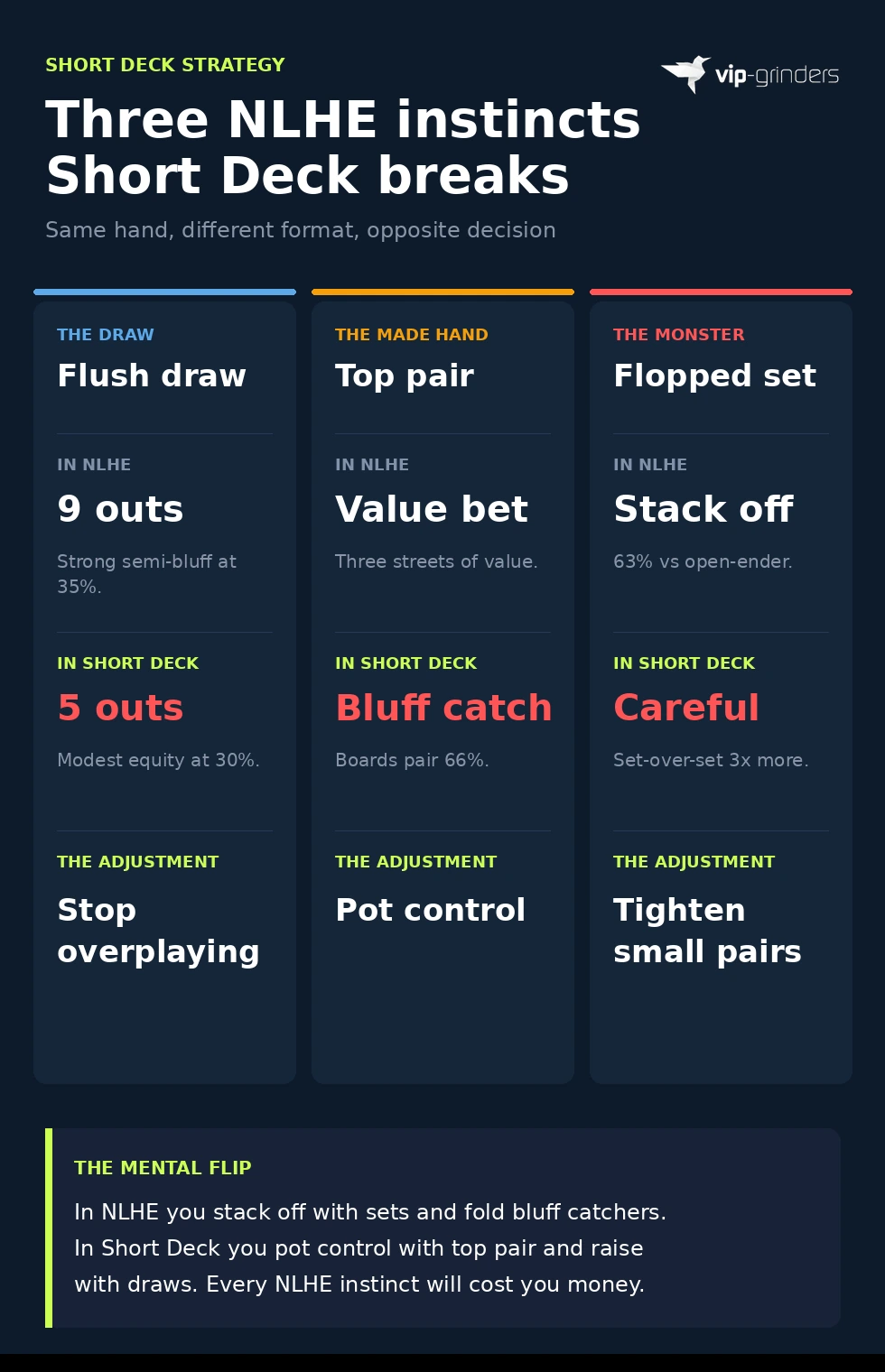
Notice that a flush draw only has 5 outs in Short Deck, not 9. This is the biggest trap for transitioning NLHE players. The hand that felt like a monster draw in Hold’em is now a modest equity hand in 6+ Hold’em, and overplaying it against made hands is a steady bleed.
Short Deck Preflop Strategy and Starting Hands
Preflop play in Short Deck breaks almost every NLHE habit you have. The ante structure changes the price of entering pots, the button-acts-first rule changes positional dynamics, and the closer equities mean hands that feel marginal in Hold’em are clear opens in 6+ Hold’em.
This section covers ante math, the four starting hand tiers, and position-by-position ranges for 6-max cash. Percentages are calibrated for online play at micro to mid stakes against typical fields.
How the Ante Structure Changes Preflop Math
The ante structure from the comparison table above puts $7 in dead money into every 6-max pot before any voluntary action, roughly 4.5x more than NLHE’s $1.50 from the blinds. That single difference changes every preflop incentive.
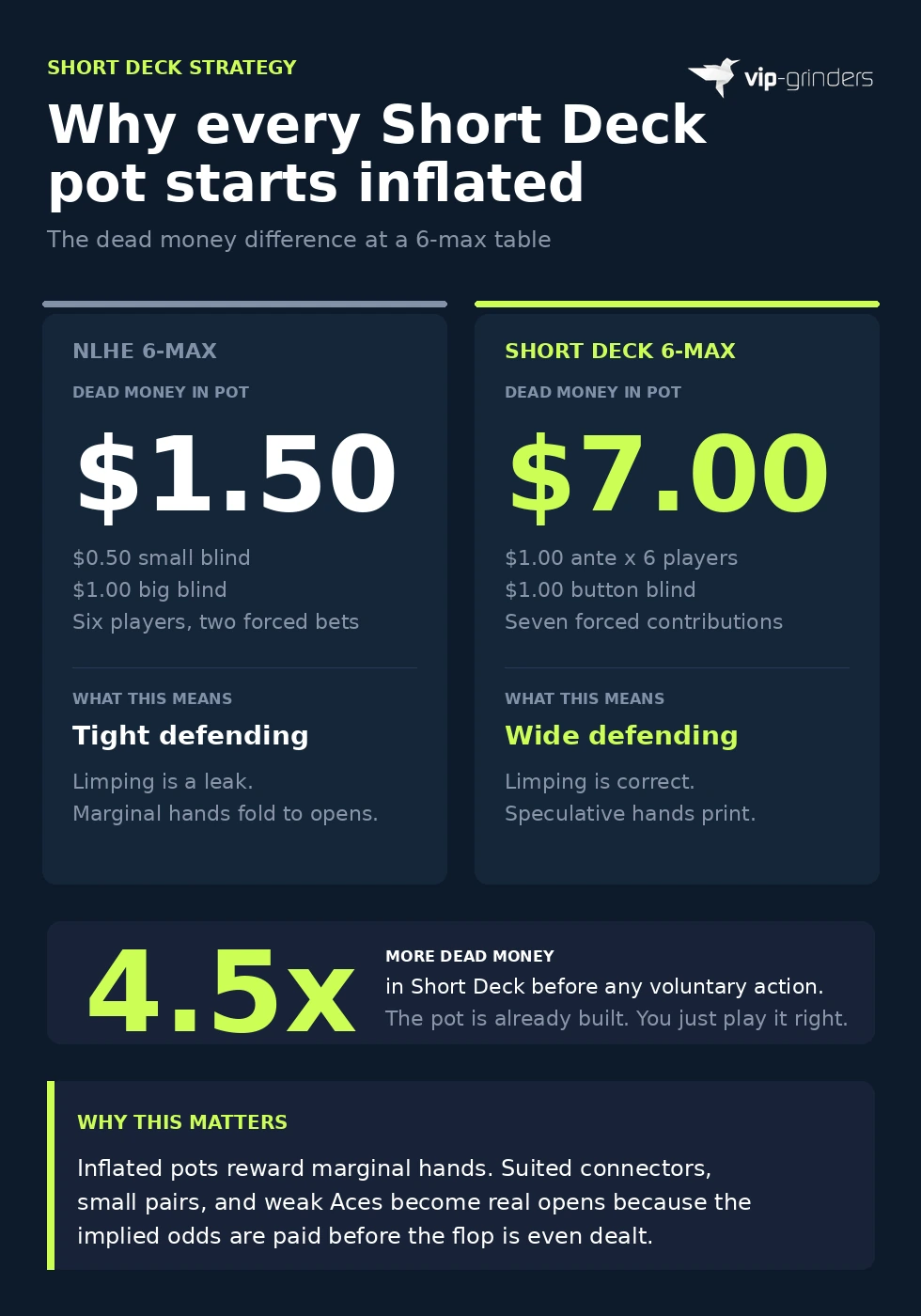
- Excellent preflop pot odds: with seven antes already in the pot before any voluntary action, players behind a standard open get a price that makes wide defending mathematically correct even with marginal hands.
- Open-limping is viable: unlike NLHE where limping is almost always a mistake, Short Deck’s ante structure rewards limping with speculative hands that want to see cheap flops in multiway pots.
- Button acts first preflop: the button opens the action because they posted the only forced bet. Postflop the button acts last as usual, which creates unique preflop/postflop positional dynamics that do not exist in NLHE.
The practical effect: every position gets to see flops cheaper and with more dead money in the pot. Hands that need implied odds to break even (suited connectors, small pairs, suited Aces) become significantly more profitable because the pot is already inflated before postflop play begins.
Open-Raise Sizing in Short Deck
Short Deck open-raises are smaller in absolute terms than NLHE because the unit of measurement is the ante, not the big blind. Standard sizing is 2x to 3x the ante, with most regulars defaulting to 2.5x from all positions.
A larger sizing burns more of your stack for the same fold equity, while a smaller sizing fails to charge wide defending ranges enough. The 2.5x default is the equilibrium that balances both pressures.
The Four Starting Hand Tiers
Short Deck starting hands fall into four tiers based on equity, playability, and how they perform in the multiway pots that the ante structure produces. Memorizing the tier of every hand you are dealt is faster than memorizing position-by-position ranges and lets you make correct decisions before consciously thinking about position.
| Tier | Hand Type | Examples | Default Action |
|---|---|---|---|
| 1 (Premium) | Big pairs, AKs | AA, KK, QQ, JJ, AKs | Open or 3-bet from any position |
| 2 (Strong) | Mid pairs, Broadway, suited Aces | TT, 99, 88, AKo, AQ, AJs, KQs | Open from any position, 3-bet selectively |
| 3 (Speculative) | Small pairs, suited connectors, suited Broadway gappers | 77, 66, 98s, T9s, JTs, KJs, QJs | Open from MP onward, limp behind in EP |
| 4 (Marginal) | Offsuit Broadway, weak suited Aces, offsuit connectors | KJo, QJo, JTo, A9s, A8s, T9o | Open from CO/BTN only, fold from EP |
The tier system has one major exception: small pocket pairs are dangerous. Pairs like 66 and 77 are speculative hands that need careful postflop play, not automatic stack-offs when they hit a set. The set-over-set section later in this guide covers why.
Suited connectors deserve special mention: T9s flops a draw or made hand on over 50% of Short Deck flops versus roughly 35% in NLHE. The value comes from straight potential, not flush potential, because flush draws only have 5 outs in this format.
Position-by-Position Starting Hand Selection (6-max)
The table below shows recommended opening hands for each position in 6-max Short Deck. These ranges assume standard 2.5x ante opens against typical online fields at micro to mid stakes.
| Position | Open-Raise Range | Limp-Behind Range |
|---|---|---|
| UTG | 99+, AJs+, KQs, AKo | None (open or fold) |
| UTG+1 | 88+, ATs+, KJs+, QJs, AQo+ | None (open or fold) |
| HJ | 77+, A9s+, KTs+, QTs+, JTs, AJo+, KQo | 66, 98s, 87s |
| CO | 66+, A7s+, K9s+, Q9s+, J9s+, T9s, 98s, ATo+, KJo+, QJo | 55, 87s, 76s, K8s, Q8s |
| BTN | Any pair, A2s+, K7s+, Q8s+, J8s+, T8s+, 98s, 87s, 76s, A9o+, KTo+, QTo+, JTo | Wider speculative hands if multiple limpers in front |
| SB | Mostly defends vs button opens; opens 88+, ATs+, KJs+, AJo+ when folded to | Limp completes with most playable hands when multiway |
Three patterns matter most:
- UTG stays tight: with five players behind you, the chance of running into a premium hand is high. Stick to hands that can stack off comfortably against a 3-bet.
- CO and BTN widen dramatically: the ante pot odds combined with position make wide opens mathematically correct. The BTN opens close to 50% of hands against typical fields.
- Limping behind is a real strategy: when multiple players have limped in front of you, completing with speculative hands like small pairs and suited connectors is correct. This is the opposite of NLHE advice.
For deeper coverage of how ranges work across all formats, see the poker ranges guide. The concepts there apply to Short Deck with the tier-based modifications above.
Defending Against Button Opens (The SB’s Role)
The big blind does not exist in Short Deck. The closest equivalent is defending against button opens from the SB, since the SB acts last preflop after the button opens. With the ante structure inflating the pot, the SB gets excellent pot odds to defend wide.
A reasonable SB defending range against a 2.5x button open includes:
- Call: any pair, any suited Ace, suited Broadways, suited connectors down to 76s, offsuit Broadway hands down to KJo
- 3-bet: JJ+, AKs, AKo for value, mixed with suited Aces like A6s and A7s as bluffs
- Fold: weak offsuit hands that cannot realize equity out of position
The wide defending range is justified by the dead money in the pot, but it requires solid postflop play because the SB plays the rest of the hand out of position. If postflop is your weakness, tighten the defending range and only call with hands that play well in 3-bet pots.
Postflop Adjustments for 36-Card Poker
Postflop in Short Deck looks like NLHE on the surface and plays nothing like it underneath. Boards connect with ranges more often, draws carry more equity than most made hands, and hands that win pots in Hold’em get stacked off in 6+ Hold’em.
The two adjustments that matter most are how to read board texture in a 36-card deck and how to handle the flipped hierarchy of draws versus made hands.
Why Board Texture Reads Change in Short Deck
Boards pair by the river 66% of the time in Short Deck versus 49% in NLHE. That single difference reshapes how every flop, turn, and river plays out.
More board pairing means three things at once:
- Full houses appear twice as often: a made hand like two pair or a straight on the flop faces a realistic threat of being outdrawn by a boat on the turn or river.
- One pair hands get counterfeited: holding top pair on a K-9-7 flop feels strong until the board runs out K-9-7-9-3 and your kicker stops mattering. This happens constantly in Short Deck.
- Overpairs become bluff catchers: QQ on a J-9-7 board is a clear value bet in NLHE. In Short Deck, the opponent’s range contains more sets, more straights, and more combo draws at every stack depth.
The practical rule: top pair and overpairs are not stack-off hands in Short Deck. They are pot-control hands. Bet for protection on the flop, check or call selectively on later streets, and avoid building large pots when your hand cannot improve.
Coordinated boards also appear far more often. Because the deck contains only nine ranks instead of thirteen, any flop is more likely to feature connected cards. A flop like 9-8-7 hits the typical Short Deck range much harder than the equivalent flop hits an NLHE range.
How Draws and Made Hands Reorder in Short Deck
The biggest postflop shift is the reordering of draw equity versus made hand equity. In NLHE, made hands almost always have more equity than draws on the flop. In Short Deck, the reverse is often true.
Three concrete equity matchups show why:
| Matchup | NLHE Equity | Short Deck Equity |
|---|---|---|
| OESD vs top pair | ~32% | ~48% |
| Combo draw (flush + OESD) vs overpair | ~52% | ~62% |
| Set vs OESD | ~63% | ~52% |
| Two overcards vs underpair | ~45% | ~52% |
The “set vs OESD” row is the one that breaks NLHE intuition hardest. In Hold’em, flopping a set against an open-ender is a 63/37 favorite, which justifies stacking off. In Short Deck the same matchup is roughly a coin flip, which means small sets are no longer mandatory commits against draws.
Practical Postflop Patterns
Three patterns govern most Short Deck postflop decisions:
- Aggression with draws, caution with made hands: the combo draw you would check-call in NLHE is a raise or bet in Short Deck. The top pair you would bet-bet-bet in NLHE is a bet-check-call line in Short Deck.
- Position matters more, not less: with pots growing faster and stacks at lower SPRs, being in position is worth more EV per hand than in NLHE. Tighten your out-of-position ranges accordingly.
- Size down on wet boards: the equity gap between made hands and draws is so small that large bets on coordinated boards get called by every draw. Smaller bets preserve pot control when you cannot fold out equity.
Set-Over-Set: The Cooler You Cannot Avoid
With pocket pairs dealt twice as often and sets flopping 18% of the time, set-over-set situations occur at a rate that breaks NLHE intuition.
The math: in any pot with two players holding pocket pairs, both flop a set roughly 3% of the time, compared to ~1% in NLHE. That sounds rare until you realize how often two players hold pocket pairs in a multiway Short Deck pot. These coolers are part of normal variance, not a sign of bad play.
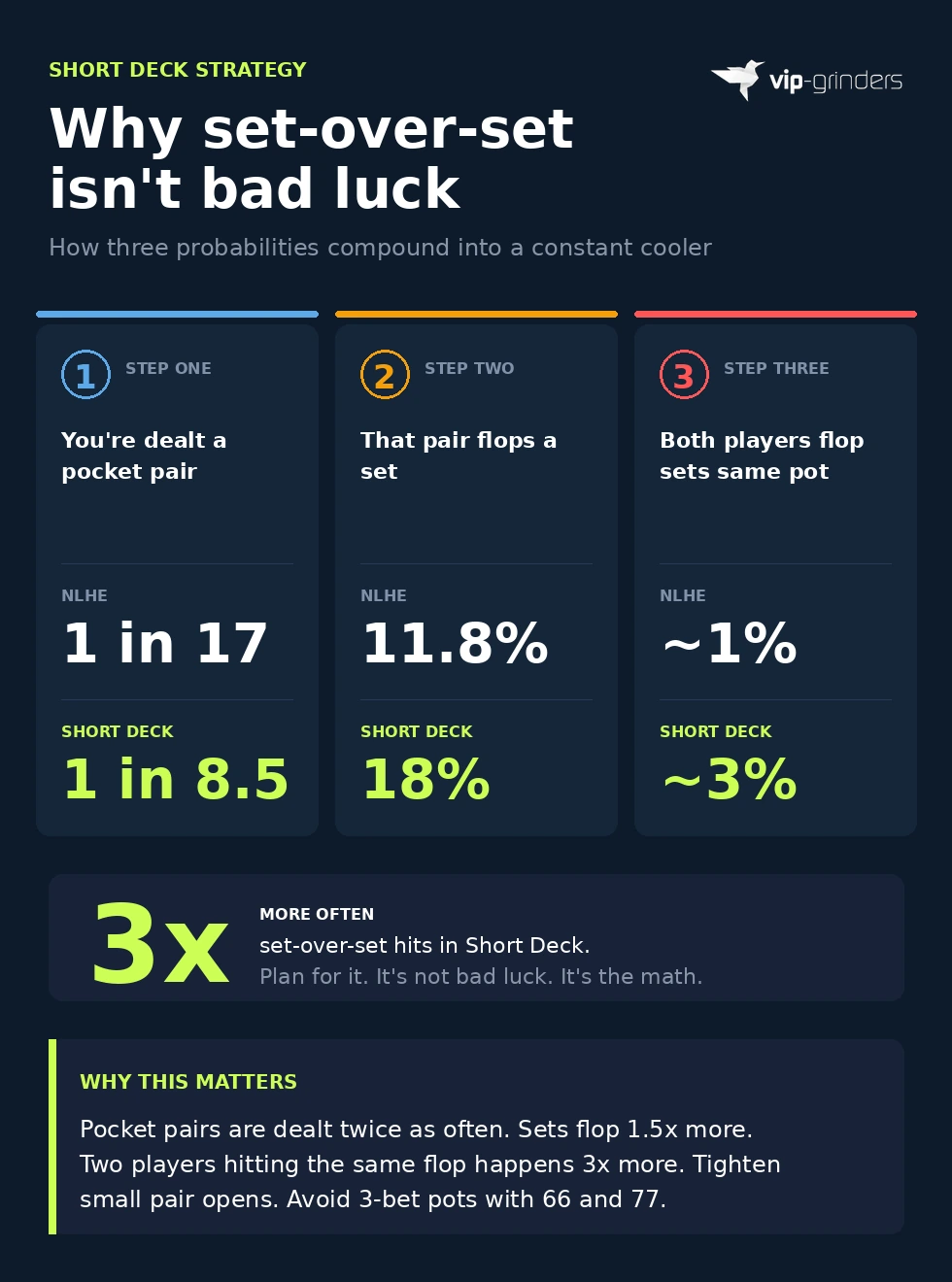
The defense is hand selection preflop, not heroic folds postflop. By tightening your small pocket pair opens from early position and avoiding 3-bet pots with hands like 66 and 77, you reduce the frequency of set-over-set scenarios where you are the one losing the stack.
How Short Deck Fits Into Your Bankroll Strategy
Short Deck variance runs higher than NLHE at the same stake. Equities run closer, pots grow larger relative to stacks because of the ante structure, and multiway situations happen more often.
The practical impact is that downswings hit harder and recover slower. A solid Short Deck winner who would need 30 to 50 buy-ins for NLHE should plan on 60 to 80 buy-ins for the equivalent Short Deck game. The bankroll management guide covers the risk of ruin math for sizing that cushion correctly.
For room-by-room breakdowns including rakeback rates, stake availability, and peak traffic hours, see our Short Deck poker sites comparison.
Frequently Asked Questions
Does a Flush beat a Full House in Short Deck?
Yes, in most Short Deck games a Flush beats a Full House. This is because removing the 2s through 5s makes flushes far rarer (only 9 cards per suit instead of 13) while straights become more common. Most online rooms including GGPoker, BCPoker, PokerStars, and CoinPoker use these Triton rules. A handful of smaller rooms still use traditional rankings where Full House beats Flush, so always check the lobby rules before sitting down.
How does the Rule of 3 and 6 work?
The Rule of 3 and 6 is Short Deck’s replacement for the NLHE Rule of 4 and 2. Multiply your outs by 6 on the flop to estimate equity through the river, and by 3 on the turn for the river only. For example, an open-ended straight draw has 8 outs in Short Deck, giving you roughly 48% equity on the flop (8 x 6) and 24% equity on the turn (8 x 3). The rule starts breaking above 13 outs, so switch to an equity calculator for combo draws.
How does Short Deck equity differ from NLHE?
Equities in Short Deck run closer on every street. Pocket Aces drop from 85% to 77% against a random hand, AKs becomes a 60% favorite over mid pairs instead of the 50/50 flip it is in NLHE, and combo draws (flush + straight) hold 50%+ equity against most made hands on the flop. The practical effect is that overpairs lose value, draws gain value, and set-over-set coolers happen far more often than NLHE players expect.
What's the best starting hand in Short Deck?
Pocket Aces is still the best starting hand, but the gap between AA and everything else closes significantly. In NLHE, AA has 85% equity against a random hand. In Short Deck that drops to 77%, and against suited connectors AA is only a 60/40 favorite instead of 80/20. Other premium hands include KK, QQ, JJ, and AKs, which play stronger in Short Deck than in NLHE because of how often they connect with coordinated boards.
Why does Short Deck use antes instead of blinds?
The ante structure was designed to generate more preflop action. Every player posts an ante, and the button posts a single “button blind” equal to the ante. This puts seven antes in the pot before any voluntary action, which gives players behind an open much better pot odds than NLHE and makes wide defending mathematically correct. It also means pots start with more dead money, which rewards limping with speculative hands and inflates multiway pots compared to Hold’em.
Is Short Deck more profitable than NLHE?
For players willing to learn the format, Short Deck can be significantly more profitable at micro and low stakes because the casino crossover traffic produces softer games than equivalent NLHE tables. The edge comes from most opponents applying Hold’em logic to a game where it does not work. That said, Short Deck variance is higher, so a 60 to 80 buy-in bankroll is recommended instead of the 30 to 50 buy-ins typical for NLHE at the same stake.
Which online poker sites spread Short Deck?
The main rooms running Short Deck in 2026 are GGPoker (largest pool, micro to mid stakes), BCPoker (crypto-first, cash plus Spin and MTT formats), PokerStars (limited traffic in select markets), and CoinPoker (crypto-native, smaller pool with provably fair RNG). GGPoker has the deepest liquidity, while the crypto-focused rooms tend to have softer fields at micro and low stakes.
Should NLHE players learn Short Deck?
If you already grind NLHE at micro to mid stakes and want to diversify your format portfolio, Short Deck is worth learning. The soft fields, the poor play of casino crossover traffic, and the underexploited math make the format highly profitable for grinders willing to put in study time. Expect a transition period of several thousand hands where your NLHE instincts cost you money, and budget bankroll accordingly.